Why a 240 Volt EV Charger Changes Everything About Owning an EV
A 240 volt EV charger is the fastest and most practical way to charge your electric vehicle at home. Here’s a quick answer to what you need to know:
What is a 240V EV charger?
- It’s a Level 2 home charging station that runs on 240V AC power (the same voltage as your dryer or oven)
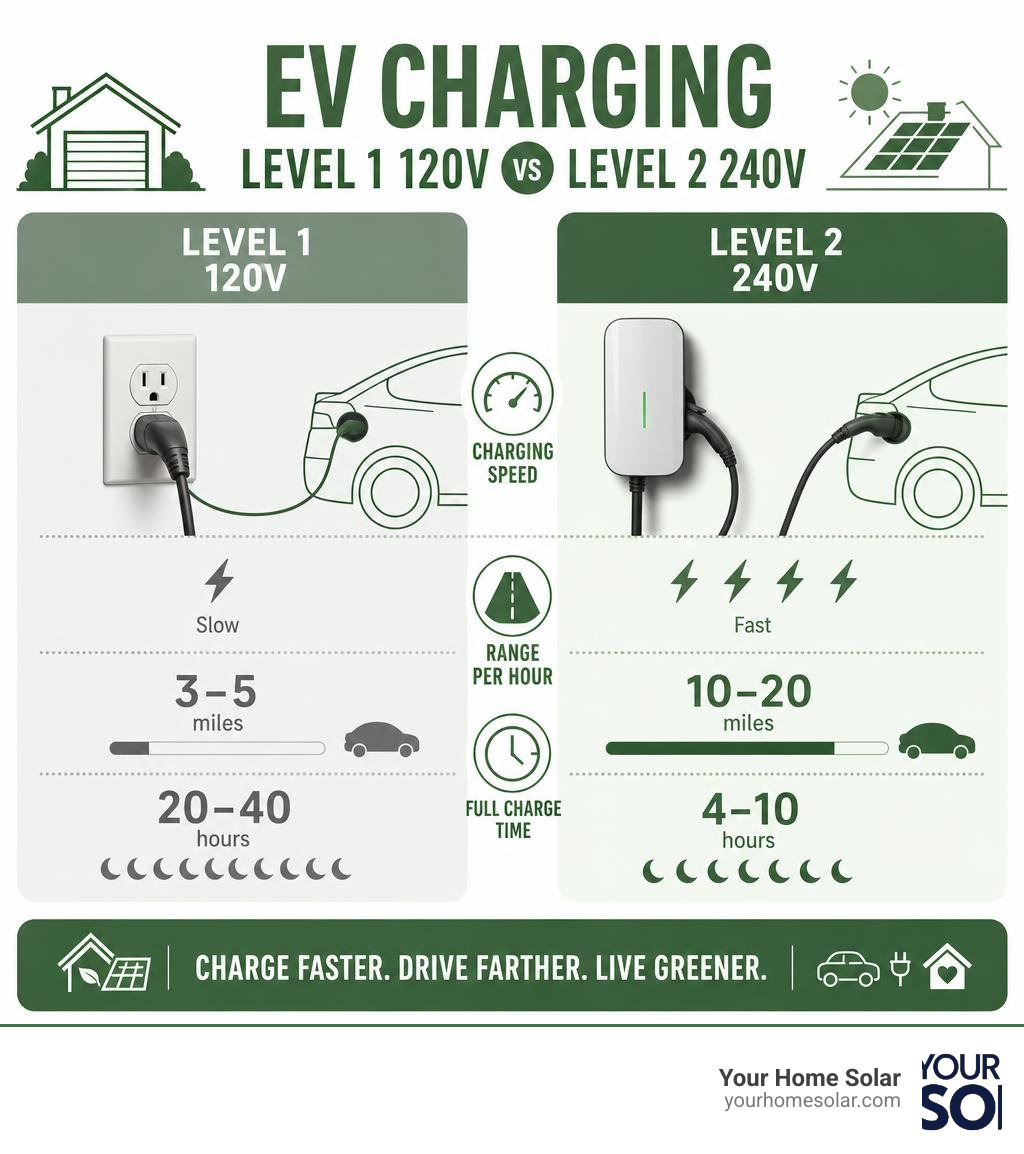
- It charges 5 to 10 times faster than a standard 120V wall outlet
- It delivers 10-20 miles of electric range per hour of charging
- A full charge on most EVs takes just 4-10 hours overnight
- Equipment typically costs $400-$700, with professional installation on top
If you’ve been relying on a regular wall outlet to charge your EV, you already know the frustration. A standard 120V outlet adds only 3-5 miles of range per hour — barely enough to keep up with daily driving. For East Tennessee homeowners who depend on their vehicle every day, that’s a real problem.
The good news? Upgrading to a 240V Level 2 charger at home solves that problem completely — and it can even work alongside a home solar system to keep your energy costs low and your household more independent from the grid.
I’m Ernie Bussell, founder and CEO of Your Home Solar, the #1 solar energy contractor in East Tennessee, and I’ve helped countless homeowners integrate 240 volt EV charger solutions with their home energy systems for maximum savings and reliability. Let’s walk through everything you need to make a confident decision.
Understanding the Power of a 240 Volt EV Charger
To truly appreciate what a 240 volt ev charger brings to your garage, it helps to look at the physics of home electricity. Most of the devices you plug into your walls—like your phone, your lamp, or your laptop—run on standard 120-volt alternating current (AC). This is known as Level 1 charging when applied to electric vehicles.
But when you step up to a 240 volt ev charger, you are tapping into the heavy-duty power lines of your home. This is the same electrical supply reserved for energy-hungry appliances like your central air conditioner, electric range, or clothes dryer. By doubling the voltage, you don’t just double the charging speed—you exponentially increase the efficiency of the power transfer.
When charging an EV, there are inherent “charging losses” (typically ranging from 5% to 8%) as the vehicle converts AC power from your wall into the Direct Current (DC) power stored in its battery. Because Level 2 chargers operate at a much higher voltage and amperage, they waste less energy overall compared to a Level 1 charger, which has to run for days to achieve the same result.
| Feature | Level 1 Charging | Level 2 Charging (240V) |
|---|---|---|
| Voltage | 120V AC | 208V – 240V AC |
| Typical Amperage | 12A – 16A | 16A – 50A |
| Power Output | ~1.0 kW to 1.9 kW | 3.8 kW to 19.2 kW (Typically 9.6 kW) |
| Range Added Per Hour | 3 – 5 miles | 10 – 20 miles (Up to 40+ with hardwired units) |
| Time to 80% (BEV) | 40 – 50 hours | 4 – 10 hours |
| Time to 80% (PHEV) | 5 – 6 hours | 1 – 2 hours |
Level 1 vs. Level 2: Why Upgrade to a 240 Volt EV Charger?
Think of a standard 120-volt outlet as a slow drip from a garden hose, while a 240 volt ev charger is a high-volume fire hose. Technically speaking, the wall unit you install in your garage is not actually the “charger” itself. It is called Electric Vehicle Service Equipment (EVSE). The EVSE acts as a smart, safe charging dock that safely delivers 240-volt AC electricity to your car. The actual charger is built directly into your vehicle, which converts that AC power into DC power.
If you stick with Level 1, you are severely limiting your vehicle’s potential. Imagine coming home from a weekend trip to Sevierville or Kingsport with an empty battery. On a 120-volt outlet, you would have to wait nearly two full days to get back to a full charge. With a Level 2 upgrade, your car is fully charged and ready to go before you even wake up the next morning.
For a deeper look into how this upgrade transforms your daily routine, check out our More info about Level 2 charging benefits.
Charging Speeds and Range Per Hour
The exact range you get per hour of charging depends on your vehicle’s efficiency and the amperage of your charger. Generally speaking, a standard 240V Level 2 setup adds about 10 to 20 miles of range for every hour it is plugged in. High-power units running on a 50-amp or 60-amp circuit can deliver up to 35 to 46 miles of range per hour.
It is also important to understand how your battery’s State of Charge (SoC) affects these speeds. Electric vehicle batteries charge incredibly fast when they are nearly empty, but the rate slows down significantly after they reach 80% capacity. This slowdown is controlled by your car’s onboard computer to protect the battery chemistry from overheating and degradation. Because of this, overnight charging is the perfect use case for Level 2 systems—it gives your vehicle plenty of time to safely top off that last 20% while you sleep.
To learn more about how these charging speeds fit into your home energy profile, read our guide on residential EV charging services.
Technical Requirements and Smart Installation Solutions
Before you buy a 240 volt ev charger, you need to make sure your home’s electrical system is ready to handle the load. This isn’t as simple as swapping out a standard plug; it requires a dedicated circuit and a careful evaluation of your electrical panel.

Circuit Capacity and Amperage Demands
A standard Level 2 charger requires a dedicated 240-volt circuit. This means no other appliances can share the line. The size of the circuit breaker you need depends on the power output of the charger you choose:
- 40-Amp Charging: Requires a dedicated 50-amp circuit breaker. (Following the National Electrical Code’s 80% continuous load rule, a 50-amp circuit can safely deliver 40 amps of continuous power, or about 9.6 kW).
- 48-Amp Charging: Requires a dedicated 60-amp circuit breaker, delivering 11.5 kW of power. Because standard NEMA 14-50 plugs are only rated for up to 50-amp circuits, any charger delivering more than 40 amps must be hardwired directly into your electrical panel.
Hardwired installations offer the fastest charging speeds and the most secure electrical connection. If you are looking for a heavy-duty, high-performance option, you can Explore Leviton 48-Amp Level 2 Charger specifications to see how a hardwired 11.6 kW unit operates.
Smart Load Management and Avoiding Panel Upgrades
One of the biggest hurdles homeowners face when installing a 240 volt ev charger is panel capacity. If your home has an older 100-amp electrical service, adding a 50-amp EV circuit could overload your panel when other major appliances (like your HVAC or dryer) are running. Traditionally, the only solution was an expensive electrical panel upgrade costing thousands of dollars.
Fortunately, modern technology offers brilliant workarounds:
- Smart Splitters: Devices like the NeoCharge Smart Splitter allow you to share an existing 240V outlet (such as your clothes dryer outlet) with your EV charger. The splitter automatically pauses EV charging if it senses your dryer is running, preventing a tripped breaker without requiring any rewiring.
- Smart Load Management: High-end chargers (like the Emporia Pro with PowerSmart) can monitor your home’s real-time electricity draw up to 3,000 times per second. If your home’s total demand gets too high, the charger temporarily dials back its power output, keeping your panel safe and avoiding the need for an upgrade entirely.
To understand how these systems are wired safely, take a look at our guide on wiring schematics for home EV chargers.
Selecting Your Ideal Home Charging Setup
Choosing the right 240 volt ev charger comes down to how you plan to use it, where you plan to install it, and what kind of vehicle you drive.

Key Features to Look For in a 240 Volt EV Charger
Modern EV chargers are far more than just dummy plugs; they are smart home devices. Here are the features that make a massive difference in your daily life:
- Wi-Fi and Bluetooth Connectivity: Allows you to monitor your charging status, track energy usage, and update firmware remotely.
- Smart App Scheduling: Many electric utilities in East Tennessee offer lower electricity rates during “off-peak” hours (usually late at night). A smart charger allows you to plug your car in after work but delay charging until those cheaper hours begin, saving you hundreds of dollars a year.
- Adjustable Amperage: Units that let you adjust the amperage (e.g., from 12A to 48A) give you the flexibility to match your charger’s draw to your current panel capacity.
If you want to see how these heavy-duty smart features look in a rugged, highly protective package, you can Check out the DEWALT 48-Amp Weatherproof Level 2 Charger.
Connector Types: J1772, NACS, and CCS
The physical plug that connects to your car is another crucial choice.
- SAE J1772: The standard plug for almost all non-Tesla electric vehicles in North America.
- NACS (North American Charging Standard / J3400): Developed by Tesla, this connector has quickly become the industry standard. Most major automakers have committed to transitioning to NACS ports on their new vehicles.
- CCS (Combined Charging System): Primarily used for public DC fast charging, though adapters are widely available to bridge the gap between J1772, NACS, and CCS.
Choosing a charger with native NACS or a highly adaptable dual-head system (like the Tesla Universal Wall Connector) is an excellent way to future-proof your garage. For more on how charging standards are evolving, read our analysis of future-proof charging standards.
Weatherproofing and Outdoor Installation Ratings
If you don’t have a garage, or if your garage is already packed with storage, you may need to mount your 240 volt ev charger outdoors. To ensure it can handle heavy East Tennessee rain, winter snow, and summer heat, check the enclosure’s weather ratings:
- NEMA 4 / NEMA 4X: Offers protection against windblown dust, rain, splashing water, and hose-directed water. It is also corrosion-resistant.
- IP66 Rating: Completely dust-tight and protected against powerful water jets from any direction.
- NEMA 3R: Standard outdoor rating that protects against rain, sleet, and external ice formation.
All quality outdoor chargers are designed to operate safely in temperatures ranging from -22°F to 122°F, meaning you can plug in with absolute confidence, rain or shine.
Cost, Incentives, and Professional Installation
While the long-term savings of driving an EV are undeniable, getting your home set up for Level 2 charging does require an upfront investment.
Equipment and Installation Costs
The total cost of upgrading to a 240 volt ev charger is split into two parts: the hardware and the professional installation.
- Equipment Costs: High-quality, smart Level 2 chargers typically range from $400 to $700. Basic, non-Wi-Fi portable units can sometimes be found for slightly less, while dual-port or high-amperage commercial-grade units can cost up to $900.
- Installation Costs: Electrician fees can vary widely depending on your home’s layout. If your electrical panel is right next to where you park, installation might only cost a few hundred dollars. If we have to run conduit across your entire house, through crawlspaces, or perform a panel upgrade, the cost will be higher.
For a complete breakdown of what to expect on your estimate, read our detailed guide on 240V EV charger installation costs.
Tax Credits, Rebates, and Financial Incentives
Fortunately, you don’t have to shoulder these costs alone. There are fantastic programs designed to make this upgrade highly affordable:
- Federal Tax Credit: The Section 30C Alternative Fuel Vehicle Refueling Property Credit covers 30% of the total cost of EV charging equipment and installation, capped at $1,000. Note: This credit is set to expire on June 30, 2026, so if you are reading this in early June, now is the time to act!
- Local Utility Rebates: Many local electric cooperatives and municipal utilities across East Tennessee offer special rebates, discounted rates for off-peak charging, or installation credits.
To see what local initiatives are active in our area, you can Learn about Knoxville EV charging initiatives to find current municipal programs and sustainability resources.
Frequently Asked Questions About 240V Charging
Can I charge two electric vehicles on a single 240V circuit?
Yes! You do not need to install two separate 50-amp circuits (which most home panels cannot handle anyway). Instead, you can use a dual-vehicle charger (like the Grizzl-E Duo) or two smart chargers that support power-sharing. These chargers communicate with each other to split the available electrical capacity. If only one car is plugged in, it gets 100% of the power. If a second car plugs in, the chargers automatically divide the power 50/50 so both vehicles charge safely without overloading the circuit.
Is it safe to install a 240V charger myself?
Unless you are a licensed electrician, we highly recommend avoiding the DIY route. Working with 240-volt electricity carries serious risks of electrical shock and home fires if not done correctly. A professional installation ensures that your wiring is sized correctly, permits are pulled, the circuit is properly grounded, and the installation complies with local electrical codes.
To help you weigh your options, we’ve compiled a list of answers to DIY vs Pro installation questions.
How does home charging cost compare to public DC fast charging?
Home charging is incredibly cheap. On average, home charging costs about one-third of what you would pay at a public DC fast-charging station. While public fast chargers are fantastic for road trips, relying on them for daily driving is expensive and can accelerate battery wear. Charging at home using a Level 2 charger—especially when paired with solar panels—is the absolute cheapest and healthiest way to fuel your vehicle.
Conclusion
Upgrading to a 240 volt ev charger is the ultimate way to unlock the true convenience of electric vehicle ownership. No more range anxiety, no more waiting days for a full charge, and no more expensive trips to public charging stations.
At Your Home Solar, we specialize in creating tailored, reliable, and highly rewarding home energy solutions across East Tennessee—from Knoxville and Maryville to Johnson City and Kingsport. Whether you want a standalone EV charger installation or want to pair your charger with a custom home solar system for 100% clean, self-generated fuel, our team is committed to your complete satisfaction.
Ready to take control of your home energy? Supercharge your home with our ultimate guide to home EV charging and let us help you build the perfect setup for your ride.