What Does It Really Cost to Put Solar Panels on Your Roof in 2026?
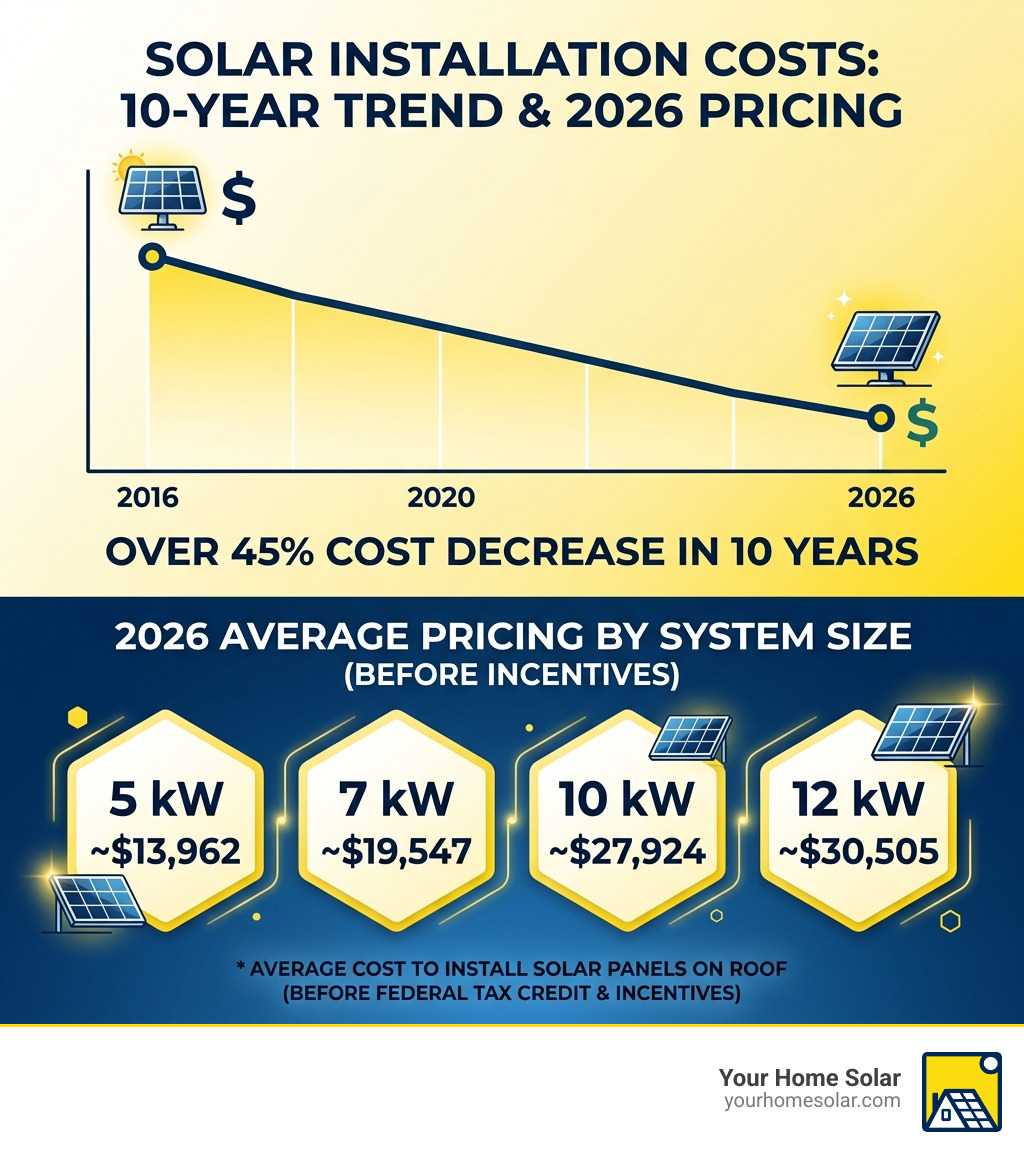
The average cost to install solar panels on roof in 2026 runs between $13,962 and $36,409, depending on your home’s size, location, and energy needs — but most homeowners land somewhere around $20,000 to $31,558 before incentives.
Here’s a quick snapshot of what you can expect to pay:
| System Size | Avg. Cost Before Incentives | Avg. Cost After 30% Federal Tax Credit |
|---|---|---|
| 5 kW | ~$13,962 | ~$9,773 |
| 7 kW | ~$19,547 | ~$13,683 |
| 10 kW | ~$27,924 | ~$19,547 |
| 12 kW | ~$30,505 | ~$21,354 |
Note: Tax credit eligibility depends on your individual tax situation. Consult a tax professional.
Over the last decade, the price of going solar has dropped by more than 45%. What once cost a homeowner $40,000 in 2010 now runs closer to $25,000 — and that number keeps trending down.
That said, the sticker price is only part of the story. Roof type, shading, system size, local labor rates, and financing choices all push that number up or down. This guide walks you through every piece of it so you know exactly what you’re looking at before you sign anything.
I’m Ernie Bussell, founder and CEO of Your Home Solar and a former solar operations leader who helped oversee a $40 million per year installation business — experience that gave me a ground-level understanding of the average cost to install solar panels on roof and where homeowners most often get misled on pricing. Let’s make sure that doesn’t happen to you.
Learn more about average cost to install solar panels on roof:
- average solar panel cost per watt
- average cost of solar panels per kilowatt
- average cost per watt commercial solar
Breaking Down the Average Cost to Install Solar Panels on Roof in 2026
When we talk about the national landscape in 2026, the gross average cost to install solar panels on roof sits at approximately $31,558. However, very few people actually pay that full amount out of pocket. Thanks to the Residential Clean Energy Credit, the net cost for an average system often drops to around $22,090.
It is helpful to think of solar like buying in bulk at a warehouse club. The total price goes up as you add more panels, but the “price per unit” (or per watt) actually goes down. For instance, a small 4 kW system might have a higher per-watt cost because the fixed expenses—like permitting and sending a crew to your house—are spread over fewer panels.
According to 2026 data from Solar Panel Cost In 2026: It May Be Lower Than You Think | EnergySage, here is how the pricing typically scales:
| System Size | Number of Panels (Approx.) | Total Gross Cost |
|---|---|---|
| 5 kW | 12-15 | $14,000 – $18,000 |
| 7.2 kW | 18-22 | $21,816 – $24,000 |
| 10 kW | 25-30 | $27,000 – $31,000 |
| 12 kW | 30-35 | $30,505 – $35,000 |
Understanding the average cost to install solar panels on roof per watt
In the solar industry, we use “cost per watt” as the universal yardstick. It’s the easiest way to compare quotes from different companies, even if they propose different system sizes. In 2026, a competitive average cost to install solar panels on roof ranges from $2.50 to $3.50 per watt.
If you receive a quote that sits around $2.79 per watt, you’re looking at a very standard, fair market price. However, if a solicitor knocks on your door and quotes you $4.00 per watt for a standard roof, they might be layering in heavy sales commissions. On the flip side, if you see a price closer to $2.00 per watt, it’s often for a massive residential system or a commercial project where economies of scale are in full effect. You can dive deeper into these metrics here: Is $3 per Watt a Fair Price? Understanding Your Solar Investment.
How system size impacts the average cost to install solar panels on roof
Size is the biggest lever we have when designing your system. A 12 kW system might have a gross price of over $30,000, but because the “soft costs” (like marketing and administrative fees) are fixed, the price per watt is significantly lower than a 4 kW system.
For homeowners with smaller energy needs, a 2 kW or 5 kW system might be the right fit, even if the per-watt price is slightly higher. We always aim to size the system to offset 100% of your usage, rather than just filling up the roof for the sake of it. You can see how smaller setups compare in our guide: Your Guide to 2kW Solar System Prices and Savings.
Hard vs. Soft Costs: What Are You Actually Paying For?
Many of our neighbors in East Tennessee are surprised to learn that the actual solar panels are only a small fraction of the total bill. In fact, the physical panels usually account for only 12% of the total installation cost.
So, where does the rest of the money go? Here is a typical breakdown of a $30,000 installation:
- Equipment (Hard Costs): This includes the panels (~$3,800), inverters (~$3,100), and racking/wiring (~$3,700). Total equipment usually accounts for about 46% of the price.
- Installation Labor: Surprisingly, the crew on your roof only represents about 7% to 15% of the total cost ($2,100 – $4,500).
- Soft Costs: This is the “invisible” part of the bill—permitting, interconnection fees, sales, marketing, and installer overhead. In some cases, these can make up 65% of the total cost.
For a detailed look at these numbers, How Much Does It Code to Install a Solar Panel? [2026 Data] | Angi provides an excellent breakdown of how administrative tasks impact your bottom line.
Solar Equipment and Hardware
The type of gear you choose matters. Monocrystalline panels are the gold standard in 2026, offering efficiencies up to 24%. While they cost more upfront than polycrystalline panels, they last longer (25-40 years) and produce more power in less space. If you’re wondering about specific panel pricing, check out Unpacking the Price: How Much for a 300W Solar Panel?.
The inverter is the “brain” of the system, converting the DC power from your panels into AC power for your home. You have three main choices:
- String Inverters: The most affordable, but if one panel is shaded, the whole string’s performance drops.
- Power Optimizers: A middle-ground solution that helps with shading.
- Microinverters: These are installed under each individual panel. They are the most expensive but offer the best performance and longest warranties—often 25 years.
Labor and Operational Expenses
Operational expenses include things like pulling permits from the local building department (which can range from $200 to $1,000) and the “interconnection fee” your utility company charges to hook your system to the grid. Because these tasks require specialized knowledge of local Tennessee codes, they are a significant part of the average cost to install solar panels on roof. We take care of all this paperwork for our clients to ensure a smooth transition. To understand how these operational costs fit into your investment, read Your Home’s Solar Investment: Breaking Down Installed Panel Prices.
Key Factors Influencing Your Roof Installation Quote
No two roofs are exactly alike. When we visit a home in Knoxville or Johnson City, we look at several physical factors that can swing the average cost to install solar panels on roof by thousands of dollars.

Roof Type and Condition
The material of your roof dictates how we attach the panels. Standard asphalt shingles are the easiest and cheapest to work with. Metal roofs are also great but require different mounting hardware. If you have a complex roof with many peaks and valleys, the labor cost will increase because the crew has to spend more time on safety and precision.
Crucial Tip: If your roof is more than 10-15 years old, we often recommend replacing it before the solar goes on. Removing and reinstalling solar panels later for a roof repair can cost $5,000 or more. Some homeowners find it more cost-effective to bundle a roof replacement with their solar project. For more on this, see Unpacking Solar Costs: What You Need to Know Before You Buy.
Energy Usage and System Sizing
Your past utility bills are the blueprint for your solar system. A typical home consuming 900 kWh per month usually needs a 7 kW to 8 kW system. If you have a larger home or a “power-hungry” lifestyle (think heated pools or multiple EV chargers), you might need a 10 kW or 12 kW system.
We recommend looking at a full year of bills to account for the heavy AC usage in our humid Tennessee summers. If you’re currently using about 1,000 kWh a month, we’ve got a specific guide for you: 1000 kWh Per Month Solar: Unpacking the Price Tag.
Maximizing ROI with Incentives and Financing
The “sticker price” of solar is high, but the “real” price is much lower once you factor in the 30% Federal Investment Tax Credit (ITC). This credit, extended through 2032 by the Inflation Reduction Act, allows you to claim 30% of your total project cost—including labor and equipment—as a credit on your federal taxes.
For a $25,000 system, that’s a $7,500 direct reduction in what you owe the IRS. This single incentive is the biggest reason the payback period for solar in 2026 is now between 7 and 12 years. After that point, your electricity is essentially free for the remaining 15-20 years of the system’s life. Check out An Essential Guide to Solar Panels Cost for a deeper dive into these savings.
Financing Options for Homeowners
How you pay for your system changes your total 25-year return:
- Cash: This offers the highest ROI. You own the system and the tax credit from day one.
- Solar Loans: Many homeowners prefer this because it allows for $0-down installation. Monthly loan payments are often lower than your current electric bill.
- Leases/PPAs: You don’t own the system, and the provider keeps the tax credit. While this has the lowest upfront cost, it offers the lowest long-term savings.
Long-term Savings and Home Value
Solar is one of the few home improvements that actually pays for itself. Beyond the monthly bill savings, research from the Lawrence Berkeley National Laboratory shows that homes with owned solar installations sell at a premium—approximately $4 per watt of installed capacity. For a 7 kW system, that’s an added $28,000 in home value.
Additionally, solar acts as a hedge against rising utility rates. While your neighbors might see 3-5% increases in their power bills every year, your “fuel” (the sun) is locked in at $0.00. For more on these long-term trends, see The Kilowatt Crunch: Your Guide to Average Solar Panel Costs.
Regional Spotlight: Solar Installation in Tennessee
In East Tennessee, we have a unique energy landscape. The average cost to install solar panels on roof in the Volunteer State is often slightly lower than the national average, coming in at around $2.97 per watt.
For a typical 6.7 kW system in Tennessee, you’re looking at a gross cost of roughly $21,198. After the federal tax credit, that price falls to $14,839.
We work closely with local utilities across the region, including KUB in Knoxville, LCUB in Lenoir City, and others across Sevierville, Maryville, and Johnson City. While Tennessee doesn’t have a state-wide mandate for net metering, many local power providers under the TVA umbrella offer programs that allow you to get credit for the excess energy you send back to the grid.
For specific details on our local market, visit: Solar Panel Installation Knoxville Cost.
Frequently Asked Questions about Solar Costs
Is solar worth it in 2026 without local rebates?
Yes. Even without specific state-level rebates in Tennessee, the 30% federal tax credit combined with the 25-year lifespan of the panels makes the math work. Most homeowners see a 100% return on their investment within a decade, followed by 15+ years of pure profit.
How much does adding a battery backup increase the cost?
Adding a solar battery like a Generac PWRcell or similar storage solution typically adds $7,000 to $18,000 to the total project cost. While this increases the upfront investment, it provides energy security during outages and allows you to use your solar power at night, maximizing your independence from the grid.
What are the hidden costs of roof solar installation?
The most common “hidden” costs are:
- Main Panel Upgrades: If your home’s electrical panel is under 200 amps, you may need an upgrade ($1,500 – $4,000).
- Tree Trimming: To get the best ROI, you might need to remove branches shading your roof ($300 – $1,500).
- Critter Guards: We highly recommend these to keep squirrels from nesting under your panels (~$400).
Conclusion
Investing in solar is about more than just numbers—it’s about taking control of your home’s future. Whether you are in Kingsport, Morristown, or right here in Knoxville, understanding the average cost to install solar panels on roof is the first step toward energy independence.
At Your Home Solar, we pride ourselves on being East Tennessee’s trusted experts. We don’t just slap panels on a roof; we design comprehensive energy solutions tailored to your specific home and budget. From the initial consultation to the final inspection, our goal is 100% customer satisfaction.
Ready to see what the numbers look like for your specific roof? We’re here to help you navigate the incentives, the technology, and the installation process with total transparency.