
Is a Battery Backup for House Power Right for You?
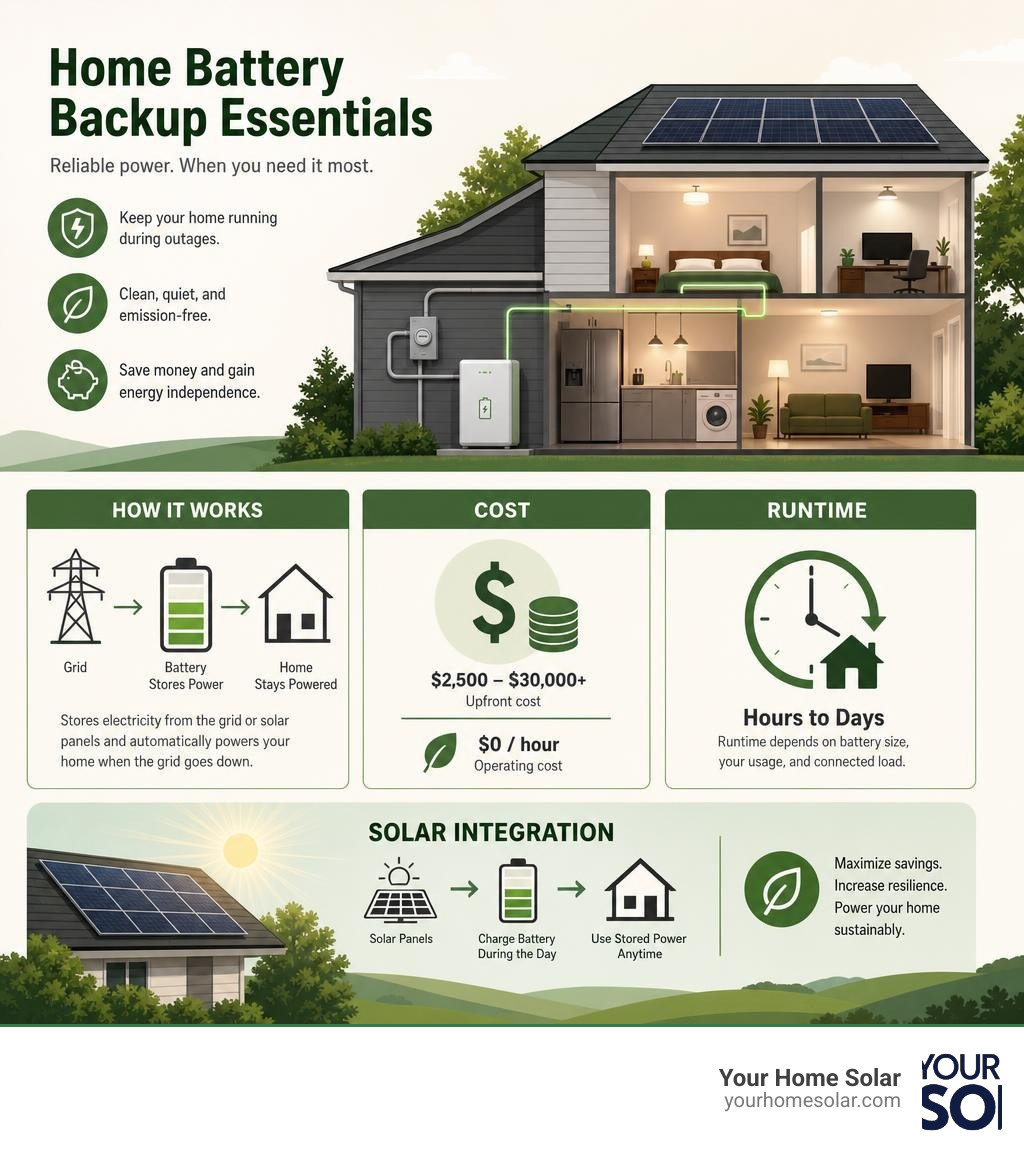
Battery backup for house power stores electricity — from the grid or solar panels — and releases it automatically when the grid goes down, keeping your lights, fridge, and essential devices running without fuel, noise, or fumes.
Here’s a quick comparison to help you decide:
| Factor | Home Battery Backup | Gas Generator |
|---|---|---|
| Startup time | Instant (< 20 ms) | 10–30 seconds |
| Noise | Silent | 60–80 dB |
| Emissions | None | Carbon monoxide + exhaust |
| Fuel required | No | Yes |
| Runtime | Hours to days (expandable with solar) | Unlimited with fuel |
| Upfront cost | $2,500–$30,000+ | $3,000–$15,000+ |
| Operating cost | $0/hour | $5–$15/hour |
| Lifespan | 10–15 years | 10–20 years |
| Solar compatible | Yes | Limited |
The demand for home battery systems is growing fast — 20% annually — and it’s easy to see why. Extreme weather is more common. Grid outages last longer. And East Tennessee homeowners are looking for reliable ways to stay powered without depending on the utility company.
Power outages aren’t just inconvenient. They can mean a lost refrigerator full of food, a dark house during a storm, or a missed dose of power-dependent medical equipment. A well-sized battery system solves all of that quietly, cleanly, and automatically.
I’m Ernie Bussell, founder and CEO of Your Home Solar — East Tennessee’s #1 solar energy contractor — and after years of helping homeowners navigate energy decisions, including battery backup for house power, I’ve seen what works and what wastes money. This guide cuts through the noise so you can make a confident, informed decision.
Simple battery backup for house power word guide:
What is a Battery Backup for House Power and How Does It Work?
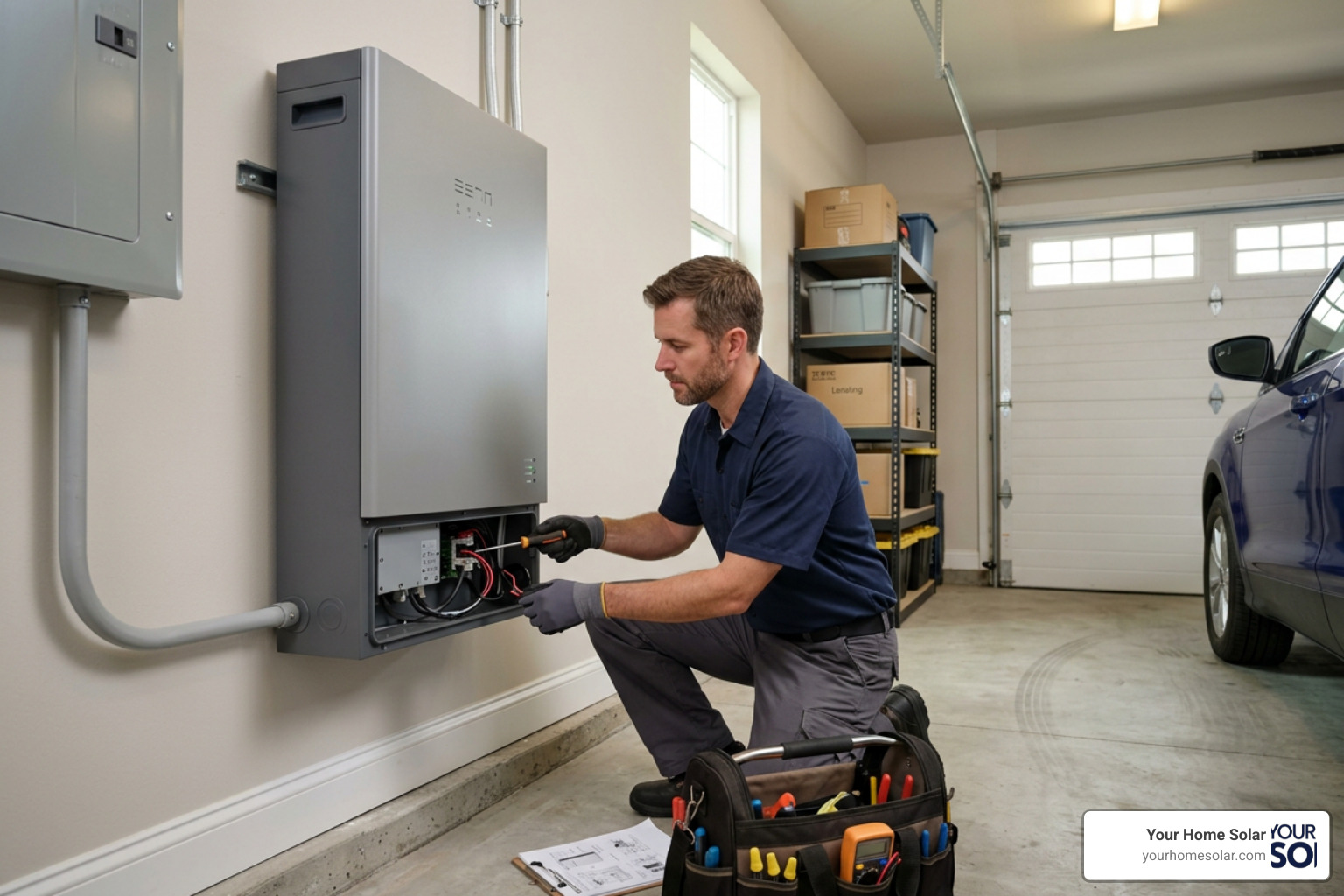
To understand a battery backup for house power, it helps to think of it as a giant, highly intelligent version of the portable power bank you use to charge your phone. Instead of sitting on your kitchen counter, however, these systems are permanently installed in your garage, utility closet, or on an exterior wall.
At its core, a home battery backup system consists of three main components:
- The Battery Cells: The physical storage units (usually using Lithium Iron Phosphate, or LiFePO4, chemistry) that hold the electrical energy.
- The Inverter: Batteries store power as Direct Current (DC), but your home runs on Alternating Current (AC). The inverter converts this power back and forth seamlessly.
- The Automatic Transfer Switch (ATS) or Smart Gateway: This is the “brain” of the system. It constantly monitors the utility grid. The millisecond it detects that the grid has failed, it disconnects your home from the utility line and connects it to the battery.
How fast is this switch? Standalone premium systems can switch over in less than 10 milliseconds, and fully integrated whole-home smart panels do it in under 20 milliseconds. This is so fast that your digital clocks won’t even blink, and your desktop computer won’t shut down.
During normal times when the grid is active, your battery backup for house power sits quietly, keeping itself topped off from either your solar panels or the grid. In areas with time-of-use (TOU) electricity rates, a smart system can also perform “load shifting”—charging up when electricity is cheap (like in the middle of the night) and discharging to power your home when rates spike in the afternoon.
To learn more about how energy storage fits into your home’s setup, check out our guide on Beyond the Grid: How Solar Battery Banks Keep Your Lights On.
Can I Add Solar Panels to My Battery Backup for House Power?
Absolutely. In fact, pairing solar panels with your battery backup for house power is the ultimate way to achieve true energy independence.
Without solar panels, your battery backup is a finite resource. Once it drains during an outage, you are back in the dark until the grid is repaired. But when you add solar panels, you create an off-grid microgrid. During a prolonged blackout—such as those caused by severe storms in Knoxville or Kingsport—your solar panels will power your home during the day while simultaneously recharging the battery. When the sun goes down, the battery takes over to keep your lights on through the night.
This cycle can repeat indefinitely, providing unmatched resilience. If you want to dive deeper into why this combination is so powerful during emergencies, read our article on Why Emergency Solar Power is the Brightest Idea for Your Next Outage.
Home Battery Backup vs. Gas Generators: Which is Best?
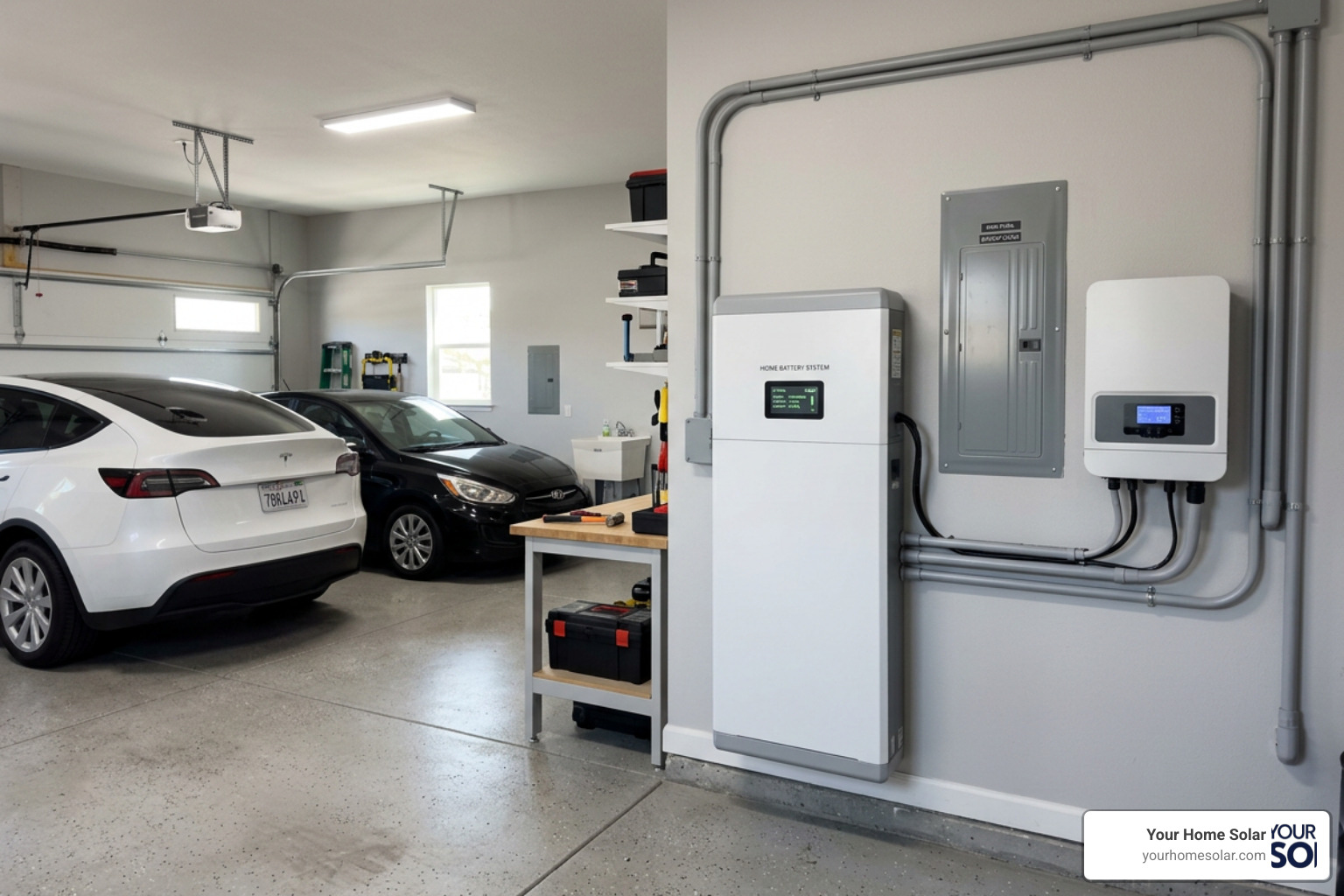
When looking for a way to secure your home against outages, you will inevitably compare battery storage to traditional standby gas or propane generators. Both solve the problem of power outages, but they do so in completely different ways.
Traditional generators are mechanical engines. They require a steady supply of fuel (natural gas, liquid propane, or diesel), require regular engine maintenance (like oil changes), and produce a loud roar (usually 60 to 80 decibels) along with toxic exhaust fumes. They also have a startup delay of 10 to 30 seconds, meaning your house will go completely dark before the generator kicks in.
A battery backup for house power, on the other hand, is completely solid-state. It operates in total silence, emits no emissions, and can be safely installed indoors. It requires zero active maintenance and switches on instantly.
While generators trade startup delays and ongoing fuel costs for unlimited runtime (as long as you have fuel), batteries offer clean, quiet, and reliable instant-on power that can be infinitely replenished if paired with solar. For a detailed breakdown of this comparison, take a look at Power to the People with a Battery Generator Backup.
Additionally, you can explore traditional integration options via Home Battery Storage Products – Briggs & Stratton Energy Solutions to see how mechanical systems compare with modern storage.
How to Choose the Right Size Battery Backup for Your Home
Sizing a battery backup for house power is not a one-size-fits-all process. If you buy a system that is too small, you will run out of power quickly or trip the system by overloading it. If you buy a system that is too large, you will spend thousands of dollars on capacity you don’t actually need.
To size your system correctly, you must understand two distinct metrics:
- Continuous Output (measured in Kilowatts or kW): This is how much power the battery can push out at any single moment. It determines how many appliances you can run at the exact same time.
- Capacity (measured in Kilowatt-hours or kWh): This is the total amount of energy stored in the battery. It determines how long you can run those appliances.
To calculate your needs, start by listing your essential appliances and separating their running wattage from their surge wattage (the extra power required for a few seconds to start up a motor, like in a refrigerator or sump pump).
| Appliance | Running Wattage | Surge Wattage |
|---|---|---|
| Refrigerator / Freezer | 150W – 300W | 800W – 1,200W |
| Wi-Fi Router & Modem | 20W – 50W | 20W – 50W |
| LED Light Bulbs (x10) | 90W | 90W |
| Sump Pump (1/3 HP) | 800W | 1,500W – 2,000W |
| Well Pump (1/2 HP) | 1,000W | 2,500W – 3,000W |
| Mobile Phone Charger | 10W | 10W |
| CPAP Medical Machine | 30W – 60W | 200W |
By summing up the running wattages of your must-have items, you can determine your minimum continuous power requirement. For a small home with basic needs, a system delivering 3,000W to 6,000W of continuous output is plenty. For larger homes or those wishing to run central heating and cooling, you will want a system capable of 12,000W or more.
For a comprehensive walkthrough on mapping out your emergency power plan, read Don’t Get Caught Off Guard: The Ultimate Guide to Emergency Home Power.
Powering Your Entire House vs. Essential Circuits
When installing a battery backup for house power, you have two primary options for how your home’s electrical panel is wired:
1. Essential Circuits (Critical Loads Backup)
In this setup, your installer adds a secondary electrical panel called a “critical loads subpanel.” We physically move the breakers for your most important appliances—such as your refrigerator, internet router, select lights, kitchen outlets, and medical equipment—into this subpanel. During an outage, only these circuits receive battery power. This is highly efficient, cost-effective, and ensures your battery lasts as long as possible. Modular systems like the 12kWh Haven Home Battery Backup w/ Haven 10 Transfer Switch | Goal Zero are perfect examples of this target-circuit approach.
2. Whole-Home Backup
If you want absolutely no lifestyle changes during an outage, you can opt for a whole-home backup. This requires a much larger battery bank and a high-output inverter system, such as a multi-unit Powerwall installation. This setup backs up your main electrical panel directly, allowing you to run heavy 240V appliances like central air conditioning, clothes dryers, and electric water heaters.
To help weigh these choices, check out The Ultimate Guide to Staying Powered When the Grid Goes Down.
How Long Will a Battery Backup for House Power Last During an Outage?
The duration your battery will last depends entirely on your usage habits and the size of your battery bank.
If you are running an “essentials-only” setup with a standard 10 kWh battery, you can easily power your refrigerator, Wi-Fi, lights, and device chargers for 24 hours or longer. If you practice strict energy conservation—only turning on lights when necessary and avoiding heavy appliances—you can stretch that same 10 kWh battery to 48 hours.
However, if you attempt to run a whole-home setup with central AC, an electric oven, and water heaters on a single battery, you could fully deplete it in as little as 2 to 4 hours. This is why proper sizing and load management are so critical. If you want to see detailed runtime scenarios based on different battery sizes, check out The Ultimate Guide to Staying Powered When the Grid Goes Down.
Costs, Lifespan, and Maintenance of Home Battery Systems
The price of a battery backup for house power varies based on capacity, brand, and installation complexity.
A basic, portable-leaning system designed to back up a few essential circuits can start between $2,500 and $6,000. However, a professionally installed, grid-tied whole-home battery system typically ranges from $10,000 to $30,000+.
While the upfront investment is significant, it’s important to look at the total return on investment (ROI). A battery backup prevents expensive food spoilage, avoids basement flooding from failed sump pumps, allows you to continue working from home during grid failures, and can actively lower your monthly electric utility bills through peak shaving and load shifting.
To learn more about the complete pricing breakdown, including permit fees and utility hookups, read The Real Price of Never Losing Power Again.
For those looking to explore different manufacturers, you can also check out Home Battery Backup – BLUETTI or alternative power subscription models like Base Power: Affordable, Reliable Home Power .
Battery Lifespan and Maintenance Requirements
Modern home battery backups are incredibly durable. Most premium systems manufactured today use Lithium Iron Phosphate (LiFePO4) chemistry.
Compared to older lithium-ion chemistries (like NMC), LiFePO4 batteries are exceptionally stable, highly resistant to thermal runaway (fire hazards), and offer a vastly superior cycle life. A high-quality LiFePO4 battery will typically last for 3,000 to 10,000 complete charge cycles—which translates to 10 to 15+ years of daily use—before experiencing any noticeable degradation in capacity.
Even better? They require zero active maintenance. There are no fluids to check, no spark plugs to replace, and no fuel stabilizers to add. They simply sit on your wall and run quietly.
To understand the differences between various battery chemistries, check out Everything You Need to Know About Residential Solar Battery Types: What’s Best?.
| Battery Chemistry | Typical Lifespan | Maintenance Required | Safety Profile |
|---|---|---|---|
| Lithium Iron Phosphate (LiFePO4) | 10–15+ Years (3,000+ Cycles) | None | Excellent (Highly Stable) |
| Lithium-Ion (NMC) | 8–12 Years (1,500+ Cycles) | None | Good |
| Lead-Acid (AGM/Gel) | 3–5 Years (500+ Cycles) | Low to Medium | Fair |
Federal Tax Credits and Local Rebates
Fortunately, you do not have to shoulder the entire cost of a battery backup for house power on your own.
Under the federal government’s Residential Clean Energy Credit, homeowners can claim a 30% tax credit on the total cost of purchasing and installing a battery storage system. This credit applies to both standalone battery systems (with a capacity of 3 kWh or greater) and systems paired directly with solar panels.
Additionally, depending on where you live in East Tennessee—whether you are served by the Knoxville Utilities Board (KUB), local electric cooperatives, or other municipal utilities—there may be local rebates, net metering programs, or emergency demand response incentives that can lower your net costs even further. Learn more about federal guidelines directly via the Federal Residential Clean Energy Tax Credits page.
Frequently Asked Questions about Home Battery Backups
Does a home battery backup work with an existing solar system?
Yes, absolutely! We can easily integrate a battery with an existing solar array using a method called AC coupling. This allows your existing grid-tied solar inverter to communicate seamlessly with the new battery inverter, ensuring your solar panels can still charge your batteries during a grid outage. For a deep-dive comparison on how different systems handle this, read our In-Depth Guide to Solar Battery Backup Comparison.
Can a home battery backup run a central air conditioner?
Yes, but central air conditioners require a massive amount of power to start up their compressors (the surge current). To run a central AC on a battery backup, you will either need a large, multi-battery system designed for whole-home loads, or you can install a simple, inexpensive device called a soft starter on your AC unit. A soft starter reduces the startup surge by up to 70%, making it much easier for a standard battery system to power your HVAC.
What happens if the battery runs out during a long outage?
If your battery depletes before grid power returns or before the sun comes up to recharge your solar panels, the system will shut down safely to protect itself. However, as soon as the sun rises, a smart battery system with solar integration will perform a “black start”—using the very first rays of morning sunlight to reboot itself and begin powering your critical loads while recharging the battery bank.
Conclusion
Investing in a battery backup for house power is one of the smartest decisions you can make to secure your home, protect your family, and gain complete control over your energy future. Whether you want to back up a few essential circuits to keep your fridge running through a storm, or you want to cut the cord entirely with a whole-home solar-plus-storage setup, there is a perfect configuration waiting for you.
At Your Home Solar, we pride ourselves on providing the highest quality installations and trusted expertise to homeowners across East Tennessee—from Knoxville and Oak Ridge to Maryville, Johnson City, and beyond. We don’t believe in high-pressure sales pitches; we believe in designing custom, reliable solutions that deliver 100% customer satisfaction.
Ready to take the next step toward ultimate energy security? Check out our master resource, The Ultimate Guide to Solar Batteries and Energy Storage Solutions, or reach out to our team today to schedule your custom home energy consultation. Let’s build your personal power grid together!