What a 10kW Solar System with Battery Storage Can Do for Your Home
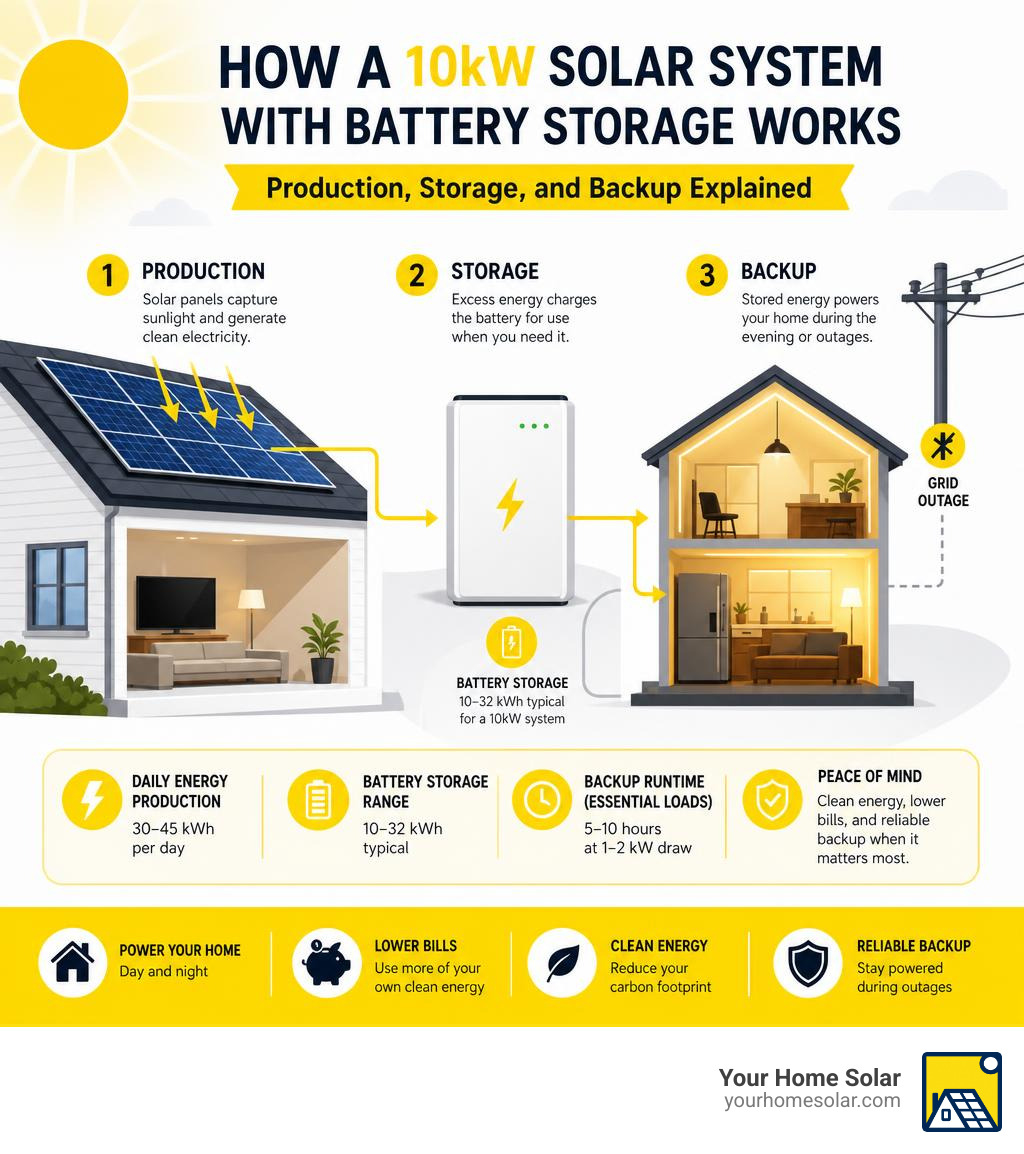
A 10kW solar system with battery storage is one of the most capable home energy setups available today — and for good reason. Here’s a quick snapshot of what you need to know:
| Feature | Details |
|---|---|
| Daily energy production | 30–45 kWh per day (varies by location and sunlight) |
| Battery storage range | 10–32 kWh typical for a 10kW system |
| Panels required | 25–40 panels (~575–650 sq ft of roof space) |
| Total installed cost | $7,000–$18,000 before incentives |
| After 30% federal tax credit | $4,900–$12,600 |
| Backup runtime (essential loads) | 5–10 hours at 1–2 kW draw |
| Payback period | 5–12 years depending on location and usage |
For most East Tennessee homeowners, a 10kW solar system can comfortably cover the energy needs of an average household — and keep the lights on when the grid goes down.
High energy bills, unreliable grid power, and rising electricity rates are real concerns. A 10kW solar and battery system addresses all three at once: it generates clean power during the day, stores the surplus for evening use, and delivers backup power when outages hit.
I’m Ernie Bussell, founder and CEO of Your Home Solar, and after leading solar operations for a $40 million per year installation business and spending the past three-plus years helping East Tennessee homeowners choose the right 10kW solar system with battery storage, I’ve seen what works — and what doesn’t. In this guide, I’ll walk you through everything you need to make a confident, well-informed decision.
Common 10kw solar system with battery storage vocab:
What is a 10kW Solar System with Battery Storage?
At its core, a 10kW solar system with battery storage is a hybrid powerhouse designed to give you both energy generation and energy security. The “10kW” (kilowatt) rating refers to the peak capacity of the solar panel array itself. Under ideal conditions, these panels can produce 10,000 watts of direct current (DC) power at any given moment.
However, generation is only half the battle. To make that power truly useful, a modern system integrates three critical components:
- The Solar Panel Array: Captures sunlight and converts it into DC electricity.
- The Hybrid Inverter: The “brain” of the system. It converts the DC electricity from your panels or battery into alternating current (AC) electricity to power your home. It also manages where the power goes—directly to your appliances, into your battery storage, or back to the utility grid.
- The Lithium Battery Bank: Stores excess power generated during the brightest parts of the day so you can use it at night or during an outage.

By pairing generation with storage, you transition from a basic grid-tied setup (which shuts off during a power outage for safety reasons) to a resilient, self-sustaining energy ecosystem. If you are curious about how these systems function completely independent of the utility grid, you can read more in our guide, Beyond the Grid: A Comprehensive Guide to Off-Grid Solar Panel Systems. Complete pre-configured off-grid kits, such as those featured on the Shop 10 kw Solar System | 10kw Solar Power System – SunGoldPower page, demonstrate how robust these individual components are when bundled together.
How Many Solar Panels and Space Are Required?
A standard 10kW (10,000-watt) system requires a physical footprint on your property that depends directly on the efficiency of the panels you select:
- High-Efficiency Panels (400W–440W+): If you use premium, high-efficiency monocrystalline panels, you will need approximately 24 to 25 panels. This setup is ideal for tighter roof spaces, requiring roughly 575 square feet of unobstructed, shade-free roof area.
- Standard Panels (300W–360W): If you opt for more budget-friendly, lower-wattage panels, you may need between 30 to 40 panels. This configuration requires up to 650 square feet of roof space.
When planning your roof layout, we must account for local building codes, which often require fire safety pathways (typically 3-foot setbacks from roof edges and ridges). If your roof does not have enough unshaded, south-facing space, a ground-mounted system is an excellent alternative, provided you have the yard space. You can explore various high-quality layouts and hardware setups directly through 10kW Solar Systems – GoGreenSolar.com .
Daily Electricity Production of a 10kW Solar System with Battery Storage
On average, a 10kW solar system generates 30 to 45 kWh of electricity per day. Over a month, this adds up to approximately 1,350 kWh under optimal conditions (assuming an average of 5 peak sun hours per day with a south-facing orientation).
However, real-world production is never a flat line. Several factors influence your daily yield:
- Seasonal Changes: In East Tennessee, summer days bring long, intense sunlight, pushing production to its peak. In the winter, shorter days and lower sun angles reduce daily generation.
- Weather and Shading: Overcast skies, seasonal storms, and shade from nearby trees can cause temporary efficiency losses of 5% to 15%.
- Panel Technology: Advanced options like N-type TOPCon or bifacial panels can capture reflected light from the underside. For example, some bifacial panels can achieve up to a 25% energy gain from the rear side, boosting a nominal 550W panel’s maximum output to 688W on bright, reflective days.
Battery Storage Options and System Architecture
The battery is what transforms your solar panels from a daytime-only savings tool into a 24/7 home security system. But not all batteries are built the same.

When choosing a battery for your 10kW solar system with battery storage, the primary decision comes down to battery chemistry:
- Lithium Iron Phosphate (LiFePO4): This is the gold standard for modern home energy storage. LiFePO4 batteries are exceptionally stable, highly resistant to thermal runaway (making them incredibly safe), and offer an impressive lifespan. They typically deliver 6,000 to 8,000 charge cycles (and some high-end models reach up to 10,000+ cycles) while retaining 80% of their original capacity. This translates to 10 to 15+ years of reliable daily service.
- Lithium Nickel Manganese Cobalt (NMC): Common in older home battery models and electric vehicles, NMC batteries have a higher energy density (meaning they are smaller and lighter). However, they have a shorter cycle life—usually 3,000 to 5,000 cycles—and carry a slightly higher thermal risk compared to LiFePO4.
To dive deeper into the chemistry, safety ratings, and longevity of these options, check out our resource, Everything You Need to Know About Residential Solar Battery Types: What’s Best?.
AC-Coupled vs. DC-Coupled Systems
How your battery connects to your solar panels and your home’s electrical system matters. There are two primary configurations:
- AC-Coupled Systems: In an AC-coupled system, the solar panels and the batteries have their own separate inverters. The DC power from the panels is converted to AC by the solar inverter, and then converted back to DC by the battery’s internal inverter to store it.
- Best for: Retrofitting a battery onto an existing solar panel system.
- Example: The Enphase Encharge 10, which features twelve embedded grid-forming microinverters.
- DC-Coupled Systems: In a DC-coupled system, both the solar panels and the battery bank connect directly to a single, shared hybrid inverter. The DC electricity from your panels charges the battery directly without any intermediate conversions.
- Best for: Brand-new, comprehensive solar-plus-storage installations.
- Advantage: Higher round-trip efficiency (typically 2% to 5% better than AC-coupled systems) because it avoids multiple conversion steps.
Comparing Battery Options for a 10kW Solar System with Battery Storage
When designing your system, we look at several leading industry options to find the right fit for your budget and performance needs.
| Battery Model | Usable Capacity | Chemistry | Warranty / Cycle Guarantee | Round-Trip Efficiency |
|---|---|---|---|---|
| Enphase Encharge 10 | 10.5 kWh | LiFePO4 | 10 years / 4,000 cycles (70% retention) | 89% (AC-coupled) |
| BYD Battery-Box Premium | 12.0 kWh | LiFePO4 | 10 years / 6,000 cycles (80% retention) | ~95% (DC-coupled) |
| SolarEdge Energy Bank | 9.7 kWh | LiFePO4 | 10 years / Unlimited cycles (70% retention) | 94.5% (DC-coupled) |
| EG4 / Server Rack Batteries | 20–32 kWh | LiFePO4 | 10 years / 8,000 cycles (80% retention) | ~95% (DC-coupled) |
For a comprehensive evaluation of how these brands stack up in real-world scenarios, read our In-Depth Guide to Solar Battery Backup Comparison. Additionally, you can review technical specifications for advanced hybrid battery configurations directly through the manufacturer at 10 Kw Solar System With Battery | Energy Storage Manufacturer .
What Can a 10kW Solar System Power?
A common question we hear in East Tennessee is: “Will a 10kW solar system with battery storage actually run my whole house?”
The short answer is yes, but it depends on how you manage your loads.
A 10kW solar array generates more than enough power during the day to run standard household appliances, charge your battery, and even feed some excess back to the grid. To understand what you can run, we have to look at the difference between daily generation and peak power draw:
- Continuous Power Output: Most home battery systems deliver between 3.8 kW and 10 kW of continuous AC power.
- Surge Power: This is the temporary boost (often up to 20 kW for premium hybrid inverters) required to start motor-driven appliances, like a well pump or a central air conditioning compressor.
For a detailed breakdown of grid-down survival strategies and load management, consult our guide, The Ultimate Guide to Staying Powered When the Grid Goes Down.
Daytime Power Generation vs. Nighttime Battery Usage
Managing your power is all about timing.
- During the Day: Your 10kW solar panels are actively producing power. You can easily run high-draw appliances like your washing machine, dishwasher, and pool pumps directly off the sun. Any extra power is automatically diverted to top off your batteries.
- At Night: Your solar panels go to sleep, and your home seamlessly transitions to drawing power from your battery bank. To maximize your stored energy, it is best to practice basic load management—such as waiting until morning to run the clothes dryer or charge your electric vehicle.
Emergency Backup and Outage Performance
When a severe storm rolls through East Tennessee and knocks out the grid, your hybrid system instantly isolates your home from the utility lines (a process called “islanding”) within milliseconds.
How long your battery lasts depends entirely on your usage:
- Essential Loads Only (1–2 kW draw): If you only power your refrigerator, freezer, home Wi-Fi router, LED lights, and a few phone chargers, a 10–16 kWh battery will easily last 10 to 20 hours.
- Moderate Loads (3–5 kW draw): Adding a microwave, running a well pump, or operating a space heater will reduce your runtime to 2 to 5 hours of continuous use.
- With Active Solar Generation: If the sun is shining the next day, your solar panels will power your home and recharge the battery simultaneously, allowing you to run critical systems indefinitely.
This level of self-reliance is a cornerstone of neighborhood safety. To learn more about how home solar strengthens local grids during crises, read The Role of Solar Energy in Disaster Resilience: Building Stronger Communities.
Costs, Incentives, and Return on Investment (ROI)
Investing in a 10kW solar system with battery storage is a major financial decision. Let’s look at the numbers for a professional, turnkey installation in May 2026:
| Expense Category | Typical Cost Range |
|---|---|
| Premium Solar Panels & Inverter | $6,000 – $9,000 |
| Lithium Battery Storage (10kWh–16kWh) | $7,000 – $12,000 |
| Professional Installation, Permitting & Grid Connection | $3,000 – $6,000 |
| Total Turnkey System Cost (Before Incentives) | $16,000 – $27,000 |
| 30% Federal Tax Credit (ITC) Savings | -$4,800 – -$8,100 |
| Net Investment Cost | $11,200 – $18,900 |
Note: While basic DIY component kits can be purchased online for $7,000 to $18,000, they do not include professional labor, electrical panel upgrades, utility interconnection fees, or engineering permit plans.
Federal Tax Credits and Local Incentives
Fortunately, you do not have to shoulder the entire cost alone:
- The Federal Residential Clean Energy Credit (Section 25D): This incentive allows you to deduct 30% of the total cost of your solar and battery system from your federal taxes. This applies to both the equipment and the professional installation costs. Best of all, standalone battery storage systems (10 kWh or larger) also qualify for this 30% credit, even if you add them to an existing solar system later.
- Local Utility Programs: In East Tennessee, local power companies offer varying interconnection policies. For example, customers in the Johnson City area can check out Solar for Your Home – BrightRidge to see their specific requirements for grid-tied solar systems.
- Navigating Local Requirements: Navigating local permitting and utility requirements in counties like Blount County or Knox County is crucial. Working with a knowledgeable local installer ensures your system complies with all regional codes and utility interconnection policies.
Payback Period and Financial Savings
Your return on investment (ROI) is determined by how much utility power you replace with your own clean generation.
In East Tennessee, where electricity rates are relatively stable but rising, a professionally installed 10kW solar system with battery storage typically achieves a payback period of 7 to 12 years.
Your payback timeline is influenced by:
- Avoided Outage Costs: Preventing even one instance of basement flooding (by keeping your sump pump running) or avoiding hundreds of dollars in spoiled food can instantly pay back a portion of your battery investment.
- Time-of-Use (TOU) Rates: If your utility charges more for electricity during peak hours, you can program your battery to discharge during those expensive windows, saving you an estimated $700 to $1,400 annually.
To see exactly how a battery bank keeps your hard-earned money in your pocket, read our detailed analysis, Beyond the Grid: How Solar Battery Banks Keep Your Lights On.
Frequently Asked Questions about 10kW Solar Systems
How long will a 10kW battery last during a power outage?
A 10kWh battery will typically last 5 to 10 hours if you are powering essential loads (like your refrigerator, Wi-Fi, lights, and a few outlets drawing about 1 kW of power). If you manage your electricity carefully and turn off non-essential appliances, you can stretch that runtime to 15 to 20 hours. If the outage occurs during a sunny stretch, your solar panels will recharge the battery during the day, giving you virtually indefinite emergency power.
Can I install a 10kW solar battery system myself?
While you can buy DIY solar kits online, we strongly advise against self-installation unless you are a licensed electrician. Solar installations require working with high-voltage DC electricity, mounting heavy equipment on rooftops, navigating local structural building codes, and submitting detailed engineering plans to secure utility interconnection agreements. A professional installation ensures your system is safe, fully code-compliant, and covered by manufacturer warranties.
Is a 10kW solar battery system worth the investment?
Yes. For the majority of homeowners in East Tennessee, a 10kW system strikes the perfect balance between upfront cost and long-term capability. It provides substantial monthly electric bill savings, complete peace of mind during severe weather outages, and can add measurable value to your property.
To keep your investment running at peak performance for decades, regular upkeep is key. Learn what is required in our Residential Solar Solutions Guide: Solar System Maintenance.
Conclusion
A 10kW solar system with battery storage is more than just a home upgrade—it is a clear path to energy independence, grid security, and long-term financial savings. By generating your own clean power and storing it safely on-site, you protect your family from rising utility rates and unexpected power outages.
At Your Home Solar, we specialize in providing tailored, high-performance energy solutions throughout East Tennessee—from Knoxville and Maryville to Oak Ridge and the Tri-Cities. Our team is committed to trusted expertise and 100% customer satisfaction, ensuring your transition to clean energy is seamless, reliable, and rewarding.
Ready to take control of your power? Explore our comprehensive Residential Solar Solutions Guide: The Ultimate Guide to Solar Batteries and Energy Storage Solutions or contact us today to schedule your custom home energy assessment!