
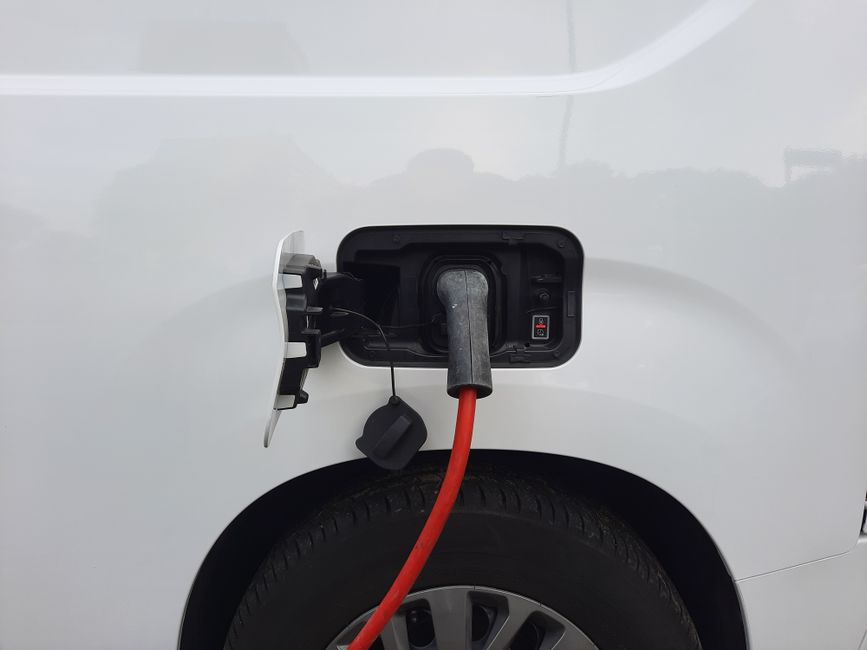
Why the Right Cable for an EV Charger Matters
Start by separating two cables: the cable you plug into the car and the fixed wire that supplies the home charger. For the plug-in cable, match the connector to your vehicle and choose a current rating at least as high as the charger will deliver. For a 48A hardwired charger, plan for a 60A circuit. That often means 6 AWG copper conductors in a suitable conduit system or 4 AWG copper NM-B cable, not 6 AWG NM-B. Have a qualified electrician confirm the wire, terminals, installation conditions, and local code before work begins.
I’m Ernie Bussell, founder of Your Home Solar, and my Navy quality-assurance experience taught me to check safety details before they become problems. When homeowners search for “cable for ev charger,” I help them start with the distinction that matters most: the cable they handle is not the wire inside the wall.
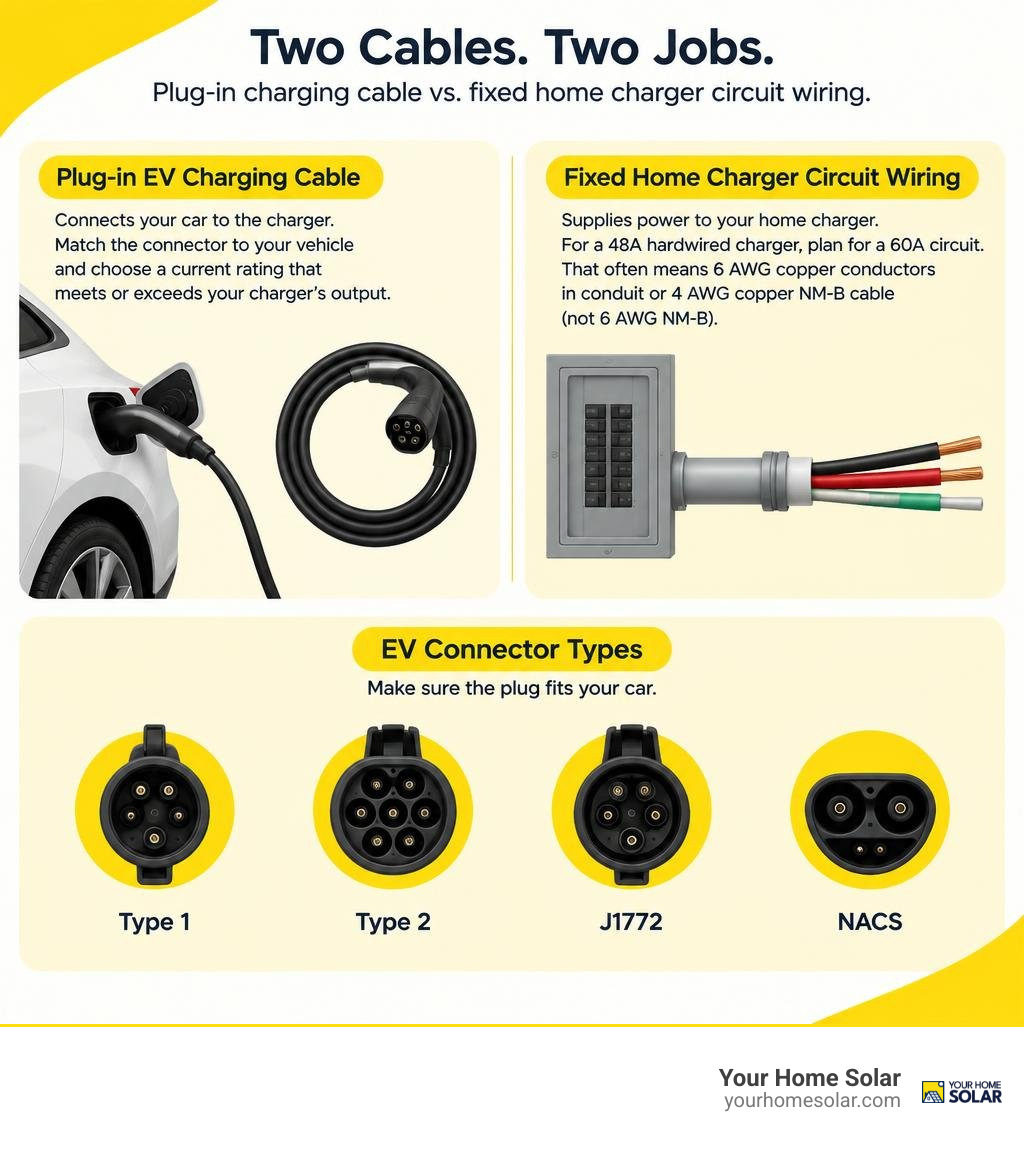
Cable for EV charger: identify the right connector and charging setup
Before we talk amps and wire gauges, let’s make sure the plug fits the car. A beautifully rated cable is just an expensive rope if the connector is wrong.
Cable for EV charger compatibility: Type 1, Type 2, J1772, and NACS
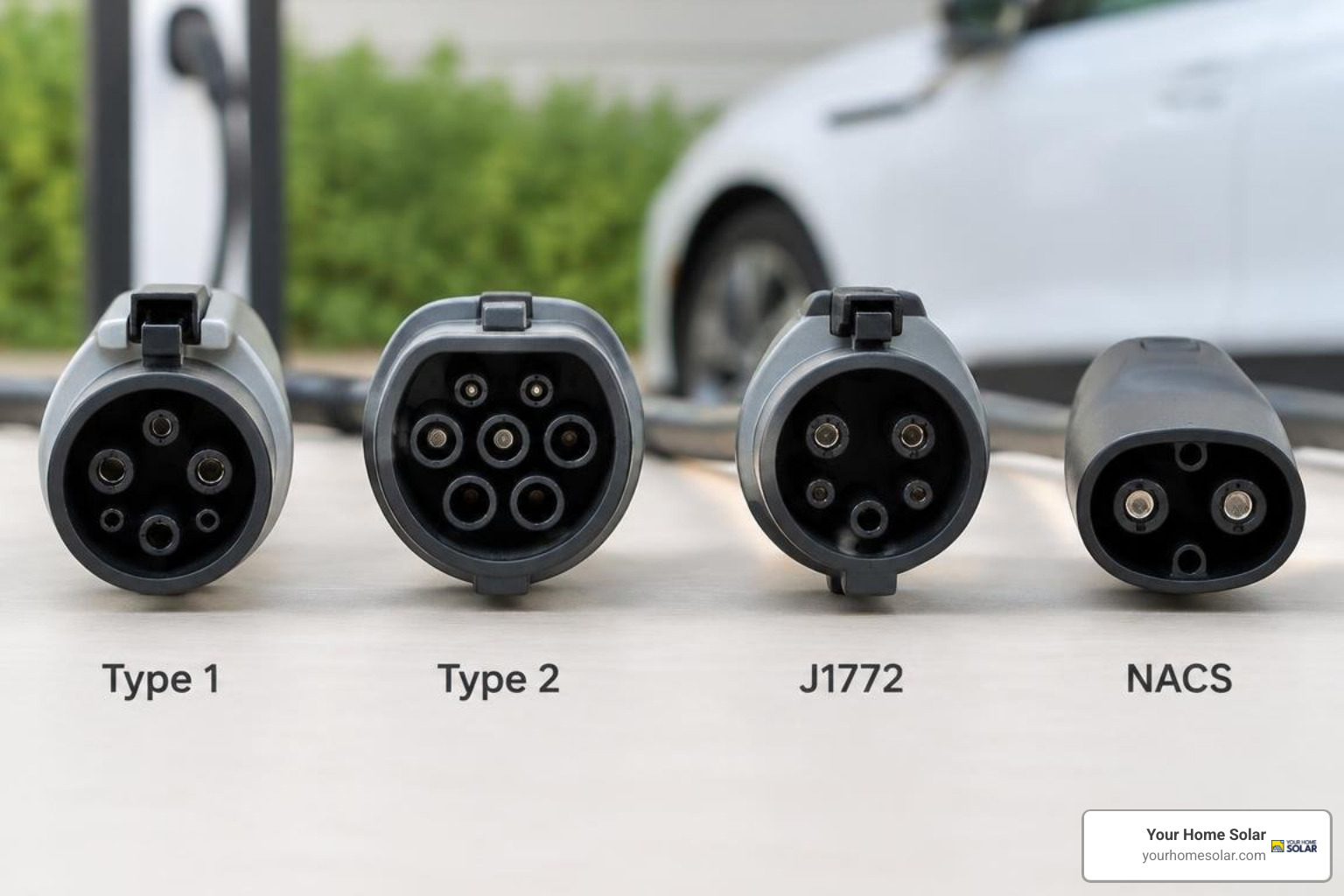
Here is how the common connectors line up:
- Type 1 (SAE J1772): a round plug with five pins. It is common in North America and Japan, and it is the standard for Level 2 AC charging on most non-Tesla vehicles in the U.S.
- Type 2: a seven-pin plug that is the European standard. You will mostly meet it on imported vehicles or in overseas shopping listings.
- NACS (SAE J3400): the compact connector that began on Tesla vehicles and is now appearing on many other makes. Cables are offered for it in 50A and 80A classes.
- CCS1 and CCS Combo 2: the DC fast-charging versions that add two large pins below the AC plug shape. CCS1 is the North American flavor; Combo 2 is the European one.
How do you know which one your car uses? Look at the charge port, then confirm in your owner’s manual. The model year matters because some vehicles changed port styles between generations. In the U.S., most homeowners need either a J1772 or a NACS cable, depending on the vehicle and the charger. Always buy a cable whose connector matches both ends of your setup.
Cable for EV charger use: tethered, untethered, AC, and DC
A tethered charger has its cable permanently attached. An untethered charger has a socket, and you bring your own cable. Neither is universally better.
| Feature | Tethered | Untethered |
|---|---|---|
| Convenience | Always there, nothing to carry | You must pack and store the cable |
| Flexibility | Fixed cable and connector | Cable can travel with you or be swapped for another car |
| Cable ownership | Part of the charger | Yours to buy, size, and replace |
| Typical use | Home garages, DC fast chargers | Public AC points in some regions, workplaces |
Tethered is generally more practical for a home garage, since the cable is always ready and usually long enough. Untethered gives you flexibility, especially if two different vehicles share a charger.
Then there is AC versus DC. AC is what regular home and public Level 2 chargers deliver, and the car’s onboard charger converts it. DC fast chargers skip that step and push far more current directly to the battery, with power from 50 kW up to 350 kW. Because of that current, DC chargers use heavy, often cooled cables, and they are tethered to the post. You cannot use your own cable for DC fast charging, and you do not need to. A plug-in AC cable cannot do the job anyway.
When a Mode 2 granny charger makes sense
A Mode 2 cable, nicknamed a “granny charger,” is a portable charging unit that plugs into a household outlet. It is handy for occasional top-ups, emergencies, or a visit to a relative’s house. It is slow, though, and an EV is a continuous load that can run for hours. Household outlets and wiring were not built for that kind of long, steady draw, so use a dedicated circuit in good condition and never an overloaded extension setup. For more on that last point, see our guide to EV Level 2 extension cord safety and limitations. If you charge most days, a proper Level 2 charger on its own circuit is the better path.
Choose the circuit wire for a 48A home EV charger
Now for the wire hiding in your wall. This is where size really matters.
Size conductors for the continuous load and installation conditions
EV charging is a continuous load, meaning it runs for three hours or more. Electrical code treats continuous loads at 125% of their rating. The math in plain words: 48 amps times 1.25 equals 60 amps. That is why a 48A charger gets a 60A breaker and conductors sized to match.
Several things affect what wire is acceptable:
- Conductor material: copper and aluminum carry different currents at the same gauge, so aluminum needs to be larger.
- Terminal temperature rating: the charger’s lugs set the limit on which wire ampacity column applies. Many chargers will not accept 4 AWG at all.
- Voltage drop: long runs from the panel need extra attention to keep performance steady.
- Derating: heat, bundled conductors, and insulation in walls can reduce what the wire may safely carry.
- Local code: requirements vary, so a licensed electrician should confirm the design.
The stakes are real. One widely discussed homeowner thread reported 6 AWG wire running above 60°C at a 48A load. That is the kind of detail inspectors care about, and the kind that turns a fast charger into a “melty crispy” headache.
Compare NM-B, THHN/THWN, and TC-ER-JP options
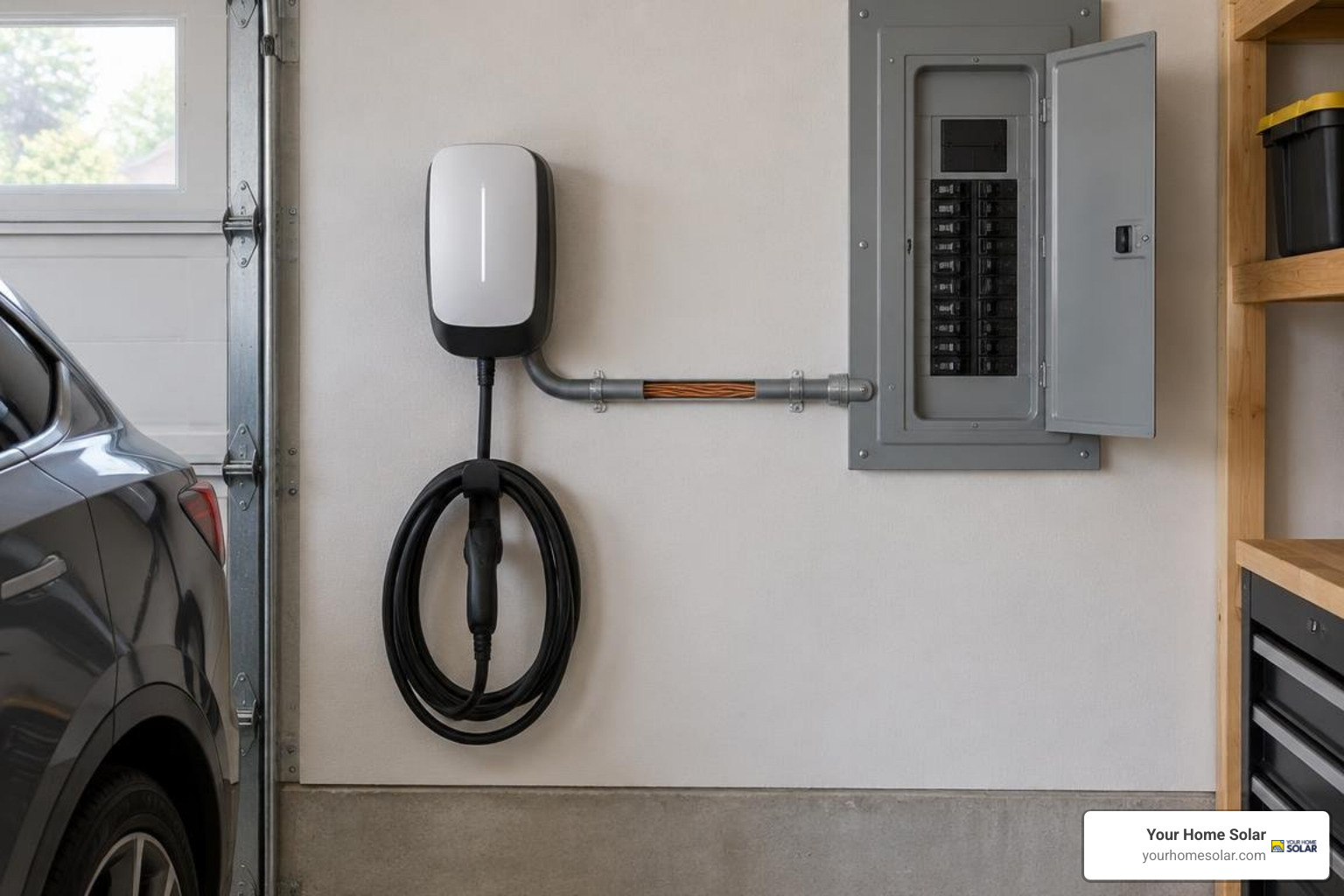
Here is how the common options stack up for a 48A charger on a 60A circuit:
- 6 AWG NM-B or UF cable: not suitable for 48A continuous charging. NM cable is evaluated in the 60°C column, where 6 AWG copper falls short of this load.
- 4 AWG copper NM-B: electrically appropriate, but many charger terminals will not accept that size.
- 6 AWG copper THHN/THWN in conduit: a common solution. Individual conductors run through conduit, and conduit is installed empty first, then the wires are pulled in.
- 4 AWG aluminum THWN: workable where the charger lugs are listed for aluminum, which many chargers are not.
- Copper SER/SEU cable: another route when the charger will not accept larger conductors.
- TC-ER-JP tray cable: one product example is a 6 AWG two-conductor cable with an 8 AWG ground, THWN conductors, 600V, and 90°C dry and wet ratings. It is sunlight resistant and rated for direct burial. It can suit panel-to-charger runs when installed according to the National Electrical Code, but your electrician must verify that the whole installation qualifies.
A tip from the conduit world: metal EMT can serve as the equipment ground, so two 6 AWG THHN conductors can fit in a 1/2 inch conduit. Flexible ENT conduit can make limited-access wall runs easier. If you might add vehicle-to-home features later, leaving a larger conduit between garage and panel is a smart, inexpensive bit of future-proofing.
Always check the charger manufacturer’s terminal limits first, because the charger decides what it will accept. Our guide to electrical panel capacity and EV charger compatibility explains how to check whether your panel can handle the load, and our EV charger wiring schematics walk through how the pieces connect. If you are weighing a weekend project, read our professional versus DIY installation considerations first.
Check safety ratings, listings, and outdoor protection
A cable that carries high power for years needs proof it can do so safely. Look for:
- UL listing: for North American equipment, with UL 2251 applying to NACS connectors.
- SAE J1772 and SAE J3400: the connector standards for Type 1 and NACS.
- IEC 62196 and IEC 61851: international standards covering connector compatibility, temperature-rise testing, and charging systems.
- IP rating: IP44 is a reasonable floor for outdoor installations. IP65 or higher gives more weather resistance.
- Build quality: heat-resistant, flexible jackets, sealed contacts, and strain relief at the connector.
Inspect cables regularly. Cracked insulation, a loose connector, or discoloration near the plug means stop charging and replace the cable. Well-built cables use contact coatings and sometimes temperature sensors to guard against overheating. For deeper reading, see this overview of AC cable standards and design considerations and these EV charging cable specifications, which show how voltage, current, length, and ingress protection are compared.
Match charging-cable amps, kW, phase, and length
Cable for EV charger power: amps, kW, and phases
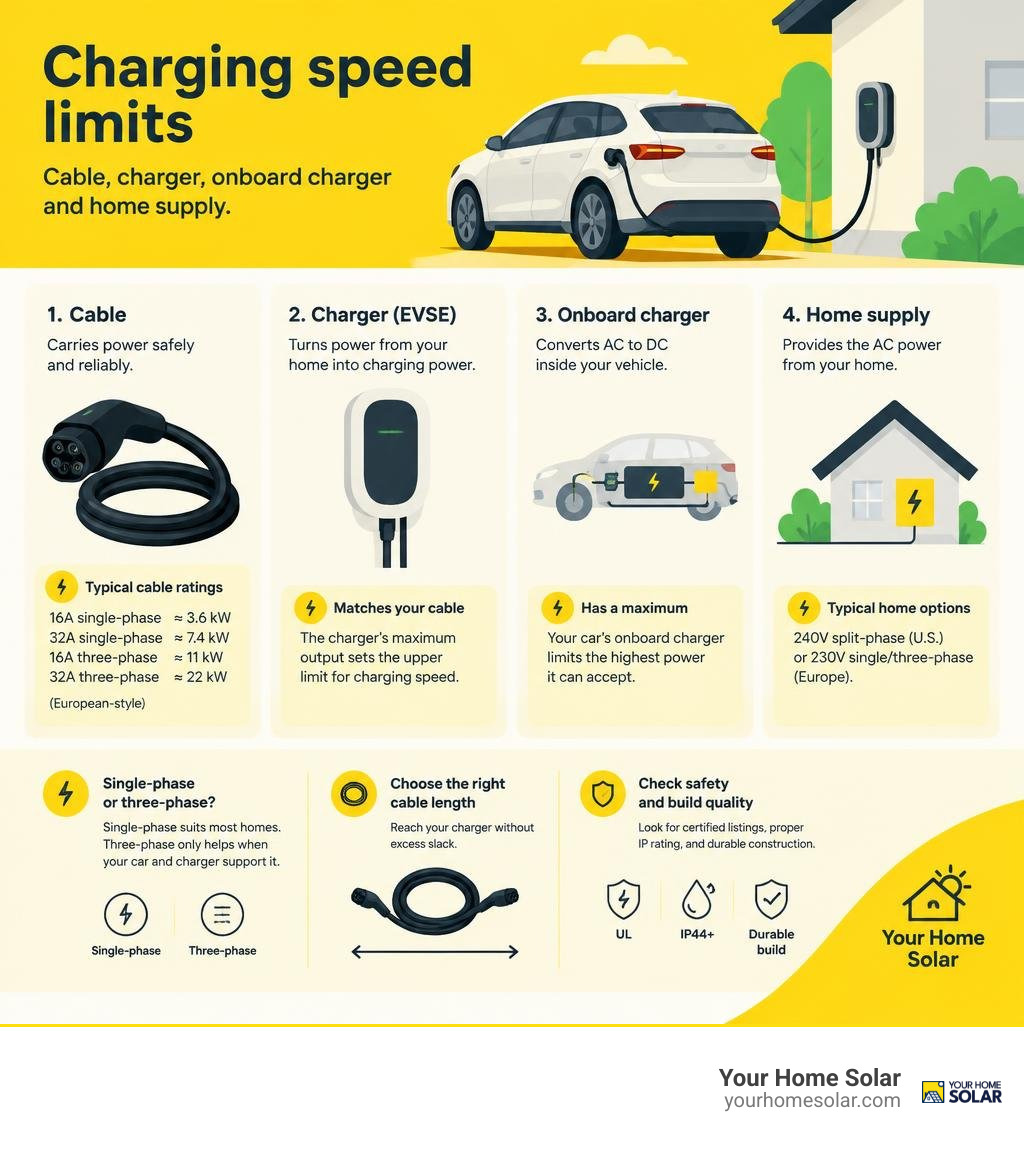
Charging speed comes from simple arithmetic: watts = volts × amps. Here are the standard European-style single and three-phase ratings you will see on cables:
| Rating | Power |
|---|---|
| 16A single-phase | about 3.6 kW |
| 32A single-phase | about 7.4 kW |
| 16A three-phase | about 11 kW |
| 32A three-phase | about 22 kW |
U.S. homes use 240V split-phase, so 48A at 240V works out to about 11.5 kW. For a vehicle that gets about 3 miles per kWh, that restores around 300 miles of range in 8 hours.
Your actual speed is limited by the lowest of four things: the cable, the charger (EVSE), the car’s onboard charger, and your home supply. A bigger cable will not push a car beyond what its onboard charger accepts. Still, choosing a cable rated at or above the car’s maximum is a smart way to be ready for your next vehicle.
Choose single-phase or three-phase capability
Single-phase cables suit most homes. Three-phase cables carry more power but only help when the car and the charging point both support three-phase. Type 1 vehicles are always single-phase. If your car is single-phase, a three-phase cable works but gives no speed boost. It can still be handy for a household with two cars, one single-phase and one three-phase, sharing a cable. If your car supports three-phase and you may visit three-phase charging points, spending a bit more is worthwhile. For home-only charging in a single-phase home, a 32A single-phase cable is plenty.
Select a cable length that reaches without excess slack
Common lengths run from 5m to 10m, and 6.5m (about 21 feet) is a good compromise between reach and easy storage. Many driveways do well with 7.5m or 10m. Here is how to choose:
- Measure the route from charger to charge port, not the straight line. Park in your usual spot and follow the path the cable will take.
- Add 1 to 2 meters of slack so the cable is never under strain.
- Stop there. Longer cables get heavier, harder to coil, more expensive, and a bigger trip hazard.
For fixed U.S. chargers, 18 to 25 feet is typical. If a cable cannot reach, resist the urge to improvise with household extension cords. Moving the charger or choosing a longer cable made for the job is safer.
Frequently asked questions about EV charger cables
Can a three-phase cable charge a single-phase car?
Yes. It will work, but it will not charge any faster. The vehicle’s onboard charger and the charging point set the limit, so the extra conductors simply sit idle.
Do I need my own cable at a public charging station?
It depends on the station. Some public AC points are untethered, so you must bring a cable, which is more common in Europe. Many U.S. Level 2 stations have an attached J1772 cable. DC fast chargers always have a cable attached to the post, such as CCS, and you cannot use your own. You can find local options in Knoxville, Oak Ridge, Maryville, Kingsport, and Sevierville. Johnson City also unveiled its first public Level 3 charger.
Is a 48A home charger necessary, and can I use a granny charger?
Not for everyone. If your daily mileage is modest, a lower-amp charger refills the battery overnight with room to spare, and it keeps wire sizes and costs down. A 48A charger makes sense for larger batteries, high daily mileage, or future-proofing. A granny charger is fine for occasional use on a healthy, dedicated outlet, but it is not ideal for daily charging. Before choosing, have an electrician assess your panel and load, since a 48A charger takes a big slice of household capacity.
Conclusion
Getting a cable for an EV charger right comes down to a few matches: the connector fits your car, the charging rate fits your vehicle and charger, the circuit conductor fits the 60A load, the length fits your driveway, and everything carries proper safety certification. 6 AWG NM-B is not the answer for a 48A charger.
At Your Home Solar, we install EV chargers across East Tennessee with licensed care and a commitment to 100% customer satisfaction. If you want a closer look at the wiring side, start with our home EV charger wiring guidance, then reach out and we will help you plan a safe, right-sized setup.