Why Sustainable Home Energy Matters Now More Than Ever
Sustainable home energy is the practice of minimizing your home’s environmental impact and energy costs through efficient design, smart technology, renewable power generation, and responsible resource use. It combines immediate habit changes, building envelope improvements, efficient appliances, and renewable technologies to create homes that are comfortable, affordable, and resilient.
Quick Overview: Your Path to Sustainable Home Energy
- Start with simple habits – Turn down your thermostat by 1 degree to save up to 10% on heating bills, switch to LED bulbs (80% less energy), and wash clothes at 30°C instead of 40°C (38% less energy)
- Seal your home’s envelope – Add loft insulation (save £445 annually), cavity wall insulation (save up to £485 yearly), draught-proofing, and double glazing (up to 30% energy savings)
- Upgrade to efficient systems – Install smart thermostats (8% savings on heating/cooling), energy-efficient appliances, and heat pumps (up to 70% consumption reduction)
- Generate renewable power – Add solar panels (save around £340 annually), battery storage for energy independence, and consider off-grid solutions
- Access financial support – Federal tax credits, utility rebates, and Energy Efficient Mortgages can offset 4-8% of upgrade costs
Here in East Tennessee, homeowners face a unique set of challenges: unpredictable power outages, rising utility bills, and the growing need for energy independence. England’s 25 million homes produce 58.5 million tonnes of CO2 annually—equivalent to the emissions from 28 million cars. In the U.S., home heating and cooling account for nearly half of all energy bills, while 74% of UK households still rely on gas boilers as their only central heating.
The good news? Every step toward sustainable home energy delivers measurable returns. Small changes like adjusting your thermostat or switching to LED lighting provide immediate savings. Larger investments in insulation, renewable heating, and solar power offer long-term financial protection against rising energy costs while dramatically reducing your carbon footprint.
This isn’t just about being “green.” It’s about building a home that works for you—one that stays comfortable during outages, costs less to operate every month, and protects your family’s future. Whether you’re dealing with an older home that needs a complete energy overhaul or a newer property ready for solar panels and battery backup, sustainable home energy solutions exist for every budget and timeline.
I’m Ernie Bussell, Founder and CEO of Your Home Solar, and over the past three years I’ve helped hundreds of East Tennessee families transition to sustainable home energy through solar installations, backup power solutions, and comprehensive energy planning. My background in naval operations, education, and leading high-performance teams taught me that the best solutions come from clear communication, attention to detail, and systems that actually work—principles I apply every day to help homeowners make confident energy decisions.
Defining Sustainable Home Energy and Its Importance
When we talk about sustainable home energy, we are looking at a holistic way of living. It isn’t just about sticking a solar panel on a roof and calling it a day. It involves a deep Sustainability and Reducing Your Carbon Footprint with Solar by looking at the entire lifecycle of how your home uses resources.
The importance of this shift cannot be overstated. In the construction industry, sustainability is no longer a trend; it’s a necessity. A sustainable home optimizes natural resources like sunlight and wind, integrating harmoniously with its surroundings through bioclimatic design. This means your home works with the Tennessee weather rather than fighting against it. By prioritizing resource efficiency, we reduce the strain on our local grid and ensure that our homes remain habitable and affordable for decades to come.
What is a Sustainable Home?
A sustainable home is designed to minimize its environmental impact throughout its entire lifecycle—from the materials used to build it to the way it manages waste and water. Key features often include:
- Passive House Design: Using the building’s orientation and high-quality insulation to maintain a steady temperature without heavy mechanical heating or cooling.
- LEED Certification: A globally recognized symbol of sustainability achievement and leadership.
- Non-toxic Materials: Using certified wood, bamboo, or natural stone to improve indoor air quality and reduce chemical off-gassing.
- Water Management: Incorporating low-flow fixtures and rainwater harvesting to protect our local water tables.
High-Performing vs. Standard Efficient Homes
You might hear the terms “efficient” and “high-performing” used interchangeably, but there is a significant difference. A standard efficient home meets the minimum building codes. A High-Performing Home is built to a much higher standard.
While a standard home might have some insulation and decent windows, a high-performing home features airtight construction and superior systems that allow it to reach “net-zero” status. This means the home produces as much renewable energy as it consumes annually. These High-Performing Homes are not just for the elite; they are a sound financial investment that protects against rising energy prices.
The Roadmap to Sustainable Home Energy
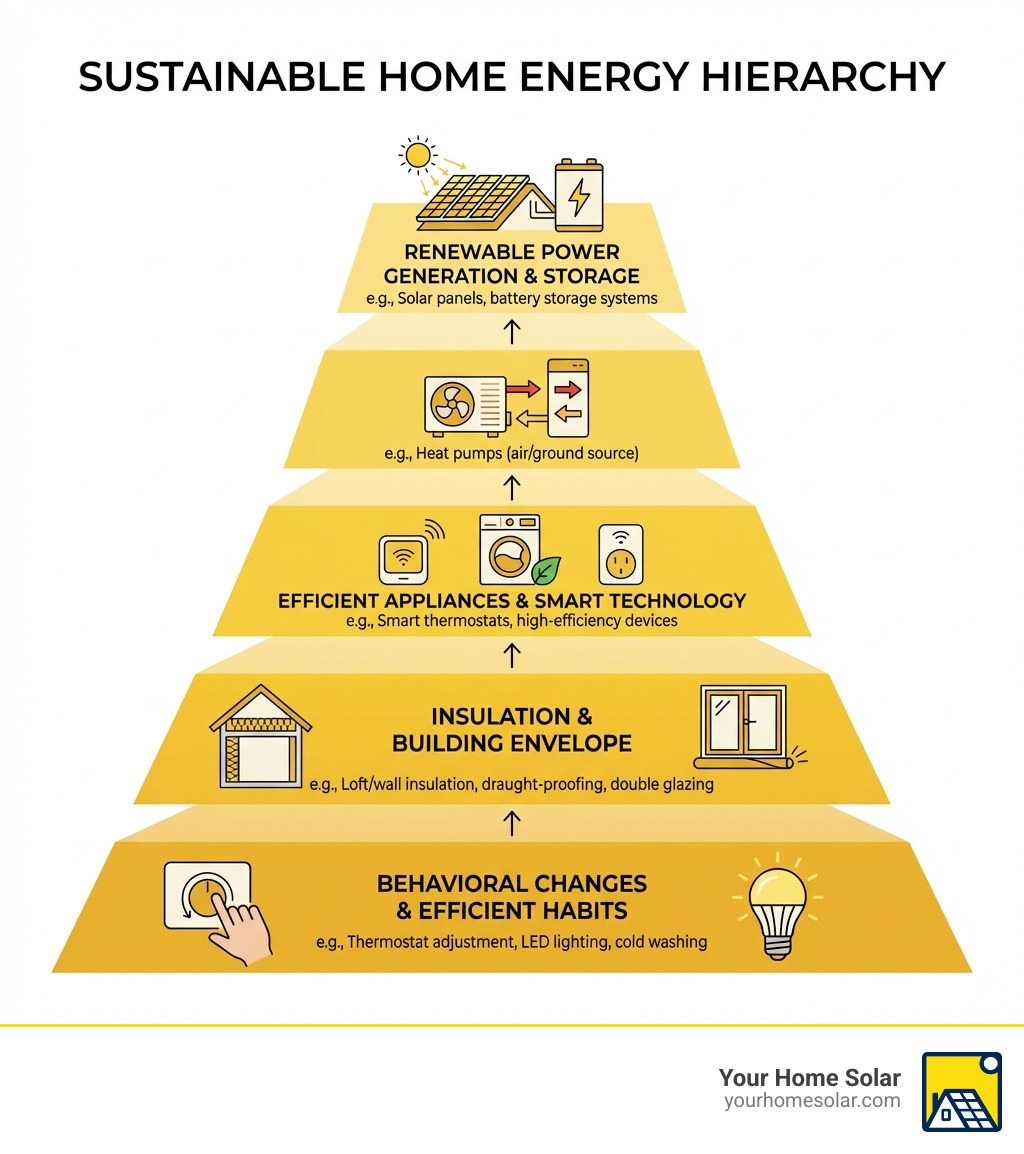
Embarking on a journey toward sustainable home energy can feel overwhelming. Do you buy a smart thermostat first, or do you dive straight into solar? We recommend a staged approach, often referred to as the “energy hierarchy.”
Assessing Your Current Performance
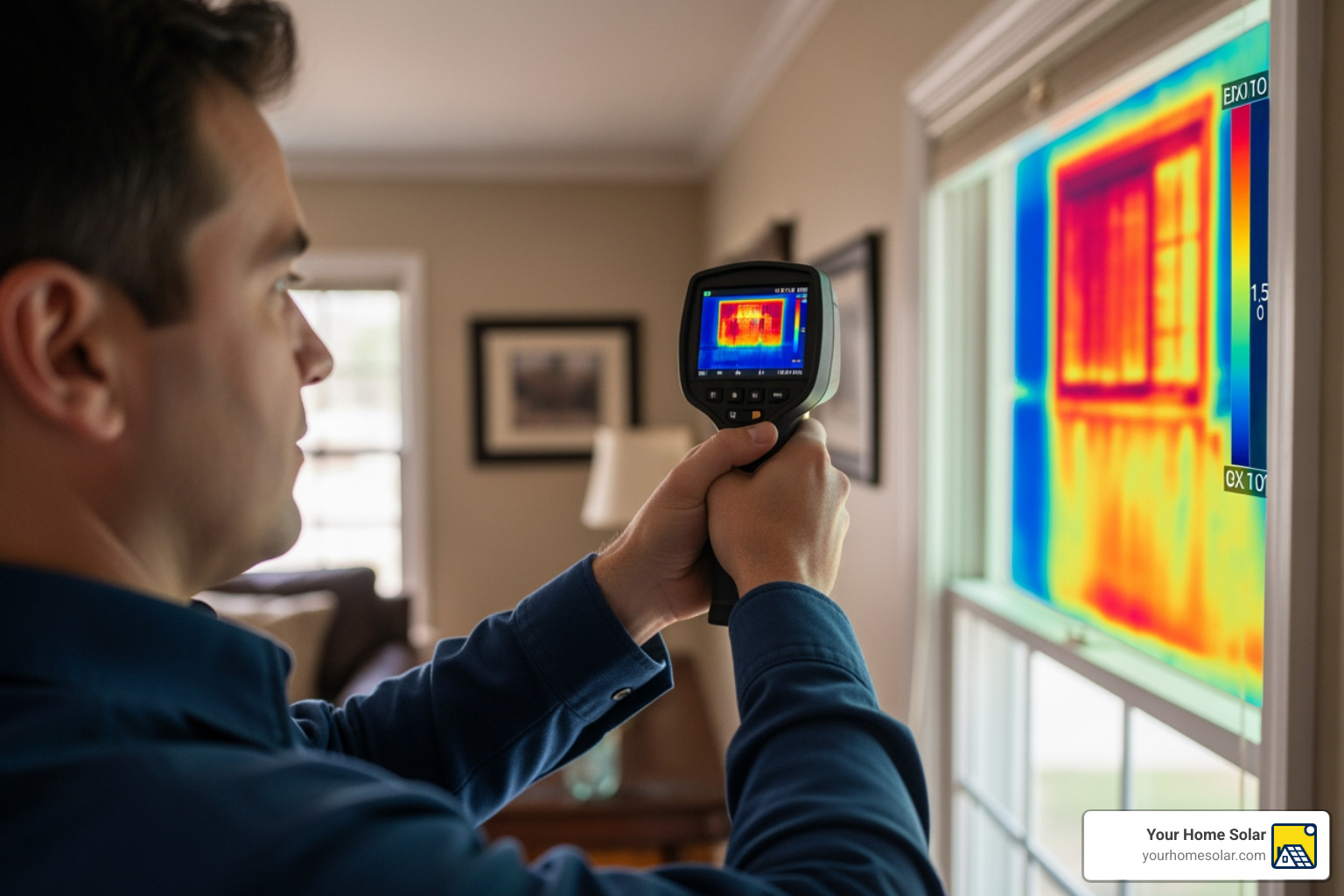
The first step for any existing house in Knoxville or Johnson City is to conduct a home energy assessment (or audit). This helps you find out exactly how your home uses energy and identifies the “low-hanging fruit” for savings.
You can use tools like the Home Energy Score, a national rating system developed by the U.S. Department of Energy. It provides a rating of your home’s current efficiency and a list of potential improvements. During an assessment, professionals might use a “blower door test” to find air leaks or thermal imaging to spot missing insulation. You can also look for “phantom energy”—the power sucked up by devices that are plugged in but not in use. To find certified professionals, you can check resources like the Residential Services Network.
Planning Your Sustainable Home Energy Journey
Once you have your data, it’s time to plan. We advocate for a “whole-house systems approach.” This considers how your appliances, insulation, and local climate interact.
Your plan should be tailored to your property’s age. For example:
- Homes 40+ years old: Prioritize electrical and plumbing updates alongside major insulation overhauls.
- Homes 10–20 years old: These often benefit most from Efficient Home Design tweaks, such as upgrading to air-source heat pumps or adding solar panels.
- New Builds: Focus on airtightness and on-site generation from day one to achieve a high-performance rating.
Maximizing Efficiency: Insulation, Appliances, and Smart Tech
Before we generate energy, we must stop wasting it. Think of your home like a bucket; there is no point in pumping more water (energy) into it if it’s full of holes.
Simple Habits for Immediate Savings
You don’t need a massive budget to start your sustainable home energy journey today.
- The 1-Degree Rule: Turning down your thermostat by just 1 degree can reduce heating bills by up to 10%.
- Laundry Logic: Washing at 30°C uses 38% less energy than 40°C programs. Since heating water accounts for 90% of a washing machine’s energy use, switching to cold water is a massive win.
- Lighting: LED bulbs use up to 80% less energy than traditional incandescent bulbs and last much longer.
- Air-Drying: Skipping the dryer and using a clothesline or rack can save significant amounts of electricity.
Sealing the Envelope: Insulation and Glazing
Around 1/3 of the heat in an uninsulated home is lost through the walls, and 1/4 is lost through the roof. This is why insulation offers some of the best returns on investment.
- Loft/Attic Insulation: Can save an average of £445 ($550+) annually.
- Cavity Wall Insulation: Can save up to £485 ($600+) per year for a detached house.
- Draught-Proofing: Sealing air leaks with caulk and weather stripping is a cheap DIY task that prevents that “chilly” feeling even when the heat is on.
- Glazing: Replacing single-pane windows with double glazing or airtight seals can result in energy savings of up to 30%.
To ensure your upgrades meet professional standards, look for contractors certified by the Building Performance Institute.
Smart Technology and Sustainable Home Energy
Smart technology acts as the “brain” of your sustainable home.
- Smart Thermostats: These can save around 8% on heating and cooling bills (roughly $50–$100 annually) by learning your schedule and adjusting temperatures when you’re away.
- Energy Monitors: These devices give you real-time data on which appliances are the biggest energy hogs.
- Smart Power Strips: These cut power to “phantom” devices automatically, potentially saving you up to $100 a year.
| Upgrade Type | Estimated Annual Saving | Payback Period |
|---|---|---|
| LED Lighting Upgrade | $50 – $100 | < 1 Year |
| Smart Thermostat | $50 – $100 | 1 – 2 Years |
| Loft/Attic Insulation | $400 – $550 | 2 – 5 Years |
| Solar Panels | $400 – $900+ | 7 – 10 Years |
| Heat Pump Installation | Up to 70% reduction | Varies by system |
Transitioning to Renewable Heating and Power
Once your home is efficient and well-insulated, it’s time to look at how you generate the energy you do need. Transitioning to Residential Renewable Energy is the most effective way to slash your carbon footprint.
Solar Panels and Battery Storage
Solar energy is the cornerstone of Residential Solar Power Explained: Benefits, Tips, and More. In Tennessee, we have ample sunlight to make photovoltaic (PV) systems highly effective.
- Financial Gains: Solar panels can save around £340 ($420) annually on electricity costs, and those savings grow as utility rates rise.
- Energy Storage: Adding a battery allows you to use your solar power at night or during a grid outage, providing true Benefits of Residential Solar.
- Off-Grid Solutions: For those in more remote parts of East Tennessee, like the mountains of Sevier or Blount County, off-grid systems with whole-home battery backups and standby generators offer total energy independence.
Heat Pumps and Underfloor Heating
Home heating makes up a massive portion of greenhouse gas emissions. Heat pumps are the sustainable answer. They work like a refrigerator in reverse, extracting heat from the outside air (even when it’s cold!) and moving it indoors.
- Efficiency: Heat pumps can result in energy consumption reductions of up to 70% compared to traditional electric or gas systems.
- Reversible Cooling: Most heat pumps also provide highly efficient air conditioning in the summer.
- Underfloor Heating: When paired with a heat pump, underfloor heating is incredibly efficient because it operates at lower temperatures than traditional radiators while providing superior comfort.
Future Trends in Sustainable Home Energy
The landscape of sustainable home energy is changing fast. We are seeing a move toward “connected neighborhoods” where homes share energy and support grid resiliency.
- EV Integration: Using your electric vehicle as a backup battery for your home (Bidirectional Charging).
- Time-of-Use Tariffs: Choosing energy plans that offer cheaper electricity during off-peak hours, which is perfect for charging EVs or running dishwashers.
- Smart Planning: When Planning for Home Renewable Energy Systems, homeowners should consider future-proofing their electrical panels for more heavy-duty electric appliances and vehicle chargers.
Financial Incentives and the Reality of Sustainable Upgrades
We know the big question: “How am I going to pay for this?” While the upfront costs can be higher, the long-term savings and increased property value make it a sound investment.
Grants and Financial Incentives
There is a wealth of help available if you know where to look. You can use the DSIRE database to find federal tax credits, state incentives, and utility rebates specific to Tennessee.
- Federal Tax Credits: These can often cover 30% of the cost of solar and battery installations.
- Energy Efficient Mortgages (EEM): These allow you to add the cost of energy-saving features (typically $3,000 to $6,000) to your mortgage, as the monthly energy savings will more than cover the slight increase in your loan payment.
- Utility Rebates: Many local Tennessee utility providers offer “weatherization” rebates or incentives for installing high-efficiency heat pumps.
Debunking Common Myths
- Myth: Sustainable upgrades are too expensive.
- Reality: While initial costs for a high-performance home may be 4–8% higher, the monthly energy savings often exceed the added mortgage cost, creating positive cash flow from day one.
- Myth: Solar doesn’t work when it’s cloudy.
- Reality: Solar panels still generate power in indirect light. Plus, with battery storage, you use the power you harvested during the sunny hours.
- Myth: Heat pumps don’t work in the cold.
- Reality: Modern air-source heat pumps are designed to work efficiently even in sub-zero temperatures, which is more than enough for our East Tennessee winters.
Frequently Asked Questions about Sustainable Home Energy
How much can I save by turning down my thermostat?
Turning down your thermostat by just 1 degree can reduce your heating bills by up to 10%. If you install a smart thermostat, you can save an additional 8% by automating your home’s climate based on when you are actually there.
What is the difference between a net-zero and a high-performing home?
A high-performing home is built to superior standards of airtightness and insulation. A “net-zero” home is a type of high-performing home that generates as much energy as it uses over the course of a year, usually through on-site solar panels.
Are sustainable upgrades worth the initial cost?
Absolutely. Beyond the immediate 10–30% savings on utility bills, these upgrades improve indoor air quality, increase your home’s resale value, and provide peace of mind through energy independence. Many insulation projects pay for themselves in just a few years.
Conclusion
The journey toward sustainable home energy is a marathon, not a sprint. Whether you start by switching to LED bulbs or go all-in with a net-zero solar and battery system, every step you take reduces your bills and your carbon footprint.
At Your Home Solar, we pride ourselves on being the trusted experts for East Tennessee homeowners. From Knoxville to Johnson City, we provide tailored, reliable installations of solar panels, backup generators, and EV chargers. We aren’t just selling equipment; we are building energy independence for our neighbors.
Ready to take the first step? Learn about solar in East Tennessee and let us help you design a home that is efficient, sustainable, and ready for the future.