Why Understanding Solar Panel Guarantees Matters for East Tennessee Homeowners
A solar panels guarantee is your financial protection for one of the biggest investments you’ll make in your home. When you spend $20,000 to $40,000 on a solar system, you need to know what happens if something goes wrong.
Here’s what a solar panels guarantee typically covers:
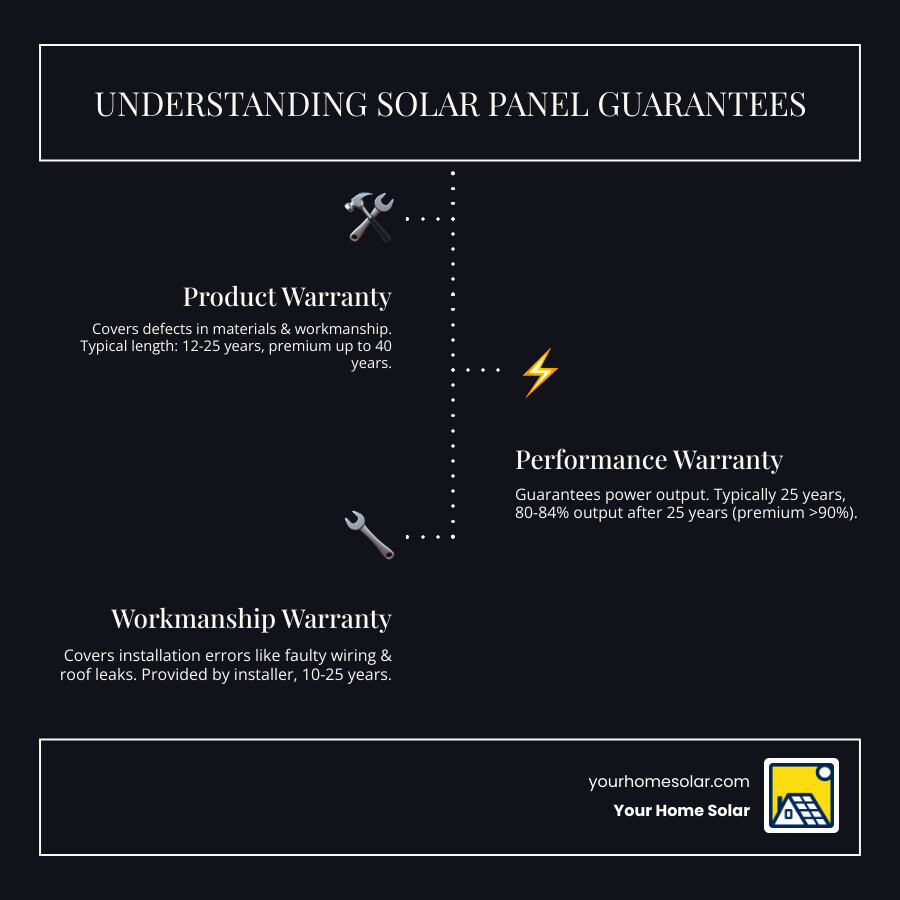
- Product Warranty (12-25 years): Protects against defects in materials and workmanship
- Performance Warranty (25 years): Guarantees your panels will produce at least 80-84% of their original power after 25 years
- Workmanship Warranty (10-25 years): Covers installation errors like roof leaks or faulty wiring
- Inverter Warranty (5-25 years): Protects the equipment that converts solar energy to usable electricity
Most solar panels come with a 25-year performance warranty, but the details vary significantly between manufacturers. Premium panels may guarantee 90% or more output after 25 years, while value panels might only guarantee 80%. The difference can mean thousands of dollars in energy savings over the life of your system.
What voids a warranty: DIY installation, unauthorized repairs, lack of maintenance, extreme weather damage (unless specified), and failure to register your panels.
Making a claim: Contact your installer first, gather your documentation (proof of purchase, serial numbers, installation date), and follow the manufacturer’s process for inspection and replacement.
I’m Ernie Bussell, founder and CEO of Your Home Solar, and I’ve spent over three years helping East Tennessee homeowners steer the complexities of solar panels guarantee terms to protect their investments. My background in operations management within the solar industry has shown me how critical it is to understand exactly what’s covered—and what’s not—before you sign any contract.
Deconstructing Solar Panel Warranties: What’s Really Covered?
Investing in solar for your East Tennessee home is a big decision, and understanding your solar panels guarantee is like having a detailed map for your journey. It’s not just one warranty; it’s a layered system of protections designed to give you peace of mind for decades to come. These guarantees cover various aspects of your solar system, from the panels themselves to the installation and other crucial components. Think of it as a comprehensive shield for your long-term energy savings. Understanding Residential Solar Warranties in East Tennessee: What’s Covered? is a great place to start learning more about what we offer locally.

The Product (Equipment) Warranty
This is your manufacturer’s promise about the physical integrity of your solar panels. A product warranty, sometimes called an equipment or materials warranty, covers defects in materials and workmanship. This means if a panel fails due to a manufacturing flaw – perhaps a faulty connection or a material defect – the manufacturer is on the hook.
Typically, product warranties for solar panels range from 12 to 25 years. However, with advancements in technology, we’re seeing some premium manufacturers pushing these boundaries significantly. For instance, some top-tier panels now come with impressive 25 to 40-year product warranties. SunPower/Maxeon, for example, offers an industry-leading 40-year warranty for their equipment durability. Panasonic also provides a robust 25-year workmanship warranty as part of their TripleGuard coverage.
If an issue covered by this warranty arises, the manufacturer’s remedies usually include repairing the product, replacing it with a new one (or one of equal or greater wattage), or in some cases, offering a pro-rated refund for the panel. This warranty is crucial because it protects the very hardware that makes up your solar array.
The Performance (Power Output) Warranty
While the product warranty covers if your panel works, the performance warranty covers how well it works over time. Also known as a power output or efficiency warranty, this guarantee ensures that your solar panels will continue to produce a minimum amount of electricity for a specified period, accounting for natural degradation.
Solar panels slowly reduce their power output over time. This phenomenon, known as Light-Induced Degradation (LID), is a natural process caused by exposure to sunlight, UV radiation, and high temperatures. Don’t worry, it’s accounted for!
Nine times out of 10, solar panels will come with a 25-year power performance warranty. The industry standard for this warranty is that panels will retain 80-84% of their original power output after 25 years.
Let’s break down how this performance is calculated:
- First-year degradation: The initial drop in efficiency is typically the largest. While the average is a maximum of 2.5%, some companies guarantee no more than 1%. Panasonic, for instance, guarantees just 2% in the first year, and Trina Solar boasts one of the lowest at 1%. Canadian Solar, on the other hand, has a slightly faster initial dip of up to 3%.
- Annual degradation: After the first year, the efficiency loss slows considerably. The average is about 0.5% annually over the following 24 years. Some premium manufacturers guarantee as low as 0.25% annually. Panasonic guarantees a maximum annual degradation of just 0.26%, and SunPower/Maxeon guarantees 0.25%. LG offers an even more impressive guarantee of a minimum of 92% of original efficiency after 25 years, far better than the industry standard. Canadian Solar is at 0.55% per year for the following 24 years, resulting in 83.1% after 25 years.
So, when we talk about a performance warranty, we’re looking at a specific degradation rate that ensures your panels continue to deliver substantial energy savings for a quarter-century and beyond.
The Workmanship (Labor) Warranty
This is where your installer, like us at Your Home Solar, comes into play. A workmanship or labor warranty covers the quality of the installation itself. It protects you from issues that arise due to errors made during the setup of your solar system. This could include faulty wiring, improper mounting of panels, or even roof penetrations that lead to leaks.
The average labor warranty lasts for 10 years, but many reputable installers and manufacturers offer longer terms. For example, SunPower covers labor for 25 years, and Q Cells offers a 25-year labor warranty if you register your panels. Some companies, like SunPower, even provide roof leak coverage for 10 years, which can be a huge relief for homeowners in East Tennessee.
Choosing an installer with a strong workmanship warranty is paramount. We pride ourselves on our trusted expertise and commitment to 100% customer satisfaction, ensuring that our installations are done right the first time. If there’s ever an issue with our work, our warranty means we’ll be there to fix it. This warranty is a direct reflection of an installer’s confidence in their team and practices. For tips on keeping your system running smoothly, check out our guide on Solar Energy Maintenance 101: Tips for Keeping Your System Running Smoothly.
Warranties for Other System Components
A solar energy system is more than just panels. It includes several other critical components, each with its own warranty considerations:
- Inverters: These devices convert the DC electricity from your panels into usable AC electricity for your home. Their warranties vary significantly based on type. String inverters typically last 10-20 years, with corresponding warranty periods. Microinverters and DC optimizers, which are often installed with each panel, generally have longer lifespans and warranties, often 20-25 years. It’s important to check if the inverter warranty covers materials, labor, and transport costs, as this can vary widely.
- Battery Storage: If you opt for a solar battery, it will come with its own warranty. These are often for 10 years and may include guarantees based on a fixed term, a minimum number of charge/discharge cycles, or a total energy throughput (e.g., MWh). They might also specify an end-of-warranty capacity, guaranteeing a certain percentage of original capacity remains after the warranty period.
- Racking System Guarantees: While less commonly a standalone warranty, the racking that holds your panels in place is usually covered by the overall workmanship warranty provided by your installer. A sturdy, properly installed racking system is essential for the long-term stability and safety of your array.
- Monitoring Equipment: Many modern solar systems come with monitoring equipment that allows you to track your energy production. Issues with this equipment are typically covered under the inverter warranty or as part of the overall system package.
What to Look For in a Solar Panels Guarantee
Choosing a solar panels guarantee isn’t just about picking the longest number; it’s about understanding the nuances of coverage, degradation rates, and the reliability of both the manufacturer and your installer. It’s about reading the fine print and knowing what truly protects your investment. Our Residential Solar Solutions Guide can help you steer these choices.

Comparing Premium vs. Value Panel Warranties
When you’re shopping for solar panels, you’ll likely encounter options for both value and premium panels. The warranties often reflect this difference:
- Efficiency and Degradation Rates: Premium PV panels typically offer higher efficiency and significantly stronger power performance guarantees. They usually have lower first-year and annual degradation rates. For example, while a value panel might guarantee 80% output after 25 years with a 0.7% annual degradation, a premium panel could promise 92% output with only 0.25% annual degradation.
- Product Warranty Length: Value panels might come with product warranties as short as 10-12 years (e.g., Grape Solar and Renogy, which offer 10 years or even 3-5 years on some products). Premium panels, however, often provide 20, 25, or even 40-year product warranties.
- Cost vs. Value: While premium panels have a higher upfront cost, their superior warranties and lower degradation rates can translate to thousands more in energy production and savings over the system’s lifespan. This long-term value often outweighs the initial price difference.
The Importance of a Strong Installer Warranty
Beyond the manufacturer’s guarantees, the warranty provided by your local installer is incredibly important. We at Your Home Solar are deeply rooted in East Tennessee, serving communities like Knoxville, Maryville, and Johnson City. This local presence means we’re invested in our community and our reputation.
- Workmanship Coverage Length: A robust installer warranty, like the one we offer, covers any issues arising from the installation process itself. This includes problems with wiring, panel mounting, or roof penetrations. We offer a comprehensive workmanship warranty, giving you confidence in our installation quality.
- Roof Leak Protection: This is a crucial aspect for homeowners. Improperly installed panels can lead to roof leaks, which can be costly to repair (between $1,000 and $10,000). A good installer warranty should specify coverage for roof leaks caused by the installation.
- Response Time for Claims: A local installer can respond much quicker to any warranty claims or service needs than a national company operating from afar. This swift response can be invaluable, especially if you experience an issue.
- Installer Longevity and Bankability: What happens if your manufacturer goes out of business? While rare, it can happen. A long-standing, reputable local installer like Your Home Solar can often help steer such situations or even provide direct support. Our commitment to East Tennessee means we’ll be here for you. For more common questions, check out our FAQ.
Key Metrics to Check: Degradation Rate and Warranty Length
When evaluating a solar panels guarantee, pay close attention to these critical numbers:
- First-year degradation percentage: This is the initial drop in power output. Look for panels with a lower percentage here (e.g., 1-2% is better than 3%).
- Annual degradation rate: This tells you how much efficiency you’ll lose each subsequent year. Lower numbers (0.25-0.5% vs. 0.7%) mean more power over time. Jinko Solar, for example, has an annual degradation rate of 0.7%, which is higher than the industry average.
- Total warranted output at year 25: This is the minimum percentage of original power output guaranteed after 25 years. The industry standard is 80-84%, but premium panels can guarantee 88-92%.
- Product warranty term: This is the length of the guarantee against manufacturing defects. While 12 years is standard for some, 25 or even 40 years (like Maxeon’s) offers significantly more protection.
Solar panels are reliable. A study by the National Renewable Energy Laboratory found that just 5 in 10,000 modern solar panels fail – a rate of 0.05%. This low failure rate, combined with strong warranties, means your investment is well-protected.
Protecting Your Investment: Warranty Claims, Exclusions, and Voids
Understanding your solar panels guarantee is one thing; knowing how to protect it and what might jeopardize it is another. We want you to be fully informed so you can enjoy uninterrupted, reliable solar power for decades. This section digs into the common pitfalls that can void your warranty, the process for filing a claim, and typical limitations to be aware of. We advocate for consumer protection and transparency in all solar dealings.
Common Factors That Can Void Your Solar Panels Guarantee
Several actions or circumstances can invalidate your solar panels guarantee, leaving you without protection. It’s crucial to be aware of these:
- Improper Installation: This is a big one. If panels are installed by a DIY homeowner or a non-licensed professional, most manufacturer warranties will be voided. Manufacturers specify installation guidelines for a reason – to ensure safety and proper function. Always choose a professional, certified installer.
- Unauthorized Repairs or Modifications: Attempting to repair panels yourself or having them serviced by someone not approved by the manufacturer or your original installer can void your warranty. This includes any modifications to the panels or system components not in accordance with manufacturer guidelines.
- Lack of Maintenance: While solar panels are relatively low-maintenance, neglecting regular solar maintenance can cause issues that might not be covered. This includes not cleaning panels to remove excessive dirt or debris, or not addressing obvious damage.
- Damage from Extreme Weather (Acts of God): This is a common exclusion. While solar panels are built to withstand tough East Tennessee weather, damage from unforeseen events like severe hailstorms, tornadoes, lightning strikes, floods, or fires are often explicitly excluded from manufacturer warranties. These are typically covered by your homeowner’s insurance instead.
- Vandalism or Accidents: Deliberate damage, theft, or accidental damage (e.g., a tree falling on your panels) are generally not covered by your standard solar panels guarantee. Again, homeowner’s insurance is your shield here.
- Failure to Register Panels: Some manufacturers require you to register your panels within a specific timeframe after installation to activate or extend certain warranty coverages. Failing to do so could mean you miss out on valuable protection.
- Altering or Removing Product Labels: As seen in Canadian Solar’s warranty, altering or removing serial numbers or other product identification labels can void the warranty.
The Step-by-Step Process for Filing a Warranty Claim
If you suspect an issue with your solar system that might be covered by a solar panels guarantee, here’s how we recommend you proceed:
- Identify the Issue: Modern monitoring systems often alert you to performance discrepancies. If you notice a significant drop in power production, an error message on your inverter, or visible damage to a panel, it’s time to investigate.
- Contact Your Installer First: For most issues, especially those related to installation or general system performance, your first call should be to us, your trusted local installer at Your Home Solar. We can often diagnose the problem quickly and determine whether it falls under our workmanship warranty or needs to be escalated to a manufacturer.
- Gather Documentation: Before making contact, have your records ready. This includes your original purchase agreement, the installation date, the specific model and serial numbers of the affected components, and copies of all warranty statements. Proof of purchase is vital.
- Manufacturer Inspection: If the issue is determined to be a product or performance defect, your installer will likely coordinate with the manufacturer. This may involve a manufacturer’s representative or a certified technician (often your installer) conducting an on-site inspection to verify the claim.
- Follow-Up Process: Stay in communication with your installer and the manufacturer. They will guide you through the next steps, which could include shipping replacement parts, scheduling repairs, or arranging for new panels.
- Repair or Replacement Logistics: Understand who is responsible for the costs associated with removal, reinstallation, and shipping of components. While some premium manufacturer warranties might cover these, many do not, and these costs typically fall to the homeowner unless specified otherwise in your installer’s warranty.
Understanding Common Limitations and Exclusions
Even with a robust solar panels guarantee, there are typically limitations and exclusions to be aware of:
- Cosmetic Changes & Normal Wear and Tear: Minor aesthetic changes, such as slight discoloration that doesn’t impact performance, are usually not covered. Warranties focus on functionality.
- Shipping and Labor Costs: As mentioned, many manufacturer product warranties cover the replacement component itself but not the labor or shipping costs to get the faulty panel off your roof and a new one installed. This is where a strong installer warranty becomes invaluable. Panasonic’s optional labor warranty, for example, is a premium feature that covers these costs if certain conditions are met.
- Issues Caused by Non-Compatible Components: If you’ve integrated components into your solar system that aren’t compatible with the original setup, any resulting issues might not be covered.
- Power Surges & Shading Issues: While some warranties might cover certain electrical issues, damage from external power surges might be excluded. Similarly, performance issues due to constant shading (if not accounted for in the initial design) may not be covered by a performance warranty, as the panel is performing as expected given the conditions.
- Acts of Nature and Man-Made Disasters: Beyond extreme weather, exclusions often include power failures, floods, fires, explosions, acts of war, and other events beyond the manufacturer’s control (as detailed in Canadian Solar’s warranty statement).
Frequently Asked Questions about Solar Panel Guarantees
We often hear similar questions from East Tennessee homeowners about their solar panels guarantee. Let’s address some of the most common ones to further clarify your understanding.
Are solar panel warranties transferable to a new homeowner?
In most cases, yes, solar panels guarantee terms are transferable to a new homeowner when you sell your property. This is a significant benefit, as it adds value to your home. However, the exact process can vary:
- Automatic Transfer: Some manufacturers automatically transfer the warranty to the new owner, provided the panels remain at their original installation location.
- Requested Transfer: Others may require you to formally notify the manufacturer and/or your installer of the sale and request the transfer. This might involve submitting documentation and potentially a small fee.
It’s always best to clarify the transferability process with both your installer (us!) and the panel manufacturer. This foresight ensures a smooth transition and maintains the long-term protection for the new owners, highlighting the enduring value of your solar investment. After all, solar panels are designed for the long haul; see our article on Solar Panel Durability: How Long Do They Last? for more details.
How does a solar panel guarantee interact with home insurance?
Your solar panels guarantee and your homeowner’s insurance serve different, yet complementary, purposes.
- Homeowner’s Insurance Coverage: Your home insurance policy typically covers your solar panels as part of your dwelling coverage (if roof-mounted) or “other structures” coverage (if ground-mounted). This is crucial because it protects against events that are usually excluded from manufacturer warranties, such as:
- Damage from severe weather (hail, wind, snow, ice)
- Fire
- Theft
- Vandalism
It’s vital to inform your insurance provider about your solar installation to ensure adequate coverage and adjust your policy if necessary. While the average panel replacement cost is around $1,332, and repairs can be $500-$750, your deductible will apply to these claims.
- Potential for Voiding Roof Warranties: A common concern is whether installing solar panels will void your existing roof warranty. Generally, if the installation is done professionally and correctly by a licensed and experienced installer like Your Home Solar, it should not void your roof warranty. However, DIY installations or those by inexperienced contractors that involve improper roof penetrations are much more likely to create issues and void existing roof guarantees. Always check your specific roof warranty documentation and ensure your solar installer is aware of it. Owens Corning, for instance, provides guidance on warranty protection when adding solar panels to a roof.
Is an extended solar panel warranty worth the cost?
This is a question many East Tennessee homeowners ponder. While some manufacturers offer extended solar panels guarantee options, our general recommendation is that if an extended warranty comes with an additional cost, it’s usually not necessary. Here’s why:
- Standard Warranty Sufficiency: Most high-quality solar panels come with a 25-year performance warranty and a 12-25 year product warranty. Given that the typical payback period for a solar array is around 11 years, these standard warranties cover your investment well beyond the point where your system has paid for itself in energy savings.
- Free Extended Warranties: Some manufacturers offer extended product warranties (e.g., 25 years instead of 12) if you register your panels or have them installed by a certified dealer. Silfab, for example, offers a standard 12-year warranty with an option to extend to 25 years when using a registered installer. Panasonic also offers an optional, additional labor warranty for 25 years if installed by an Authorized Installer and registered within 90 days. If an extended warranty is offered for free upon registration, absolutely take advantage of it!
- Cost vs. Benefit: Paying extra for an extended warranty often provides diminishing returns. The core reliability of modern solar panels, coupled with comprehensive standard warranties, means that additional years of paid coverage may not offer significant extra protection proportionate to their cost. As one expert noted, “The five to 10 years an extended warranty adds isn’t worth it” if it means paying extra.
Conclusion: Securing Your Solar Investment for Decades
Navigating solar panels guarantee terms can seem complex, but with the right knowledge, you can ensure your investment is thoroughly protected. We’ve explored the three main pillars of solar warranties: the product warranty, which covers manufacturing defects; the performance warranty, which guarantees power output over time; and the workmanship warranty, which protects against installation errors. We’ve also touched on warranties for other critical components like inverters and batteries.
Remember the key takeaways: always scrutinize degradation rates and warranty lengths, understand the crucial role of a strong, local installer, and be aware of factors that could void your coverage. For homeowners in Knoxville, Maryville, Johnson City, and across East Tennessee, choosing a reputable, local installer like Your Home Solar means you’re not just getting a solar system; you’re gaining a partner committed to your long-term energy independence and satisfaction.
Your solar energy system is designed to provide clean, reliable power for 25 years or more. A robust solar panels guarantee is your assurance that this promise will be kept, giving you invaluable peace of mind for decades to come.
Want to learn more about how we protect your investment? Learn more about our comprehensive Warranties and find how Your Home Solar can tailor a reliable and rewarding solar solution for your home.