
Why Solar Geyser Maintenance Determines How Long Your System Lasts
Solar geyser maintenance is the regular care routine that keeps your solar water heating system running safely and efficiently for 20+ years.
Here’s a quick summary of what it involves:
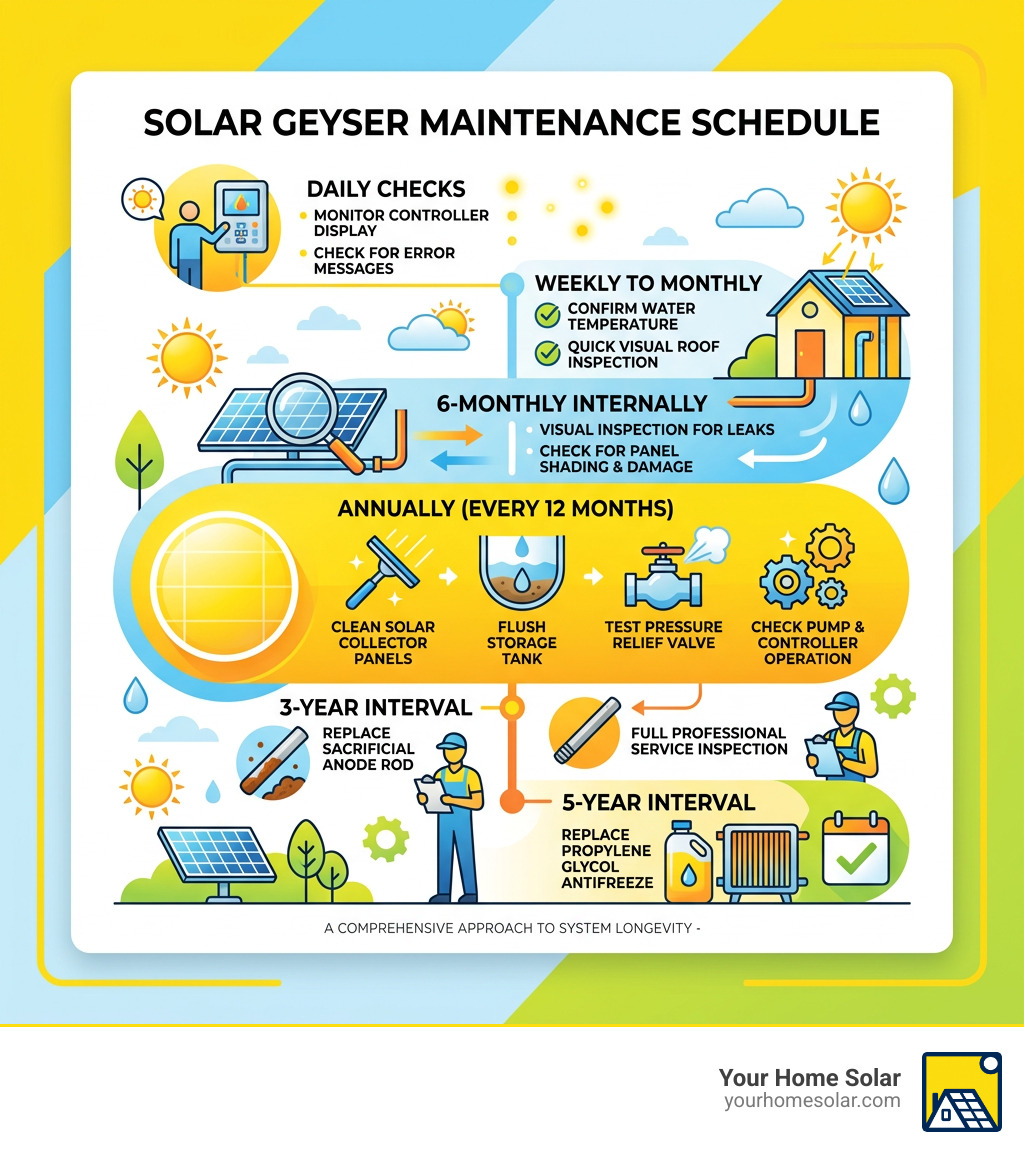
| Task | How Often |
|---|---|
| Visual inspection (leaks, shading, damage) | Every 6 months |
| Clean solar collector panels | At least once a year |
| Flush storage tank to remove sediment | Annually |
| Test pressure relief valve | Annually |
| Check pump and controller operation | Annually |
| Replace sacrificial anode rod | Every 3-5 years |
| Replace propylene glycol antifreeze | Every 3-5 years |
| Full professional service | Every 3 years |
You’ve invested good money in a solar water heating system to cut energy bills and gain some independence from the grid. But without routine care, that investment quietly loses value.
Scale buildup alone can cut system efficiency by 5 to 20% every year. Pumps and sensors that go unchecked tend to fail within 5 to 7 years. And systems that skip maintenance rarely make it past the 10-year mark — while well-maintained ones routinely last 20 to 30+ years.
The good news? Most solar geyser maintenance tasks are simple, low-cost, and easy to stay on top of once you know what to look for.
I’m Ernie Bussell, founder of Your Home Solar and a solar energy contractor with hands-on experience building and maintaining systems across East Tennessee — solar geyser maintenance included. In this guide, I’ll walk you through everything you need to keep your system running at peak performance, season after season.
Essential Solar Geyser Maintenance Checklist
When we talk about keeping your hot water flowing, we aren’t just talking about the tank in your utility room. A solar geyser system is a loop that connects your roof to your faucets. In places like Knoxville or Maryville, where we experience a full range of seasons, staying proactive is the difference between a free hot shower and an expensive emergency repair.
Visual Inspections and Leak Detection
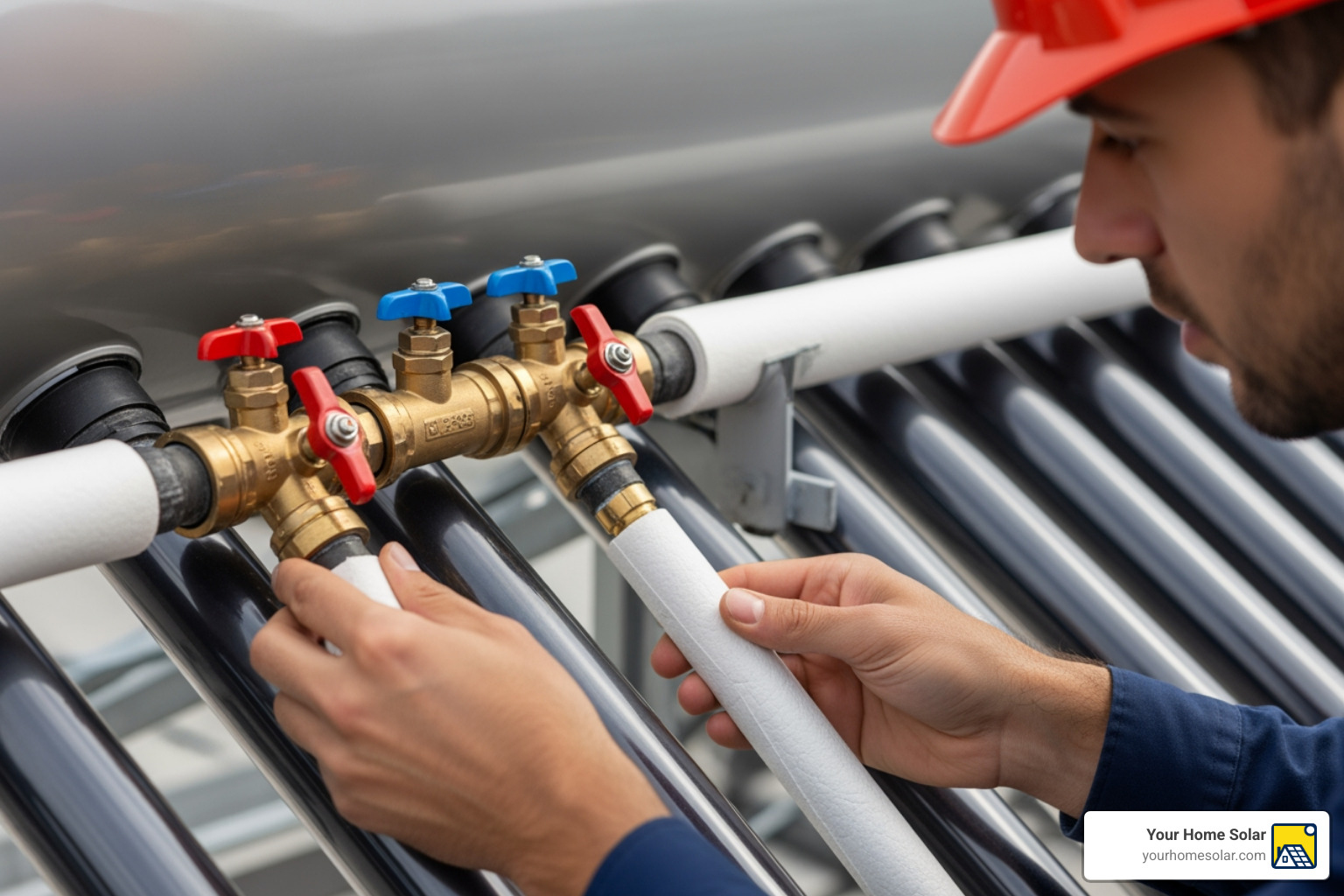
At least twice a year, we recommend a “walk-around” inspection. You don’t always need a ladder for this; a good pair of binoculars can help you spot issues from the ground. Look for:
- Cracks or chips: Check the glass on your flat-plate collectors or the vacuum seals on evacuated tubes.
- Fluid leaks: Look for “white strips” (mineral tracks) or damp insulation around pipe joints.
- Pipe insulation: In the Tennessee sun, foam insulation can degrade. If you see bare copper or plastic, it’s time to re-wrap it.
According to the Solar Water Heating System Maintenance and Repair | Department of Energy, regular checks of the support structure and roof penetrations are vital to prevent long-term structural damage. For more localized advice, you can explore our more info about residential solar maintenance to see how we handle these systems here in East Tennessee.
Maintenance Task Comparison Table
| Frequency | Task | Purpose |
|---|---|---|
| Daily/Weekly | Check Controller | Ensure no “Error” lights are flashing and pump is running during sun hours. |
| Monthly | Monitor Temp | Check if water is reaching expected temperatures on sunny days. |
| Bi-Annually | Visual Check | Look for shading from new growth or leaks in exposed piping. |
| Annually | Deep Clean & Flush | Clean panels, flush the tank, and test the Pressure Relief Valve (PRV). |
| 3-5 Years | Major Service | Replace the sacrificial anode and refresh heat transfer fluids (glycol). |
Safe Cleaning Practices for Solar Geyser Maintenance
Living in areas like Sevierville or Johnson City means dealing with pollen in the spring and fallen leaves in the autumn. If your panels are covered in dust or debris, they can’t “catch” the sun.
To clean your collectors safely:
- Time it right: Only clean panels in the early morning or late evening. Cold water on a “boiling” hot glass panel can cause it to shatter.
- Use the right tools: Use a soft-bristle brush and a telescopic rod. Avoid abrasive pads that can scratch the glass.
- Mild detergents: A delicate, non-abrasive detergent or a specialized solar cleaning solution works best. If you have hard water, choosing a detergent with a descaling agent prevents streaks.
- Safety first: If your roof is steep or high, don’t risk a fall. Professional solar panel maintenance in Knoxville is often safer and more thorough.
Managing Shade and Debris
A solar geyser is only as good as the sunlight it receives. We often see systems that worked perfectly five years ago but now struggle because a nearby oak tree has grown three feet.
Check your panels for shading at mid-morning, noon, and mid-afternoon. Even a small “neighborhood shadow” from a new chimney or a growing tree can drop performance significantly. After heavy Tennessee storms, always check for branches or debris that might have landed on the collectors. Managing these small factors is a key part of how to maintain and extend the lifespan of your home solar panels.
Protecting the System from Scaling and Corrosion
In many parts of East Tennessee, “hard water” is a common household headache. In a solar geyser, hard water leads to “scaling”—the buildup of calcium and magnesium deposits inside your pipes and tank.
When scale builds up, it acts like insulation inside your pipes, preventing the heat from the sun from reaching your water. This forces your backup heating element to work harder, driving up your electric bill. To fix this, professionals often circulate a mild acidic de-scaling solution through the collector loop every 3 to 5 years.
The Role of the Sacrificial Anode
Most solar geysers use a steel storage tank. To prevent the water from eating through the steel, manufacturers include a “sacrificial anode.” This is usually a magnesium or aluminum rod that hangs inside the tank.
The water attacks the anode rod instead of the tank walls. Over time, the rod dissolves. If you don’t replace it (usually every 3 to 5 years), the water will start corroding the tank itself, leading to a very expensive leak. This is one of the most critical easy maintenance for residential solar systems in East Tennessee because a $50 rod can save a $2,000 tank.
Flushing the Storage Tank and Collectors
Sediment—tiny bits of sand, rust, and minerals—settles at the bottom of your tank over time. This sediment can bury your backup heating element or clog your valves.
Once a year, we recommend “flushing” the tank. This involves opening the drain valve at the bottom of the tank and letting the water run until it comes out clear. This simple act of solar energy maintenance 101 keeps the system’s “veins” clear and ensures your water stays clean and hot.
Winterization and Advanced Troubleshooting
While we enjoy plenty of sun in Tennessee, our winters can get bitey. Protecting your system from freezing is the most important part of solar geyser maintenance for anyone living in higher elevations like Greeneville or Oak Ridge.
Freeze Protection and Propylene Glycol
Most active solar systems in our region use an “indirect” loop. This means a special fluid (usually propylene glycol) circulates through the panels, picks up heat, and transfers it to your water via a heat exchanger.
- Antifreeze Levels: Propylene glycol degrades over time. You should have the pH and freeze-protection levels tested every few years. If the fluid turns acidic, it can eat through your copper pipes.
- Drainback Systems: Some systems are designed to “drain back” into a reservoir whenever the pump stops. For these to work, every foot of piping must have a minimum slope of 0.25 inches. If a pipe sags, water gets trapped, freezes, and bursts the pipe.
Troubleshooting Performance Drops
If you notice you’re running out of hot water faster than usual, don’t panic. Check these common culprits:
- The “No Hot Water” Mystery: First, check your controller. Is the pump running? If you hear a humming sound but no water is moving, the starting capacitor in the pump might have failed. This is a cheap fix compared to replacing the whole pump.
- Overheating: In the height of a Tennessee summer, systems can actually get too hot. If your pressure relief valve is constantly dripping, your system might be “stagnating.” An expansion tank or a specialized cooling function on your controller can help manage this.
- Sensor Failure: Solar systems use two sensors—one on the roof and one in the tank. If one falls off its mounting or the wire is chewed by a squirrel, the system won’t know when to turn the pump on.
Maintaining Active System Components
Active systems (those with pumps) require a bit more love than passive (gravity-fed) systems.
- Circulation Pumps: These usually last 5-7 years. Listen for unusual grinding noises.
- Controllers: Modern controllers like those from SolarEdge or Enphase (often used for PV but applicable in concept) provide data. If your solar geyser controller is blank, check the fuse or the power supply.
- Pressure Relief Valves: Once a year, quickly lift the lever on the valve to make sure water flows out and the valve snaps shut. This ensures the valve isn’t “frozen” shut by scale.
Frequently Asked Questions about Solar Geyser Maintenance
How often should my solar geyser be professionally inspected?
We recommend a professional “health check” every 3 years. While you can handle the cleaning and visual checks, a pro has the tools to check glycol pH, test sensor resistance, and inspect the sacrificial anode rod without making a mess.
What are the signs that my solar geyser has a leak or scale buildup?
Look for “white tracks” on your roof or down the side of your tank—this is dried mineral residue from a slow leak. For scale buildup, the main sign is a slow decline in water temperature over several months, even on perfectly sunny days.
Can I use automotive antifreeze in my solar heating loop?
Absolutely not. You must only use food-grade propylene glycol. Automotive antifreeze is toxic. Since there is always a small risk of a leak in the heat exchanger, using toxic chemicals could contaminate your home’s drinking and bathing water.
Conclusion
Investing in a solar geyser is one of the smartest ways for Tennessee homeowners to achieve energy independence. Whether you’re in Knoxville, Kingsport, or anywhere in between, a little bit of solar geyser maintenance goes a long way. By keeping your panels clean, your tank flushed, and your anode rod fresh, you ensure that your system pays for itself many times over.
At Your Home Solar, we’re committed to helping our neighbors across East Tennessee get the most out of their renewable energy investments. From Morristown to Farragut, our goal is 100% customer satisfaction through reliable, expert service.
If you’re unsure about the state of your system or just want the peace of mind that comes with a professional eye, don’t hesitate to reach out. You can schedule your solar panel maintenance in Knoxville or any of our surrounding service areas today. Let’s keep that water hot and those energy bills low!