Is Leasing Solar Panels Worth the Cost? Here’s What You Need to Know First
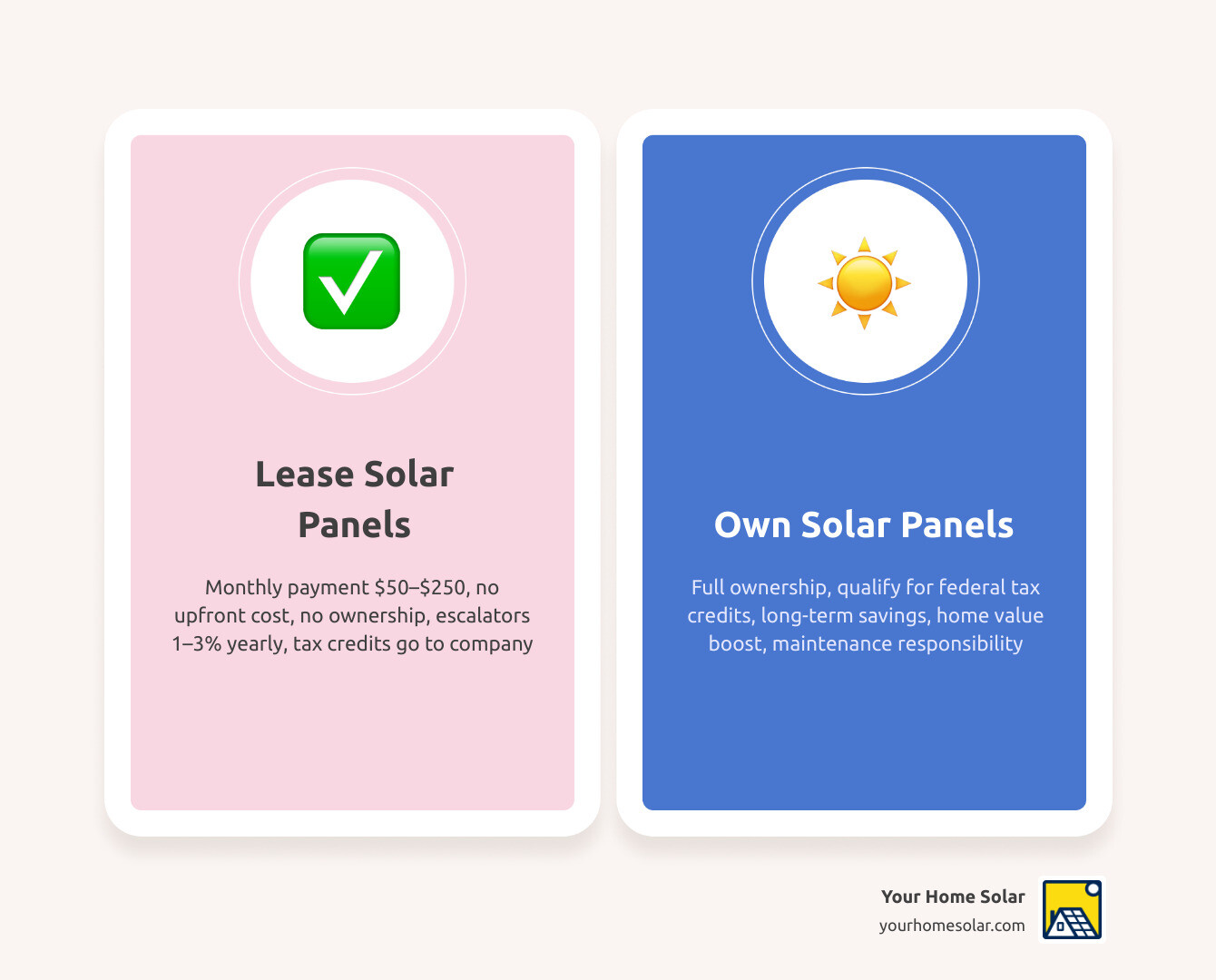
The cost of leasing solar panels typically falls between $50 and $250 per month, depending on your system size, location, and contract terms. Here’s a quick snapshot:
| Factor | Typical Range |
|---|---|
| Monthly lease payment | $50 – $250/month |
| Lease term length | 15 – 25 years |
| Annual payment escalator | 1% – 3% per year |
| Upfront cost | $0 (most contracts) |
| Monthly savings vs. utility bill | 10% – 30% |
| Tax credits for homeowner | None (goes to leasing company) |
So leasing can lower your monthly energy costs right away — with no money down. But the full picture is more complicated than that.
Electricity rates across the U.S. have climbed roughly 34% between 2021 and 2025. That’s pushed a lot of homeowners to look at solar — and leasing sounds like an easy answer. No big upfront check. No maintenance headaches. Just a lower monthly bill.
But here’s the catch: a lease is not ownership. The solar company owns the panels on your roof. That changes everything — from your tax benefits, to what happens when you try to sell your home, to how much you actually save over 20+ years.
This guide walks you through exactly what you’re agreeing to before you sign anything.
I’m Ernie Bussell, founder and CEO of Your Home Solar, East Tennessee’s #1 solar contractor — and before building this company, I spent years in solar operations overseeing a $40 million annual installation business, which means I’ve seen every angle of the cost of leasing solar panels debate from the inside. I want to give you the straight facts so you can make the right call for your home and your budget.
Cost of leasing solar panels terms to know:
Understanding the Monthly Cost of Leasing Solar Panels

When we talk about the cost of leasing solar panels, we’re usually talking about a monthly rent payment. In a solar lease, a third-party company installs the panels on your roof, but they retain ownership of the equipment. You simply pay them a fixed monthly fee to use the electricity those panels generate.
For most homeowners in East Tennessee, from Knoxville to Johnson City, these monthly payments fall into a range of $50 to $250. According to the Average Cost to Lease Solar Panels: A Comprehensive Guide for American Homeowners 2026, the most common sweet spot is between $75 and $200.
The goal of a lease is to provide “day one” savings. If your current utility bill is $200, a solar company might offer a lease for $150. Even with a small remaining utility connection fee, you’re coming out ahead. This makes it a popular payment option for going solar without breaking the bank.
However, you have to look at the “all-in” cost. While a lease often requires $0 down, some companies offer “prepaid” leases or contracts with a small down payment ($1,000 to $3,000) to lower those monthly installments. Over a 25-year term, a $150 monthly payment adds up to $45,000. When you realize a 7 kW system might only cost $20,000 to $28,000 to buy outright, you start to see why the “convenience” of leasing comes with a significant markup.
Factors Influencing the Cost of Leasing Solar Panels
Not every roof is created equal, and neither is every lease. Several factors will dictate where you land on that $50–$250 spectrum:
- System Capacity: A 10 kW system requires more hardware and generates more power than a 4 kW system, naturally leading to a higher monthly payment.
- Household kWh Usage: Companies look at your past 12 months of energy use to size the system. If you’re running the AC non-stop in Sevierville all summer, you’ll need a larger array.
- Credit Requirements: Most leasing companies require a minimum FICO score of 650. If your credit is on the edge, you might face higher rates or be denied the “zero-down” promotional offers.
- Local Electricity Rates: Leasing companies often peg their prices to what the local utility is charging. As noted in ConsumerAffairs’ guide on solar lease costs, if utility rates are high in your area, the lease payment might be higher, though still designed to save you 10% to 30% compared to the grid.
The Impact of Annual Escalators on Your Long-Term Cost of Leasing Solar Panels
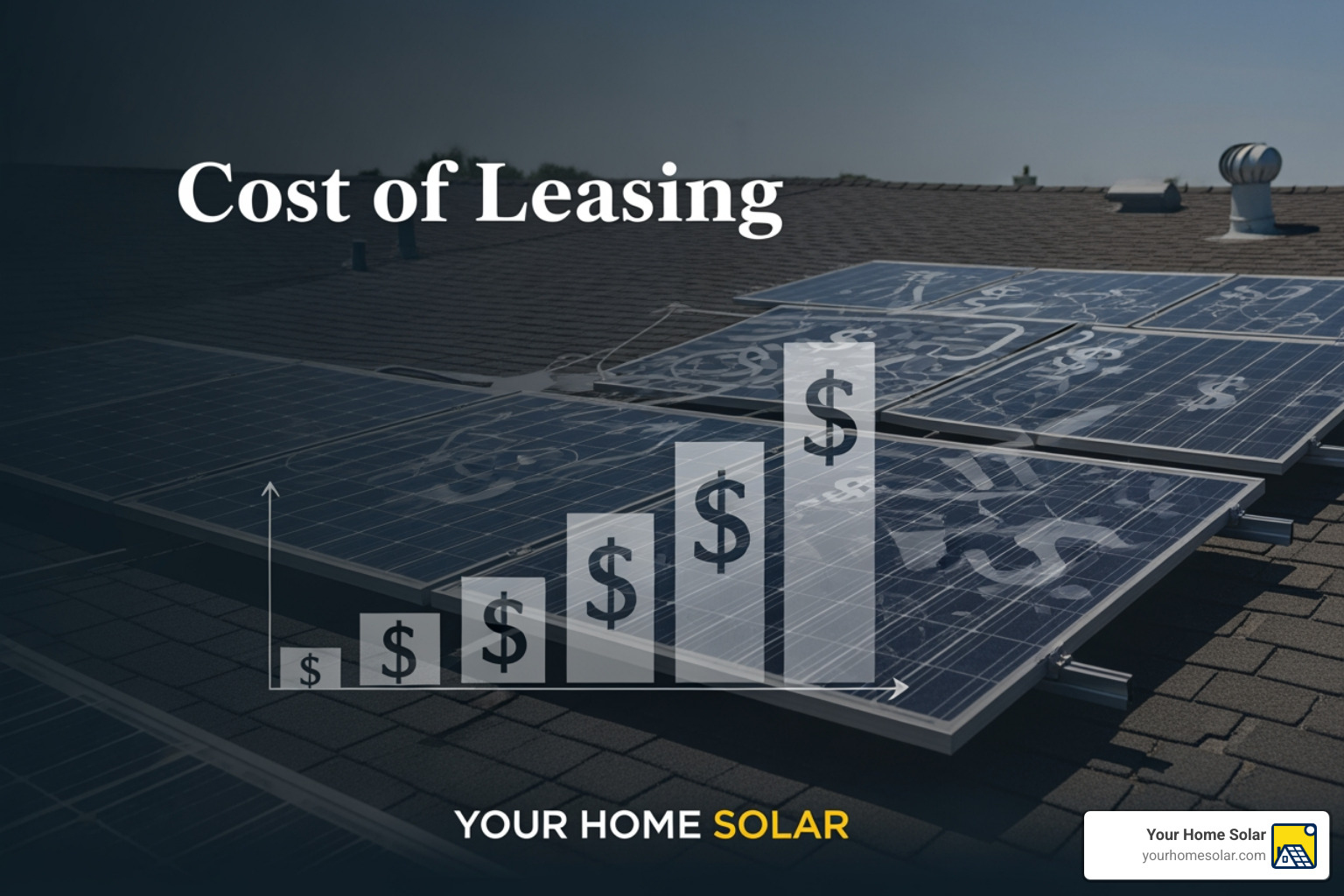
This is the part of the contract that often hides in the fine print: the escalator clause. Many solar leases aren’t a flat rate for 25 years. Instead, they include an annual increase, typically between 1% and 3.5%.
At first, a 2.9% increase doesn’t sound scary. But over 20 years, that $150 payment grows significantly. For example, a 12-cent per kWh rate can balloon to over 18 cents by the end of the term.
The logic used by sales teams is that utility rates will rise even faster (historically 5% to 9% annually since 2021), making the lease a “hedge” against inflation. However, if utility rates stabilize or rise more slowly than your escalator, your savings could evaporate. We always tell our neighbors in Morristown and Kingsport to unpack these solar costs carefully before signing a 25-year commitment.
Solar Lease vs. Power Purchase Agreement (PPA)
While people often use the terms interchangeably, a lease and a PPA are different financial animals.
| Feature | Solar Lease | Power Purchase Agreement (PPA) |
|---|---|---|
| Payment Basis | Fixed monthly “rent” | Price per kilowatt-hour (kWh) produced |
| Predictability | High (you know exactly what you pay) | Variable (depends on sun/season) |
| Maintenance | Included by owner | Included by owner |
| Ownership | Third-party | Third-party |
| Performance Guarantee | Usually included | Usually included |
In a Solar Lease, you pay for the equipment. If it’s a cloudy month in Oak Ridge and the panels produce less, you still pay the same monthly rent.
In a PPA, you pay for the power. You agree to buy the electricity the panels produce at a set rate (e.g., $0.15 per kWh). If the sun doesn’t shine, you don’t pay as much. This shifts the “production risk” to the solar company, but it makes your monthly budgeting a bit more like a traditional utility bill.
Both options generally include maintenance and monitoring, which is a big draw for those who don’t want to worry about repairs. You can learn more about the mechanics of how these third-party arrangements work to see which fits your risk tolerance.
The Financial Trade-offs: Incentives and Home Value
This is where the cost of leasing solar panels starts to look a bit more expensive. When you lease, you are effectively handing over the most valuable financial benefits of solar to a corporation.
The Federal Solar Tax Credit (ITC) is a massive incentive. In 2026, the 48E Clean Electricity Investment Credit allows for a 30% credit on the cost of the system. On a $25,000 system, that’s $7,500 back in your pocket. But when you lease, the leasing company claims that credit, not you. They might pass some of that value to you via a lower monthly payment, but you lose the direct tax break. We’ve written extensively about how to harness the sun and save on taxes, and it’s a key reason we often recommend ownership.
Then there’s the issue of home value. Studies show that owned solar systems can increase a home’s resale value by an average of $15,000 or roughly 4.1% to 6.9%. A leased system does not add this value because it is a liability (a monthly bill) rather than an asset. In fact, it can sometimes make a home harder to sell. For a deep dive into local benefits, check out our Tennessee 2026 Solar Incentives Guide.
Selling a Home with Leased Panels
Selling a home in Farragut or Maryville with a leased system requires jumping through a few hoops:
- Lease Transfer: The new buyer must agree to take over the lease and, in many cases, pass a credit check from the solar company.
- Buyer Reluctance: Some buyers simply don’t want to step into a 20-year contract they didn’t sign. We’ve seen cases where sellers had to pay $20,000+ to buy out the lease just to close the sale.
- Disclosure: You must be upfront about the lease early in the process to avoid deals falling through at the last minute.
It’s vital to avoid getting burned by residential incentives that sound good on paper but complicate your life later.
Is Leasing Right for You in 2026?
Leasing isn’t “bad”—it’s just a specific tool for a specific situation. Here is how we help our clients in East Tennessee decide:
Leasing might be for you if:
- You have little to no taxable income (and therefore can’t use the federal tax credit).
- You don’t have the cash for a down payment and don’t qualify for a solar loan.
- You want a “hands-off” experience where someone else handles every repair and cleaning.
- You want immediate, guaranteed savings on your monthly cash flow today.
Ownership (Cash or Loan) is likely better if:
- You want the highest possible return on investment (ROI).
- You want to increase your home’s equity and resale value.
- You want to take advantage of the 30% federal tax credit.
- You plan on staying in your home for more than 7–10 years (the typical “break-even” point for owned systems).
For many, the real price of never losing power again involves owning the system and pairing it with a battery backup, something that is often more complicated or expensive within a lease structure.
Frequently Asked Questions about Solar Leasing
What happens at the end of a solar lease term?
Most leases in Tennessee last 20 to 25 years. When the clock runs out, you generally have three choices:
- Renew: Sign a new agreement (often at a lower rate) to keep the system.
- Purchase: Buy the system at “Fair Market Value.” Be careful here—some contracts define this in a way that makes a 25-year-old system surprisingly expensive.
- Removal: The company comes and takes the panels off your roof. Usually, they are required to leave the roof in good condition, but you should verify this in your specific contract.
Do I qualify for the federal solar tax credit if I lease?
No. Because the leasing company owns the hardware, they are the ones who file for the credit. This is a common point of confusion. If you want that 30% credit to lower your personal tax bill, you must own the system. We’ve helped many folks in Tennessee save big with local incentives, but the federal ITC is strictly for owners.
What are the red flags in a solar lease contract?
Keep an eye out for these “shady” tactics:
- High Escalators: Anything over 3% is aggressive and might eventually cost you more than the grid.
- Maintenance Exclusions: The contract should cover everything—inverters, panels, and wiring. If they charge for “service calls,” it defeats the purpose of leasing.
- Transfer Restrictions: If the process to move the lease to a new homeowner is overly complex or expensive, it’s a red flag.
- Hidden Fees: Watch for “administrative” or “filing” fees that pop up at the end of the signing process.
Conclusion
At Your Home Solar, we believe in transparency. We love seeing our community in East Tennessee—from the hills of Blount County to the streets of Knoxville—take control of their energy future. Whether the cost of leasing solar panels makes sense for you or you’d rather own your power outright, we’re here to help you navigate the math.
Leasing offers a low-barrier entry to clean energy, but ownership offers the greatest long-term wealth. Our mission is to provide tailored, reliable, and rewarding installations that leave you 100% satisfied.
Ready to see which option puts the most money back in your pocket? Start your journey with residential solar today and let us build a solution that fits your home perfectly.