

What Does It Actually Cost to Install a Level 2 EV Charger in 2026?
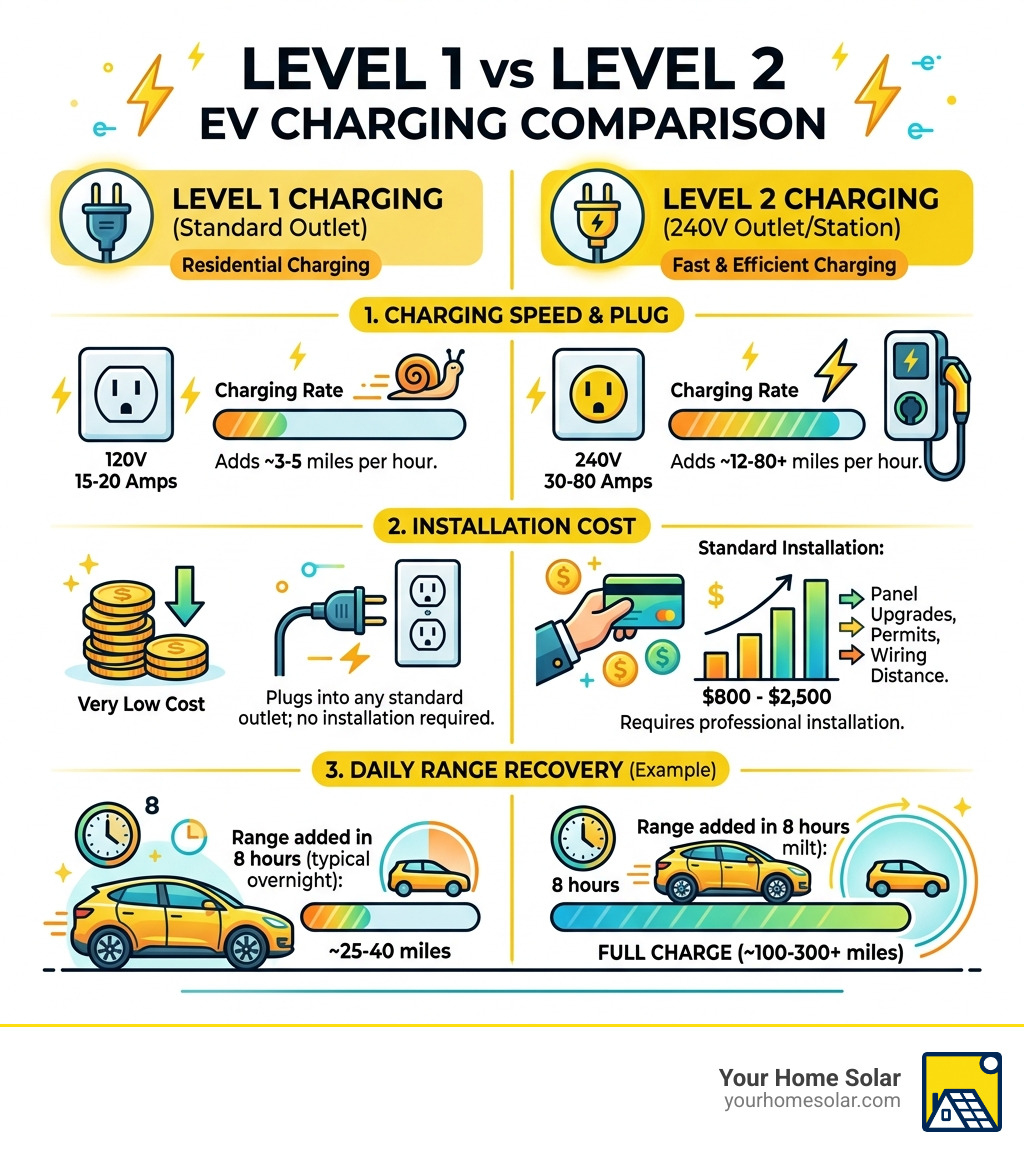
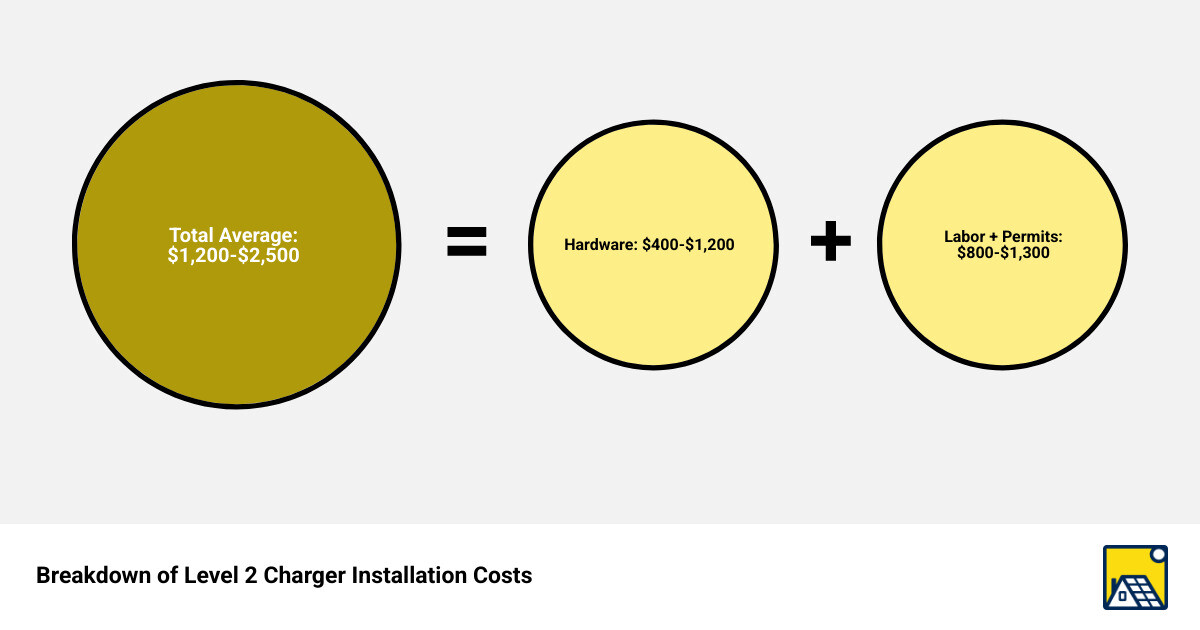
The cost of installing level 2 charger equipment in a typical home falls between $800 and $2,500, with most homeowners landing around $1,200 to $1,700 for a standard setup.
Here’s a quick snapshot of what to expect:
| Cost Component | Typical Range |
|---|---|
| Charger hardware | $400 – $1,200 |
| Electrician labor & wiring | $400 – $1,500 |
| Permits & inspections | $50 – $300 |
| Total (standard install) | $800 – $2,500 |
| Panel upgrade (if needed) | Add $500 – $5,000+ |
These numbers cover most single-family homes with a garage close to the electrical panel. More complex jobs — like detached garages, long wiring runs, or older panels — can push costs higher.
That wide range is exactly why so many EV owners feel confused when they start getting quotes. One installer says $900. Another says $3,500. Both can be right, depending on your home’s specific setup.
The good news? Once you understand what drives the price, the numbers start to make sense — and you can take real steps to keep costs down.
I’m Ernie Bussell, founder and CEO of Your Home Solar, East Tennessee’s #1 solar energy contractor, and my background in home energy systems gives me a clear-eyed perspective on the true cost of installing level 2 charger equipment — including the hidden variables most homeowners don’t see coming. Let’s walk through everything you need to know so you can budget with confidence.
Common cost of installing level 2 charger vocab:
- 240 volt charging station installation
- Trusted EV charger installer
- Residential EV charging solutions
Breaking Down the Total Cost of Installing Level 2 Charger
When we talk about the cost of installing level 2 charger units, we aren’t just looking at one price tag. It is a puzzle made of hardware, labor, and administrative fees. In May 2026, the market has stabilized somewhat, but labor and materials remain the primary drivers.

For a standard installation in East Tennessee—meaning your electrical panel is in the garage and has room for a new circuit—you can expect to pay between $1,200 and $2,500 all-in. However, “standard” is a relative term. If your home was built in the 1970s and still has a 100-amp panel, your journey will look different than someone with a modern 200-amp service.
| Scenario | Estimated Total Cost | Why the difference? |
|---|---|---|
| Simple | $800 – $1,400 | Panel in garage, 240V circuit exists or is a short run. |
| Standard | $1,500 – $2,500 | New 50A circuit, 25-foot wire run, minor drywall work. |
| Complex | $3,000 – $7,000+ | Panel upgrade required, trenching to detached garage. |
According to the Level 2 EV Charging: Complete Cost & Installation Guide, the physical distance of the “run” (the wiring between the panel and the charger) is often the biggest variable. Every foot of heavy-gauge copper adds up.
Average cost of installing level 2 charger hardware
The charger itself—technically called Electric Vehicle Supply Equipment (EVSE)—usually costs between $400 and $1,200. In 2026, the NACS (North American Charging Standard) has become the norm, so most units you buy today will be compatible with almost every new EV on the road without needing clunky adapters.
- Basic Units ($400 – $600): These are “dumb” chargers. You plug them in, and they charge. They are reliable and perfect if you don’t care about tracking energy usage via an app.
- Smart Units ($700 – $1,200): These connect to your Wi-Fi. They allow you to schedule charging for the middle of the night when electricity rates are lowest and provide detailed reports on how much “fuel” you’re using.
Regardless of the “bells and whistles,” we always recommend choosing UL-listed equipment. This ensures the device has been third-party tested for safety, which is non-negotiable when you’re pulling 40 to 50 amps of power for hours on end. For a deeper dive into these hardware options, check out our more info about 240V charging costs.
Labor, permits, and inspection fees
You might be tempted to skip the permit to save a few hundred bucks, but in our experience, that’s a recipe for disaster. Permits typically cost between $50 and $300 in areas like Knoxville or Sevierville.
Why pay for a permit?
- Safety: An inspector verifies the work meets the National Electrical Code.
- Insurance: If an unpermitted electrical installation causes a fire, your insurance company may deny the claim.
- Resale: When you sell your home, unpermitted work can hold up the closing.
Labor rates for licensed electricians in East Tennessee generally range from $75 to $125 per hour. A straightforward install takes about 3 to 6 hours, while complex jobs can take a full day or more. Choosing a Trusted EV charger installer ensures the job is done right the first time, preventing “nuisance tripping” or melted outlets down the road.
Key Factors That Impact Your Installation Quote
Every home is a unique snowflake, and your electrician’s quote will reflect that. The physical layout of your property is usually more important than the brand of charger you buy.
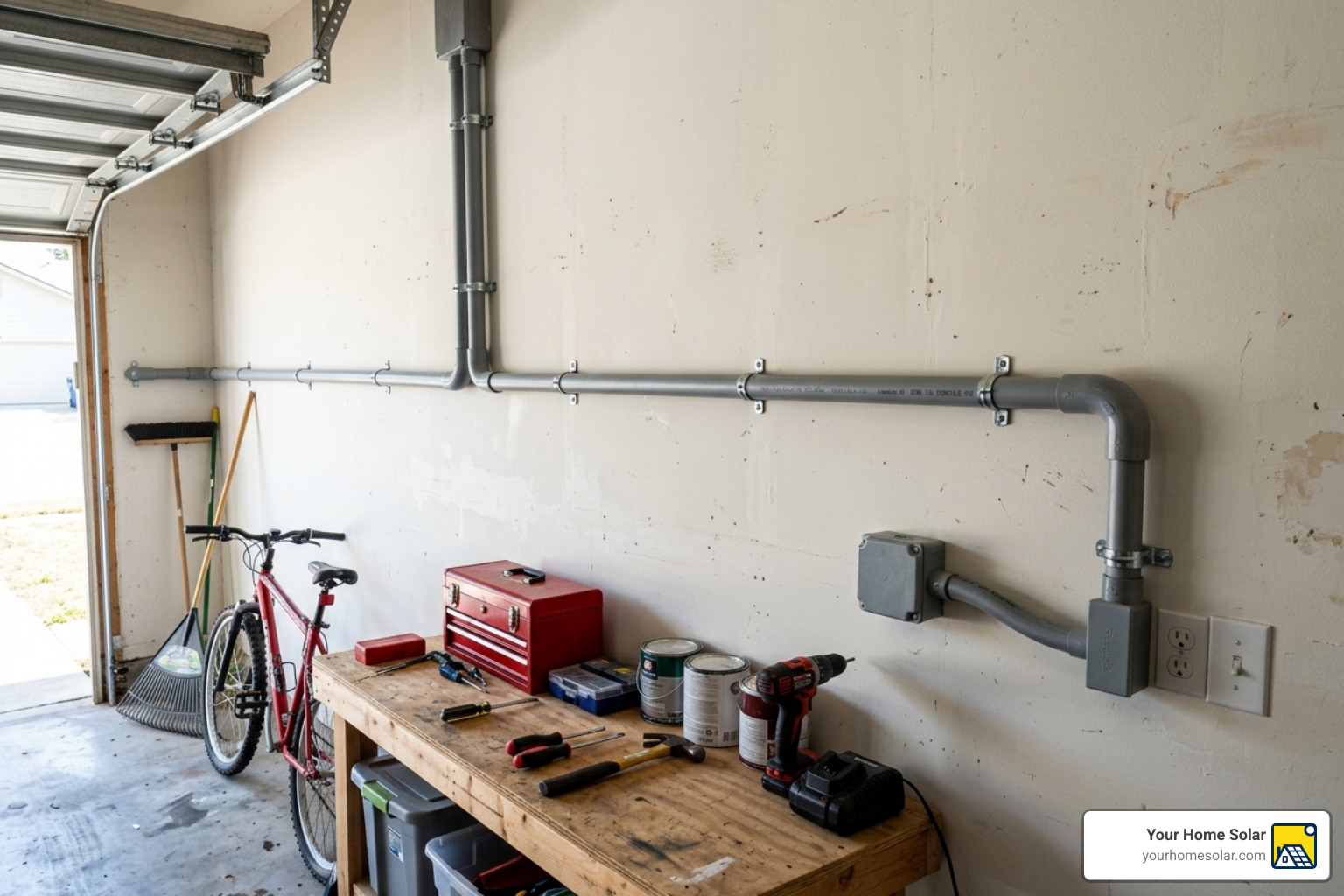
The “run” is the distance between your breaker box and the charging port. Copper wire prices have been volatile, and for a Level 2 charger, you need thick, 6-gauge or 4-gauge wire. According to Qmerit, runs exceeding 25 feet can add $10 to $20 per linear foot in materials and labor.
Hardwired vs. plug-in cost of installing level 2 charger
You have two main choices for how the charger connects to your home:
- Plug-In (NEMA 14-50): This involves installing a heavy-duty 240V outlet (like a dryer outlet). You then plug your charger into it. This offers flexibility; if the charger breaks, you just unplug it and buy a new one. However, modern codes often require expensive GFCI breakers for outlets, which can sometimes “nuisantly trip” with EV chargers.
- Hardwired: The charger is wired directly into a junction box. This is generally considered the “gold standard” for reliability and weatherproofing. It also allows for higher charging speeds (up to 48A or 50A), whereas most plug-in setups are capped at 40A.
Many homeowners find that hardwiring is actually the “less drama” choice because it avoids the compatibility issues between GFCI breakers and the charger’s internal safety checks. You can read more on this in our guide: Diy Or Pro Your 240V Ev Charger Installation Questions Answered.
Indoor vs. outdoor and detached garage variables
Installing a charger inside a garage is the most cost-effective path. If you need to mount the unit on an exterior wall or in a driveway, you’ll need weather-rated conduit and potentially a more expensive outdoor-rated charging station.
The real “quote-killer” is the detached garage. If we have to run power from your house to a separate building, we usually have to dig a trench. Trenching costs can range from $300 to $2,000+ depending on whether we are digging through soft East Tennessee red clay or cutting through a concrete driveway. For more technical details on these layouts, see our deep dive into EV charger wiring schematics.
Hidden Infrastructure Expenses: Panel Upgrades and Load Management
This is the part of the quote that catches people off guard. Your home’s electrical panel is like a highway; it can only handle so many cars (amps) at once.
If your panel is already full—meaning you have an electric range, clothes dryer, HVAC, and a hot tub—adding a 50-amp EV circuit might exceed your home’s total capacity. A full panel upgrade (moving from 100-amp to 200-amp service) typically costs between $1,500 and $5,000.
Certain older panel brands, such as Federal Pacific or Zinsco, are also considered fire hazards by modern standards. If an electrician sees one of these, they will likely insist on a replacement before they’ll touch the EV installation.
Avoiding a full service upgrade
If you’re staring at a $5,000 quote for a panel upgrade, don’t panic. Technology has caught up. We often use Load Management Systems or “smart” circuit breakers. These devices monitor your home’s total power draw. If you turn on the oven and the dryer at the same time, the system will temporarily throttle back the EV charger to ensure you don’t blow your main breaker.
As noted by SimpleSwitch, these energy management systems can save you thousands by bypassing the need for a utility-side service upgrade. This is a key part of future-proofing your garage.
Maximizing Savings with Incentives and Rebates
While the upfront cost of installing level 2 charger equipment can be high, there are several ways to claw that money back.
- Federal 30C Tax Credit: This is the big one. Through June 30, 2026, homeowners in eligible census tracts (which cover much of East Tennessee) can claim a tax credit of 30% of the total project cost, up to $1,000. This includes both the hardware and the labor. If you spend $2,000 on your install, Uncle Sam could give you $600 back at tax time.
- Local Utility Programs: Companies like the Tennessee Valley Authority (TVA) and local providers like KUB or LCUB often offer their own incentives. These can range from direct rebates on the charger to “Time-of-Use” (TOU) rates.
By switching to a TOU plan, you might pay significantly less for electricity between 11 PM and 6 AM. Over a year of driving, these savings can completely offset the cost of the installation. Check out The Ultimate Guide To Home Ev Charging for a full list of current incentives.
Frequently Asked Questions About Level 2 Charging
How long does the full installation process typically take?
The physical labor usually takes 4 to 8 hours. However, the “process” is longer. You should budget 2 to 4 weeks from the time you sign a contract to the time you are actually plugging in. This buffer accounts for site visits, pulling local permits in counties like Knox or Blount, and scheduling the final inspection.
Is a Level 2 charger worth the investment compared to Level 1?
Absolutely. Research shows that 87% of BEV owners who try to survive on Level 1 charging (the standard wall outlet) upgrade to Level 2 within six months. Level 2 is 5 to 7 times faster. While a Level 1 outlet adds about 3-5 miles of range per hour, a Level 2 station adds 25-40 miles. This means you can fully recover your daily commute in just a few hours rather than waiting all weekend. It’s about more than speed; it’s about the peace of mind knowing your car is always ready. Learn more about residential EV charging services.
Can I install a Level 2 charger myself to save money?
We strongly advise against it. Level 2 charging requires a 240V circuit, which carries enough current to be lethal if mishandled. Beyond the immediate risk of electrocution, improper wiring is a major fire hazard. Furthermore, most manufacturer warranties and home insurance policies require professional installation by a licensed electrician. Saving $500 on labor isn’t worth risking your home or your car’s sophisticated electronics.
Conclusion
The cost of installing level 2 charger equipment is an investment in your home’s value and your daily convenience. While the $800 to $2,500 price range can seem daunting, the long-term savings compared to gasoline—and the sheer joy of never visiting a gas station again—make it one of the smartest upgrades an EV owner can make.
At Your Home Solar, we specialize in making this transition seamless for homeowners across East Tennessee. Whether you’re in Knoxville, Maryville, or Johnson City, we bring the expertise needed to handle everything from simple garage installs to complex panel upgrades and solar integrations. We pride ourselves on 100% customer satisfaction and tailored solutions that fit your specific budget and vehicle needs.
Ready to stop “trickle charging” and start living the EV life to the fullest? Schedule your professional EV charger installation in Knoxville today and let us take the mystery out of your home energy setup.