
When the Grid Goes Down, Emergency Solar Power Keeps You Running
Emergency solar power gives homeowners a clean, silent, and fuel-free way to keep essential appliances running during outages — no gas cans, no fumes, no noise complaints from neighbors.
Here is a quick overview of what you need to know:
| Question | Quick Answer |
|---|---|
| What is it? | Solar panels + battery storage that power your home when the grid fails |
| How long can it last? | Hours to days, depending on battery capacity and your energy use |
| Can it run a fridge? | Yes — a 5,000Wh+ system can run a standard fridge for roughly 24 hours |
| Is it safe indoors? | Yes — no carbon monoxide, no fumes, quiet operation |
| How does it recharge? | From the sun, a wall outlet, or both at the same time |
| Who needs it most? | Homeowners, medical device users, elderly residents, remote workers |
Power outages are no longer rare events. Severe storms, wildfires, and aging grid infrastructure have made them a real and growing risk — especially in areas like East Tennessee, where mountain weather can turn fast and hard.
The difference between a scary outage and a manageable one often comes down to one thing: preparation.
I’m Ernie Bussell, founder and CEO of Your Home Solar, and after years working in solar operations and installation — including helping homeowners across East Tennessee design emergency solar power systems that actually perform when it matters — I’ve seen what separates a system that holds up from one that falls short. In the sections below, I’ll walk you through everything you need to make a confident, informed decision.
Quick Emergency solar power definitions:
Understanding Emergency Solar Power: Solar vs. Gas Generators
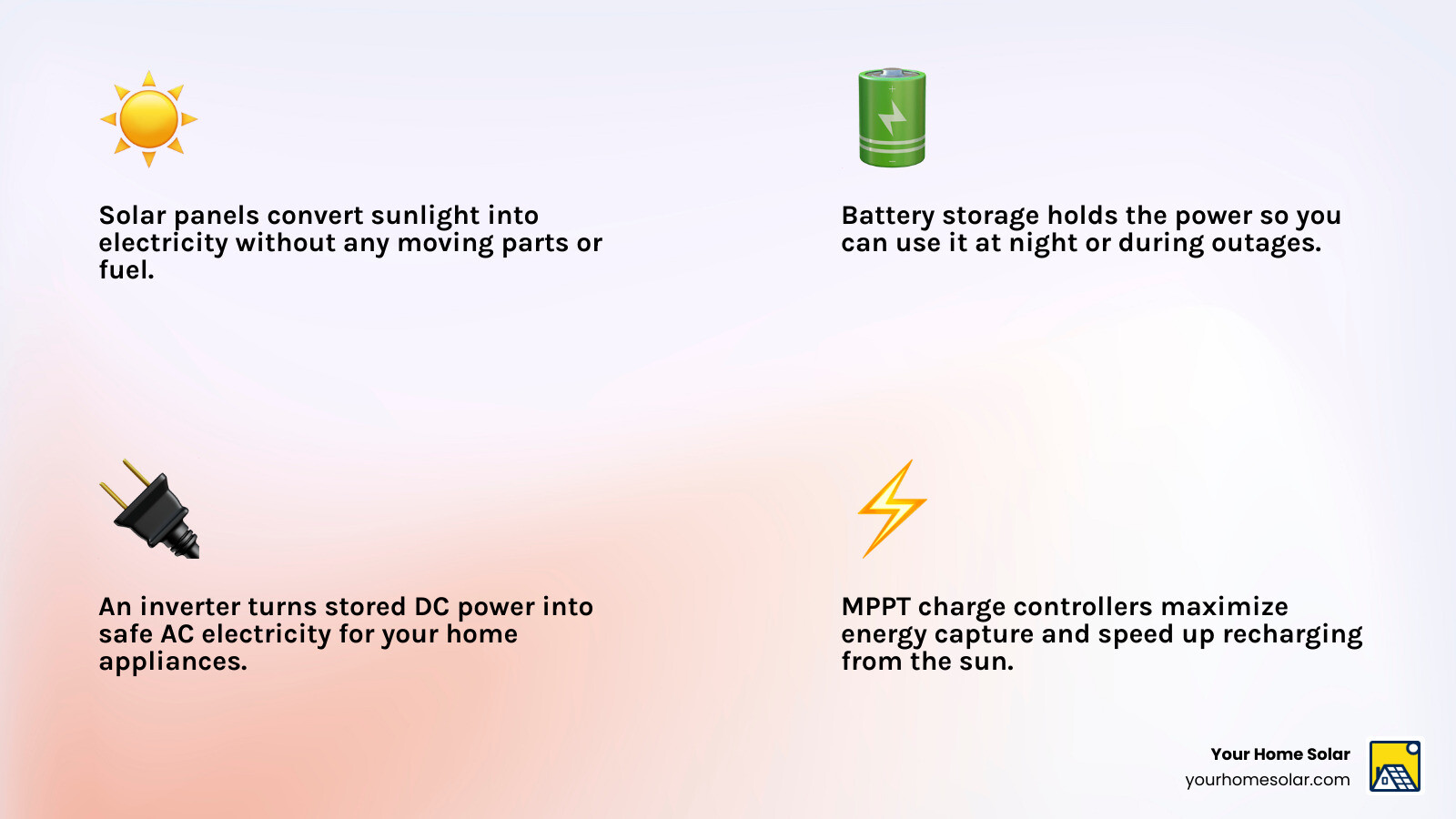
At its simplest, a solar generator is a battery power station paired with solar panels. The panels collect sunlight, the battery stores that energy, and the inverter turns it into usable household electricity.
That sounds similar to a gas generator because both provide backup power. But in real life, they behave very differently.
A gas generator:
- Burns fuel to make electricity in real time
- Needs gasoline, propane, or natural gas
- Produces noise, fumes, and carbon monoxide risk
- Usually must stay outdoors
- Needs more ongoing maintenance
A solar generator or home battery backup:
- Stores electricity for later use
- Recharges from solar, a wall outlet, or even a vehicle in some setups
- Runs quietly
- Produces no fumes during use
- Can often be used safely indoors when designed for indoor operation
That indoor safety advantage matters more than most people realize. During an outage, people are tired, stressed, and trying to keep food cold, phones charged, and families comfortable. A backup option with no exhaust and no fuel handling removes a lot of danger and hassle. If you want a broader look at outage planning, our guide on emergency home power is a good next read.
Another big difference is refueling. Gas generators stop when the fuel runs out. Emergency solar power systems can recharge as long as sunlight is available. That does not mean infinite power, of course. Clouds still exist, and the sun stubbornly refuses to work the night shift. But it does mean you are not dependent on finding fuel after a storm.
For larger emergency and community-scale uses, solar-plus-storage can go far beyond a portable battery. Systems such as off-grid solar nanogrids show how solar, battery storage, and hybrid backup can support critical services when the grid is down.
So who benefits most from owning emergency solar backup?
In East Tennessee, we see the biggest value for:
- Homeowners who want quiet backup for essentials
- Families with refrigerated medication
- CPAP or medical device users
- Elderly residents who need reliable lighting and climate support
- Remote workers who cannot lose internet and laptop power
- Campers and RV owners who want flexible backup beyond the home
Sizing Your System: Capacity and Calculations
Sizing is where many buyers go wrong. They shop by marketing terms like “whole-home ready” or “mega power” instead of looking at the two numbers that actually matter:
- Watt-hours (Wh): how much energy is stored
- Watts (W): how much power the unit can deliver at one time
Think of watt-hours as the size of the fuel tank and watts as how wide the pipe is.
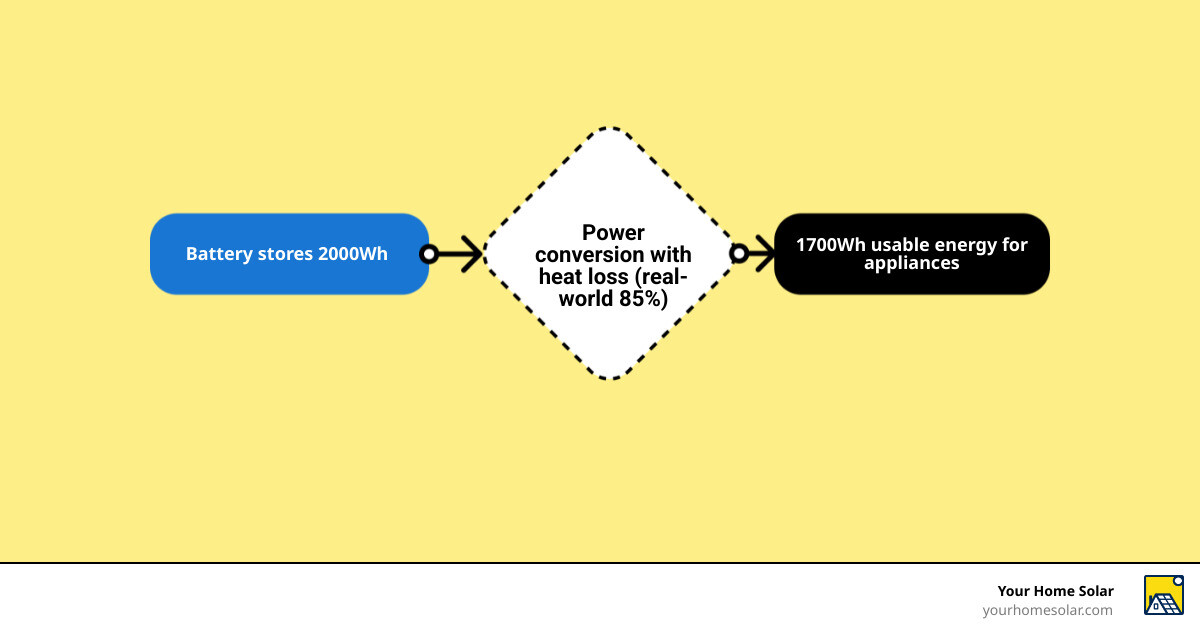
A 2,000Wh station may power a 2,000W load, but only for about an hour. If you cut the load in half, runtime roughly doubles. Real-world runtime is never perfect because energy conversion wastes some power as heat. A good planning rule is to assume you will get about 85% of the advertised battery capacity.
Here is a practical example for a 2,000Wh station:
| Appliance | Typical Running Watts | Estimated Runtime on 2,000Wh Station |
|---|---|---|
| Wi-Fi router | 10W | About 170 hours |
| CPAP | 40W | About 42 hours |
| TV | 100W | About 17 hours |
| Full-size fridge | 180W | About 9.4 hours of compressor runtime |
| Microwave | 1,000W | About 1.7 hours |
| Space heater | 1,500W | About 1.1 hours |
Formula: Runtime in hours = Battery Wh x 0.85 / Device watts
If you are planning a larger backup strategy, our article on solar battery banks explains how to think beyond a small portable unit.
Calculating Your Needs for Emergency Solar Power
Start with the devices you truly need, not the devices you would like to keep running if the outage turned into a luxury resort stay.
Usually that list includes:
- Refrigerator
- Internet modem and router
- Phones and laptops
- Lighting
- Medical devices
- Small cooking appliances
- Fans
Now check both:
- Running watts
- Starting or surge watts
Motor-driven devices like refrigerators, freezers, pumps, and some air conditioners can spike well above their normal running draw when starting up. Research shows a typical full-size fridge may run at around 180W to 200W, but surge to 600W or more when the compressor kicks on.
That means your backup must handle:
- Continuous load: the normal ongoing watts
- Surge load: the temporary startup spike
A good rule is to add 10% to 20% headroom above your expected loads so your system is not operating at the ragged edge.
For example, to run a fridge for 24 hours:
- 180W x 24 hours = 4,320Wh
- Then add a margin for conversion losses and surge support
- A practical recommendation is at least 5,000Wh capacity and about 700W or more maximum output if the fridge is the only load
If you also want lights, charging, and internet, you will need more battery capacity.
Why Emergency Solar Power is Essential for Medical Safety
For some households, backup power is not about convenience. It is about health and safety.
The most common critical medical uses we see include:
- CPAP machines
- Oxygen concentrators
- Refrigeration for medication
- Mobility equipment charging
- Communication devices for telehealth or emergency contact
This is where battery backup shines. A quality system can deliver instant or near-instant switchover during an outage. Some modern units advertise UPS-style transfer times as low as 10 milliseconds, which can help sensitive devices stay running without interruption.
That does not mean every portable unit should replace a medical-grade power plan, but it absolutely means emergency solar can be part of one. Families caring for elderly relatives or medically vulnerable loved ones should plan for:
- Runtime requirements overnight and through the next day
- Surge capacity for any motorized medical device
- Redundant charging methods
- A clear emergency load list taped near the unit
At the community level, resilient solar-backed systems can also support emergency response and critical services, as shown by rapid-deployment off-grid power solutions.
Key Features for Reliability and Longevity
When buying an emergency solar system, specs matter. A lot.
The features we recommend prioritizing are:
LiFePO4 battery chemistry
LiFePO4 batteries are now the standard we prefer for emergency backup because they are safer, more stable, and longer-lasting than older battery chemistries. Modern LiFePO4 units typically handle around 5,000 charge cycles before dropping to about 80% of their original capacity. In normal home use, that can translate to eight to 10 years or longer.
Pure sine wave inverter
Sensitive electronics prefer clean power. A pure sine wave inverter is the better choice for:
- Medical devices
- Computers
- Routers
- TVs
- Modern appliances
Real-time display and app monitoring
One of the most useful features is a display that shows:
- Current input watts
- Current output watts
- Battery percentage
- Estimated runtime remaining
A countdown-style runtime estimate is especially helpful during outages because it lets you manage loads before the battery gets low. App monitoring can also make it easier to check battery status without walking to the garage or utility room with a flashlight in your mouth like a determined raccoon.
Enough ports for real life
Look for a mix of:
- AC outlets
- USB-A
- USB-C
- 12V car outlet
- RV outlet if needed
If you own an RV, a TT-30R outlet can be a major convenience because it allows direct 30-amp RV connection on compatible systems.
Portability and usability
Heavy units are not automatically bad. They are often the most capable. But if a unit weighs 50, 70, or 90 pounds, portability features matter:
- Wheels
- Telescoping handle
- Side handles
- Compact footprint
A technically impressive battery that nobody in the house can move is less useful in an actual emergency.

Solar Panel Integration and Charging Speeds
Solar panels are what turn a battery backup into a sustainable outage solution instead of a one-and-done battery box.
The good news is that many modern systems use MC4 connectors, which are common in the solar industry. That often allows cross-brand panel compatibility as long as the voltage and current stay within the unit’s input limits. The less good news: not every panel combination is safe, so always match panel specs to the battery system.
When choosing panels, focus on:
- Total solar input supported by the battery
- Panel wattage
- Connector compatibility
- Portability versus permanent mounting
- Weather resistance
Portable foldable panels are useful for temporary emergency deployment. Permanently mounted home solar panels are more convenient for routine backup charging because they are already in place when the storm arrives. We explain that in more detail in our guide to why solar panels are so effective for backup power.
How fast do solar generators recharge?
Wall charging is almost always faster than solar charging.
From current 2026 market data:
- Some mid-size units can recharge from the wall in a little over an hour
- Larger high-capacity systems may take around two hours or slightly more
- Solar charging varies widely based on panel size, weather, angle, and season
Real-world solar production is often only 50% to 75% of a panel’s rating in ordinary conditions. So a 200W panel may deliver more like 100W to 150W for much of the day. That is normal, not a defect.
A few practical charging tips:
- Reposition portable panels through the day for better output
- Keep panels clean and unobstructed
- Use the maximum solar input the unit safely allows
- Do not rely on a tiny panel to recharge a large battery quickly
Some systems also allow pass-through charging, meaning you can charge the battery while powering devices at the same time. That is especially helpful for routers, lights, and CPAP use during longer outages.

Common Questions About Backup Solar
How long will a solar generator power a refrigerator?
It depends on the fridge size, how often the door opens, room temperature, and battery size.
A common full-size fridge draws about 180W to 200W while running, but startup surge can hit 600W or more. Using the 85% usable-capacity rule:
- 1,000Wh station: roughly 4 to 5 hours of compressor runtime
- 2,000Wh station: roughly 9 hours
- 5,000Wh station: about 23 to 24 hours
That is why a 5,000Wh-plus system is the safer recommendation for a full day of fridge backup.
Can solar generators be used in extreme weather?
Usually yes, within their rated limits.
LiFePO4 batteries generally offer solid temperature performance and better safety than older lithium chemistries. Some systems are designed to discharge in very cold conditions, though charging in freezing temperatures can be more limited unless the battery includes built-in heating.
Important reminder:
- Keep the battery unit dry and protected
- Follow manufacturer temperature limits
- Use weather-resistant or properly deployed panels outdoors
- Do not leave connectors sitting in standing water
In East Tennessee, we plan more often for storms, humidity, heat, and winter cold snaps than for desert conditions. Protective placement matters.
What is the difference between watt-hours and watts?
This is the question behind almost every sizing mistake.
- Watts = how much power a device needs right now
- Watt-hours = how much energy the battery stores over time
Example:
- A 100W TV uses 100 watts while running
- A 2,000Wh battery stores 2,000 watt-hours of energy
- With 85% usable energy, that battery could run the TV for about 17 hours
So:
- Watts tell you what the system can power
- Watt-hours tell you how long it can power it
If you need more help comparing options, these related resources can help:
- The Ultimate Guide to Staying Powered When the Grid Goes Down
- Power to the People with a Battery Generator Backup
- The Real Price of Never Losing Power Again
Conclusion
The best backup power system is the one that matches your real life, not a marketing fantasy.
For some East Tennessee households, that means a portable battery and a few foldable panels for lights, phones, and a fridge. For others, it means a professionally designed home battery system integrated with solar so critical circuits stay on automatically when the grid fails.
What matters most is this: Emergency solar power gives you cleaner, quieter, safer energy security with far less day-to-day hassle than fuel-only backup.
It is especially valuable for:
- Families preparing for storm outages
- Medical and elderly households
- People working from home
- Homeowners who want long-term resilience and better return on their energy investment
At Your Home Solar, we help homeowners across Knoxville, Oak Ridge, Maryville, Johnson City, Kingsport, Morristown, Sevierville, Farragut, Powell, and throughout East Tennessee choose reliable backup systems that fit their homes, priorities, and budgets.
If you are ready to explore the next step, start with The Ultimate Guide to Solar Batteries and Energy Storage Solutions.
And if you want the short version: the grid may be unpredictable, but your backup plan does not have to be.