What Is the Average Cost of a Home Solar Power System in 2026?
The average cost home solar power system in 2026 runs between $17,500 and $36,000 before incentives, depending on your home’s energy needs and system size. Here’s a quick snapshot:
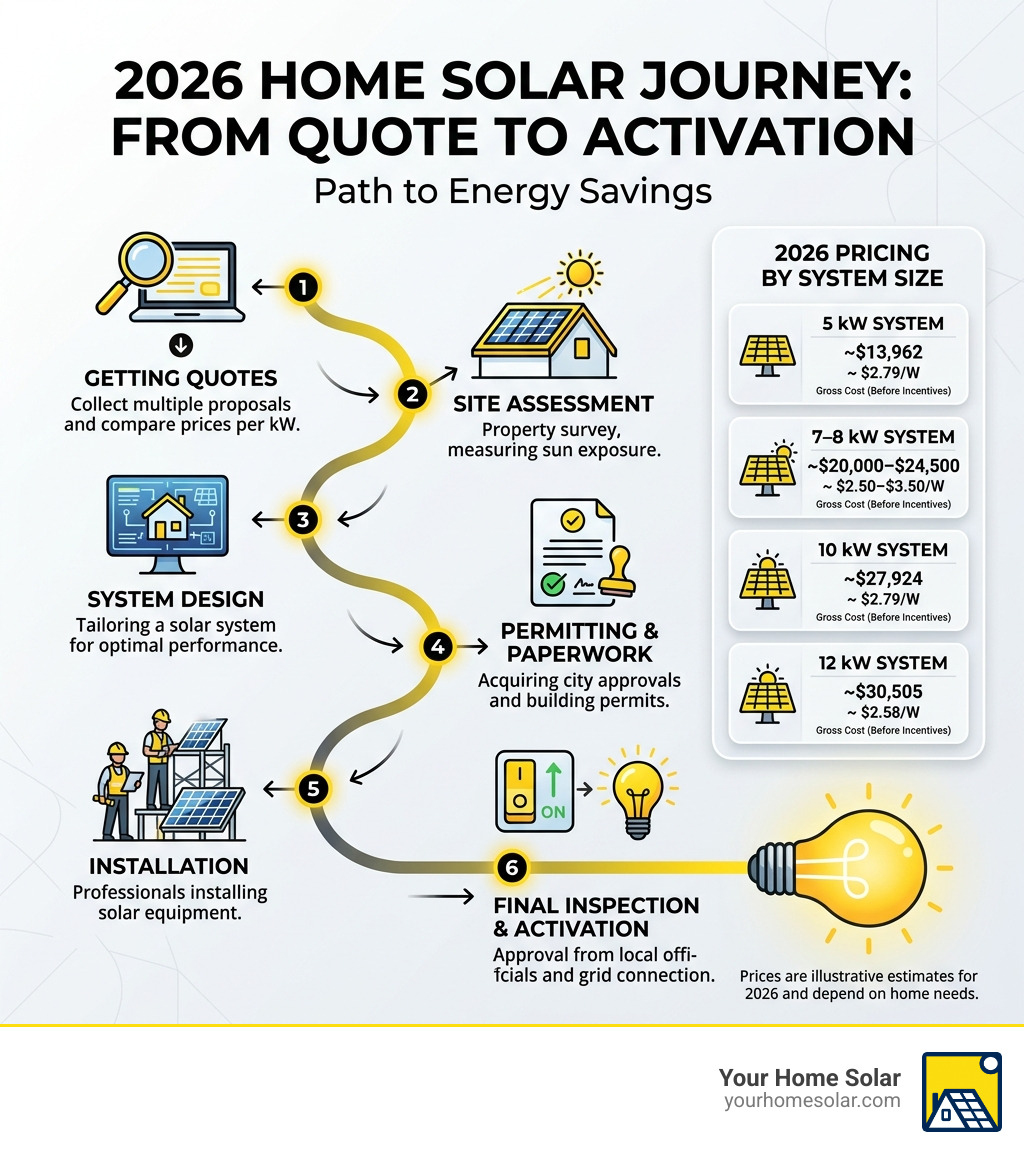
| System Size | Gross Cost (Before Incentives) | Cost Per Watt |
|---|---|---|
| 5 kW | ~$13,962 | ~$2.79/W |
| 7–8 kW | ~$20,000–$24,500 | ~$2.50–$3.50/W |
| 10 kW | ~$27,924 | ~$2.79/W |
| 12 kW | ~$30,505 | ~$2.58/W |
Most homeowners land somewhere in the $19,000–$25,000 range for a system that covers the bulk of their electricity use.
If that number feels large, keep this in mind: solar panels typically pay for themselves within 7 to 12 years — and then generate essentially free electricity for another 15 to 20 years after that. Over 25 years, the average homeowner avoids $41,000 to $62,000 in utility costs.
Solar prices have also fallen dramatically — from nearly $7 per watt in 2010 to under half that today. The technology is more reliable, more efficient, and more accessible than ever.
For East Tennessee homeowners dealing with rising energy bills and unpredictable grid reliability, understanding exactly what you’ll pay — and what you’ll save — is the smartest first step you can take.
I’m Ernie Bussell, founder and CEO of Your Home Solar, and I’ve spent years helping homeowners across East Tennessee navigate the real numbers behind the average cost home solar power system — from my time managing a $40 million solar operation to building the region’s most trusted installation company. In this guide, I’ll walk you through everything you need to know to make a confident, informed decision.
Average cost home solar power system word roundup:
- average cost of solar panels per kilowatt
- average solar panel cost per watt
- 2 kilowatt solar system price
Breaking Down the Average Cost Home Solar Power System in 2026
When we talk about the average cost home solar power system, we have to distinguish between the “sticker price” (gross cost) and what you actually pay after incentives (net cost). In 2026, the gross pricing for residential systems remains stable, but the way we calculate savings has shifted. According to Solar Panel System Costs in the U.S.: A Price Guide 2026, a standard 7.2 kW system now averages around $21,816 before any credits are applied.
For those of us in East Tennessee, from the busy streets of Knoxville to the quiet hills of Sullivan County, the total investment is often determined by your specific energy goals. Are you looking to completely offset your utility bill, or do you just want enough power to keep the lights on during a TVA outage?
In our An Essential Guide to Solar Panels Cost, we note that while a 5kW system might cost roughly $14,000, a larger 12kW system—which is becoming the standard for modern, all-electric homes—can reach upwards of $30,000. The “Costco effect” is real here: as the system size increases, your total price goes up, but your cost per unit of energy typically goes down.
Understanding the Average Cost Home Solar Power System Per Watt
The most accurate way to compare solar quotes is by looking at the price per watt ($/W). In 2026, the competitive benchmark for a residential installation is between $2.50 and $3.50 per watt.
If you receive a quote significantly higher than this, you should ask why. High-end equipment, like premium monocrystalline panels or advanced microinverters, can push the price toward the $3.50 mark. Conversely, a very low quote might indicate a “budget” installer who cuts corners on labor or permitting. We explore whether Is 3 per Watt a Fair Price Understanding Your Solar Investment in detail, but generally, $3.00/W is considered a fair, mid-range price for high-quality workmanship in the Tennessee market.
How System Size Impacts the Average Cost Home Solar Power System
Size isn’t just about the number of panels; it’s about the kilowatt (kW) rating. A small home with modest energy needs might only require a 2kW to 4kW setup. You can find more details in Your Guide to 2kw Solar System Prices and Savings, where we explain how these smaller systems are often used for supplemental power or tiny homes.
However, the average American home uses about 900 kWh per month, which usually requires a 7kW to 10kW system to achieve 100% offset. If you’ve recently added an EV charger or a heat pump in your Morristown or Sevierville home, your system size—and therefore your total cost—will naturally be higher.
Factors Influencing Your Solar Investment

Not every roof is created equal. When we visit a home in Oak Ridge or Maryville, we look at several variables that can sway the average cost home solar power system away from the national median.
- Hardware Quality: Monocrystalline panels are the gold standard in 2026. While they cost more upfront than polycrystalline options, their 22% or higher efficiency means you need fewer panels to get the same results.
- Soft Costs: This is the “hidden” part of the iceberg. According to the Solar Panel Installation Cost: The Complete 2026 Breakdown for US Homeowners, soft costs—including permitting, design, and installer overhead—make up about 60% of your total bill.
- Labor Rates: Local labor markets in East Tennessee are generally more affordable than the West Coast, but skilled solar technicians are in high demand.
To truly understand what you’re paying for, check out our guide on Unpacking Solar Costs What You Need to Know Before You Buy.
Regional Price Variations and Tennessee Specifics
Geography plays a huge role in solar pricing. In Tennessee, we benefit from a relatively low cost of living, which keeps labor costs manageable. For example, Solar Panel Installation Knoxville Cost data shows that local systems often price out slightly below the national average per watt.
However, Tennessee does not have a state-wide personal income tax credit for solar, which makes federal incentives and local utility programs even more critical. We work closely with homeowners in Johnson City and Kingsport to identify specific municipal rebates that might be available through local power boards.
Roof Characteristics and Installation Complexity
Is your roof a simple south-facing rectangle, or does it have multiple gables, dormers, and a steep pitch? Complexity adds time, and time adds cost.
- Shading: If your property in the Great Smoky Mountains is surrounded by trees, we might need to use microinverters or power optimizers to ensure one shaded panel doesn’t tank the whole system’s performance.
- Electrical Upgrades: If your home’s main service panel is older than 20 years, you might need a 200-amp upgrade (costing $1,500–$4,000) before we can safely interconnect your solar.
For a deeper dive into how these physical factors change the math, see The Kilowatt Crunch Your Guide to Average Solar Panel Costs.
Long-Term Value: Payback Periods and Savings
Solar is one of the few home improvements that actually pays you back. In 2026, the average payback period for a system in Tennessee is roughly 10 to 13 years. As electricity rates continue to climb (averaging a 2-3% increase annually), your solar panels become more valuable every year.
According to Solar Panel Cost In 2026: It May Be Lower Than You Think, homeowners can see a total ROI of 10-20% over the life of the system. If you’re curious about what a specific energy target looks like, our breakdown of 1000 kwh per Month Solar Unpacking the Price Tag shows how a well-sized system can virtually eliminate your monthly utility liability.
Incentives and Tax Credits in 2026
The landscape of incentives changed as we moved into 2026. While the federal Residential Clean Energy Credit (Section 25D) has historically provided a 30% tax credit, check the current status of these programs as they relate to your specific installation date.
As noted in the How Much Do Solar Panels Cost in 2026? Complete State-by-State Guide, many homeowners are now looking toward local property tax exemptions. In Tennessee, the value added to your home by a solar installation is often exempt from property tax assessments, meaning your home value goes up, but your tax bill doesn’t.
Financing Options: Cash vs. Loans vs. Leases
How you pay for solar changes your total ROI:
- Cash: Offers the fastest payback and highest total savings because you avoid interest and dealer fees.
- Solar Loans: Allow you to go solar for $0 down. In 2026, typical loan rates range from 4% to 9%. Many solar loans include “dealer fees” of 15-25% to buy down the interest rate.
- Leases/PPAs: These are “third-party owned” systems. You don’t own the panels, and you usually can’t claim the tax credits yourself.
We generally recommend ownership (cash or loan) to maximize your Your Homes Solar Investment Breaking Down Installed Panel Prices.
Beyond the Panels: Hidden Costs and Add-ons

When budgeting for the average cost home solar power system, don’t forget the extras. The most popular “add-on” in 2026 is battery storage.
A home battery (like those from EcoFlow or Generac) typically adds $7,000 to $18,000 to your project. While this increases the upfront cost, it provides something panels alone cannot: power during a blackout. In East Tennessee, where summer storms and winter ice can knock out power for days, many of our customers in Farragut and Powell consider a battery essential for energy security.
According to the How Much Does Solar Installation Cost? Price Guide for 2026, you should also budget for long-term maintenance. While panels last 25-30 years, string inverters may need replacement after 12-15 years, costing between $1,000 and $3,000.
For those looking at massive projects, we even have data on The Gigawatt Dream How Much for a 100kw Solar Setup, though that’s usually reserved for large farms or commercial properties.
Roof Repairs and Structural Reinforcement
You should never put a 30-year solar system on a 20-year-old roof. If your roof has less than 10 years of life left, we recommend reroofing first. This can add $5,000 to $15,000 to your total project cost, but it saves you from paying $3,000+ later to have the panels removed and reinstalled for a roof repair.
We discuss the specifics of panel-level pricing and how it fits into your roof’s footprint in our guide: Unpacking the Price How Much for a 300w Solar Panel.
Commercial vs. Residential Cost Comparisons
If you own a business in Greeneville or Athens, you’ll find that commercial solar is significantly cheaper per watt than residential solar. Because of the massive scale, commercial systems often price out at $1.50 to $2.50 per watt.
Residential systems carry higher “soft costs” per panel because the same amount of permitting and design work goes into a 20-panel home system as a 100-panel small business system. You can see how these scales compare in Watts the Deal a 180w Solar Panel Price Comparison.
Frequently Asked Questions about Solar Costs
What is the average payback period for a home solar system?
In 2026, most homeowners in the Tennessee Valley see their system pay for itself in 10 to 13 years. This depends heavily on your local utility rates and how much of your energy you can “self-consume” or sell back to the grid through net metering programs.
Are there hidden costs like permits or grid interconnection fees?
Yes. Depending on your county (such as Knox or Hamilton), permits and inspections can cost between $300 and $1,000. Most utilities also charge an interconnection fee to hook your system to the grid, which typically ranges from $100 to $500. At Your Home Solar, we include these in our turnkey quotes so there are no surprises.
Is solar still worth the investment after the 2025 incentive shifts?
Absolutely. Even as federal tax credit percentages fluctuate, the cost of solar hardware continues to drop, and the efficiency of panels continues to rise. When you factor in the 4% increase in home value that solar typically provides, it remains one of the safest long-term investments for homeowners.
Conclusion
Navigating the average cost home solar power system doesn’t have to be a headache. At Your Home Solar, we pride ourselves on being East Tennessee’s experts in tailored energy solutions. Whether you’re in Morristown, Maryville, or anywhere in between, we focus on 100% customer satisfaction by providing reliable, rewarding installations that make sense for your specific budget.
From solar panels and battery backups to standby generators and EV chargers, we’re here to help you achieve energy independence. If you’re ready to see exactly what the numbers look like for your roof, we’d love to chat.