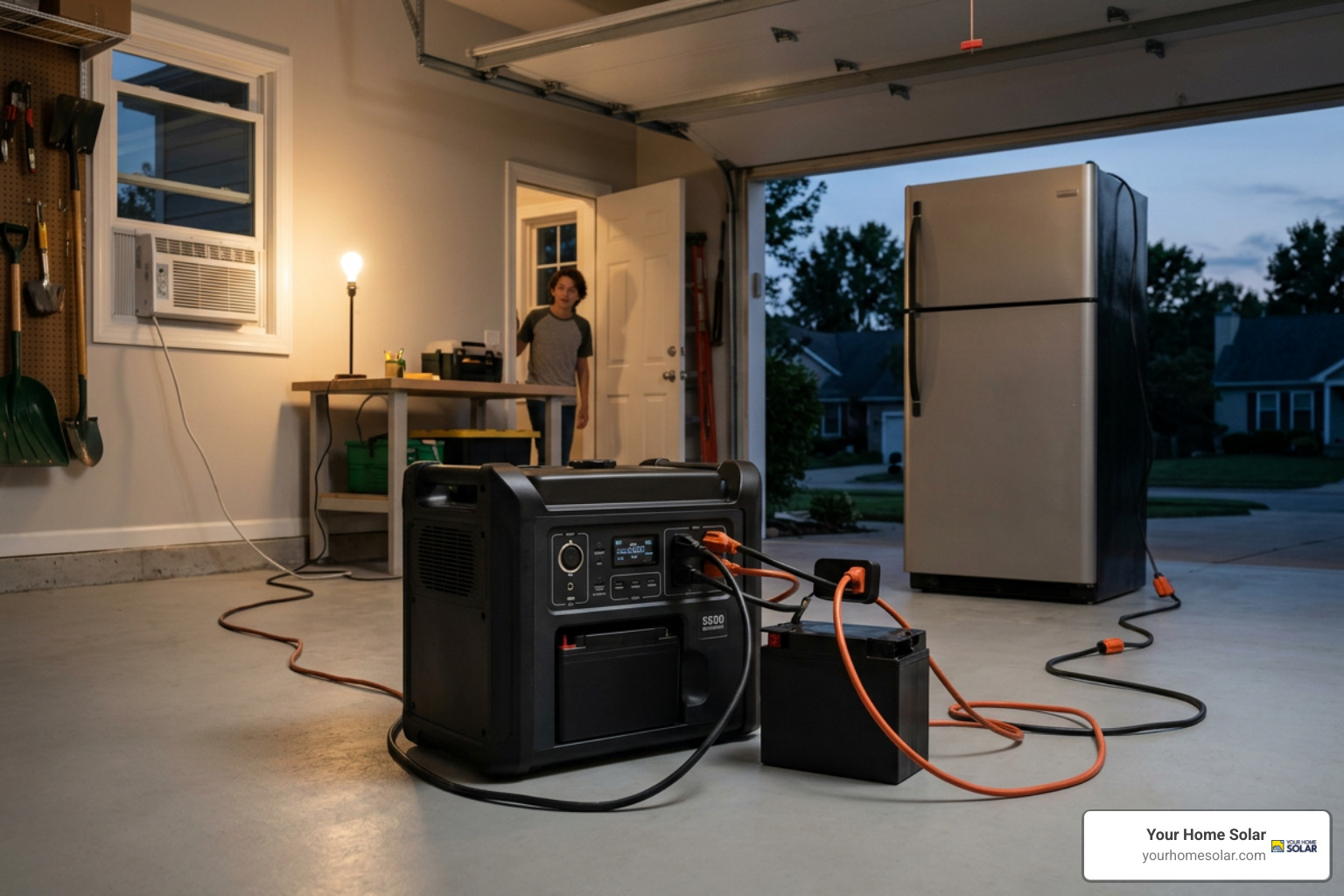
What a 5500 Watt Solar Generator Can Do for Your Home Backup
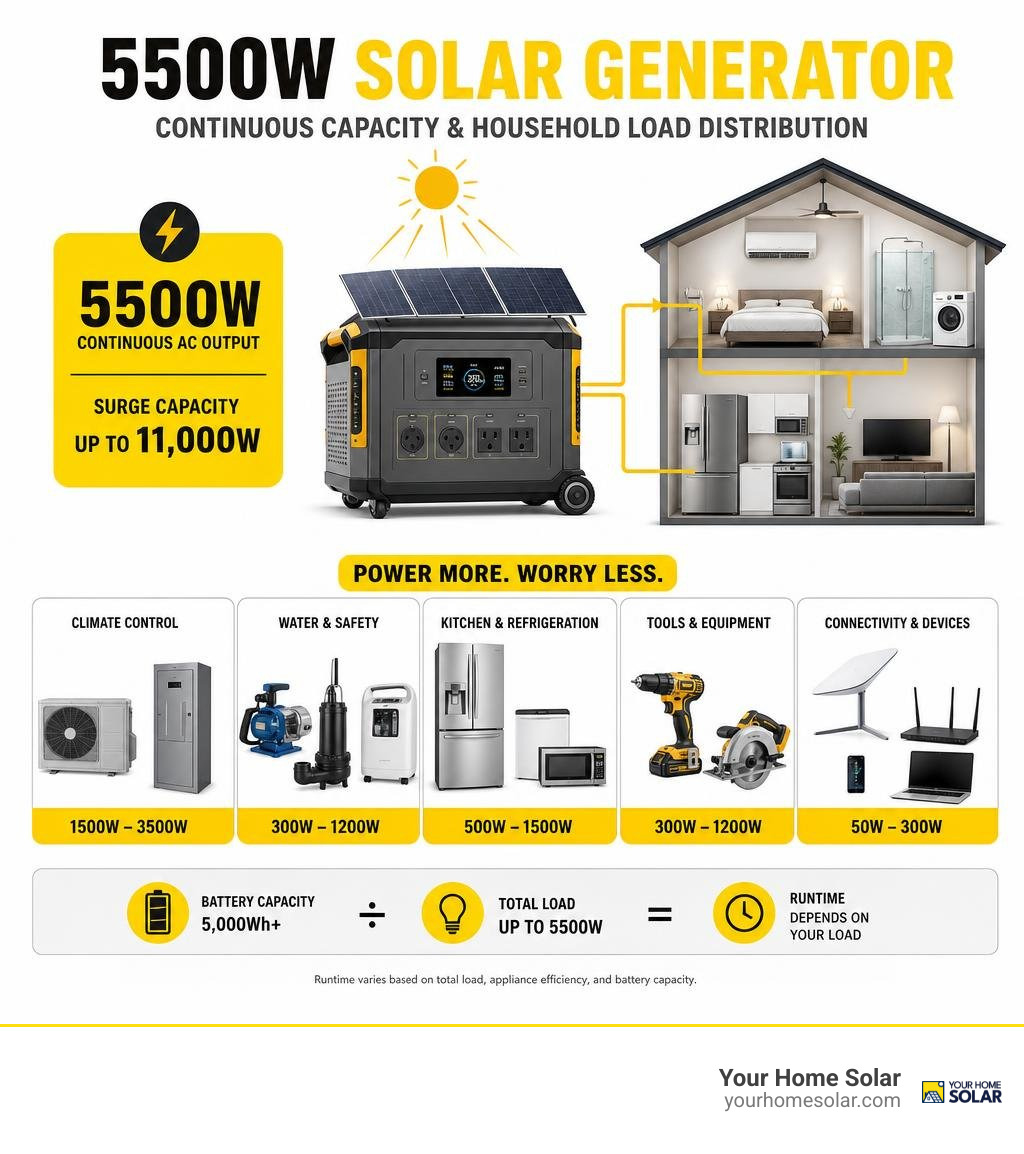
A 5500 watt solar generator provides 5,500 watts of continuous AC output (often surging up to 11,000 watts) paired with a high-capacity lithium battery bank—typically 5,000 watt-hours (Wh) or more. This delivers enough muscle to start and run major 120V and 240V residential loads simultaneously during a blackout.
With a 5500W output threshold, you can power critical high-draw home equipment without tripping an inverter:
- Whole-house essentials: Central AC units, heat pumps, and electric water heaters.
- Water & safety systems: Well pumps, sump pumps, and medical devices like oxygen concentrators.
- Kitchen & refrigeration: Full-sized French-door refrigerators, deep freezers, and microwave ovens.
- Emergency tools & connectivity: Power tools, Starlink systems, home networks, and device charging.
I’m Ernie Bussell, Founder and CEO of Your Home Solar in East Tennessee, bringing my background in U.S. Navy nuclear quality assurance to residential power design. Over the years, I have helped hundreds of homeowners evaluate whether a heavy-duty 5500 watt solar generator provides the right level of off-grid security for their families.
5500 watt solar generator terms to know:
Core Capabilities: Understanding the 5500 Watt Solar Generator
When evaluating emergency energy equipment, the continuous wattage rating determines what can run indefinitely, while peak surge capacity dictates whether heavy motor-driven appliances can even start. A high-output 5500W lithium portable power station is engineered to solve the startup bottleneck common in smaller battery stations.
Pure sine wave inverters are fundamental to modern solar generators. They produce clean, stable alternating current that mirrors or exceeds the quality of grid utility power, eliminating the harmonic distortion that damages sensitive circuit boards in modern variable-speed appliances, CPAP machines, and high-end electronics. When configuring systems for complete residential resilience, units offering both 120V and split-phase 240V outputs allow homeowners to back up heavy domestic circuits without complicated external step-up transformers.
| Appliance / Equipment | Running Wattage (Continuous) | Surge / Starting Wattage (Peak) | Supported by 5500W Inverter? |
|---|---|---|---|
| Deep Well Water Pump (1/2 to 1 HP) | 1,000W – 1,500W | 3,000W – 4,500W | Yes |
| Central Air Conditioner (3-Ton System) | 3,000W – 3,800W | 6,000W – 9,000W | Yes (with soft-start) |
| French-Door Refrigerator & Freezer | 150W – 400W | 800W – 1,200W | Yes |
| Electric Water Heater (Select Elements) | 2,500W – 4,500W | 4,500W | Yes |
| Sump Pump (1/2 HP) | 800W – 1,050W | 2,100W – 2,500W | Yes |
| Microwave Oven | 1,000W – 1,500W | 1,500W | Yes |
| Oxygen Concentrator / Medical Devices | 300W – 600W | 600W | Yes |
What Appliances Can a 5500 Watt Solar Generator Run Simultaneously?
With a 5,500W continuous threshold and an 11,000W peak surge capability, you no longer have to pick between preserving food and keeping the water running. During severe outages, a 5500W power station can comfortably run a full-sized refrigerator (200W), a deep well pump cycling on demand (1,200W running, 3,500W surge), home Wi-Fi and communications (80W), LED lighting throughout key rooms (100W), and a high-efficiency mini-split heat pump (1,500W) simultaneously, with headroom to spare for emergency home power tools and electronics.

Small Portable Kits vs. High-Capacity Emergency Generators
The gap between portable outdoor power kits and high-capacity backup generators comes down to energy density and discharge capability. Compact recreational power banks, such as a 500W portable power station or a 154Wh kit, are built for camping trips to charge phones, cameras, and 12V coolers.
However, running a household during an extended winter storm or flood requires substantial watt-hour reserves. A 5,000Wh+ storage base can run critical refrigeration and medical loads for days, whereas an ultra-compact kit would exhaust its capacity in under two hours under standard household loads. Understanding how you plan to use your energy helps determine whether lightweight gear or a heavy-duty system fits your needs when exploring portable solar systems.
Battery Chemistry, Hardware Specs, and System Lifespan
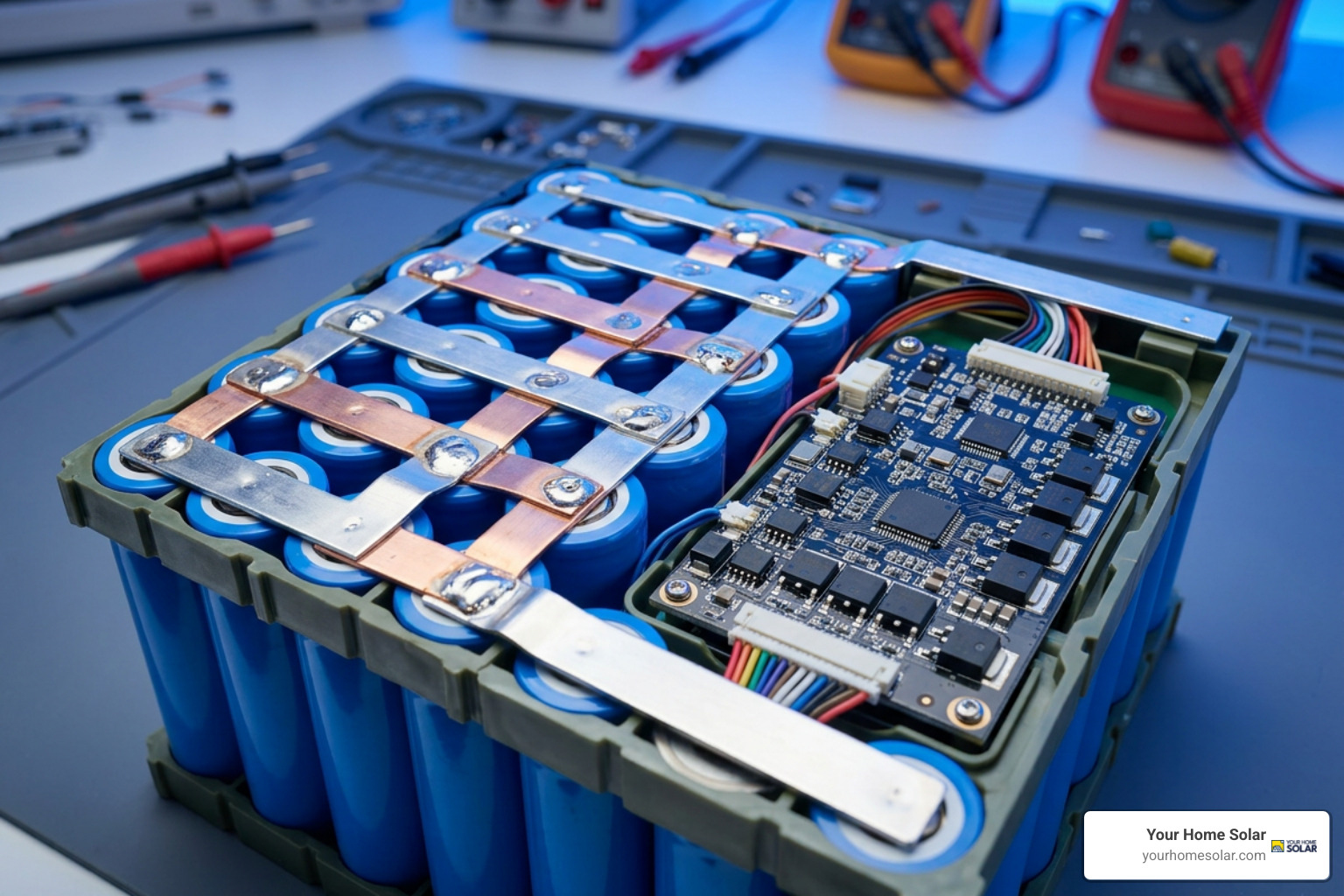
Modern 5500W power stations utilize Lithium Iron Phosphate (LiFePO4 or LFP) battery chemistry. Compared to legacy nickel-manganese-cobalt (NMC) or sealed lead-acid cells, LiFePO4 chemistry offers superior thermal and chemical stability, virtually eliminating thermal runaway risks even under heavy charge and discharge cycles.
An advanced internal Battery Management System (BMS) continuously monitors cell voltage, current, and temperature across every module. This hardware intelligence safeguards against overcharging, deep discharge, short circuits, and extreme temperature swings. For long-term home preparedness, choosing reliable home battery backup options ensures that your investment remains safe and functional inside your living space for years to come.
Inverter Output, UPS Transfer Speed, and Surge Capacities
When grid power drops, switching speed matters. High-performance units feature integrated Uninterruptible Power Supply (UPS) functionality with transfer speeds under 20 milliseconds. This rapid switchover prevents desktop computers, NAS drives, and home medical devices from rebooting or dropping offline when the primary power line cuts out.
Motor-driven appliances like air compressors, table saws, and well pumps draw an initial inductive surge that can reach two to three times their standard operating wattage. The heavy-duty pure sine wave inverters inside 5500W systems are specifically rated to deliver up to an 11,000W surge for short durations, ensuring that compressors turn over smoothly without collapsing the inverter’s voltage rail or causing total harmonic distortion.
Portability, Weight, and Physical Footprint
Energy density comes with physical mass. A complete 5500W solar generator featuring roughly 5,120Wh to 6,000Wh of internal LiFePO4 cells weighs approximately 45 kg (around 100 lbs).
To keep this equipment manageable for a single person, manufacturers incorporate heavy-duty suitcase-style pull handles, ruggedized all-terrain wheels, and reinforced side lift points. Optimized enclosure engineering ensures that cooling fans maintain airflow across the internal transformers without exposing sensitive electronics to dust or moisture during transport.
Recharging Times: Solar Array Sizing vs. Grid Charging
Restoring battery reserves quickly is critical during multi-day outages when grid power remains down. Modern solar generators support multiple high-wattage charging inputs, pairing Maximum Power Point Tracking (MPPT) charge controllers with AC wall fast charging. Standard 120 volt solar generators are versatile, but high-capacity units allow for massive input pipelines to restore 5kWh+ banks in just a few hours.
Solar Panel Sizing to Recharge a 5500 Watt Solar Generator

To charge a 5,000Wh+ battery bank within a single day of sunlight, your solar array must be sized to match the unit’s MPPT voltage and wattage windows. Dedicated solar inputs typically accept between 12V to 150V DC, supporting solar inputs ranging from 1,200W up to 2,400W across dual MPPT trackers, as seen on advanced units like a 5000Wh solar generator with 1200W MPPT.
In East Tennessee and surrounding regions, we calculate systems based on an average of 4.5 to 5 peak sunlight hours per day. Sizing your system with four to six 400W rigid panels (providing 1,600W to 2,400W of rated power) ensures that even with standard atmospheric losses, the generator receives a steady 1,200W–1,800W, achieving a full charge from empty in 3.5 to 4.5 hours. While portable solar panels offer flexibility for mobile use, permanently mounted or ground-mounted rigid arrays provide the best harvest efficiency for home backup setups.
AC Wall Charging and Hybrid Generator Inputs
When grid power is active, high-speed AC wall charging can replenish a 5kWh battery in under 3 hours at 2,000W input.
During extended blackouts with persistent cloud cover, hybrid versatility becomes vital. Pairings like the Anker SOLIX E10 system ($5,599.00 on sale, down from $7,799.00) or standalone units with the Anker SOLIX Smart Generator 5500 Tri-Fuel ($1,799.00 sale price) allow users to burn propane, natural gas, or gasoline to rapidly charge the DC battery bank while using pure solar whenever the sun emerges. Extended hybrid packages featuring up to 12kWh of expansion batteries range from $7,299.00 to $8,799.00, giving homeowners layered energy resilience.
Installation and Transfer Switches for Home Resilience
Plugging extension cords through windows during an ice storm is inconvenient and introduces safety hazards. To safely supply whole-house power, a 5500W generator should connect directly to your home’s electrical panel via a dedicated transfer switch.
Proper isolation protects utility line workers from dangerous backfeeding and safeguards your appliances against grid surges when main utility lines are restored. Ensuring your system is set up for resilience against Tennessee storms is straightforward when you consult our generator installation cost guide to plan your setup correctly.
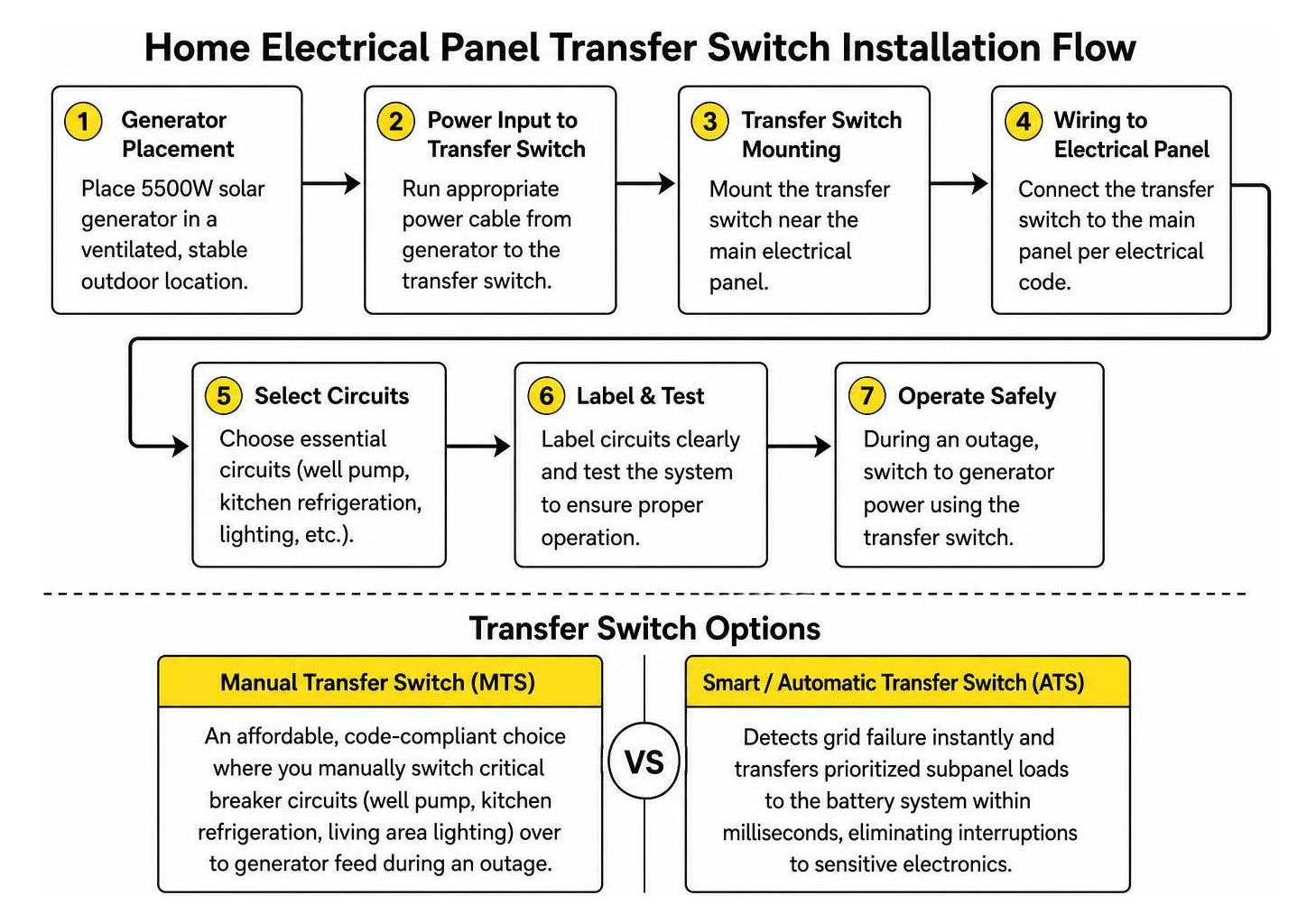
Manual vs. Automatic Transfer Switches for Whole-Home Integration
- Manual Transfer Switch (MTS): An affordable, code-compliant choice where you manually switch critical breaker circuits (well pump, kitchen refrigeration, living area lighting) over to generator feed during an outage.
- Smart / Automatic Transfer Switch (ATS): Detects grid failure instantaneously and transfers prioritized subpanel loads to the battery system within milliseconds, eliminating interruptions to sensitive electronics.
Home Backup vs. Off-Grid Remote Living
High-capacity solar generators serve two primary roles: residential emergency backup and primary off-grid living. For off-grid cabins in the hills of East Tennessee or rural homesteads, pairing a 5500W system with fixed ground arrays delivers true utility independence.
Regional clean energy initiatives, including utility-scale developments like the Oak Ridge solar projects, reflect the broader shift toward dependable, localized solar infrastructure across the state. Whether for permanent remote homesteading or residential emergency preparedness, scalable battery systems offer clean, silent alternatives to noisy fossil-fuel generators.
Frequently Asked Questions About High-Capacity Solar Generators
How long will a 5000Wh to 5500W solar generator run essential home appliances during an outage?
Runtime depends on your total continuous wattage load. If powering essential loads averaging 500W (a refrigerator cycling periodically, LED lights, internet router, and a CPAP machine), a 5,120Wh battery provides roughly 8.5 to 10 hours of continuous runtime before factoring in solar replenishment. With a 1,200W solar array actively charging during daylight hours, the system can run continuously off-grid indefinitely.
Can a 5500-watt system be charged with solar and a wall outlet at the same time?
Yes. Most advanced 5500W lithium power stations feature dual-input charging architecture. You can connect both an AC wall connection (or gas generator input) and an MPPT DC solar array simultaneously. The internal charge controller combines both power streams to maximize input wattage, charging the battery bank to full in as little as 1.5 to 2 hours.
What is the expected lifespan of a LiFePO4 battery in a solar generator?
LiFePO4 (Lithium Iron Phosphate) batteries generally deliver 3,000 to 4,000 full charge-and-discharge cycles before their storage capacity drops to 80% of its original rating. If cycled daily, this translates to over 10 years of reliable service. Under typical emergency backup usage of 20 to 50 cycles per year, the battery cells will easily last 15 to 20 years with minimal capacity degradation.
Conclusion
A high-capacity 5500W solar generator delivers the continuous wattage, peak surge capacity, and battery reserves necessary to keep critical household systems running through severe grid outages. By combining clean LiFePO4 storage, high-speed MPPT solar charging, and seamless transfer switch integration, you eliminate the noise, fumes, and fuel-storage challenges of traditional gas units.
At Your Home Solar, we take pride in helping homeowners across Knoxville, Maryville, Sevierville, and communities throughout East Tennessee achieve complete energy independence. To explore customized designs for your property, check out our comprehensive off-grid solar systems guide or connect with our team today to build a reliable backup power solution for your home.