Is Knoxville a Good Place for Solar Panels? Here’s the Short Answer
Is Knoxville a good place for solar panels? Yes — but with some important caveats every East Tennessee homeowner should know before signing anything.
Here’s a quick summary:
| Factor | Knoxville Reality |
|---|---|
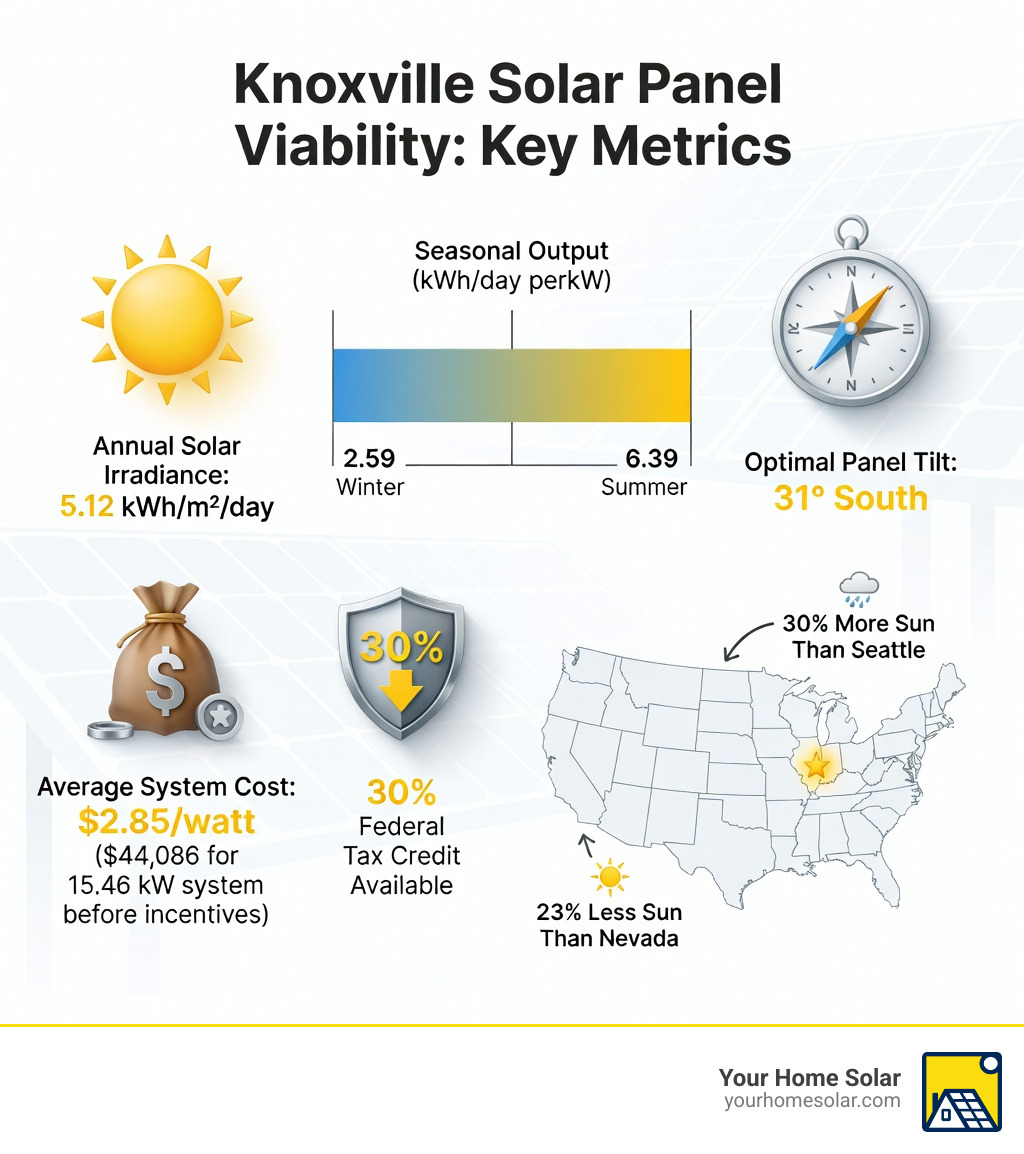
| Solar irradiance | 5.12 kWh/m²/day annual average — solid, not spectacular |
| Sunlight vs. other cities | 30% more than Seattle, 23% less than Las Vegas |
| Average system cost | $2.85/watt (~$44,086 for a 15.46 kW system before incentives) |
| Federal tax credit | 30% off via the Residential Clean Energy Credit |
| Payback period | Varies widely — can range from 12 to 36+ years depending on your setup |
| Best candidates | Homeowners with south-facing, unshaded roofs and higher electricity usage |
| Worst candidates | Renters, heavily shaded homes, or homes with very low electric bills |
The honest answer is that Knoxville sits in a middle ground. You get enough sun to make solar work. But low electricity rates from TVA and KUB mean your savings accumulate more slowly than in states like California or Arizona. That doesn’t make solar a bad idea here — it just means the details matter a lot.
Your electric bill keeps climbing whether you’re ready or not. And locking in predictable energy costs for the next 25–30 years is exactly what a well-designed solar system does.
I’m Ernie Bussell, Founder and CEO of Your Home Solar and the #1 solar energy contractor in East Tennessee — with a background spanning the U.S. Navy, a decade in education, and years of hands-on solar operations leadership, I’ve helped hundreds of Knoxville-area homeowners figure out exactly is Knoxville a good place for solar panels for their specific home and budget. Let me walk you through everything you need to make a confident decision.
Is Knoxville a Good Place for Solar Panels?
When we look at the raw data, Knoxville is surprisingly well-positioned for solar energy. We aren’t the “Sunshine State,” but we hold our own. The average annual solar radiation in Knoxville is 5.12 kWh/m²/day. To put that in perspective, the Global Horizontal Irradiance (GHI)—which measures the total solar radiation on a horizontal surface—averages about 4.34 kWh/m²/day here.
However, we can do better than average. By tilting panels at an angle equal to our latitude, we can increase that output by about 14%. This scientific potential is why Knoxville was historically selected as one of the few Solar America Cities by the Department of Energy. Between 2008 and 2011, this program helped Knoxville’s solar capacity grow from a tiny 15 kW to over 1,300 kW.
Today, the Tennessee Valley Authority (TVA) and the Knoxville Utilities Board (KUB) are leaning heavily into renewables. KUB has committed to a 20% renewable electricity goal, securing over 500 MW of solar to power approximately 83,000 homes. When you ask if solar panel viability in Tennessee is real, you only need to look at the massive utility investments happening in our backyard to see that the “Quest for Solar” is well underway.
Is Knoxville a good place for solar panels compared to other US cities?
We often hear folks say, “It’s too cloudy in East Tennessee for solar!” We like to counter that with a bit of “solar geography.” Knoxville actually receives about 30% more solar radiation than Seattle, a city where solar is incredibly popular. While we do get about 23% less sun than a desert city like Las Vegas, we fall firmly into a “moderately favorable” zone.
According to the U.S. Energy Information Administration, Tennessee’s energy mix is evolving. While we enjoy relatively low rates compared to the national average, those rates aren’t static. Knoxville’s solar potential is higher than many cities in the Northeast and Pacific Northwest, making it a hidden gem for homeowners looking to hedge against future utility hikes.
Is Knoxville a good place for solar panels for renters and shaded homes?
This is where we have to be honest: if your home is nestled under a thick canopy of ancient Knoxville oaks, rooftop solar might not be your best move. Shading is the “kryptonite” of solar performance. Even partial shading on one or two panels can significantly drop the efficiency of the entire string.
For renters or those with heavily shaded lots, there are still ways to enjoy the benefits of going solar in Knoxville TN. Before jumping into a solar contract, we always recommend an “efficiency first” approach. Sealing air leaks and upgrading insulation can often save you more money per dollar spent than panels on a shaded roof. If your roof is clear but you’re worried about small shadows from chimneys or vents, modern micro-inverters can help mitigate those losses.
The Financials: Costs, Incentives, and ROI in East Tennessee
Let’s talk brass tacks. How much does it actually cost to go solar in the Marble City?
In Knoxville, the average solar panel system costs approximately $2.85 per watt including installation. For a standard residential system size of 15.46 kW, the total comes to about $44,086 before incentives. We see price ranges typically falling between $37,473 and $50,699 depending on the equipment quality and installation complexity.
| System Size | Estimated Cost (Pre-Incentive) | Estimated Cost (After 30% Credit) |
|---|---|---|
| 7.9 kW (Small) | $22,515 | $15,760 |
| 10 kW (Medium) | $28,500 | $19,950 |
| 15.46 kW (Avg) | $44,086 | $30,860 |
| 20 kW (Large) | $57,000 | $39,900 |
Note: Data based on Solar Panel Installation Knoxville Cost research.
Federal and Local Solar Incentives
The “secret sauce” that makes these numbers work is the Federal Residential Clean Energy Credit. Thanks to the Inflation Reduction Act, you can claim a 30% tax credit on the total cost of your solar system. This isn’t just a deduction; it’s a dollar-for-dollar credit against your federal income tax liability.
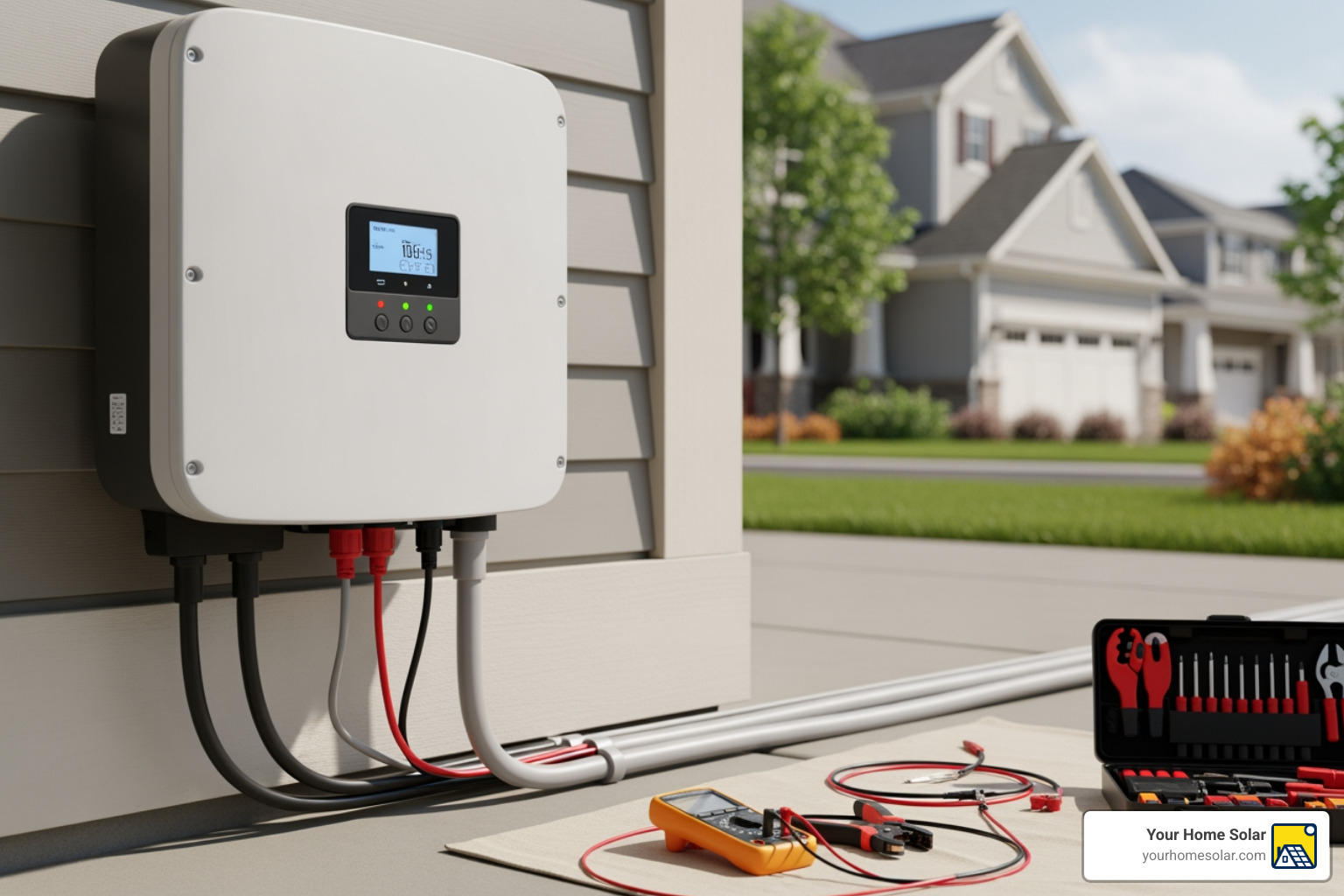
Locally, the options are a bit more nuanced. The TVA Dispersed Power Production program allows you to sell excess energy back to the grid. While KUB and TVA don’t currently offer a “traditional” net metering policy that wipes your bill to zero as easily as some other states, their renewable programs are designed to support grid resiliency. To get the most out of residential solar installation in Knoxville TN, you want a system that is sized correctly for your specific usage—not just the biggest one that fits on the roof.
Long-term ROI and Payback Periods
Solar is a marathon, not a sprint. Most high-quality panels are rated for a 25–30 year lifespan. Over that time, your system acts as a shield against rising utility rates. While some national calculators suggest long payback periods for Tennessee (sometimes up to 36 years if electricity rates stay artificially low), real-world experience often tells a different story.
By using NASA solar and meteorological data to precisely model your home’s production, we can often find a much faster path to ROI. Factors like property value increases—which are often exempt from property tax hikes in many jurisdictions—and the sheer peace of mind of energy independence add value that doesn’t always show up on a simple spreadsheet.
Maximizing Performance: Climate, Tilt, and Topography
To get the most “bang for your buck,” your installation needs to be optimized for the East Tennessee landscape.
In Knoxville, the optimal fixed tilt for solar panels is 31° South. This angle maximizes the “liquid sunshine” we get throughout the year. If you have the space for a ground-mounted system with seasonal adjustment, you can squeeze out even more:
- Summer: 20° tilt (Yields ~6.39 kWh/day per kW)
- Spring: 29° tilt (Yields ~5.75 kWh/day per kW)
- Winter: 51° tilt (Yields ~2.59 kWh/day per kW)
Humidity is a factor here, too. Knoxville’s “muggy” summers can lead to some efficiency loss due to heat and moisture. We often recommend panels with anti-reflective coatings and high-quality inverters that can handle the thermal load.
Weather Resilience and Maintenance
“But Ernie, what about the hail?” It’s a common question. Most modern solar panels use tempered glass designed to withstand significant impact—usually hail up to an inch in diameter traveling at terminal velocity. Our solar panel maintenance in Knoxville typically involves simple checks.
Rainfall in East Tennessee actually helps keep your panels clean, washing away pollen and dust. While snow can occasionally cover panels in the winter, it usually slides off quickly because the panels are dark and tilted, absorbing heat the moment the sun peeks out.
Topography and Site Selection
The geography of the Tennessee Valley plays a role in your solar success. If you live on the slopes of the Cumberland Plateau or in a deep valley, your “solar window” (the hours of direct sun) might be shorter.
When you learn about solar in East Tennessee, you’ll find that south-facing roofs are the gold standard. However, if your roof isn’t ideal, a ground-mount system can be a fantastic alternative if you have the acreage. Always ensure your installer has NABCEP certification—this is the “gold standard” for solar professionals and ensures they know how to navigate our unique topography.
Alternatives to Rooftop Solar in the Marble City
Not every home is a candidate for rooftop solar, but that doesn’t mean you have to be left out of the renewable revolution.
Knoxville is home to the first community solar array at the Public Works Service Center. This 1 MW array uses over 2,000 panels and allows KUB customers to “buy shares” in solar energy. For as little as $5 a share, you can support local green energy even if you live in a shaded apartment or a condo.
Utility-Scale Projects and Future Outlook
The future of solar in Knoxville is bright—literally. KUB’s investment in more than 500 MW of solar is part of a larger plan to reduce greenhouse gas emissions by 80% by 2050.
Programs like TVA Green Invest are attracting billions in investment to the region. Major companies like Google and Ford are moving to the Tennessee Valley specifically because they can access this renewable power. This industrial demand is driving the infrastructure that will eventually make residential solar even more seamless and affordable for the rest of us.
Frequently Asked Questions
What is the average cost of solar in Knoxville?
As of 2025-2026, the average cost is about $2.85 per watt. For a typical 15.46 kW system, you’re looking at roughly $44,086 before the 30% federal tax credit. After the credit, that price drops to around $30,860.
How long is the solar payback period in Tennessee?
Because our electricity rates are lower than the national average, the payback period can be longer—often between 15 and 25 years for residential systems. However, this varies wildly based on your specific energy usage, the orientation of your roof, and whether you take advantage of all available tax credits.
Does KUB offer net metering for residential solar?
KUB works within the TVA framework. While they don’t offer “one-to-one” net metering (where you get paid the full retail rate for every watt you send back), they do have programs like the Dispersed Power Production program that allow you to receive credit for the energy you contribute to the grid.
Conclusion
So, is Knoxville a good place for solar panels? If you are looking for a way to achieve energy independence, lock in your monthly costs, and do something positive for the East Tennessee environment, the answer is a resounding yes.
At Your Home Solar, we don’t believe in “one-size-fits-all” sales pitches. We provide tailored, reliable, and rewarding installations because we live here too. Whether you’re in Knoxville, Maryville, or Sevierville, our goal is 100% customer satisfaction.
Ready to see if your roof has what it takes? Connect with the expert solar installers in Knoxville TN today. Start your Knoxville solar journey with a free, honest assessment of your home’s potential. Let’s get you powered by the sun!