Open uping Savings: Your Guide to Solar Incentives Tennessee
For homeowners interested in solar energy, the most impactful solar incentives Tennessee currently offers are:
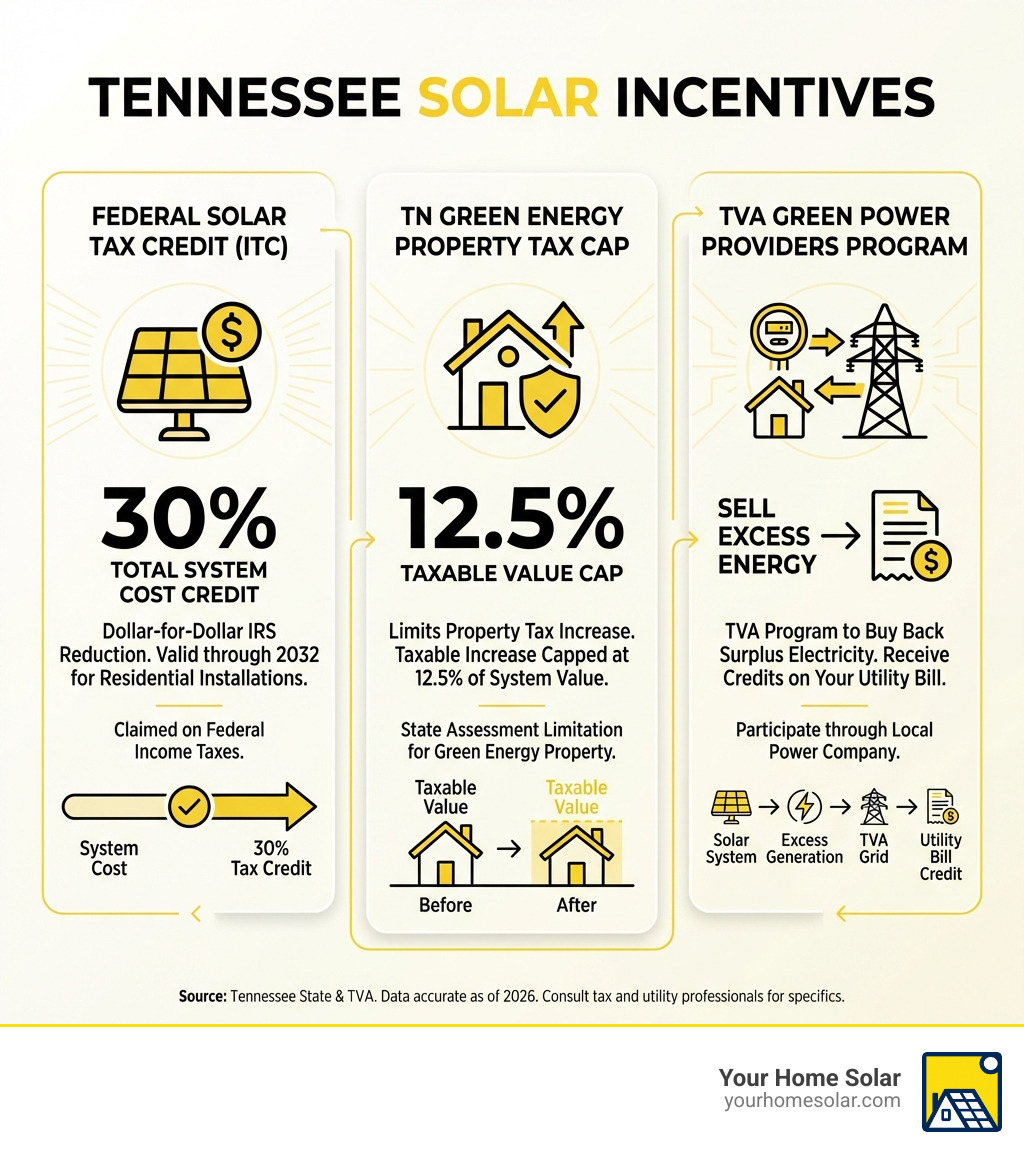
- Federal Solar Investment Tax Credit (ITC): This provides a 30% tax credit on the total cost of your solar system. It’s the largest financial benefit available.
- Tennessee Green Energy Property Tax Assessment: This state incentive limits how much your property taxes can increase after installing solar panels, capping the taxable value at just 12.5% of the system’s cost.
- TVA Green Power Providers Program: While Tennessee doesn’t have statewide net metering, the Tennessee Valley Authority (TVA) offers a program to buy back excess electricity your system produces. This provides credits on your utility bill.
If you’re an East Tennessee homeowner looking to reduce high energy bills, protect against power outages, and contribute to a cleaner environment, understanding solar incentives Tennessee is key. The Volunteer State offers a good amount of sunshine, with about 205 sunny days each year. This makes it a great place to harness solar power.
But installing solar panels is an investment. Luckily, several programs exist to make it more affordable. These incentives can significantly lower the upfront cost of a solar system. They also help increase your long-term savings. This guide will walk you through the most important financial benefits for Tennessee homeowners.
Ernie Bussell, Founder and CEO of Your Home Solar, has deep expertise in navigating solar incentives tennessee. His background in military service, education, and operations management ensures homeowners receive clear guidance and reliable solutions.
Maximizing Solar Incentives Tennessee: The Federal Tax Credit
When we talk about solar incentives Tennessee, the federal Residential Clean Energy Credit, often called the Investment Tax Credit (ITC), is undoubtedly the star of the show. This powerful incentive allows you to claim a significant portion of your solar system’s cost directly against your federal income taxes. It’s not a rebate, meaning you won’t get a check in the mail, but it reduces what you owe the IRS dollar-for-dollar.
Thanks to the Inflation Reduction Act (IRA), this credit received a substantial boost and extension. For systems installed between 2022 and 2032, homeowners can claim a generous 30% of the total purchase price of their solar system. This percentage is set to decrease slightly in subsequent years: 26% for systems installed in 2033 and 22% for those installed in 2034. After December 31, 2034, the residential credit is currently scheduled to expire. This extended timeline provides a fantastic window of opportunity for East Tennessee homeowners to make the switch to solar.
Consider this: the average expense for home solar systems in Tennessee ranges, but let’s take an example. If your 6-kilowatt (kW) solar photovoltaic (PV) system costs an estimated $16,740, a 30% federal tax credit would amount to $5,022. This brings your net cost down to an appealing $11,718. For a typical solar energy system costing around $38,520, the 30% credit could be as much as $11,556! This credit applies to the entire cost of your system, including panels, inverters, mounting hardware, and “soft costs” like installation, inspection, and permitting fees. Even standalone battery storage installed in 2023 or later qualifies for this credit, offering even more ways to save and secure your energy independence.
One of the best features of the federal ITC is its flexibility. If your tax credit exceeds your tax liability in the year you install your system, you don’t lose out. The unused portion can be carried forward and applied to your federal taxes for up to five subsequent years. This means that even if you don’t owe enough in taxes to use the entire credit in one year, you can still reap the full benefit over time. This makes the federal ITC the most valuable perk available to us in Tennessee, offering an average potential value of over $11,500 for homeowners.
To dive deeper into how this and other incentives can reduce your solar costs, explore our Residential Solar Solutions Guide: Incentives and Tax Credits for Solar Systems.
How to Claim the Federal ITC
Claiming the federal ITC is a straightforward process, but it requires a few steps:
- Complete Your Installation: Ensure your solar energy system is fully installed and operational within the tax year you plan to claim the credit.
- Gather Documentation: Keep all receipts and documentation related to your solar system purchase and installation, including the cost of equipment and labor.
- Obtain IRS Form 5695: When you’re ready to file your federal income taxes for the year your system was placed in service, you’ll need to complete IRS form 5695, titled “Residential Clean Energy Credit.”
- Calculate Your Credit: Follow the instructions on Form 5695 to calculate the exact amount of your credit. The form will guide you through determining eligible expenses and applying the correct percentage.
- File with Your Taxes: Attach the completed Form 5695 to your federal tax return (Form 1040). If you use tax preparation software, it will typically prompt you for information about home energy improvements and automatically fill out the necessary forms.
- Consult a Professional: While the process is manageable, we always recommend consulting a qualified tax professional. They can ensure you maximize your credit and steer any specific circumstances related to your tax situation.
This credit is for systems you purchase outright or finance with a solar loan. Systems acquired through a lease or Power Purchase Agreement (PPA) are generally not eligible for the homeowner to claim the federal ITC.
State and Local Benefits: Property Tax and Utility Rebates
While the federal ITC is a heavy hitter, Tennessee also offers state-level benefits that sweeten the deal for solar adoption. These primarily focus on property tax relief and, in some cases, specific local utility programs for energy efficiency.
One of the most significant solar incentives Tennessee provides at the state level is the Green Energy Property Tax Assessment. Typically, when you make a home improvement that increases its value, your property taxes go up. Installing solar panels definitely adds value to your home, but Tennessee has a policy to mitigate this. This assessment limits how much of your system’s value is considered when determining your property value for tax purposes. Specifically, it caps the taxable increase on PV equipment at a mere 12.5% of the system’s total value. This is a huge win for homeowners!
For businesses, there’s an additional perk: business-owned systems can also receive a sales tax credit. While this doesn’t directly apply to residential installations, it shows Tennessee’s broader support for renewable energy development.
It’s also worth noting Tennessee’s Decommissioning Law (Tenn. Code Ann. § 66-9-207), which addresses the end-of-life requirements for larger solar facilities (5 MW or larger, amended from 10 MW as of July 1, 2024). While this law primarily impacts commercial and utility-scale projects, it demonstrates the state’s forward-thinking approach to responsible solar development.
For a comprehensive look at all available incentives, including those for businesses, visit our Tax Credits & Incentives page.
How Solar Incentives Tennessee Affect Your Property Taxes
The Green Energy Property Tax Assessment is an excellent incentive because it works automatically. You don’t need to fill out any special forms or jump through hoops to claim it. Your local tax assessor considers this policy when reappraising residential properties annually.
Let’s put some numbers to it. If a typical solar system costs around $16,000 and your home is valued at $250,000, under normal circumstances, the full $16,000 might be added to your taxable property value. However, with Tennessee’s assessment, only 12.5% of that $16,000 is added, which is just $2,000. Given Tennessee’s typical property tax rate, this partial exemption can save you around $225 per year, totaling over $4,000 over the 20-year lifespan of your system. That’s a nice chunk of change that stays in your pocket!
This policy is especially helpful for East Tennesseans, who often have well-above-average energy consumption. It directly addresses a common concern about solar installations—that they might lead to significantly higher property taxes. Instead, it ensures your investment in clean energy doesn’t become a burden. You can learn more about how property assessments work in Tennessee via this assessment.
Local Utility Rebates and Solar Incentives Tennessee
When it comes to direct cash rebates for installing residential solar panels, Tennessee doesn’t currently offer a statewide program. As of 2023, there are no specific solar rebates from the state itself. However, some local utility companies in our service areas do provide incentives, though these are often focused on broader energy efficiency upgrades rather than direct solar installation.
For instance, in our service areas:
- Knoxville Utilities Board (KUB): Customers of KUB can take advantage of the Electric Vehicle (EV) Charging Station Rebate Program, offering up to a $400 rebate for installing a Level 2 EV charger in their homes. While not directly for solar, many solar homeowners also own EVs, making this a relevant perk. You can find more local insights in the 2025 Solar Incentives Guide for Knoxville, TN – Tax Credits & Rebates.
- Bristol Tennessee Electric Service (BTES): BTES customers have access to affordable, low-interest loans of up to $10,000 through their Energy Savings Loan Program. These can be used for various energy-efficient home improvements, including new windows, insulation, and heat pumps.
- Electric Power Board of Chattanooga (EPB): In Hamilton County, EPB offers an Energy Efficient New Homes Program, providing rebates of up to $3,000 to builders constructing new energy-efficient homes. These savings can sometimes be passed on to the homeowner.
While these aren’t direct solar rebates, they highlight a general push towards energy efficiency, and many homeowners combine solar with other efficiency upgrades for maximum savings and comfort. It’s always a good idea to check with your specific local utility provider to see if any programs are available in your area.
Net Metering and the TVA Dispersed Power Program
Net metering is a system that allows solar panel owners to send excess electricity generated by their system back to the grid in exchange for credits on their utility bill. It’s an essential incentive in many states, maximizing the financial benefits of going solar. Unfortunately, the Tennessee Public Utilities Commission (PUC) does not mandate that utility providers offer net metering. As a result, most major energy providers in the state, including the Tennessee Valley Authority (TVA), do not choose to offer traditional net metering.
This means that if your solar panels produce more electricity than your home consumes at any given moment, you typically won’t receive full retail credit for that excess energy. However, that doesn’t mean your excess power goes to waste!
The TVA, which supplies power to most of East Tennessee, does offer a similar incentive known as the Green Power Providers Program. Through this program, TVA buys back excess energy from interconnected residential solar systems. However, it’s purchased at the “avoided-cost rate,” which is generally lower than the retail rate you pay for electricity. While not as financially advantageous as full net metering, it still provides a mechanism for you to be compensated for the clean energy you contribute to the grid, helping to further reduce your overall electricity bills.
Understanding how your local utility handles excess solar generation is crucial when planning your system. While we’d love to see mandated net metering across Tennessee, the TVA’s program still offers a viable way to gain value from your solar investment. You can find more details about TVA’s program at Tennessee Valley Authority (TVA). For a deeper dive into how East Tennessee utility companies interact with solar power, check out our guide: Do East Tennessee Utility Companies Buy Back Solar Power? Find Out Here.
Costs, Financing, and Consumer Protection
Understanding the cost of a solar panel system and how to finance it is critical for any homeowner considering solar. In Tennessee, the average expense for home solar systems can vary depending on various factors. Some sources indicate an average of $2.79 per watt, translating to approximately $16,740 for a 6-kilowatt (kW) system before incentives. Other data suggests an average of $3.95 per watt, meaning a 5 kW system could cost around $18,750 before the federal tax credit. After applying the 30% federal tax credit, these costs drop significantly, for example, a 5 kW system would be about $13,125.
The typical system size for solar installations in Tennessee is around 6.7 kW. However, many homeowners find that systems ranging from 5 kW to 12 kW are appropriate for their energy needs.
Here’s a look at estimated costs and potential savings for common system sizes after the federal tax credit:
| System Size (kW) | Estimated Upfront Cost (After 30% ITC) | Estimated Payback Period | Net 20-Year Savings |
|---|---|---|---|
| 5 kW | $13,125 | 7 Years | $23,294 |
| 7 kW | $18,375 | 10 Years | $28,000+ |
| 10 kW | $21,534 – $26,250 | 14 Years | $40,000+ |
| 11 kW | $28,875 | 16 Years | $45,000+ |
Note: These are estimates. Actual costs and savings will vary based on specific system design, installer, and individual energy consumption.
The factors influencing the overall cost include:
- System Size: Larger systems naturally cost more.
- Panel Type and Efficiency: Monocrystalline panels are generally more efficient and pricier than polycrystalline.
- Installation Complexity: Roof type, shading, and any unique site challenges can affect labor costs.
- Additional Equipment: Adding battery storage, for example, can add $10,000 – $20,000 to the total cost, though it also qualifies for the federal ITC.
- Permitting Fees: Local regulations and fees vary.
On average, a Tennessee resident will recoup the costs of their solar power system in about 13 to 16 years. While this is slightly longer than the national average payback period of 12 years, considering a solar system typically lasts 25 years or more, you’re looking at substantial long-term savings. Homeowners with solar panels in Tennessee can avoid an average of $13,826 in utility costs over 25 years, with some seeing savings of $55,000 or more depending on inflation rates and energy usage.
Financing Your Solar Panel Installation
We understand that the upfront cost of solar can seem daunting, even with incentives. Fortunately, several financing options are available for East Tennessee homeowners:
- Cash Purchase: If you have the capital, an outright cash purchase offers the best long-term savings. You own the system immediately and reap all the financial benefits, including the federal ITC.
- Solar Loans: Many homeowners opt for solar loans, which function much like other home improvement loans. You spread the cost over several years, making monthly payments. It’s crucial to shop around for competitive interest rates and favorable terms.
- Home Equity Loans or HELOCs: Using your home’s equity can provide a low-interest financing option, allowing you to leverage your existing assets for your solar investment.
- Solar Leases and Power Purchase Agreements (PPAs): These options typically involve little to no upfront cost. With a lease, you pay a fixed monthly fee to a solar company for the use of their panels. With a PPA, you pay a fixed rate per kilowatt-hour for the electricity generated by the panels. While they offer immediate savings on energy bills, homeowners generally don’t own the system or qualify for the federal ITC, and these agreements can sometimes complicate home sales. We emphasize ownership for maximum long-term benefit for our customers.
For a detailed exploration of your financing options, visit our Solar Home Energy Financing in East Tennessee page.
The Emerging Solar for All Program and Consumer Protection
Exciting news on the horizon for solar incentives Tennessee is the federal Solar for All program. This initiative, part of the EPA’s Greenhouse Gas Reduction Fund, aims to significantly increase access to affordable, resilient, and clean solar energy for low-income households and disadvantaged communities. Tennessee applied for the maximum eligible amount of $250,000,000 and was awarded a substantial $156,120,000!
The Tennessee Department of Environment and Conservation (TDEC) will administer these funds, with a planning period of up to one year to develop detailed program guidelines. The program will involve partnerships with local governments, power companies, nonprofits, and community action agencies to ensure equitable access across varied urban, suburban, and rural communities in Tennessee.
Consumer Protection Notice: While the Solar for All program is a fantastic development, it’s crucial to be aware of potential scams. As of now, Solar for All funding is NOT yet available to residents. We’ve seen instances of fraudulent claims offering “free solar” equipment or services under the guise of this program. These offers are not affiliated with the official Solar for All initiative. Always exercise caution and verify information. If an offer sounds too good to be true, it probably is. The U.S. Department of Treasury has issued a Consumer Advisory warning residents about these types of scams. We encourage you to review it and be vigilant.
Key Considerations for Choosing a Solar Installer in Tennessee
Choosing the right solar installer is as important as understanding the incentives themselves. We believe in transparency and expertise, and here’s what we suggest you look for:
- NABCEP Certification: The North American Board of Certified Energy Practitioners (NABCEP) offers a rigorous certification for PV Installation Professionals. This signifies specialized knowledge beyond a basic electrical license. We pride ourselves on having NABCEP-certified professionals on our team.
- Local Presence and Reputation: Opt for a local company that is invested in the community. Local installers, like us, are dependent on referrals and have a vested interest in providing excellent service and support. Check their reputation with organizations like the Better Business Bureau or the Tennessee Division of Consumer Affairs.
- Experience and Communication: Look for an installer with a proven track record and several years of experience. Ensure the salesperson and installation team communicate clearly, answer all your questions, and provide realistic expectations for your project.
- Licensing and Insurance: Verify that the company is properly licensed and insured to operate in Tennessee. This protects you and ensures adherence to safety and quality standards.
Frequently Asked Questions about Solar Incentives in Tennessee
We often hear similar questions from East Tennessee homeowners exploring solar. Let’s tackle some of the most common ones.
Does Tennessee offer a state-level solar rebate?
As of our latest information, Tennessee does not offer a statewide direct cash rebate for residential solar panel installations. The primary financial drivers for solar adoption in our state are the federal Residential Clean Energy Credit (ITC) and the state’s Green Energy Property Tax Assessment. While there aren’t state-level rebates, some local utility companies, like KUB or EPB, may offer incentives for general energy efficiency upgrades, which can complement a solar installation. Our focus is always on maximizing the powerful federal ITC for our customers.
How long is the payback period for solar in Tennessee?
The payback period for solar panels in Tennessee, which is the time it takes for your energy savings to offset your initial investment, typically ranges from 13 to 16 years. This is slightly longer than the national average of around 12 years. However, considering that solar panel systems are designed to last 25 years or more, you’ll enjoy many years of “free” electricity once your system has paid for itself. Over the 25-year lifespan of a system, East Tennessee homeowners can expect to avoid an average of $13,826 in utility costs, with some seeing significantly higher savings, especially as electricity rates continue to rise. This makes solar a solid long-term investment.
What is the Solar for All program in Tennessee?
The Solar for All program in Tennessee is an exciting new initiative funded by a $156.12 million grant from the EPA’s Greenhouse Gas Reduction Fund to the Tennessee Department of Environment and Conservation (TDEC). The program’s goal is to increase access to affordable, resilient, and clean solar energy, particularly for low-income households and disadvantaged communities across the state. TDEC is currently in a planning phase to develop the program guidelines and expects to work with local partners to deploy financing and technical assistance. Funding is not yet available, and homeowners should be wary of any offers claiming “free solar” under this program, as these are likely scams. We will keep our customers updated as the program develops and becomes accessible.
Conclusion
Navigating the landscape of solar incentives Tennessee can seem complex, but with the right guidance, it’s clear that going solar is a smart, financially rewarding decision for East Tennessee homeowners. The federal Residential Clean Energy Credit offers a substantial 30% tax credit, the Green Energy Property Tax Assessment protects your property value, and the TVA Green Power Providers Program ensures you get value for your excess energy.
At Your Home Solar, we’re dedicated to helping our East Tennessee neighbors achieve energy independence. We provide comprehensive home energy solutions, including solar, backup generators, and EV chargers. With our trusted expertise and commitment to 100% customer satisfaction, we ensure custom, reliable, and rewarding installations.
Don’t miss out on the opportunity to take advantage of these significant incentives. The future is bright, and it’s powered by the sun!
Ready to explore how solar can benefit your home? Contact us today to start your solar journey and take control of your energy future. You can also dive deeper into the possibilities with our Solar Incentives Tennessee 2026 Guide.