Understanding Solar Panel Legality in Tennessee
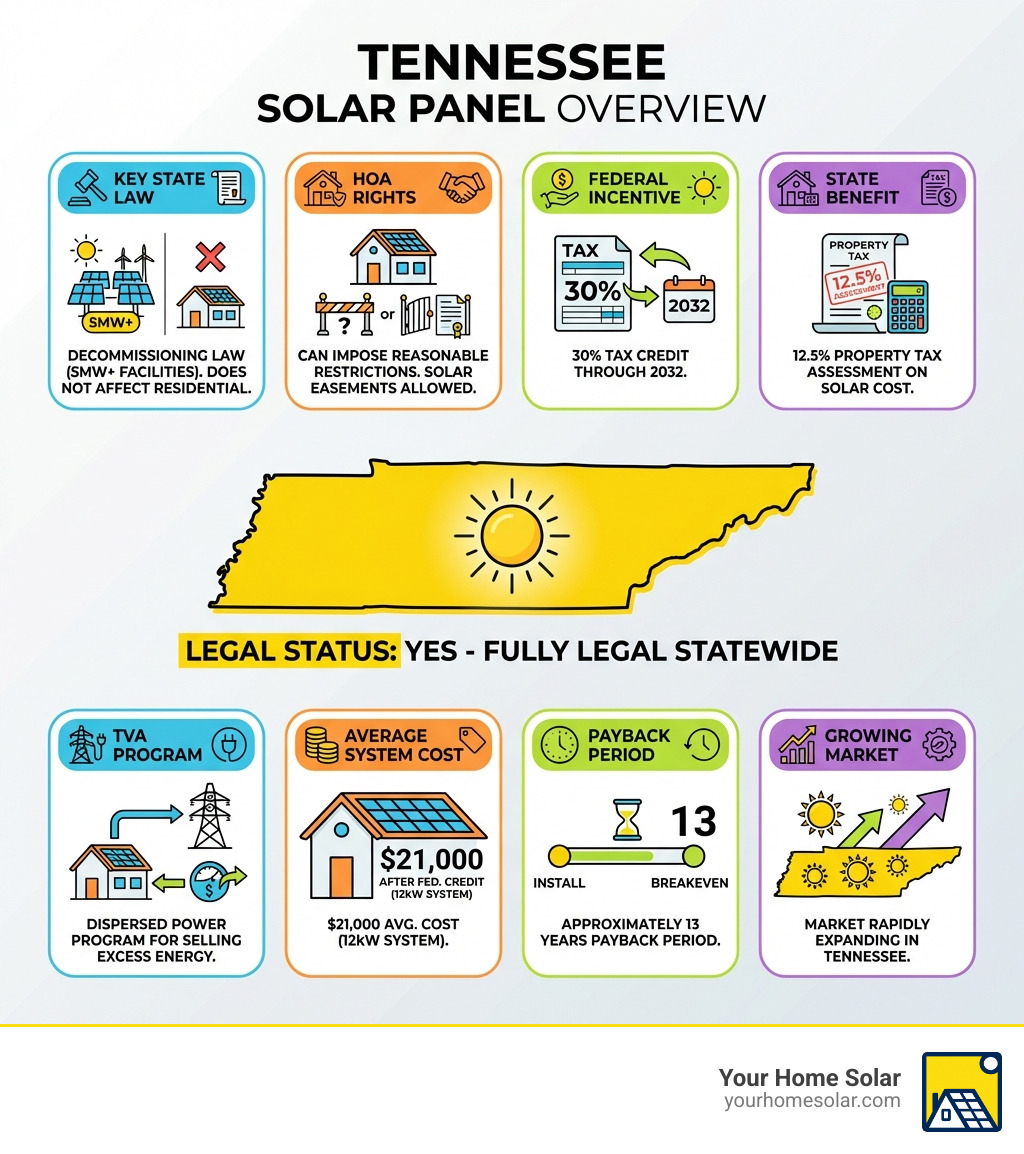
Are solar panels legal in Tennessee? Yes, solar panels are completely legal to install in Tennessee for both residential and commercial properties. Here’s what you need to know:
- Legal Status: Solar panels are legal throughout Tennessee with no statewide restrictions on installation
- Key Legislation: The Tennessee Decommissioning Law (Tenn. Code Ann. § 66-9-207) applies to large utility-scale facilities (5 MW or larger), not residential installations
- HOA Considerations: Tennessee allows solar easements but lacks strong solar access laws, meaning HOAs may impose “reasonable restrictions”
- Primary Incentive: Federal Residential Clean Energy Credit (30% tax credit) plus Tennessee’s partial property tax exemption
If you’re an East Tennessee homeowner concerned about rising energy bills, frequent power outages, or your environmental footprint, you’ve probably wondered whether going solar is even an option in our state. The good news is straightforward: solar panels are legal in Tennessee, and the market is growing rapidly. As of 2022, Tennessee ranked 20th among states for installed solar capacity, with over 60 solar companies operating across the state and a market valued at $1.3 billion.
But legality is just the starting point. Understanding how solar works in Tennessee—including federal tax credits, the Tennessee Valley Authority’s unique role, local zoning requirements, and HOA restrictions—is essential to making a confident decision. The regulatory landscape might seem complex at first, especially when you’re balancing concerns about property rights, long-term savings, and energy independence.
As Ernie Bussell, founder and CEO of Your Home Solar and East Tennessee’s #1 solar energy contractor, I’ve helped countless homeowners steer the question of are solar panels legal in Tennessee and what that means for their specific situation. My background in military operations, education, and solar industry leadership has taught me that clear, honest information is the foundation of every good energy decision.
So, Are Solar Panels Legal in Tennessee? The Official Stance
Let’s cut right to the chase: absolutely, solar panels are legal in Tennessee. There are no state-level laws that prohibit homeowners or businesses in East Tennessee from installing solar energy systems. In fact, the adoption of solar energy, or solar photovoltaics (PV), is on the rise across residential, commercial, and utility-scale uses, driven by decreasing installation costs, available financial incentives, and a growing commitment to sustainable energy sources.
Tennessee’s solar market is vibrant and expanding. In 2022, our state proudly ranked 20th nationally for installed solar capacity, reaching an impressive 129 MW. This growth is supported by a robust local industry, with over 60 companies focused on solar installation as of 2023. The entire solar market in Tennessee is valued at a substantial $1.3 billion.
While we’re still in the early stages compared to some other states, Tennessee’s trajectory aligns with national trends towards cleaner, more sustainable energy. The potential for solar here is immense, with estimates suggesting that rooftop solar panels alone could generate up to 23% of the state’s total electricity usage. This indicates a bright future for solar adoption across East Tennessee, offering significant Advantages of Installing Solar Panels in Tennessee.
Tennessee’s Key Solar Legislation: The Decommissioning Law
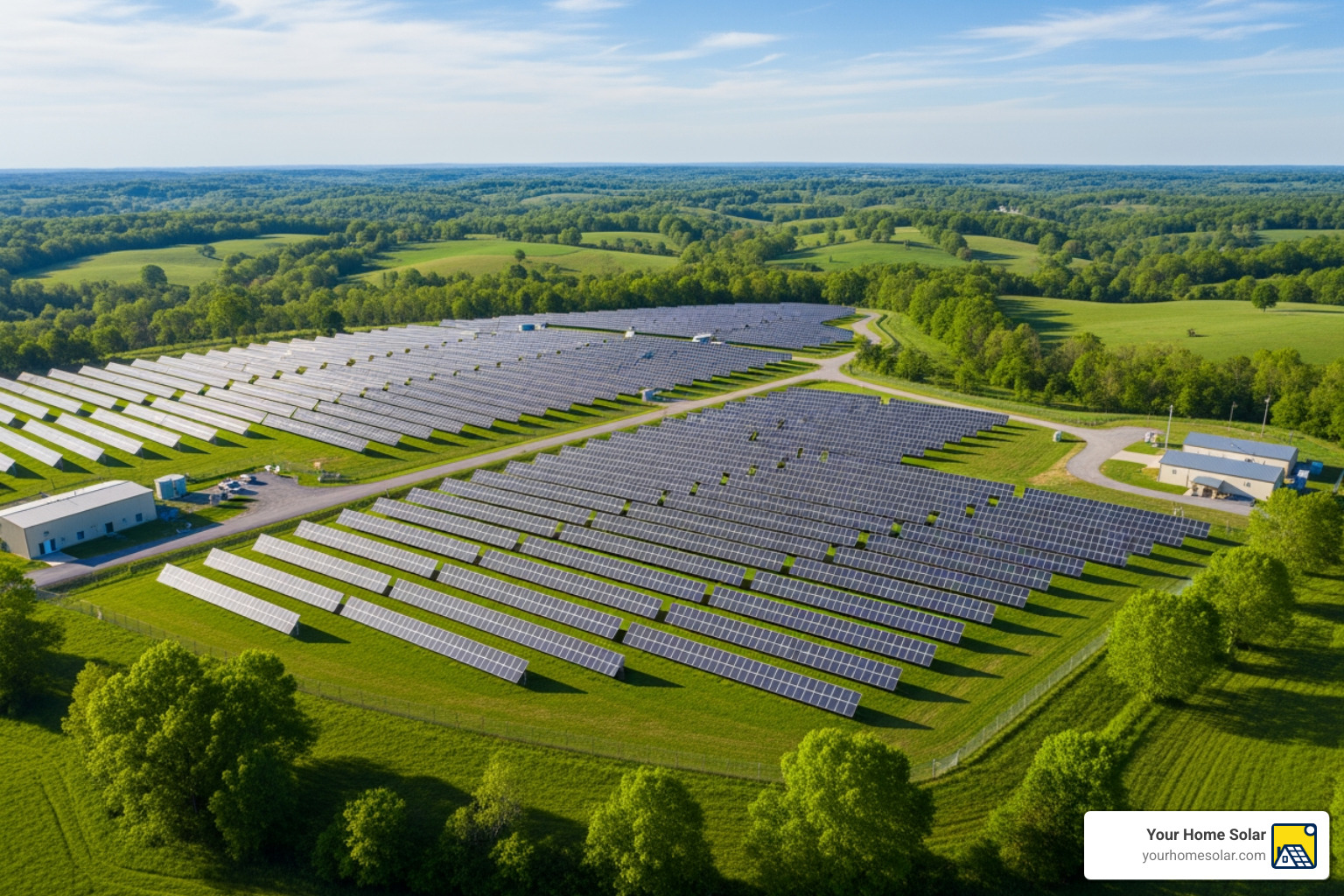
When we talk about specific laws governing solar in Tennessee, it’s interesting to note that there’s only one statewide law that directly addresses solar development: the ‘Decommissioning Law’ (Tenn. Code Ann. § 66-9-207). This law, established in 2022, focuses primarily on large-scale solar power facilities, not your typical residential rooftop system.
The Decommissioning Law imposes requirements on solar power facilities regarding their decommissioning obligations and the removal of components. Essentially, it ensures that when a large solar farm reaches the end of its operational life, the land is restored to its pre-construction condition. This includes provisions for removing all equipment (except for electrical or communications lines buried more than three feet below the surface) and establishing a plan for disconnecting the facility from the grid.
Initially, this law applied to facilities of at least 10 MW. However, effective July 1, 2024, it was amended to apply to solar-generating devices or structures of at least 5 MW. For context, the average home solar system is around 12 kW, which is significantly smaller than the 5 MW threshold. So, while crucial for utility-scale projects, this law typically won’t impact our East Tennessee homeowners directly.
To ensure these requirements are met, solar power facility agreements must include a decommissioning plan with financial assurance. This assurance starts at 5% of the decommissioning cost at the project’s commencement, increases to 50% at the 10th anniversary, and reaches 100% at the 15th anniversary. The TDEC Office of Energy Programs (OEP) is responsible for receiving and storing these agreements. You can find more detailed information on the Tennessee Decommissioning Law and review its Frequently Asked Questions.
The Role of the Tennessee Valley Authority (TVA)
The Tennessee Valley Authority (TVA) plays an enormous, almost monolithic, role in our state’s energy landscape. As a federally-owned corporation, TVA provides electricity to approximately 99.7% of Tennessee’s service territory, including all of East Tennessee. This unique structure means that TVA’s policies heavily influence solar energy development in our region.
One of the most common questions we hear is about net metering: “Can I sell the excess power my panels generate back to the grid?” Here’s the scoop: Tennessee does not have a statewide net metering program. This means that unlike many other states where utilities are mandated to credit solar owners for excess energy at the retail rate, our state leaves it up to individual utilities.
However, TVA operates a program called the Dispersed Power Program, which functions similarly to net metering. Through this program, homeowners can sell their excess solar power back to the grid. The terms and rates for this can vary, so it’s always wise to understand your specific utility’s buyback policy. For a deeper dive into this, check out our guide: Do East Tennessee Utility Companies Buy Back Solar Power? Find Out Here!.
Navigating Local Rules: HOAs, Easements, and Permitting
While state laws confirm solar panels are legal in Tennessee, the journey to installation often involves navigating local rules and regulations. This is where local governments, zoning ordinances, and homeowners’ associations (HOAs) come into play, especially in the diverse communities of East Tennessee from Knoxville to Johnson City.
Local governments have the authority to implement zoning ordinances that guide the development, location, and physical characteristics of solar installations. These ordinances are designed to ensure that solar projects align with community values, aesthetics, and land-use priorities. This can include requirements for setbacks from property lines, buffer zones, and even fencing to mitigate visual impacts. For example, Bedford County has established a “renewable energy development zone” to streamline the approval process for solar projects. While this is a commercial example, it illustrates how local zoning can impact solar development.
The permitting process is another local hurdle. Before any solar installation begins, permits must be secured from your local municipality or county. This ensures that your system meets local building codes, electrical standards, and safety regulations. We work closely with local authorities across East Tennessee to ensure every installation is fully compliant and hassle-free for our customers.
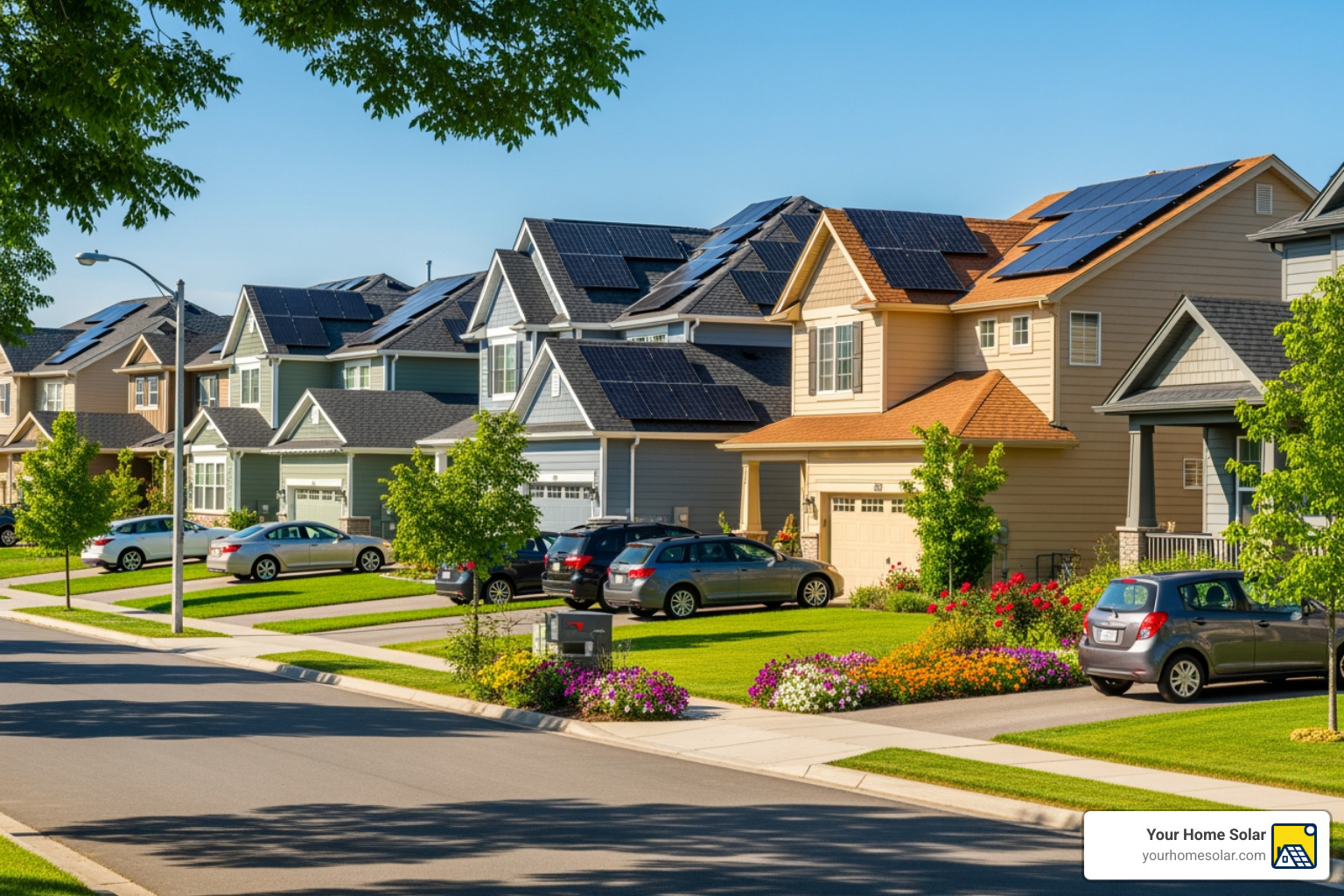
Understanding HOA Rules: Are solar panels legal in Tennessee neighborhoods?
Many of our customers live in communities governed by Homeowners Associations (HOAs), and this is often where questions about solar legality become a bit more nuanced. Are solar panels legal in Tennessee neighborhoods under HOA rules? The answer is generally yes, but with some important caveats.
Unlike many other states that have robust “solar access laws” explicitly limiting an HOA’s power to restrict solar installations, Tennessee does not have such strong statewide protections. This means that HOAs in East Tennessee generally have more leeway to impose rules regarding solar panels.
However, this doesn’t mean they can outright ban solar panels in most cases. What they can, and often do, impose are “reasonable restrictions” regarding the placement, size, and aesthetic integration of your solar array. For instance, an HOA might require panels to be installed on a specific roof plane, or to be screened from street view, or to match certain aesthetic guidelines. These restrictions are usually aimed at maintaining community appearance and property values.
While Tennessee allows residents to create solar easements (which we’ll discuss next), it does not have specific laws that prevent HOA restrictions on solar access. This is a key difference when comparing Tennessee’s solar laws to those in states like California, Florida, or Arizona, where HOAs are legally prohibited from preventing solar installations or imposing restrictions that significantly increase costs or decrease efficiency.
Navigating these HOA waters requires a clear understanding of your specific community’s covenants and bylaws. We always recommend reviewing these documents thoroughly and working with a knowledgeable installer who can help you present your project to your HOA for approval. For more insights into residential solar solutions, you can explore our Residential Solar Solutions Guide.
Solar Easements: Protecting Your Access to Sunlight
Even though Tennessee lacks comprehensive solar access laws to curb HOA power, it does have provisions for solar easements. A solar easement is a legal agreement between property owners designed to ensure that a solar energy system has continued access to sunlight, free from obstruction by neighboring properties.
Think of it this way: if your neighbor plans to build a new addition or plant a tall tree that would shade your solar panels, a solar easement could prevent that. It’s a proactive measure to protect your solar investment by formally guaranteeing your system’s access to sunlight.
Tennessee’s Solar Access Law of 1979 (Tenn. Code Ann. § 66-9-201) allows for the creation of these easements. These are typically voluntary agreements negotiated between property owners. An easement should clearly define the dimensions of the solar energy device, the area of the airspace or property that must remain unobstructed, and any terms for compensation or maintenance.
While not as broad as a statewide solar access law that directly limits HOA power, solar easements are a valuable tool for East Tennessee homeowners. They provide a legal framework to protect your panels from future shading issues, offering peace of mind and safeguarding the long-term performance of your system. We can guide you through understanding how a solar easement might benefit your specific property and help you protect your investment from potential future obstructions.
The Financial Side of Solar in Tennessee
One of the most compelling reasons homeowners in East Tennessee are asking are solar panels legal in Tennessee is the financial benefit. While the initial investment might seem significant, the long-term savings and incentives make solar an increasingly attractive option.
The cost of solar power in Tennessee has become more accessible over the years. As of 2023, solar power in our state typically averages about $2.49 per watt. For the average East Tennessee home, which often installs a 12 kW (12,000-watt) system, the upfront cost might be around $30,000 before incentives. However, this is where the financial benefits truly shine.
With the federal Residential Clean Energy Credit, this upfront cost can be significantly reduced. For a $30,000 system, that’s a $9,000 deduction, bringing the net cost down to approximately $21,000. These systems are built to last, with a typical lifespan of 25 years or more. Over that quarter-century, Tennessee residents can experience significant savings, potentially recouping their investment in about 13 years and enjoying an estimated $55,000 or more in net savings over the system’s lifetime.
Beyond direct savings, solar panels also add value to your home. Studies show that for every $1 saved on your yearly energy bill with solar, your property value increases by $20. So, not only are you saving money every month, but you’re also building equity in your home.
What are the financial benefits if are solar panels legal in tennessee?
The question of are solar panels legal in Tennessee is quickly followed by “what incentives are available?” While Tennessee’s state-specific incentives are limited, federal programs offer substantial savings that make solar a smart investment for East Tennessee homeowners.
The most significant financial boost comes from the federal Residential Clean Energy Credit. This fantastic incentive allows you to deduct 30% of the cost of your solar system installation directly from your federal taxes. This credit is available through 2032, making now an excellent time to go solar. To claim this credit, you’ll need to complete IRS Form 5695 and attach it to your federal tax return. It’s a non-refundable credit, meaning it can reduce your tax liability to zero, and any excess can be carried forward to future tax years.
On the state level, Tennessee offers a partial property tax exemption for solar installations. Rather than taxing the full value of your solar system, our state only assesses 12.5% of the installation cost for property tax purposes. This significantly minimizes any increase in your property tax bill due to your new solar array. For example, a $16,000 solar system on a $250,000 home might only add about $12 annually to your property taxes.
As mentioned earlier, while we don’t have statewide net metering, the TVA’s Dispersed Power Program allows you to sell excess energy back to the grid. This means your panels are always working for you, even when you’re not directly using all the power they generate.
These incentives, combined with the long-term savings on electricity bills (especially given that East Tennessee residents’ electricity usage is about twice the national average), make the average payback period for a solar system in Tennessee around 13 years. While this might be a bit longer than the national average, considering systems last 25 years or more, you’ll enjoy over a decade of free electricity. For a comprehensive overview of incentives, check out our Solar Incentives Tennessee 2026 Guide.
Finding a Reputable Installer
Once you’ve confirmed that solar panels are legal in Tennessee and understood the financial benefits, the next crucial step is choosing the right installer. This decision can significantly impact the efficiency, reliability, and longevity of your solar system. With over 60 solar companies operating in Tennessee, do your homework.
We recommend asking prospective solar installers a few key questions to ensure you’re partnering with a trusted expert:
- Are you a NABCEP Certified PVIP Installation Professional? The North American Board of Certified Energy Practitioners (NABCEP) offers a voluntary certification that sets national standards for solar professionals. This indicates specialized knowledge beyond a basic electrical license.
- Where are you based? Do you have a local office? Choosing a local company like Your Home Solar means you’re partnering with someone invested in the East Tennessee community. Local companies often rely on referrals, ensuring a higher commitment to customer satisfaction and easier access for ongoing maintenance and support.
- Do you use local installers or subcontractors from outside the area? Local companies and their employees are typically more invested in their community and reputation. They’re also more accessible for quicker response times if issues arise.
- Has the salesperson installed or serviced a solar system? A salesperson with hands-on experience can offer more accurate advice, answer technical questions confidently, and provide realistic expectations for your project.
Beyond these questions, we encourage you to vet companies thoroughly. Check for appropriate licensing and bonding in Tennessee, look for several years of experience, and read reviews on platforms like the Better Business Bureau or inquire with the Tennessee Division of Consumer Affairs. Clear communication throughout the project is paramount. For more guidance, explore our Best Solar Companies Tennessee Reviews.
Frequently Asked Questions about Tennessee Solar Laws
We understand you might have more specific questions as you consider going solar in East Tennessee. Let’s tackle some common FAQs:
Can my HOA completely ban me from installing solar panels in Tennessee?
While Tennessee does not have strong statewide solar access laws that explicitly prevent HOAs from restricting solar panels, they generally cannot impose an outright ban. HOAs in East Tennessee can, however, implement “reasonable restrictions” regarding the placement and aesthetics of your solar system. This means they might dictate where on your roof the panels can go, or require them to be screened from public view, to maintain community standards.
It’s important to review your HOA’s specific covenants and bylaws and work with a knowledgeable solar installer who can help you steer these rules. Additionally, Tennessee does allow for solar easements, which can protect your access to sunlight.
Does Tennessee offer state-level rebates for solar panels?
Currently, Tennessee does not offer statewide rebates or direct tax credits specifically for residential solar panel installations. The primary financial incentive for homeowners remains the federal Residential Clean Energy Credit (the 30% federal tax credit).
However, our state does offer a significant benefit through a partial property tax exemption for solar installations. This means only 12.5% of the cost of your solar system is factored into your property tax assessment, substantially reducing any potential tax increase. Furthermore, the TVA’s Dispersed Power Program allows you to sell excess electricity generated by your panels back to the grid, providing ongoing financial benefit.
What is the difference between solar access laws and solar easement laws?
These two terms, while related, serve different purposes in the context of solar energy rights.
Solar access laws are legislative measures, typically at the state level, that protect a property owner’s right to install and operate a solar energy system. These laws often prevent local governments or HOAs from prohibiting solar installations or imposing unreasonable restrictions that significantly increase costs or decrease system efficiency. Many states have strong solar access laws, but Tennessee is not one of them.
Solar easement laws, on the other hand, are legal agreements between two or more property owners. They are designed to ensure that a specific solar energy system on one property continues to receive unobstructed sunlight from a neighboring property. This means if your neighbor were to build a new structure or grow trees that would shade your panels, a pre-existing solar easement could prevent that. Tennessee does have solar easement laws (Tenn. Code Ann. § 66-9-201), allowing homeowners to proactively protect their solar access through mutual agreement.
Your Next Steps Toward Solar Energy
The answer to are solar panels legal in Tennessee is a resounding yes, and the Volunteer State’s solar landscape holds immense potential for homeowners and businesses alike. While we may not have all the state-level incentives found in some other regions, the powerful federal tax credit, combined with Tennessee’s unique property tax exemption and the TVA’s programs, creates a compelling financial case for going solar.
Navigating the specifics of federal incentives, understanding how the TVA’s Dispersed Power Program works, and ensuring compliance with local zoning ordinances and HOA guidelines can seem like a lot to take in. That’s precisely why partnering with a trusted local expert is so crucial.
At Your Home Solar, we pride ourselves on providing comprehensive home energy solutions custom specifically for East Tennessee residents. From Knoxville to Johnson City, and all the counties in between, we understand the local nuances and are dedicated to guiding you through every step of the process. Our commitment to trusted expertise and 100% customer satisfaction means you get a reliable and rewarding installation that brings you closer to energy independence.
Ready to explore your solar options and see how much you can save? Don’t let the details overwhelm you. Let us help you open up the full potential of solar energy for your home.