Why Understanding the True Cost Matters for Commercial Solar
The 100 kilowatt solar system cost typically ranges from $175,000 to $400,000 before incentives, but the final price depends heavily on your specific site conditions, equipment choices, and available tax credits. Here’s what you need to know:
Quick Cost Breakdown:
- Average Total Cost: $175,000 – $225,500 (before tax credits)
- Cost Per Watt: $0.95 – $1.83 per watt
- After Federal ITC (26%): ~$129,500 – $166,870
- Annual Energy Production: 100,000 – 130,000 kWh
- Space Required: 6,500 – 10,000 square feet
If you’re a business owner in East Tennessee looking at solar, you’re probably balancing two concerns: the upfront investment and the long-term savings. A 100kW system is a serious commitment—it’s designed for medium to large commercial operations, farms, or industrial facilities with significant energy needs. But it’s also a powerful hedge against rising utility rates and a path toward energy independence.
The numbers matter, but so does the context. Your roof condition, available land, local labor rates, and whether you qualify for accelerated depreciation all play a role in your final cost. The good news? With federal incentives like the Investment Tax Credit (ITC) and the Modified Accelerated Cost Recovery System (MACRS), businesses often recover 45% of their investment in the first year alone.
I’m Ernie Bussell, founder and CEO of Your Home Solar, and I’ve spent years helping East Tennessee businesses steer the complexities of commercial solar, including accurately estimating the 100 kilowatt solar system cost for diverse applications from farms to industrial facilities. My background in operations management and solar project oversight has taught me that transparency in pricing is the foundation of good decision-making.
Breaking Down the 100 Kilowatt Solar System Cost
Understanding the itemized expenses for a typical 100kW commercial solar project is crucial for any East Tennessee business considering this significant investment. It helps you see exactly where your money goes and what factors contribute to the overall price tag.
What is the Average 100 kilowatt solar system cost?
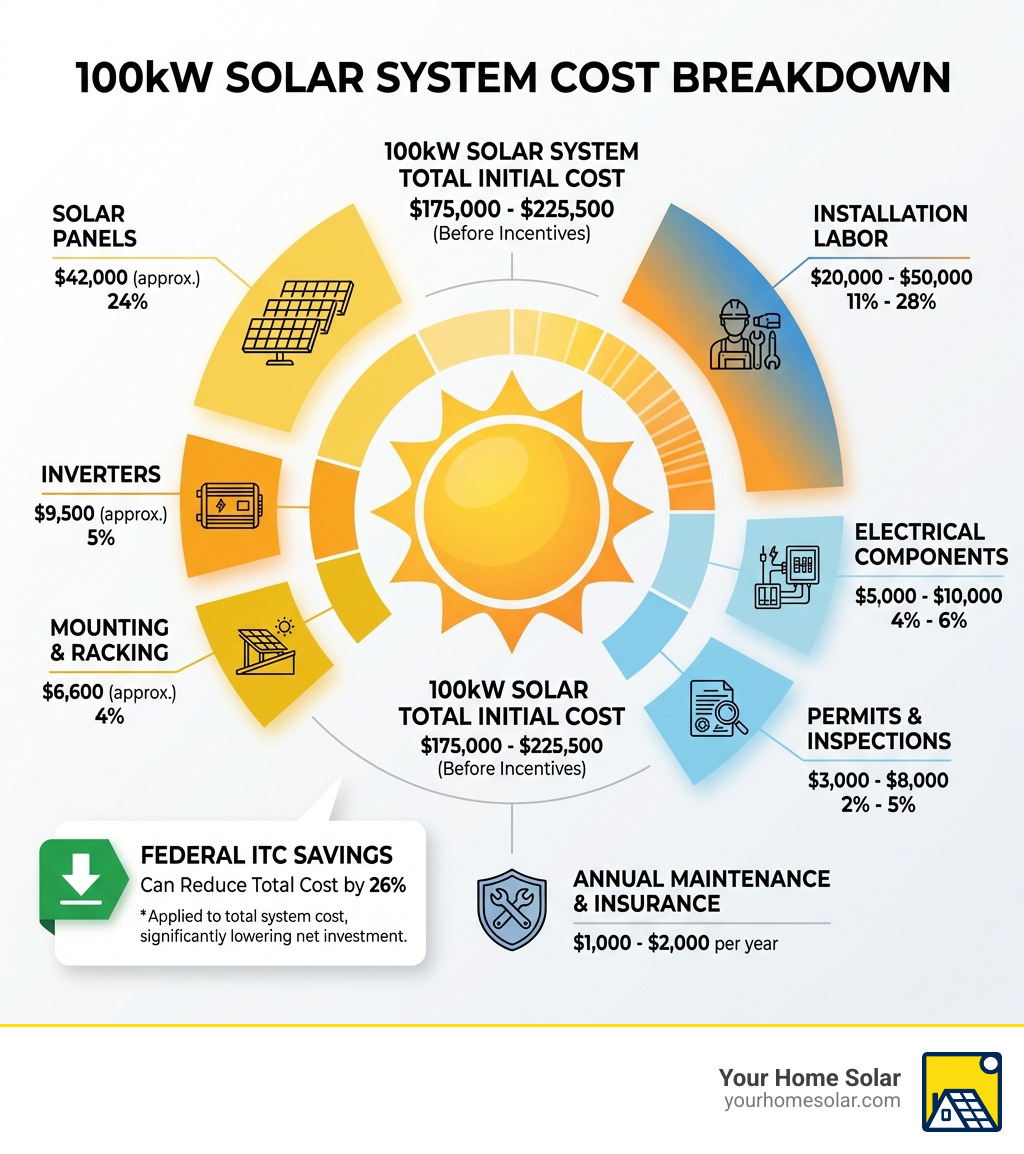
The average 100 kilowatt solar system cost for commercial applications in the United States generally falls between $200,000 and $400,000. More specifically, before any tax credits or incentives are applied, you can expect a range of $175,000 to $225,500. This translates to a price per watt of roughly $0.95 to $1.83. For instance, some 100kW solar kits are priced from $0.95 to $1.25 per watt, while the commercial average is around $1.83 per watt.
This pricing typically covers what we call a “turnkey installation.” A turnkey solution means that from the initial design and permitting to the final installation and grid connection, everything is handled by your solar provider. It simplifies the process for you, ensuring a seamless transition to solar power. For more details on overall solar costs and financing options, you can explore our guide on Cost and Financing of Solar Systems.
Core Equipment Expenses
The heart of any solar system lies in its components. For a 100kW setup, these are the primary drivers of cost:
- Solar Panels: These are the most visible part of your system. For a 100kW system, you’ll typically need around 250-300 solar panels, each rated at 400W or higher. The cost of these panels alone can be around $42,000, representing a significant portion of the total investment.
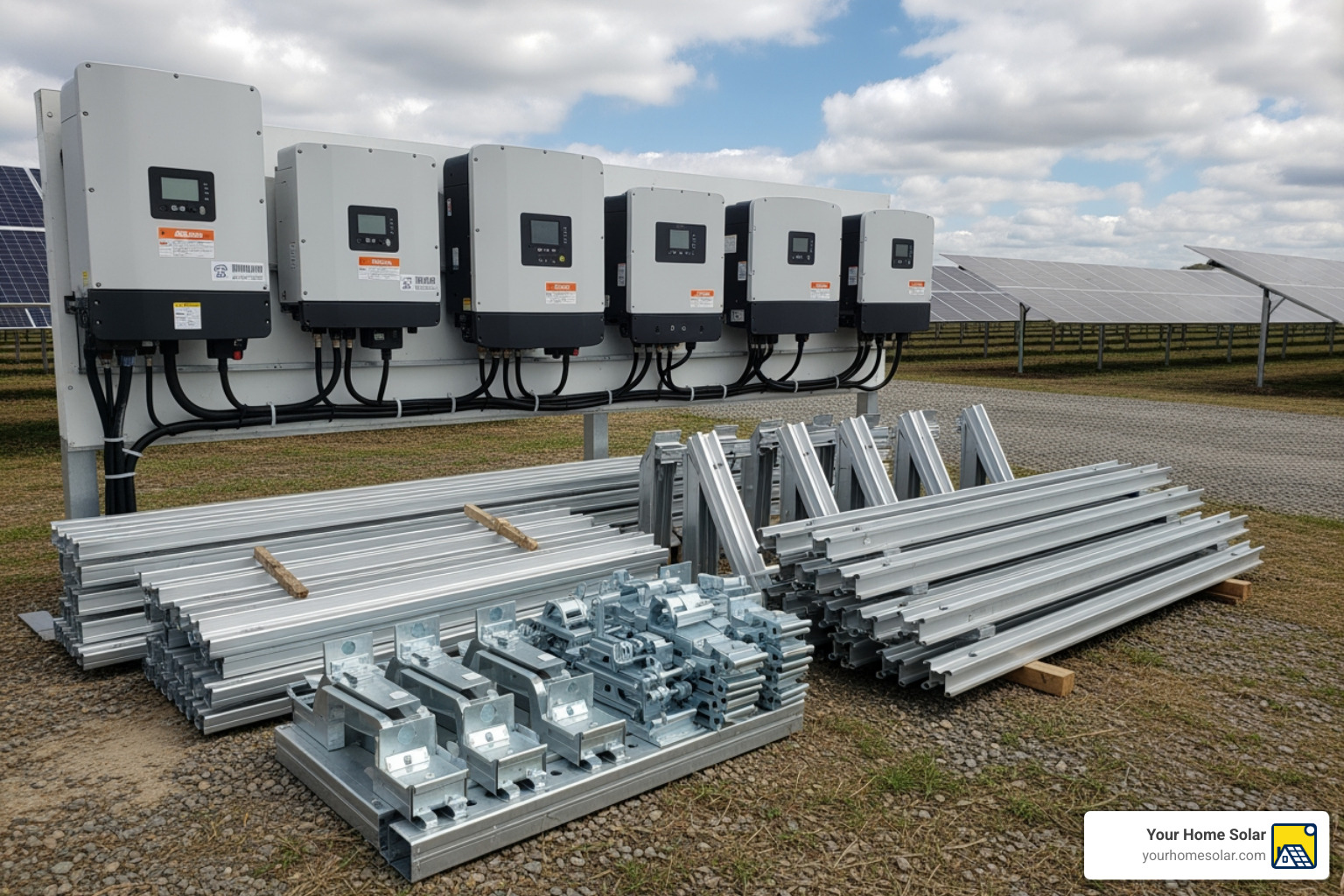
- Inverters: Inverters convert the direct current (DC) electricity generated by your solar panels into alternating current (AC) electricity, which is what your business uses. For a 100kW system, the inverters can cost approximately $9,500.
- Mounting and Racking: This is the physical structure that holds your solar panels in place, whether on a rooftop or the ground. High-quality, durable mounting and racking are essential for the longevity and safety of your system. For a 100kW system, these components typically cost around $6,600.
- Electrical Components: This category includes all the wiring, conduits, circuit breakers, disconnects, and other electrical hardware needed to safely integrate your solar system with your business’s electrical infrastructure and the grid. These components can range from $5,000 to $10,000.
- Balance of System (BOS): This is an umbrella term for all the other components that make the system work, beyond the panels and inverters. It includes wiring, switches, monitoring systems, and other miscellaneous hardware.
Soft Costs: Labor, Permitting, and More
Beyond the physical equipment, a substantial portion of the 100 kilowatt solar system cost comes from “soft costs.” These are essential services and administrative fees that ensure your system is designed correctly, installed safely, and compliant with all local regulations in East Tennessee.
- Installation Labor Costs: Installing a commercial-scale solar system requires skilled professionals including electricians, roofers, and general laborers. These costs can range significantly, typically from $20,000 to $50,000 for a 100kW system, depending on the complexity of the installation and local labor rates in areas like Knoxville, Chattanooga, or Johnson City.
- Permitting Fees: Before any construction can begin, permits must be obtained from local authorities. These fees vary by municipality and ensure that your installation meets safety and building codes.
- Inspection Costs: Once installed, your system will undergo several inspections by local building and electrical authorities to verify compliance before it can be connected to the grid.
- Engineering and Design Fees: A professional solar design includes detailed plans, structural analyses, and electrical schematics custom to your specific site. This ensures maximum efficiency and safety.
- Grid Interconnection Fees: Connecting your solar system to the utility grid involves administrative processes and sometimes fees from your local utility provider (e.g., TVA, Knoxville Utilities Board, etc.) to ensure seamless integration and net metering capabilities.
Ongoing Maintenance and the Long-Term 100 kilowatt solar system cost
While the upfront 100 kilowatt solar system cost is a primary concern, it’s equally important to consider the long-term operational expenses. Thankfully, solar systems are relatively low-maintenance, but some ongoing costs are necessary to ensure optimal performance and longevity.
- Annual Maintenance Estimates: We recommend annual check-ups to ensure your system is running efficiently. This can include cleaning panels, checking electrical connections, and monitoring system performance. Annual maintenance costs can be around $1,000 to $2,000. For comprehensive tips on keeping your system running smoothly, check out our guide on Solar Panel Maintenance Knoxville.
- Insurance Costs: Protecting your investment with adequate insurance is wise. This typically involves adding your solar system to your existing property insurance policy. The additional cost can be a few hundred dollars per year, depending on your provider and coverage.
- Component Lifespan: Modern solar panels are incredibly durable, designed to last 25 to 30 years or more. With proper maintenance, your system can operate efficiently for many years beyond its expected lifespan. Inverters typically have a shorter lifespan (10-15 years) and may need replacement once or twice over the system’s lifetime. For more insights into how long solar systems last, refer to How Long Does a Residential Solar System Last? Your Home Solar Has the Answer.
Key Factors That Influence Your Final Price Tag
The total 100 kilowatt solar system cost can vary significantly based on your specific site and equipment choices. Understanding these variables is crucial for accurate budgeting and ensuring you get the most value for your investment in East Tennessee.
Equipment Quality and Brand
Just like with any major purchase, the quality and brand of your solar equipment play a huge role in the overall cost and performance of your 100kW system.
- Tier 1 vs. Tier 2 Panels: Tier 1 manufacturers are typically large, established companies that have been in business for many years, invest heavily in R&D, and have fully automated manufacturing processes. Their panels often come with longer warranties and better performance guarantees, but also a higher price point. While Tier 2 panels might be more budget-friendly, they might not offer the same long-term reliability or efficiency.
- Inverter Types: The choice of inverter impacts both cost and performance. Central inverters are often used for larger commercial systems due to their cost-effectiveness per watt. However, string inverters with optimizers or micro-inverters can offer benefits like panel-level monitoring and improved performance in shaded conditions, albeit at a potentially higher cost.
- Panel Efficiency: More efficient panels can generate more electricity from a smaller footprint. This can be a critical factor if you have limited roof or ground space. Higher efficiency often comes with a higher price per panel, but it might reduce the total number of panels needed, influencing the overall 100 kilowatt solar system cost.
- Warranty Differences: Panels typically come with performance warranties (guaranteeing a certain output over 25-30 years) and product warranties (covering defects for 10-25 years). Inverters usually have a 10-12 year warranty. Stronger, longer warranties often reflect higher quality and can provide greater peace of mind.
For a deeper dive into solar panel technology, our Comprehensive Guide to Understanding Solar Panels offers valuable insights.

Installation Complexity: Rooftop vs. Ground-Mount
The physical location and method of installation are significant cost drivers for a 100kW system.
- Rooftop Installation:
- Rooftop Condition: The age and structural integrity of your commercial building’s roof are paramount. If the roof needs significant repairs or replacement, these costs must be factored in before solar installation. Our expert advice on Will Putting a Solar System on My Roof Damage It? Expert Advice for East Tennessee Homeowners provides relevant insights for commercial properties as well.
- Roof Type and Pitch: Complex rooflines, multiple angles, or unusual materials can increase labor time and the need for specialized mounting hardware.
- Accessibility: Easy access to the roof for equipment and personnel can keep labor costs down.
- Ground-Mount Installation:
- Ground Preparation: This can involve clearing land, grading, and ensuring proper drainage. The type of soil also influences the foundation required for the racking system.
- Labor Intensity: While ground-mounts can sometimes be easier to install than complex rooftops, they often require more extensive trenching for electrical conduits and more substantial foundational work.
- Innovative Mounting Systems: Newer technologies in mounting systems can significantly reduce installation time and costs. These systems can minimize the need for heavy equipment and extensive geotechnical reports, making ground-mounts more efficient and cost-effective, especially for larger projects in East Tennessee’s diverse terrain.
Geographic Location and Site Conditions
Where your business is located within East Tennessee and the specific characteristics of your property have a direct impact on the 100 kilowatt solar system cost.
- Solar Irradiance: East Tennessee generally receives good sunlight, but the exact amount varies depending on specific microclimates and elevation. More sunlight means more energy generated, potentially requiring fewer panels to meet your needs, thus affecting costs.
- Local Labor Rates: Labor costs can fluctuate across different counties in East Tennessee, from Knox County to Hamilton County. This impacts installation expenses.
- Shading Analysis: Any trees, adjacent buildings, or other obstructions that cast shadows on your proposed solar array will reduce its energy production. A thorough shading analysis is crucial during the design phase, and mitigation (e.g., trimming trees, choosing a different location, or using micro-inverters) can add to the cost.
- Property Accessibility: If your site is difficult to access for delivery of materials or heavy equipment, it can increase logistical costs.
- Permitting and Regulations: While we handle all necessary permits, the specific requirements and associated fees can vary slightly between cities like Knoxville, Chattanooga, or Johnson City, and rural areas within our service region.
Understanding these localized factors is key to an accurate estimate. Our team at Your Home Solar specializes in Solar Panel Viability in Tennessee and can provide precise assessments for your specific location.
Opening up the Value: ROI, Incentives, and Energy Production
A 100kW system isn’t just an expense; it’s a major asset designed to provide significant returns. This section explores its energy output, financial benefits, and the powerful incentives that make it an attractive investment for East Tennessee businesses.
How Much Electricity Will a 100kW System Generate?
One of the most exciting aspects of installing a 100kW solar system is the sheer volume of clean electricity it can produce.
- Annual kWh Production: A 100kW commercial solar system can generate approximately 100,000 to 130,000 kWh annually. This is a substantial amount of power, capable of covering a significant portion, if not all, of a medium to large commercial business’s energy needs. To put it in perspective, some 100kW solar kits are estimated to generate around 12,000 kWh of AC power per month, assuming optimal conditions (at least 5 sun hours per day with a south-facing array).
- Factors Affecting Output: Several factors influence the actual energy generated:
- Sunlight Hours: The amount of direct sunlight your system receives in East Tennessee.
- Panel Orientation and Tilt: Optimally facing south with an appropriate tilt.
- Shading: Any obstructions can reduce output.
- Panel Efficiency: Higher efficiency panels produce more power per square foot.
- Temperature: Solar panels perform slightly better in cooler temperatures than in extreme heat.
- Powering a Business: For businesses with high energy demands, such as manufacturing plants, large agricultural operations, or commercial buildings with extensive HVAC systems in East Tennessee, a 100kW system can lead to dramatic reductions in utility bills. This level of power generation often makes a business a net energy producer at certain times, potentially earning credits through net metering where available.
For insights into how we size systems to maximize energy production for your specific needs, visit Properly Sizing a Solar System for Your East Tennessee Home: Expert Tips. While this article focuses on homes, the principles apply to commercial sizing as well.
Federal, State, and Local Incentives
The 100 kilowatt solar system cost can be significantly offset by a variety of powerful incentives, making solar an even more financially attractive proposition for businesses.
- Federal Solar Investment Tax Credit (ITC): This is arguably the most impactful incentive. The federal government provides a Solar Investment Tax Credit (ITC) that allows businesses to deduct a significant portion of the cost of installing a solar energy system from their federal taxes. As of recent data, the ITC can cover 26% of the installation cost. For example, if your 100kW system costs $250,000, the ITC could deduct $65,000 from your tax liability.
- Modified Accelerated Cost Recovery System (MACRS): Businesses can also benefit from Modified Accelerated Cost Recovery System (MACRS), which allows them to recover the cost of solar energy systems through depreciation deductions. Under MACRS, the cost of the solar system can be depreciated over five years, providing significant tax benefits. This means you can write off a large portion of your investment much faster than traditional assets.
- State-Specific Rebates and Utility Programs: While Tennessee may not have as many state-level incentives as some other states, local utility providers (like TVA and its distributors across East Tennessee) often offer their own programs, grants, or net metering policies that can further improve the financial viability of your solar project. It’s crucial to check what’s available in your specific service area, whether you’re in Knoxville, Chattanooga, or a rural county like Blount or Loudon.
We keep a close eye on these opportunities to maximize your savings. Our Solar Incentives Tennessee 2026 Guide provides up-to-date information on what’s available for East Tennessee businesses.
Financing Your Commercial Solar Project
The upfront 100 kilowatt solar system cost doesn’t have to be a barrier. Several financing options are available to help businesses acquire solar power without a massive initial cash outlay.
- Solar Loans: These are traditional loans specifically for solar installations. They can be secured or unsecured and are offered by various financial institutions. The business owns the system, benefiting from tax incentives and energy savings.
- Power Purchase Agreements (PPAs): With a PPA, a third-party developer owns, operates, and maintains the solar system on your property. You, the business owner, simply purchase the electricity generated by the system at a predetermined, often lower, rate. This eliminates upfront costs and maintenance responsibilities.
- Solar Leases: Similar to a PPA, a solar lease allows you to use the solar system without owning it. You pay a fixed monthly “rent” for the system, and the developer handles maintenance.
- Cash Purchase: If your business has the capital, a cash purchase offers the highest long-term savings and the quickest return on investment, as you immediately own all the generated power and qualify for all available incentives.
- Return on Investment (ROI) and Payback Period: With the right combination of energy savings and incentives, a 100kW commercial solar system typically offers a strong ROI. Many businesses find that the payback period (the time it takes for savings to offset the initial investment) can be surprisingly short, especially after factoring in the ITC and MACRS. Businesses can often recover about 45 percent of solar panel costs within the first year through tax credits and rebate programs.
Frequently Asked Questions about 100kW Solar Systems
We often get asked similar questions by businesses in East Tennessee considering a 100kW solar system. Here are some of the most common ones:
How much space is needed for a 100kW solar system?
The space required for a 100kW solar system depends on whether it’s a rooftop or ground-mounted installation and the efficiency of the panels used.
- Rooftop Space Requirements: For a rooftop system, you’ll generally need between 6,500 and 10,000 square feet of usable, unshaded roof space. The lower end of this range (e.g., 6,500 sq ft) might be achievable with higher-efficiency panels that generate more power from a smaller area.
- Ground-Mount Space Requirements: If you opt for a ground-mounted system, you’ll typically need around 8,000 to 10,000 square feet of open land. This allows for optimal spacing between panel rows to prevent shading and accommodate access for maintenance.
- Panel Efficiency Impact: Higher-efficiency panels require less surface area to achieve the 100kW capacity, which can be a significant advantage if your available space is limited. Conversely, lower-efficiency panels will require more square footage.
How long does it take to install a 100kW system?
The timeline for installing a 100kW solar system can vary, but we work efficiently to minimize disruption to your business operations in East Tennessee.
- Typical Timeline: While the physical installation of some innovative mounting systems can be quite fast (ee.g., a few weeks for a 100kW array), the entire process from initial consultation to final commissioning typically takes longer due to administrative steps.
- Permitting Phase: This initial stage involves site assessment, system design, and obtaining all necessary permits from local authorities. This can be the longest phase, often taking several weeks to a few months, depending on the municipality in East Tennessee.
- Site Preparation: Once permits are secured, we prepare the site. For rooftop systems, this might involve minor roof repairs. For ground-mounts, it includes land clearing, grading, and foundation work.
- Installation Phase: This is where the panels, inverters, and racking are physically installed. For a 100kW system, the actual installation can often be completed within a few weeks, depending on the crew size and system complexity.
- Inspection and Commissioning: After installation, the system undergoes final inspections by local authorities and the utility company. Once approved, it’s commissioned and connected to the grid, at which point you start generating your own clean power!
For a general idea of what to expect during the installation process, our guide on What to Expect During a Solar Installation for Your East Tennessee Home provides a helpful overview that applies to many commercial aspects as well.
What is the expected lifespan of a 100kW solar system?
Investing in a 100kW solar system is a long-term commitment, and we’re proud to offer systems built for durability and longevity.
- 25-30 Year System Life: A 100kW commercial solar panel system typically has an expected lifespan of 25 to 30 years. Many systems continue to operate effectively beyond this period, albeit with a slight decrease in efficiency.
- Panel Degradation Rate: Solar panels are designed to be highly durable, but they do experience a slight decrease in power output over time, known as degradation. This is usually around 0.5% to 1% per year. Most panel warranties guarantee a certain percentage of original output (e.g., 80-85%) after 25 years.
- Inverter Lifespan: Inverters are typically the components with the shortest lifespan, often lasting 10 to 15 years. They will likely need to be replaced at least once during the system’s overall lifespan.
- Racking Durability: High-quality mounting and racking systems are built to withstand harsh weather conditions and are designed to last as long as the panels themselves, often 25 years or more.
- Warranty Periods: We only use components from reputable manufacturers with strong warranties covering performance, product defects, and workmanship. This protects your investment for decades.
You can learn more about the longevity of solar components in our article on Solar Panel Durability: How Long Do They Last?.
Is a 100kW System the Right Move for Your East Tennessee Business?
The 100 kilowatt solar system cost represents a significant investment, but the long-term benefits for businesses and farms in East Tennessee are often compelling. We’ve explored the average costs, broken down the components, discussed the factors that influence your final price tag, and highlighted the substantial energy production and financial incentives available.
A 100kW system can generate 100,000 to 130,000 kWh annually, providing a powerful hedge against rising energy costs and a clear path to energy independence. With federal incentives like the ITC and MACRS, the effective cost can be significantly reduced, leading to attractive payback periods and strong returns on investment.
However, every business is unique. Your specific energy needs, available space, local site conditions, and financial goals will determine if a 100kW system is the perfect fit. That’s where our expertise at Your Home Solar comes in. We pride ourselves on being trusted experts, offering custom, reliable, and rewarding installations with 100% customer satisfaction. We provide comprehensive home energy solutions in East Tennessee, including solar, backup generators, and EV chargers, and we’re ready to bring that same trusted expertise to your commercial project.
We encourage you to partner with an experienced local provider like us who understands the nuances of solar in East Tennessee, from permitting in Knoxville to optimizing for agricultural operations in Blount County. We can help you steer the complexities, maximize your incentives, and design a system that delivers maximum value for your business.
Ready to explore how a 100kW solar system can transform your business? Learn more about solar financing options or contact us today for a personalized consultation. Let’s make your gigawatt dream a reality.