Key Criteria for Selecting the Best Household Solar Panels
When evaluating solar modules, looking strictly at the front-label wattage rating does not tell the full story. Understanding how a module behaves under real-world conditions requires balancing technical specifications like module efficiency, temperature response, physical durability, and long-term warranty coverage. For a deeper dive into the basic science behind these systems, see our Comprehensive Guide to Understanding Solar Panels.
Panel Efficiency, Power Density, and Output Ratings
Panel efficiency measures how effectively a solar module converts sunlight hitting its surface into usable electricity. In 2026, standard Standard Test Conditions (STC) efficiency ratings for top-tier residential modules typically exceed 22%. High-efficiency panels allow you to generate more power per square foot, making them critical for homes with limited or structurally complex roof layouts.
Modern high-efficiency panels rely heavily on N-type monocrystalline silicon wafers rather than traditional P-type wafers. N-type cells utilize enhanced rear passivation techniques that reduce charge carrier recombination, yielding higher efficiency and significantly lower Light-Induced Degradation (LID). Furthermore, premium manufacturers utilize high-transparency encapsulants—the protective clear adhesive layers surrounding the silicon cells—to ensure maximum sunlight penetration into the active silicon. Discover how these advancements make rooftop power generation more practical in our article explaining Why Solar Panels for Home Are a Smart Investment.
Temperature Coefficient and Low-Light Performance
Standard solar panel output ratings are determined in laboratory settings at 25°C (77°F). However, on hot summer days across East Tennessee, dark rooftop panels frequently reach operating temperatures up to 75°C (167°F). Solar silicon naturally loses output as ambient heat increases.
This output drop is measured by the temperature coefficient, which dictates the percentage of power lost for every degree Celsius above 25°C. For instance, a panel with a temperature coefficient of -0.24%/°C will retain significantly more energy in high heat than a panel rated at -0.35%/°C.
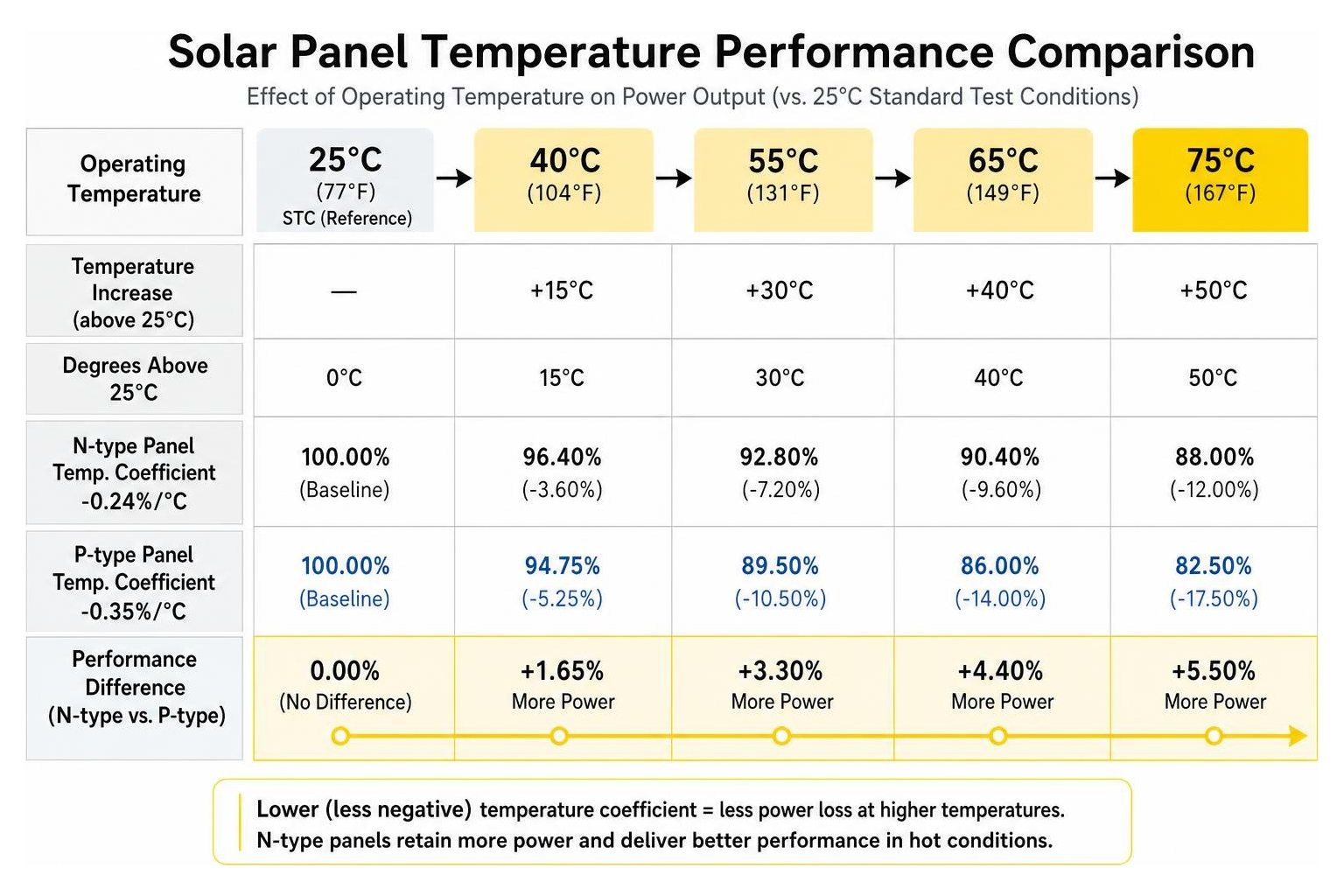
In addition to heat tolerance, N-type cells provide enhanced sensitivity to low-light and diffuse light conditions, enabling panels to generate power earlier in the morning, later in the evening, and under overcast skies.
Warranties, Linear Degradation, and Mechanical Durability
Solar panel performance naturally decreases slightly each year due to environmental exposure. A premium panel typically features an initial year-one degradation of around 1% (or less), followed by an annual linear degradation rate as low as 0.25% to 0.33% from years 2 through 25 or 30.
Evaluating durability also requires looking at physical construction and load ratings:
- Front Surface Load Tolerance: Premium panels are built to withstand heavy snow and ice loads up to 5,400 Pascals (Pa), or approximately 112.8 lbs/ft².
- Rear Surface Load Tolerance: Modules resist wind uplift pressures up to 4,000 Pa (83.5 lbs/ft²).
- Hail Resistance: Tempered front glass protects delicate silicon wafers from physical impacts.
- Warranty Scope: Top-tier manufacturers back their equipment with 25-to-40-year product (workmanship) and performance (output) warranties. Some brands even include labor reimbursement allowances (up to $450 per module) to assist with service costs if a repair is needed.
Brand Comparison: Evaluating Top Residential Solar Hardware
To help you compare equipment options effectively, we have summarized the technical specs, efficiency metrics, and pricing profiles of top-rated market models:
| Panel Brand & Model | Rated Power (Watts) | Module Efficiency | Temperature Coefficient | Guaranteed Output Year 25/30 | Warranty Length | Est. Price ($/Watt) |
|---|---|---|---|---|---|---|
| REC Alpha Pure-RX | 460 W | 22.1% | -0.24% / °C | 92.0% (Yr 25) | 25 Years | $2.45 / W |
| Maxeon 6 | 440 W | 22.8% | -0.29% / °C | 93.8% (Yr 25) | 40 Years | $2.73 / W |
| Silfab SIL-440 QD | 440 W | 22.6% | -0.29% / °C | 89.3% (Yr 30) | 25 Years | $2.35 / W |
| Hyundai NF (BK) | 440 W | 22.5% | -0.30% / °C | 88.0% (Yr 30) | 25/30 Years | $2.25 / W |
| Qcells Q.TRON BLK | 430 W | 22.0% | -0.30% / °C | 90.5% (Yr 25) | 25 Years | $2.43 / W |
| LG NeON 2 (Legacy) | 360 W | 20.8% | -0.33% / °C | 90.1% (Yr 25) | 25 Years | Legacy Spec |
Evaluating the true financial value of a module involves calculating its power density (watts per square foot of roof space) relative to its equipment cost per watt ($/W).
REC Alpha Pure-RX: Best Household Solar Panels Overall
The REC Alpha Pure-RX 460W panel stands out as one of the best household solar panels available today. Featuring advanced heterojunction (HJT) cell construction, it achieves a 22.1% efficiency rating alongside an industry-leading temperature coefficient of -0.24%/°C.
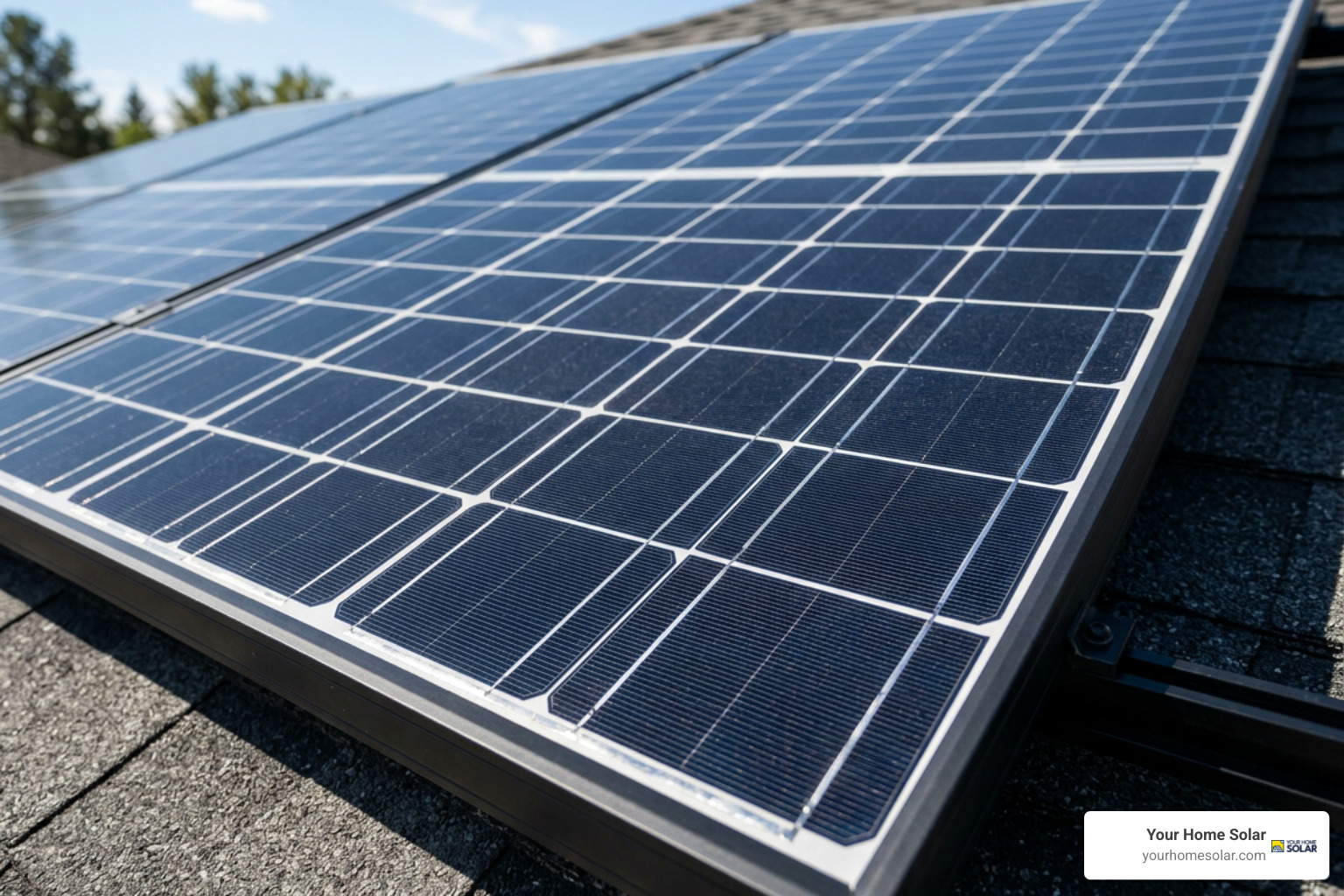
This exceptionally low heat coefficient ensures that the Pure-RX retains higher power generation during hot summer afternoons. REC backs this module with a 25-year performance warranty guaranteeing at least 92% of original power output at year 25. Priced competitively at roughly $2.45 per watt, it offers a sweet spot between high-end performance and long-term value.
Maxeon 6 and Silfab Prime: Premium Durability and Efficiency
For homeowners seeking maximum performance per square foot, the Maxeon 6 440W delivers an impressive 22.8% module efficiency. Maxeon sets an industry benchmark by offering an extensive 40-year combined product and performance warranty, guaranteeing an unmatched 93.8% output capacity at year 25. While its premium performance commands a higher cost around $2.73/W, its power retention rate makes it an exceptional choice for constrained roofs.
Matching high performance with rugged domestic manufacturing, the SIL-440 QD panel from Silfab Prime features an N-type cell architecture achieving 22.6% efficiency. Designed with high structural integrity, the SIL-440 QD is engineered to withstand front mechanical loads up to 5,400 Pa and rear loads of 4,000 Pa, providing peace of mind against severe weather.
Hyundai NF and Qcells Q.TRON: Value, AC Options, and Shade Tolerance
If budget management is a top priority, Hyundai’s NF (BK) 440W module offers 22.5% efficiency at an economical entry point around $2.25/W. It comes backed by a 25-year product warranty and a 30-year performance guarantee, disproving the idea that lower equipment costs require sacrificing efficiency. Read more on evaluating equipment pricing in our article on Cheap Solar Panels for Your Home: Myth or Reality?.
Meanwhile, Qcells Q.TRON BLK 430W panels deliver 22.0% efficiency ($2.43/W) with specialized shade management capabilities. Often configured as AC modules paired with factory-integrated microinverters, Qcells setups optimize performance per panel, preventing minor tree shading on one section of your roof from pulling down the electrical production of the entire array.
Legacy Specifications and Specialized Hardware: LG NeON 2
While LG officially exited the solar module manufacturing market, millions of their panels—such as the iconic LG LG360N1C-N5: 360W NeON® 2 Solar Panel for Home—remain in active operation on residential rooftops. Rated at 360W with a 20.8% efficiency, the NeON 2 introduced 12-wire “Cello” technology to replace standard ribbon busbars, enhancing light absorption and structural strength. LG continues to honor its 25-year limited warranty, guaranteeing 90.1% performance at year 25 along with up to $450 in labor cost reimbursements for verified module repairs.
Solar System Configurations: Battery Kits vs. Grid-Tied Setups

Selecting the best household solar panels is only half the battle; choosing how those panels deliver energy to your home is equally important. System designs generally fall into grid-tied configurations or solar-plus-storage hybrid setups.
Sol-Ark and Enphase Pre-Packaged Solar Kits
Pre-packaged solar kits provide complete, engineering-tested component matching for off-grid energy independence or whole-home backup power:
- Sol-Ark Hybrid Configurations: Packages like the Sol-Ark 15K Whole Home Solar + Storage Kit combine a powerful 15kW hybrid inverter with a Discover Helios 16kWh Lithium Iron Phosphate (LiFePO4) battery bank. Utilizing closed-loop communications, the system intelligently manages battery charge rates while powering critical household circuits during utility blackouts.
- Enphase Microinverter Packages: Setups such as the Enphase Off-Grid Solar Kit pair microgrid-forming IQ8+ microinverters with high-output Tier-1 450W bifacial solar panels. Because each panel operates independently, string-level power drops are eliminated.
To help evaluate whether a pre-engineered bundle or a custom-designed array fits your property best, explore our guide on Finding the Perfect Household Solar Panels for Your Needs.
Sizing System Capacity Around the Best Household Solar Panels
Sizing a residential system accurately requires analyzing historical kilowatt-hour (kWh) usage from utility statements, available roof area, and regional sun hours.
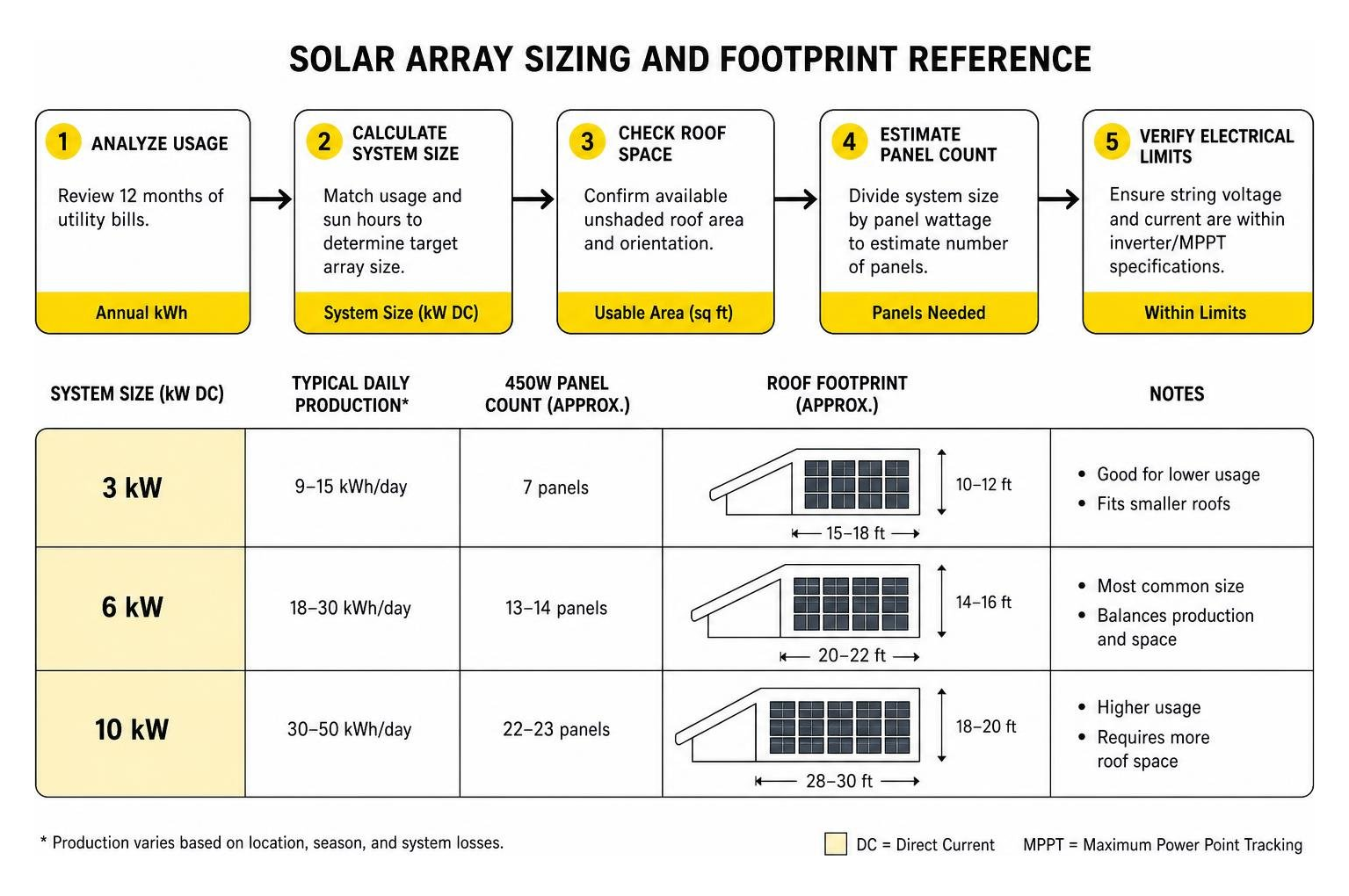
When sizing an array, your installer must verify that panel string voltages and amperages stay strictly within the Maximum Power Point Tracking (MPPT) charge controller limits of your hybrid or string inverter.
Financial ROI, Incentives, and Finding Reliable Solar Installers
Installing residential solar is a proven strategy to protect your household against escalating utility rates while creating clean, home-grown energy.
Financial Calculations, Tax Credits, and Long-Term Savings
According to energy industry marketplace metrics, a typical 12 kW residential solar system costs approximately $31,135 before incentives. Fortunately, the 30% Federal Solar Tax Credit allows eligible homeowners to deduct nearly a third of total equipment and installation costs directly from their federal tax liability, bringing the effective initial investment down closer to $21,800.
The average homeowner recoups their system investment in roughly 11 years, yielding an estimated net savings of around $60,000 over a 25-year module operating life. Regional energy rates influence these figures:
- Maryville, TN: Local home solar investment parameters can be reviewed on the Maryville, TN Solar Panel Cost resource page.
- Sevierville, TN: Pricing dynamics and average payback periods are detailed via Sevierville, TN Solar Panel Cost.
- Johnson City, TN: Check localized utility payback tracking at Johnson City solar cost and payback.
To better understand how rooftop arrays convert sunlight into ongoing utility bill reductions, consult A Guide to Home Solar Energy Panels.
Vetting Installers and Protecting Against Solar Scams
Because a solar energy system is expected to operate continuously for 30+ years, selecting a trustworthy installation company is just as critical as selecting high-grade solar panels. The U.S. Department of Energy recommends keeping the following vetting principles in mind:
- Avoid High-Pressure Sales Tactics: Walk away from door-to-door sales representatives who claim you can get “free solar from the government” or insist you must sign a contract immediately.
- Verify Licensing & Certifications: Ensure your installer holds active state electrical licenses, adequate liability insurance, and NABCEP (North American Board of Certified Energy Practitioners) credentials.
- Review Detailed Contracts: Examine product warranty terms, labor coverage, roof penetration guarantees, and net metering interconnection agreements line-by-line before signing.
- Know Consumer Protection Resources: If you encounter deceptive sales practices, consumer protections are enforced by federal regulatory bodies like the Federal Trade Commission (ReportFraud.FTC.gov) and the Consumer Financial Protection Bureau (CFPB).
Frequently Asked Questions About Residential Solar Panels
How long do residential solar panels last, and what do warranties cover?
According to the U.S. Department of Energy, quality photovoltaic panels have a operational lifespan of 30 years or longer. Panel warranties are divided into two distinct parts:
- Product Warranty (Workmanship): Covers hardware defects, glass separation, or junction box failures, typically lasting 25 to 40 years.
- Performance Warranty (Power Degradation): Guarantees that the panel will maintain a specified percentage of its original rated output (typically between 88% and 93.8%) at year 25 or 30.
How do solar panels perform under extreme heat and cloudy conditions?
High ambient heat causes panel voltage to drop. However, modern N-type monocrystalline modules feature low temperature coefficients (e.g., -0.24%/°C), significantly reducing output losses when roof temperatures reach 75°C (167°F). On overcast days, diffuse daylight passes through cloud cover; N-type cell architecture captures these light wavelengths better than older P-type panels, maintaining continuous trickle-charging.
Is installing solar panels worth the cost in 2026?
Yes. With typical 12 kW solar installations breaking even in about 11 years and operating reliably for over 30 years, homeowners can generate significant long-term power bill savings. Installing solar also cushions your household against rising electricity rates while increasing your property’s overall equity and resale value.
Conclusion
Choosing the best household solar panels comes down to balancing high efficiency, low temperature degradation, long-term warranty coverage, and overall cost-per-watt. Outstanding models like the REC Alpha Pure-RX, Maxeon 6, Silfab SIL-440 QD, Hyundai NF, and Qcells Q.TRON offer diverse solutions suited to matching different roof layouts and household budgets.
We recommend auditing your household energy usage, evaluating your property’s roof shading, and deciding whether battery storage makes sense for your backup power goals. When you are ready to explore clean energy options tailored for your property, turn to our trusted team of experts at Your Home Solar. Learn more about professional home solar services and start planning your customized system today!