Why Tennessee Solar Energy Matters Now
Driven by falling costs, federal tax incentives, and a push for energy independence, Tennessee solar energy is steadily growing. Here’s what you need to know:
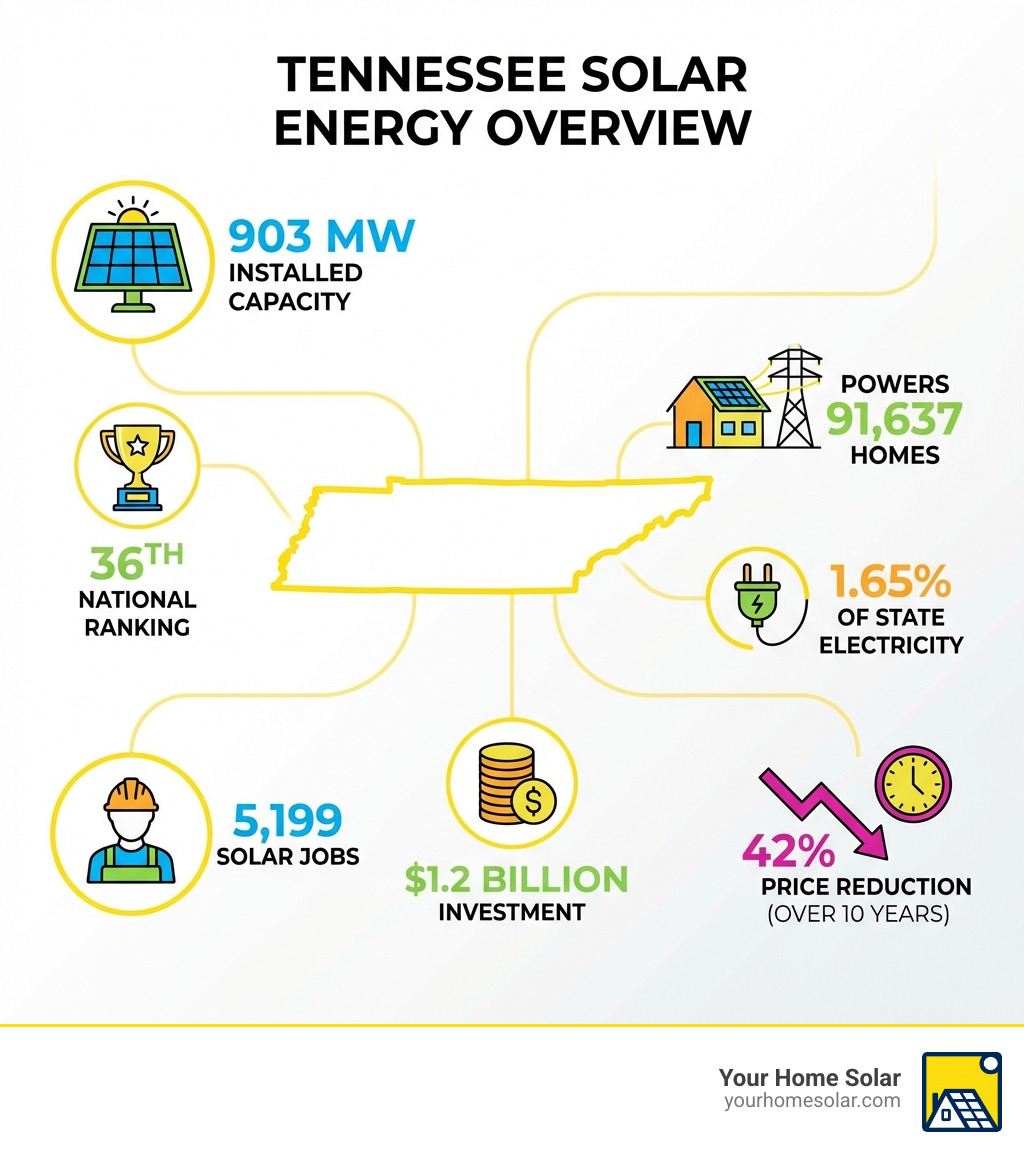
Quick Facts:
- 903 MW of solar installed statewide
- Powers 91,637 homes (1.65% of state electricity)
- $1.2 billion in total solar investment
- 5,199 jobs in the solar industry
- Solar prices have dropped 42% over the past decade
- Tennessee ranks 36th nationally for installed solar capacity
Solar offers a path to greater control over your home’s energy future, addressing concerns like rising electricity bills, power outages, and your environmental footprint.
The Tennessee solar landscape is unique because the Tennessee Valley Authority (TVA), a federally-owned utility, controls nearly all electricity. TVA sets the rules for solar adoption, creating a different set of programs and incentives for homeowners. Understanding these differences is key to an informed decision.
I’m Ernie Bussell, Founder and CEO of Your Home Solar. I’ve spent years helping East Tennessee homeowners steer the complexities of Tennessee solar energy, from TVA programs to selecting the right system for long-term savings. My goal is to provide clarity so you can make confident decisions about your home’s energy future.
The Current State of Solar in the Volunteer State
Tennessee is making significant strides in solar energy. The state now has 903 MW of installed solar capacity, enough to power 91,637 homes and representing 1.65% of our state’s electricity—a figure that continues to climb.
Despite this progress, Tennessee ranks 36th nationally for installed solar capacity. While absolute capacity has grown substantially from 129 MW in 2015, other states have accelerated faster. The future is promising, with a projected 1,814 MW to be added over the next five years.
A compelling part of the Tennessee solar energy story is the dramatic cost reduction. Prices have fallen 42% over the last decade, making solar more accessible. This affordability, combined with a $1.2 billion investment in the state’s solar sector, shows a growing commitment to renewable energy.

The advantages of embracing solar extend beyond clean energy, from reducing utility bills to increasing property values. To learn more, explore the Advantages of Installing Solar Panels in Tennessee.
Environmental and Economic Impact
The shift to Tennessee solar energy has profound environmental and economic impacts. Environmentally, solar is significant because nearly 25% of the state’s electricity (as of 2021) comes from coal. By displacing coal power, solar reduces greenhouse gas emissions and improves air quality. For a deeper dive, check out The Environmental Impact of Solar Energy: Reducing Your Carbon Footprint. You can also explore broader energy statistics via the U.S. Energy Information Administration – Tennessee State Profile.
Economically, the solar industry is a powerful engine for job creation. The Tennessee solar energy sector currently supports 5,199 jobs, with projections reaching 10,856 by 2030. This growth is supported by 126 solar companies in Tennessee—including 32 manufacturers and 51 installers/developers like us—contributing to a market valued at $1.3 billion. These figures highlight solar as a burgeoning industry bringing prosperity to the state.
Key Players and Policies Shaping Tennessee Solar Energy
Understanding Tennessee solar energy requires knowing the major players and the regulatory framework, from the Tennessee Valley Authority (TVA) to state policies and industry groups.

The Tennessee Valley Authority (TVA): A Dominant Force
As a federally-owned corporation, TVA provides electricity to nearly all of Tennessee and sets the rules for solar adoption. Its ambitious Solar Strategy has already brought $1.4 billion to the Valley, supporting over 1,600 MW of solar capacity. Looking ahead, TVA plans to add an impressive 10,000 MW of solar by 2035.
TVA offers several programs to support solar adoption:
- Green Invest Program: Matches business and community needs with new, large-scale renewable energy projects.
- Community Solar Access: Gives over 1 million people access to community solar without rooftop installations.
- Green Connect: Provides homeowners with resources for safe and reliable solar and battery installations.
- Green Switch: Allows customers to match their energy usage with 100% renewable energy.
- Green Flex: Allows businesses to purchase Renewable Energy Certificates (RECs) to meet sustainability goals.
- Dispersed Power Production (DPP): Allows customers to sell excess power from qualified facilities back to TVA.
To explore your solar potential, try the TVA Solar Calculator and review the Compare TVA Green Programs guide.
State Policies, Regulations, and Incentives
While TVA is central, state policies also impact Tennessee solar energy. Crucially, Tennessee lacks a statewide net metering policy. Instead, compensation rates for excess energy are determined by local power companies under TVA’s DPP program, leading to credit variations for homeowners.
Tennessee’s “Decommissioning Law” (Tenn. Code Ann. § 66-9-207) requires solar facilities of 5 MW or larger to have a decommissioning plan with financial assurance, ensuring land is restored after use.
For commercial entities, Tennessee offers incentives like the Green Energy Production Facility Tax Credit and a Sales Tax Exemption for Clean Energy Technology for certified facilities.
Federal tax credits are also vital. The Clean Electricity Investment Tax Credit and Clean Electricity Production Credit offer significant benefits for new facilities and energy storage after 2024. Homeowners benefit from the federal Residential Clean Energy Credit, which offers a 30% tax credit on new systems. For a comprehensive overview, see our guide on Incentives and Tax Credits for Solar Systems.
Industry Advocacy and Resources
Dedicated organizations support the growth of Tennessee solar energy. The Tennessee Solar Energy Industries Association (TenneSEIA), the official SEIA State Affiliate, advocates for policy and a robust solar market. Other resources include:
- DSIRE Incentives Database: A comprehensive source for incentives and policies, which you can access for Tennessee here: DSIRE Incentives Database – Tennessee.
- SolSmart and MTAS: These initiatives provide guidance for local governments to streamline solar development.
Types of Solar Projects and Resources
Tennessee solar energy comes in various forms, from residential rooftops to large utility-scale arrays. Understanding these project types can help you determine the best path for your solar journey.
Residential Solar: Powering Your Home
For East Tennessee homeowners, residential solar is the most direct way to adopt clean energy, offering numerous benefits:
- Energy Savings: Reduce or eliminate monthly electricity bills. With today’s lower costs, payback periods are often shorter, leading to significant long-term savings.
- Property Value Increase: Homes with solar panels often see an increase in property value. Learn more in How Solar Energy Can Increase Your Property Value.
- Energy Independence: Solar, especially when paired with battery storage, provides independence from the grid and backup power during outages.
However, the growing market has challenges. The Tennessee Attorney General’s Office received 498 complaints against nine solar companies between 2020 and 2023, highlighting the importance of choosing a qualified, reputable installer. When considering a company, ask about NABCEP certification, local presence and installers, and salesperson experience.
To protect your investment, consult SEIA’s Consumer Guide to Home Solar and our resources on Avoiding Solar Scams.
Commercial and Utility-Scale Solar
Tennessee solar energy also powers businesses and communities through larger projects like rooftop, carport, and ground-mount systems. Notable examples include an 8 MW solar farm at Volkswagen’s Chattanooga plant and other large-scale farms contributing to the state’s capacity.
A critical consideration for large ground-mounted systems is land use, typically requiring 5-10 acres per megawatt (MW). TVA’s goal of adding 10,000 MW by 2035 could use up to 100,000 acres, highlighting the need for careful planning and zoning by local governments.
An innovative solution is agrivoltaics, or dual-use solar, which co-locates solar panels with agricultural activities. This allows land to be used for both food and energy production. Tennessee is already exploring this with at least nine projects, creating a win-win for agriculture and energy. Learn more in Green Farming with Solar Power: How Solar Energy Supports Agriculture.
The Future of Solar: Challenges and Opportunities
The future of Tennessee solar energy involves both exciting opportunities and critical challenges that require sustainable solutions.
Overcoming Challenges in the Tennessee solar energy Market
The Tennessee solar energy market faces several key challenges:
- Navigating Local Utility Policies: The lack of a statewide net metering policy and TVA’s dominance create complex, varying rules from local power companies, which can be a barrier for new adopters.
- Consumer Protection: A surge in consumer complaints highlights the need for ethical sales, quality installations, and thorough due diligence when selecting an installer. We offer guidance on How to Get Solar Without Getting Scammed.
- Siting and Land Use Conflicts: Finding suitable land for large projects is challenging due to geological issues, the need to preserve farmland, and potential community opposition. This requires careful planning and clear local zoning.
Growth Projections and Future Opportunities for Tennessee solar energy
Despite these challenges, the future of Tennessee solar energy is bright:
- Projected Growth: Tennessee is projected to add 1,814 MW of solar capacity over the next five years.
- TVA’s Ambitious Goals: TVA’s plan to add 10,000 MW of solar by 2035 will transform our energy landscape.
- Rise of Agrivoltaics: This innovative approach offers a sustainable solution to land use conflicts by combining agriculture and solar generation.
- Energy Storage Integration: The nascent energy storage market holds immense potential. Integrating batteries with solar improves grid stability and provides backup power. We are at the forefront of integrating advanced battery systems like Generac Solar Battery Installation in East Tennessee, Sol-Ark, Tesla, and HomeGrid to ensure our customers have reliable power.
Falling costs and technological advancements make now an opportune time to consider solar. To understand why, read The Future is Solar: Why Now is the Time to Invest in Solar Energy for Your Home.
Frequently Asked Questions about Solar in Tennessee
Here are answers to common questions about solar in East Tennessee.
What incentives are available for residential solar in Tennessee?
The primary incentive for homeowners is the Federal Solar Tax Credit (Residential Clean Energy Credit), which allows you to claim 30% of your system’s cost as a dollar-for-dollar reduction on your income taxes. Additionally, TVA programs like Green Connect offer resources for safe installations. Some local utilities in East Tennessee may have their own rebates, so it’s crucial to check with your specific provider.
Unlike some states, Tennessee does not have major state-specific tax credits for residential solar. State incentives are primarily aimed at larger commercial or industrial projects. For a detailed guide, consult our Solar Incentives Tennessee 2026 Guide.
Does Tennessee have a net metering policy?
No, Tennessee does not have a statewide net metering law. The specifics are determined by local power companies under TVA’s Dispersed Power Production (DPP) program. This means compensation for excess electricity sent to the grid varies by utility. These rates are not standardized and directly impact your savings, so check your local power company’s specific buy-back policy. For more clarity, see our resource: Do East Tennessee Utility Companies Buy Back Solar Power? Find Out Here!.
Is my home a good candidate for solar panels?
Several factors determine if your home is a good candidate for Tennessee solar energy:
- Roof Condition: Your roof should be in good condition with at least 10-15 years of life left.
- Roof Orientation: South-facing roofs are ideal, but east and west-facing roofs can also be viable.
- Shading: Significant shading from trees or buildings can reduce efficiency.
- Local Utility Rules: Your utility’s interconnection and compensation policies are important.
- Energy Consumption: Homes with higher electricity bills often see greater savings.
We offer site assessments to evaluate these factors. For a detailed look, explore Solar Panel Viability in Tennessee and Who Are Not Candidates For Solar?.
Conclusion: Is Solar a Bright Choice for Tennessee?
Tennessee solar energy is a dynamic sector with immense potential, driven by falling costs and key players like TVA. The environmental and economic arguments for embracing solar—from displacing coal to reducing energy bills—are compelling.
However, navigating the landscape requires informed decisions, particularly regarding TVA’s regulations and choosing a reputable installer. While challenges like consumer protection and land use exist, they are being met with innovative solutions.
For homeowners and businesses in East Tennessee, the path to energy independence is clearer than ever. With our commitment to customer satisfaction and reliable, custom solutions, we are here to guide your solar journey. With trusted expertise, solar is not just a bright choice for Tennessee—it’s the smart choice.
Ready to explore your solar options? See what our customers say at Best Solar Companies Tennessee Reviews.