Why the Tennessee Solar Tax Credit Can Cut Your Energy Costs Significantly
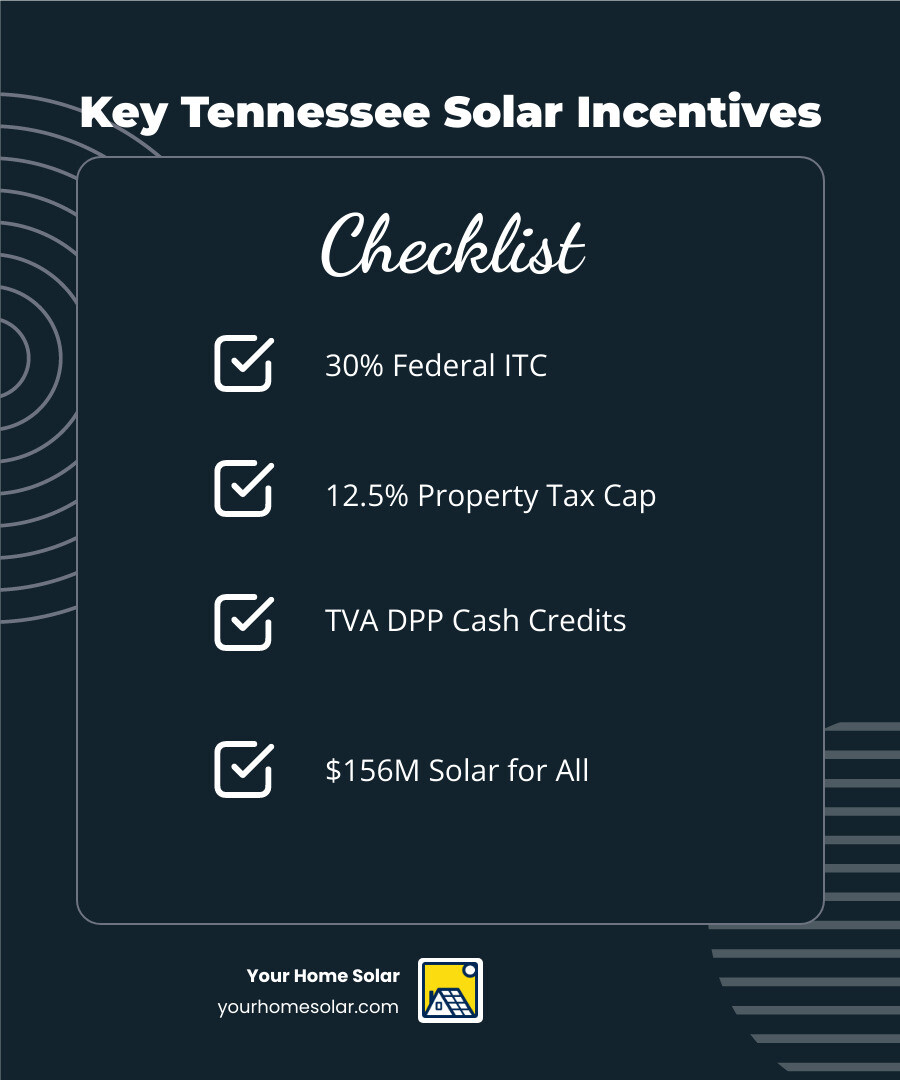
The Tennessee solar tax credit — primarily the 30% federal Residential Clean Energy Credit — is one of the most powerful ways Tennessee homeowners can reduce the cost of going solar right now. Here’s a quick summary of what’s available:
| Incentive | Savings | Who Qualifies |
|---|---|---|
| Federal Solar Tax Credit (ITC) | 30% of total system cost | Homeowners who own their system |
| Green Energy Property Tax Assessment | Only 12.5% of install cost is taxable | All TN solar homeowners (automatic) |
| TVA Dispersed Power Production | Cash credit for excess energy | TVA-served customers |
| Tennessee Solar for All | Up to $156M for low-income households | Qualifying low-income residents |
For a typical Tennessee solar system costing around $16,740, that 30% federal credit alone saves you $5,022 out of pocket. On a larger system near $38,520, the savings jump to $11,556.
Tennessee doesn’t have a dedicated state solar income tax credit, but between the federal ITC, a property tax cap on solar value, and programs like TVA’s Dispersed Power Production, the savings stack up quickly — especially as utility rates keep climbing across East Tennessee.
I’m Ernie Bussell, founder and CEO of Your Home Solar, the #1 solar energy contractor in East Tennessee, and I’ve spent years guiding homeowners through the exact process of claiming every available Tennessee solar tax credit and incentive. In this guide, I’ll walk you through everything you need to know to maximize your savings — clearly and without the pressure.
Understanding the 30% Federal Tennessee Solar Tax Credit

When people talk about the Tennessee solar tax credit, they are almost always referring to the federal Residential Clean Energy Credit. This incentive was significantly expanded under the Inflation Reduction Act of 2022, raising the credit amount to a substantial 30% of your total system cost.
This isn’t just a deduction from your taxable income; it is a dollar-for-dollar credit against your federal income tax liability. If you spend $30,000 on a solar installation in Knoxville or Maryville, Uncle Sam essentially hands you back $9,000 when you file your taxes.
What’s covered under this 30% umbrella?
- Solar PV Panels: The hardware that catches the sun.
- Labor Costs: Professional installation, including assembly and piping.
- Permitting and Inspection: The “soft costs” required to get your system legal.
- Solar Batteries: As of 2023, standalone battery storage with a capacity of 3 kWh or more is eligible for the full 30% credit, even if you don’t install panels at the same time!
To learn more about how these stack up, check out our guide on Incentives and Tax Credits for Solar Systems.
How to Claim the Federal Tennessee Solar Tax Credit
Claiming your credit is a straightforward process, but it does require some paperwork. When you file your federal income taxes for the year your system was “placed in service” (meaning it’s fully installed and ready to rock), you’ll need to use IRS Form 5695.
Here is the “Ernie-approved” step-by-step:
- Keep Your Receipts: Ensure you have an itemized invoice showing the total cost of equipment and labor.
- Fill out Form 5695: This is where you calculate your credit based on your expenses.
- Apply to Your Tax Liability: If you owe $10,000 in taxes and have a $12,000 credit, you can wipe out your entire $10,000 bill.
- Carryforward: What happens to that extra $2,000? Unlike some credits that disappear, the federal ITC allows a 5-year carryforward. You can apply the remaining balance to next year’s taxes!
For more details on the filing process, see our dedicated page on Tax Credits & Incentives.
Federal ITC Phase-Down Schedule
While 30% is the current rate, it won’t last forever. The government has set a clear timeline for when this “sale” ends. If you’re planning a project in the Tri-Cities or Chattanooga, keep these dates in mind:
- 2022–2032: 30%
- 2033: 26%
- 2034: 22%
- 2035: The credit is scheduled to expire for residential systems.
Waiting until 2033 could cost you thousands of dollars in lost incentives. We always tell our neighbors in Oak Ridge and Sevierville: the best time to plant a tree was 20 years ago; the second best time is today (especially before the tax credit drops).
Tennessee State Incentives and Property Tax Relief
While Tennessee doesn’t offer a state income tax credit (mostly because we don’t have a state income tax!), the state provides a very important “hidden” benefit: the Green Energy Property Tax Assessment.
Normally, when you add value to your home—like a pool or a massive renovation—your property taxes go up because the home is worth more. However, Tennessee law protects solar owners. Under the Tennessee Comptroller guidance, the taxable value of a solar system is capped at just 12.5% of its installed cost.
If you install a $20,000 system, the tax man can only “see” $2,500 of that value. At an average property tax rate of 0.67%, this saves the average homeowner about $225 per year, or over $4,500 over the life of the system. It’s an automatic benefit—no application required!
Curious about other local perks? Check out What Incentives Exist in Solar Within Tennessee? Ernie Answers This Commonly Asked Question.
Local Utility Rebates and Energy Loans
Depending on where you live in East Tennessee, your local utility might have extra “cherries on top” for your energy project:
- Knoxville Utilities Board (KUB): KUB offers an EV charging rebate of up to $400 for installing a Level 2 charger—perfect to pair with a new solar array.
- Middle Tennessee Electric (MTE): Offers low-interest loans for energy efficiency upgrades.
- Murfreesboro Electric (MED): Provides rebates up to $1,000 for specific energy efficiency improvements like heat pumps and water heaters.
Utility Programs and the TVA Dispersed Power Production
Tennessee doesn’t have a statewide “Net Metering” law like some other states, which can be confusing. In states with net metering, the utility buys your extra power at the same price they sell it to you. In Tennessee, we use the TVA Dispersed Power Production (DPP) Program.
Under the TVA DPP, you can sell your excess solar energy back to the grid at “avoided cost” rates. While this rate is typically lower than the retail price of electricity, it still provides a way to monetize the energy you aren’t using during the day. This requires a bidirectional meter so the utility can track how much power you’re sending back to the “Valley.”
Maximizing ROI with Self-Consumption
Because the sell-back rate is lower than the buy rate, the smartest way to use solar in Tennessee is self-consumption. This means using as much of your solar power as possible while it’s being generated.
- Smart Sizing: We help you size your system to match your daytime “baseload” so you aren’t sending too much back for a lower credit.
- Battery Storage: By adding a battery, you can store that midday sun and use it at night, effectively “saving” the full retail value of that electricity rather than selling it back for a fraction of the cost.
- Energy Offset: Our goal is to offset your most expensive power usage, ensuring your bill stays as low as possible.
Solar Costs, Payback, and the Solar for All Program
Let’s talk numbers. The average cost of solar in Tennessee is roughly $2.79 per watt. For a standard 6 kW system, that’s an investment of about $16,740.
| System Size | Gross Cost | 30% Federal Credit | Net Cost |
|---|---|---|---|
| 6 kW | $16,740 | -$5,022 | $11,718 |
| 10 kW | $27,900 | -$8,370 | $19,530 |
| 12 kW | $33,480 | -$10,044 | $23,436 |
With these incentives, the average payback period in Tennessee is roughly 13 years. Considering a high-quality system from us lasts 25 to 30 years, that’s over a decade of essentially “free” electricity.
There is also exciting news on the horizon: the EPA Solar for All announcement recently awarded Tennessee over $156 million. This program, managed by TDEC, is designed to bring solar to low-income and disadvantaged communities. While it’s still in the planning phase, it will eventually provide significant grants to help those who need it most go green.
Avoiding Scams and Qualifying for the Tennessee Solar Tax Credit
As solar grows in popularity in places like Johnson City and Kingsport, so do the “Solar Scammers.” You’ve probably seen the ads for “Free Solar Panels from the Government.”
Spoiler alert: Solar is never free.
These are often high-interest leases or aggressive marketing tactics. To protect yourself:
- Read the Consumer Advisory: The Treasury has issued a Consumer Advisory on Solar Scams to help you spot red flags.
- Look for NABCEP Certification: This is the gold standard for solar professionals. At Your Home Solar, we pride ourselves on technical expertise that goes far beyond a basic electrical license.
- Demand Transparency: If an installer won’t give you a clear, itemized breakdown of costs and the Tennessee solar tax credit math, walk away.
Frequently Asked Questions about Tennessee Solar
Does Tennessee offer a state-level solar tax credit?
No, Tennessee does not have a state-level income tax credit for solar. However, you still benefit from the 30% federal ITC, the Green Energy Property Tax Assessment (which caps your property tax increase), and potential sales tax exemptions for certified green energy production facilities.
Are solar batteries eligible for the 30% tax credit?
Yes! Thanks to the Inflation Reduction Act, standalone battery storage systems with a capacity of at least 3 kWh qualify for the 30% federal tax credit. You no longer have to install them alongside solar panels to get the deal.
What happens if the tax credit exceeds my tax liability?
The credit is “non-refundable,” meaning the IRS won’t send you a check for the difference if your credit is bigger than your tax bill. However, you can carry the unused portion forward for up to five years. This makes solar a viable option even if you don’t have a massive tax bill in a single year.
Conclusion
At Your Home Solar, we aren’t just installers; we’re your neighbors. From our home base in Knoxville to the communities of Morristown, Greeneville, and beyond, we are committed to helping East Tennessee families achieve energy independence.
The Tennessee solar tax credit landscape can be a bit of a maze, but with a 30% federal discount and our local expertise, there has never been a better time to make the switch. We offer tailored, reliable installations backed by our 100% customer satisfaction guarantee.
Ready to see how much you could save? Check out our Solar Incentives Tennessee 2026 Guide or give us a call today. Let’s get your home powered by the Tennessee sun!