Is Solar Power Worth It in Tennessee?
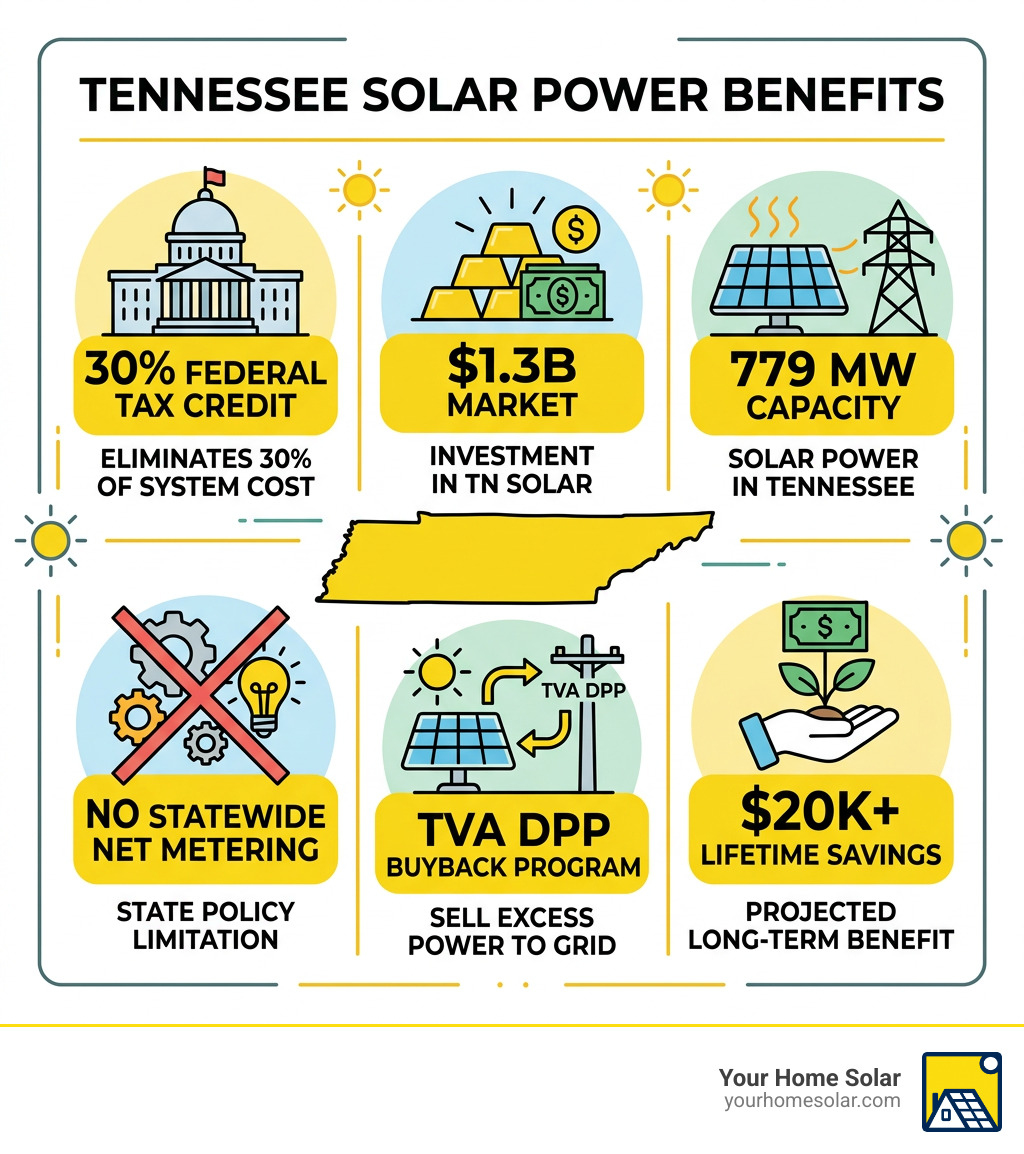
Solar power Tennessee homeowners can access is more accessible — and more valuable — than most people realize. Here’s a quick summary of what you need to know:
- Average system cost: ~$41,394 for a 13.73 kW system before incentives (about $3.02/W)
- Federal tax credit: 30% back on eligible costs = roughly $12,418 savings on an average system
- Net metering: Tennessee has no statewide policy, but TVA’s Dispersed Power Production (DPP) program lets you sell excess power back to the grid
- Solar for All funding: Tennessee received $156.1 million from the EPA to expand solar access for low-income households
- Jobs and market: A $1.3 billion solar market with 5,123 jobs today and up to 10,856 projected by 2030
- ROI: A typical system can pay for itself in 7–20 years and deliver $20,000+ in lifetime savings
Tennessee’s solar industry has grown fast — from just 129 MW of capacity in 2015 to 779 MW by 2022. And with TVA planning to add 10,000 MW of solar by 2035, the momentum isn’t slowing down.
But growing fast also means more confusion, more salespeople at your door, and more decisions to get right. Rising electricity bills, the threat of outages, and the complexity of incentives leave many East Tennessee homeowners unsure where to even start.
That’s exactly what this guide is for.
I’m Ernie Bussell, founder and CEO of Your Home Solar — the #1 solar energy contractor in East Tennessee — and I’ve spent years in solar power Tennessee operations and sales, helping homeowners cut through the noise and make confident energy decisions. I’ll walk you through everything: costs, incentives, regulations, scam warnings, and how to find an installer you can actually trust.
The Current Landscape of Solar Power in Tennessee
When we look at the hills of East Tennessee, we see more than just beautiful scenery; we see a massive, untapped battery. While Tennessee might not be the first state that comes to mind when you think of “solar giants” like California or Arizona, the Volunteer State is quietly staging a massive energy revolution.
Currently, solar power Tennessee capacity sits at approximately 779 MW as of 2022. To put that in perspective, back in 2015, we only had 129 MW. That is a staggering 500% increase in less than a decade! This growth is fueled by a mix of falling equipment costs and a growing desire for energy independence among our neighbors in Knoxville, Oak Ridge, and beyond.
The Advantages of Installing Solar Panels in Tennessee go beyond just environmental warm-fuzzies. We are talking about a Solar in Tennessee market that is now valued at over $1.3 billion. There are currently 126 solar companies operating in the state, including 32 manufacturers and 51 installers or developers.
Growth Trends in Solar Power Tennessee
The future looks even brighter. Projections suggest that by 2030, Tennessee could support up to 10,856 solar energy jobs. This isn’t just a “trend”; it’s a fundamental shift in how we power our homes and businesses. The Tennessee Valley Authority (TVA) has set an ambitious goal to add 10,000 MW of solar generation by 2035. If all that solar were placed on Tennessee farmland, it would still only occupy about 1% of the state’s total agricultural land (roughly 100,000 acres).
Major Installation Types
In Tennessee, solar isn’t a “one size fits all” solution. We see three main paths:
- Residential Rooftop: This is where most of us start. Homeowners in places like Maryville and Sevierville are installing panels to lock in their energy rates and protect themselves from rising utility costs.
- Commercial Systems: Local businesses and municipalities are catching on. Large rooftops on warehouses and retail centers are perfect for lowering overhead.
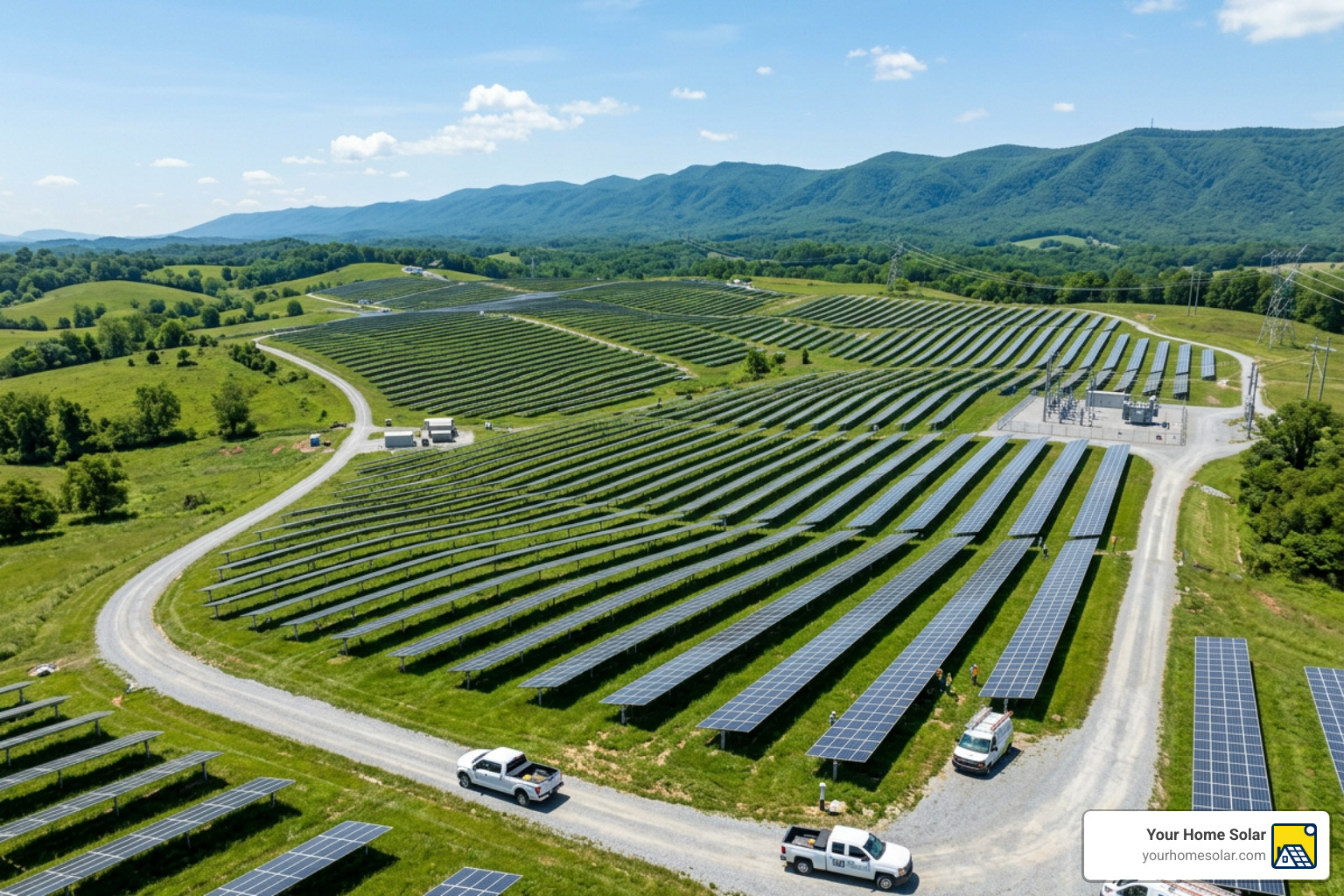
- Utility-Scale: These are the massive “solar farms” you might see while driving down I-40. They provide bulk power directly to the grid.
- Community Solar: These programs allow residents who might not have a suitable roof (like renters or those with shaded yards) to benefit from a shared solar array.
Financial Incentives and the Cost of Solar Power Tennessee
Let’s talk turkey—or rather, let’s talk dollars and cents. The most common question we get at Your Home Solar is: “How much is this going to cost me?”
As of early 2026, the average cost for a solar panel system in Tennessee is approximately $3.02 per watt including installation. For a typical 13.73 kW system, you’re looking at a gross price of about $41,394. Now, before that number makes you spill your sweet tea, this is the price before any incentives are applied.
When you factor in the Solar Incentives Tennessee 2026 Guide, the math starts looking a lot more attractive.
Federal and State Incentives for Solar Power Tennessee
The “Big Kahuna” of incentives is the federal Solar Investment Tax Credit, often called the ITC. Currently, this credit allows you to deduct 30% of the cost of your solar system from your federal income taxes. On that $41,394 system, that’s a whopping $12,418 back in your pocket.
But wait, there’s more! Tennessee offers a unique Tax Credits Incentives benefit through the Green Energy Property Tax Assessment. In many states, adding solar increases your property value (which is good), but it also hikes your property taxes (which is bad). Tennessee’s law limits the taxable value of your solar system to no more than 12.5% of its installed cost. This means you get the home value boost without the tax penalty.
Long-term ROI and Bill Savings
Solar is a hedge against inflation. While utility rates tend to climb every year, your “fuel” (the sun) stays free. A well-designed system can cover 100% of your energy needs, potentially saving you over $100 a month. Over 20 years, most Tennessee homeowners see a net benefit of over $20,000. Plus, solar panels can actually protect your roof and increase your home’s resale value, making it one of the few home improvements that actually pays you back.
Navigating the TVA and the Tennessee Solar for All Program
Tennessee’s energy landscape is unique because of the Tennessee Valley Authority (TVA). As a federally owned corporation, TVA provides electricity to roughly 99.7% of the state. Because of this, Solar Panel Viability in Tennessee depends heavily on how you interact with TVA and your local power company (like KUB in Knoxville or BrightRidge in Johnson City).
The TVA Dispersed Power Production (DPP) program
One thing to keep in mind: Tennessee does not have a mandatory statewide “net metering” law. In states with net metering, the utility buys your excess power at the same price they sell it to you. In Tennessee, we use the Dispersed Power Production program.
Under the DPP, you can sell excess electricity back to TVA, but they typically pay you at their “avoided cost” rate—which is lower than the retail rate you pay. Because of this, our best advice for solar power Tennessee design is to focus on self-consumption. We want to size your system to cover what you use, and perhaps add battery storage (like a Tesla Powerwall) to keep that energy at home rather than selling it back for a lower price.
Tennessee Solar for All Initiative
There is exciting news for low-income households! On April 22, 2024, the EPA announced that Tennessee was awarded $156,120,000 through the Solar for All Competition.
This program, managed by the Tennessee Department of Environment and Conservation (TDEC), is designed to bring residential and community solar to disadvantaged communities. It includes a one-year planning period, meaning funding and applications should become available in late 2025 or 2026. This initiative will also focus on workforce development, creating even more local jobs in the solar sector.
Land Use, Agrivoltaics, and the Decommissioning Law
As we expand solar, we have to be smart about our land. Tennessee is famous for its rolling hills and fertile farmland, and we want to keep it that way. One of the coolest ways we do this is through agrivoltaics—the dual use of land for both solar power and agriculture.
Currently, there are at least nine agrivoltaics projects in Tennessee covering about 1,900 acres. You might see sheep grazing under solar panels, which keeps the grass trimmed without gas-powered mowers while providing the sheep with shade. It’s a win-win that you can Learn About Solar in East Tennessee through various local farm initiatives.
Notable Solar Power Tennessee Projects
Tennessee is home to some impressive solar landmarks:
- Volkswagen Chattanooga: An 8 MW solar park that helps power the massive assembly plant.
- Millington Solar Farm: Once the state’s largest at 53 MW (AC), it even uses sheep for vegetation management!
- West Tennessee Solar Farm: A 5 MW facility that was a pioneer in state-level utility solar.
- Selmer and Mulberry: Two 20 MW arrays that significantly boosted our capacity in 2014.
Regulations and the Decommissioning Law
To ensure our land is protected for future generations, Tennessee passed the “Decommissioning Law” (Public Chapter 866). This law requires solar developers to have a clear plan and financial assurance (like a bond) to remove equipment and restore the land to its original state once the project is over. Originally set for projects 10 MW and larger, it was recently updated to include facilities as small as 5 MW, effective July 1, 2024.
Local governments, like Bedford County, are also leading the way by creating “renewable energy development zones” to streamline solar projects while protecting prime farmland through smart zoning.
Consumer Protection: Avoiding Scams and Choosing Installers
Now, let’s have a “front porch talk” about the less-sunny side of the industry. Because solar power Tennessee is booming, it has attracted some bad actors. Between 2020 and 2023, the Tennessee Attorney General received nearly 500 complaints about solar scams.
The biggest red flag? Anyone promising “Free Solar.” Solar is never free. While incentives make it affordable, there is always a cost for the equipment and labor. If a salesperson uses high-pressure tactics or claims the government will pay for the whole thing, walk away.
How to Identify Reputable Installers
When choosing an installer in Morristown, Kingsport, or Farragut, look for these credentials:
- NABCEP Certification: This is the gold standard for solar professionals. It requires rigorous testing and ongoing education.
- Licensed Electricians: In Tennessee, only licensed electricians can pull the necessary permits and ensure your system is up to code.
- Local Reviews: Check Google and SolarReviews. A company with a long history in East Tennessee is much more likely to be there if you need service five years down the road.
- No Pressure: A good installer will give you a transparent quote and let you think about it.
Tennessee Consumer Protection Laws
You are protected by the Tennessee Consumer Protection Act and the Home Solicitations Sales Act. These laws require clear contract disclosures and give you a “cooling off” period to cancel a contract signed at your home. Always read the fine print regarding warranties—you want to know exactly what happens if the installation company goes out of business.
Frequently Asked Questions about Tennessee Solar
Does Tennessee have net metering?
No, Tennessee does not have a mandatory statewide net metering policy. Instead, most residents use TVA’s Dispersed Power Production (DPP) program, which buys excess power at “avoided cost” rates. This makes battery storage a very smart investment for Tennessee homeowners to maximize their savings.
How much do solar panels cost in Tennessee?
On average, a system costs about $3.02 per watt. A typical 13.73 kW system costs roughly $41,394 before incentives. After the 30% federal tax credit, that price drops to around $28,976.
What is the Tennessee Solar for All program?
It is a $156 million federally funded program designed to help low-income and disadvantaged Tennessee residents access solar power. Funding is expected to roll out in late 2025 or 2026 after a mandatory planning period.
Conclusion
The transition to solar power Tennessee is about more than just panels on a roof; it’s about energy resilience, economic growth, and taking control of your family’s future. Whether you are in Knoxville, Oak Ridge, or the rural stretches of Greene County, the sun is shining, and the incentives have never been better.
At Your Home Solar, we pride ourselves on being the trusted experts for East Tennessee. We don’t just do solar; we provide comprehensive home energy solutions, including backup generators and EV chargers, tailored to your specific needs. Our goal is 100% customer satisfaction through reliable, rewarding installations.
Ready to see if your home is a good fit? Learn more about solar in East Tennessee and let’s start your journey toward energy independence together. The Volunteer State is ready to harness the sun—are you?