
Why 800 Volt Charging at Home Matters for EV Owners
800 volt charging at home is a hot topic among electric vehicle owners, but there’s widespread confusion about what it actually means for your garage. Here’s what you need to know:
Quick Answer:
- True 800V DC fast charging is not currently available for home installation due to extreme power requirements and prohibitive costs (five to six figures)
- Your EV’s 800V architecture doesn’t require an 800V home charger – standard Level 2 chargers (240-volt AC) work perfectly fine
- The real benefit of 800V systems shows up at public DC fast chargers, where compatible EVs can charge from 10-80% in under 20 minutes
- Home charging for 800V EVs uses the same equipment as 400V EVs – typically a Level 2 charger delivering 7-11 kW through your home’s 240-volt circuit
The electric vehicle market is experiencing a significant shift. While most EVs have traditionally used 400-volt electrical architecture, manufacturers are increasingly adopting 800-volt systems. This technology promises dramatically faster charging times – the Porsche Taycan can charge from 5% to 80% in just 22.5 minutes on a 270-kW public charger, compared to 90 minutes on older 400-volt infrastructure.
But here’s the catch: that speed advantage largely disappears when you plug in at home.
The confusion stems from mixing up two different concepts: your vehicle’s internal voltage architecture (400V or 800V) and the type of charging equipment you use at home (which is AC power that your car converts internally). When you charge at home, you’re using Level 2 AC charging through a standard 240-volt outlet, regardless of whether your EV has 400V or 800V architecture. Your car’s onboard charger handles the conversion, and that’s where the real bottleneck occurs for home charging speeds.
As Ernie Bussell, founder and CEO of Your Home Solar and East Tennessee’s #1 solar energy contractor, I’ve helped countless homeowners understand the practical realities of 800 volt charging at home and how to properly prepare their electrical systems for current and future EV ownership. My background in nuclear systems in the U.S. Navy and years of operational leadership in the solar and power industry have taught me that cutting through technical confusion to deliver clear, honest guidance is what homeowners need most.
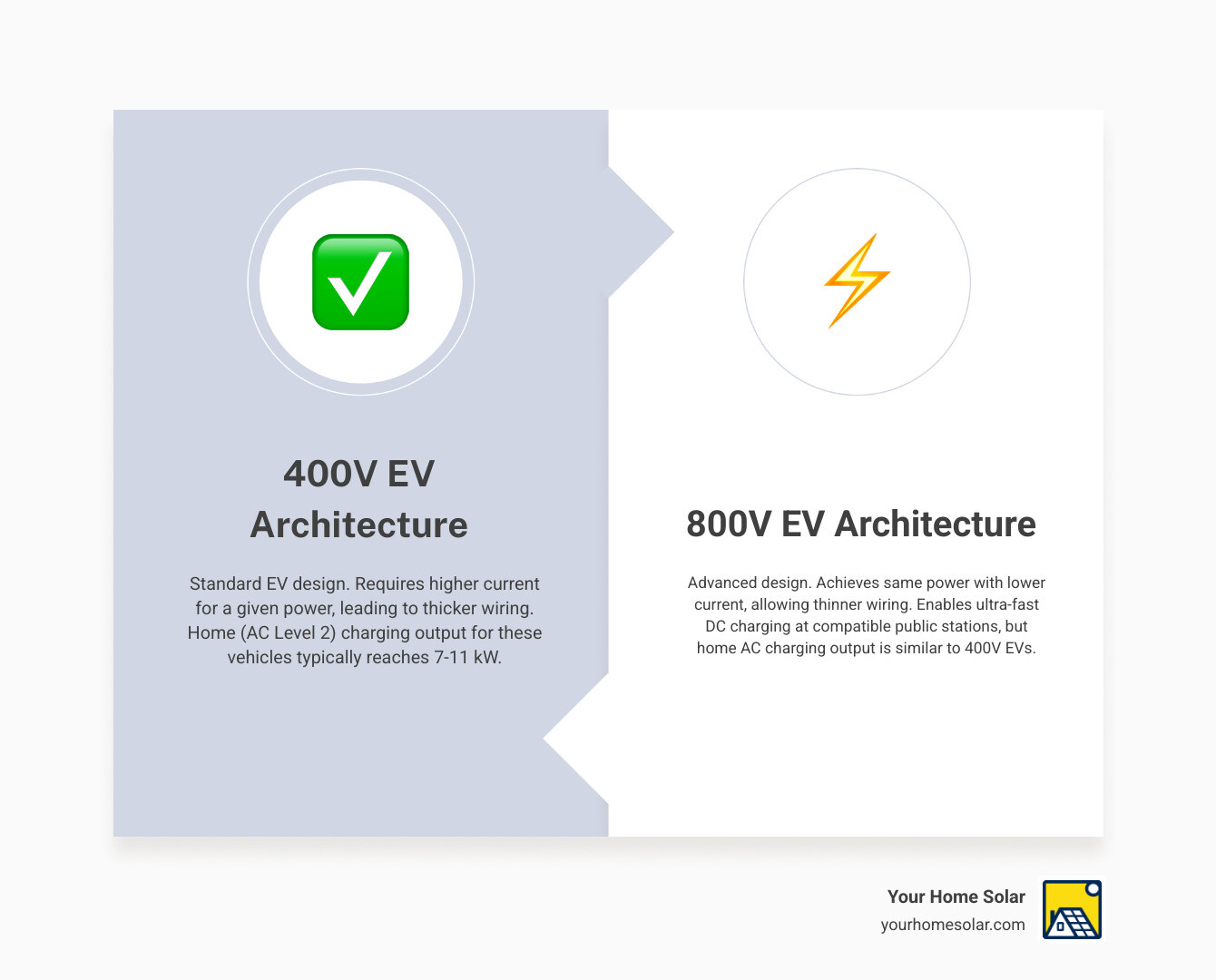
Understanding the Voltage Leap: 400V vs. 800V Architecture
Imagine electricity flowing through a wire like water through a hose. Voltage is like the water pressure – the higher the voltage, the more “push” the electricity has. Amperage (current) is the volume of water flowing, and wattage (power) is the total amount of work the water can do. In EVs, these principles determine how quickly and efficiently your car can charge.

Historically, most electric vehicles have been built with a 400-volt electrical architecture. This has been the industry standard, offering a good balance of performance and cost. However, like all technology, EV design is constantly evolving. The complex architecture of an EV involves everything from batteries and motors to inverters and wiring. The shift to 800-volt systems represents a significant advancement in how these components work together.
The fundamental difference lies in how power (measured in kilowatts, kW) is delivered. According to Ohm’s Law, Power (P) = Voltage (V) x Current (I). This means you can achieve the same power output by either increasing the voltage or increasing the current. For EV charging, increasing the voltage has proven to be a game-changer.
Every EV has an on-board charger (OBC) which is crucial for home charging. When you plug your car into your home’s alternating current (AC) electricity supply, the OBC converts that AC power into direct current (DC) power that the battery can store. This component plays a vital role in how much power your car can accept from a home charger, regardless of your vehicle’s internal voltage architecture.
How 800V Systems Work
The magic of 800V systems comes down to a simple principle: higher voltage allows for lower current to deliver the same amount of power. Think of it this way: if you want to move a certain amount of energy, you can either push a lot of water (high current) slowly, or a little water (low current) very quickly (high voltage).
Why does lower current matter? It’s all about efficiency and heat. When electricity flows, some energy is inevitably lost as heat. This heat loss is proportional to the square of the current, meaning even a small reduction in current can significantly decrease energy waste. This allows for:
- Reduced Heat Loss: Less current flowing means less resistance and dramatically less heat generated during charging and operation. This is a huge win for efficiency and component longevity.
- Thinner, Lighter Wiring: With less current, thinner and lighter cables can be used throughout the vehicle. This reduces overall vehicle weight, which in turn can improve range and performance. It also simplifies the manufacturing process.
- Improved Power Delivery Efficiency: By minimizing heat loss and resistance, more of the electrical energy makes it to where it needs to go, whether that’s the battery during charging or the motors during driving.
An 800V system has the capacity to handle more “electrical pressure” than a 400V system, enabling it to pass electricity around the system with greater efficiency and less waste.
Key Differences from 400V Systems
The transition from 400V to 800V architecture isn’t just a minor tweak; it’s a fundamental redesign that brings a host of benefits and some unique considerations. While 400V systems have served us well, 800V promises a future of even faster, more efficient EVs.
Here’s a quick comparison of the key differences:
| Feature | 400V Architecture | 800V Architecture |
|---|---|---|
| Charging Speed | Moderate (50-150 kW DC fast charging typical) | Significantly Faster (up to 350 kW DC fast charging) |
| Efficiency | Good, but more heat loss at high power | Improved, less energy lost as heat |
| Vehicle Weight | Standard wiring and components | Lighter (thinner cables, smaller components) |
| Component Size | Standard | Smaller (due to lower current needs) |
| Current Cost | Generally lower manufacturing costs | Higher initial cost for advanced components |
| Thermal Mgmt. | More robust cooling needed for high power | Less intensive cooling required |
| Performance | Solid performance | Improved, better sustained high power delivery |
A challenge for 400V systems is managing high charging currents. These can become “infeasible due to cable limitations and thermal issues,” as noted in research. 800V systems, by reducing the current, neatly sidestep these problems, allowing for previously unattainable charging speeds and improved overall vehicle performance. They can “better handle sustained high-power output,” meaning your EV can maintain its zip even after multiple rapid accelerations.
The Advantages of Higher Voltage for EV Owners
For you, the EV owner, the shift to 800V architecture translates into some genuinely exciting benefits, particularly when it comes to time savings and vehicle performance.
-
Faster Charging Times: This is the headline benefit. When connected to a compatible public DC fast charger, 800V EVs can drastically cut down on charging stops. For instance, the Porsche Taycan, one of the pioneers of 800V, can go from 5% to 80% charge in a mere 22.5 minutes on a 270-kW 800V Level 3 charger. Compare that to the same charge taking up to 90 minutes on a 50-kW, 400V charger. Similarly, the Hyundai Ioniq 5 and Kia EV6 can boast a 10% to 80% charge in less than 20 minutes when plugged into a 350-kW DC station. Lucid’s Air EV, with its system over 900 volts, can add an impressive 200 miles of range in just 12 minutes! This kind of speed makes long-distance travel much more convenient.
-
Improved Vehicle Efficiency: Less current means less resistance, and less resistance means less energy wasted as heat. This improved efficiency translates to more of your battery’s energy being used to move the car, potentially offering a slightly better range and overall energy consumption.
-
Lighter Vehicle Weight: As we discussed, 800V systems allow for thinner cables and smaller electronic components. This reduction in vehicle weight isn’t just about making your EV feel zippier; it contributes to overall efficiency and can even improve handling. Every pound saved means less energy needed to move the vehicle.
-
Improved Performance: Beyond just charging, the higher voltage allows for more efficient power delivery to the motors. This can lead to better acceleration and sustained high-power output, contributing to a more dynamic driving experience.
-
Better Regenerative Braking: While not explicitly stated in all research for 800V, improved electrical efficiency generally improves the effectiveness of regenerative braking systems. This means your EV can recover more energy when slowing down, further contributing to range and efficiency. It’s like having a perpetual motion machine, almost!
The Reality of 800 Volt Charging at Home
Now, let’s bring it back to your garage in Knoxville, Maryville, or Johnson City. While the benefits of 800V architecture are undeniable for public DC fast charging, the reality of 800 volt charging at home is a bit different – and honestly, a lot simpler than it sounds.
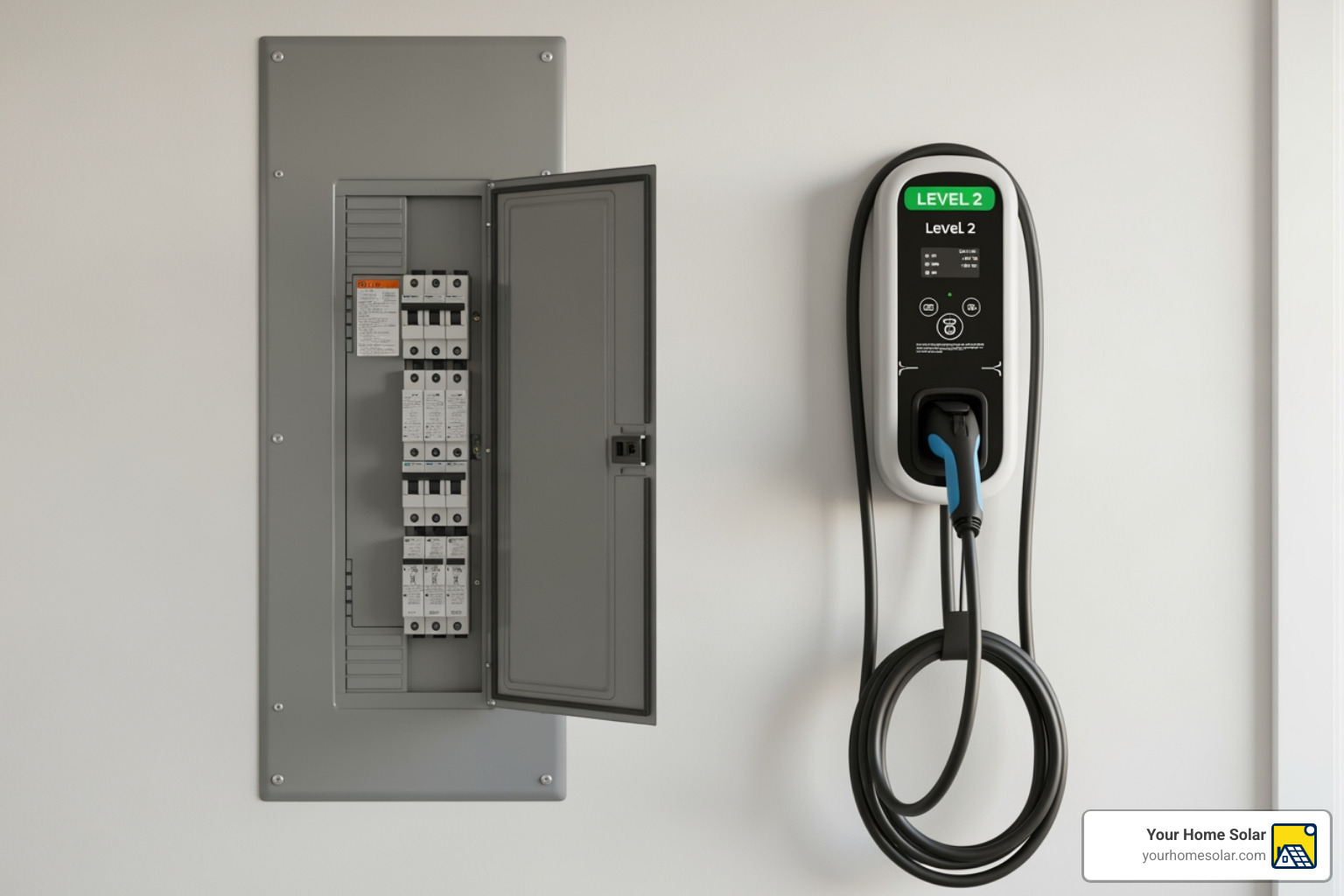
The key distinction to remember is the difference between public DC (Direct Current) fast charging and home AC (Alternating Current) charging. Public Level 3 chargers use high-voltage DC power to bypass your car’s onboard charger and feed electricity directly into the battery. This is where 800V vehicles truly shine.
At home, however, you’re almost certainly using a Level 2 AC charger. Your home’s electrical system provides AC power, typically at 240 volts. Your EV’s onboard charger (OBC) then converts this AC power into DC power that the battery can accept. This conversion process, and the OBC’s maximum input rate, is the primary limiting factor for home charging speed.
So, even if your shiny new EV boasts an 800V architecture, your home charging setup will look very similar to that of a 400V EV. The maximum power you can draw at home is dictated by your household’s electrical capacity and your car’s OBC, not its internal voltage architecture. The notion of needing an “800V home charger” for a typical residential installation is a misconception due to the “extreme power requirements and prohibitive costs” it would entail. We’re talking industrial-level infrastructure and “five to six figures” in expenses – definitely not a casual garage upgrade!
For most EV owners in East Tennessee, “home charging is substantially cheaper (roughly one-third the cost) of DC fast-charging” anyway, making it the preferred method for daily top-ups. We’re all about smart, efficient energy solutions at Your Home Solar, and that includes making sure your EV charging is as practical and cost-effective as possible. If you’re looking to optimize your home charging setup, consider a Smart EV Charger Installation in Knoxville to get the most out of your system.
Current Availability of 800 Volt Charging at Home
Let’s clear up a common misunderstanding: there are currently no true 800-volt DC fast chargers designed or available for typical residential installation. When we talk about 800 volt charging at home, we’re usually referring to charging an 800V-capable EV using a standard Level 2 (240-volt AC) home charger.
Your EV’s onboard charger (OBC) is the unsung hero here. It’s responsible for converting the AC power from your home’s outlet into DC power that your battery can use. Whether your car has a 400V or 800V battery architecture, the OBC dictates the maximum AC charging rate it can accept. Most EVs, regardless of their internal architecture, have AC charging limits typically ranging from 6.6 kW to 11 kW. So, while your 800V EV might gulp down 350 kW at a public DC fast charger, it will likely sip around 7-11 kW at home, just like its 400V cousins.
This means that the Level 2 chargers we install for our customers in areas like Sevierville and Farragut are perfectly compatible with 800V EVs. The car’s internal systems handle the voltage conversion and management. The benefits of 800V architecture primarily come into play when you access high-power public DC fast chargers, not in your garage.
Installation and Cost for 800 Volt Charging at Home
Installing a home EV charger, whether for a 400V or 800V EV, typically involves setting up a Level 2 charging station. This means you’ll need a dedicated 240-volt circuit, usually protected by a 40- or 50-amp breaker, capable of charging most EVs overnight. This is the sweet spot for convenience and efficiency for daily charging needs.
For this, professional installation is key. A qualified electrician from Your Home Solar will run a dedicated electrical line from your breaker box to the chosen location in your garage or on the exterior of your home. This ensures safety and optimal performance. For homeowners in Knoxville, our team specializes in EV Charger Installation Knoxville, ensuring everything is up to code and ready for your EV.
The cost for a standard Level 2 installation can vary. If your home’s electrical panel has sufficient capacity, it might be a few hundred dollars. However, if you need to upgrade your electrical panel to handle the increased load, the cost could be “a couple of thousand dollars.” It’s an investment, but one that significantly improves the convenience of EV ownership.
On the bright side, there’s a federal tax credit available! The Inflation Reduction Act reinstated a tax credit of “30 percent of total costs (capped at $1000)” for EV charging equipment and associated electrical upgrades. This credit is set to expire on June 30, 2026, so it’s a good time to consider making that upgrade. We can help you understand how to take advantage of these incentives for your home in East Tennessee.
Safety and Power Grid Considerations
When we discuss higher voltages, safety is always paramount. While true 800V DC charging isn’t a home reality, the internal 800V architecture of modern EVs does require careful design considerations. For instance, “increased voltage necessitates greater distances between conductors and thicker insulation to prevent arcing.” This kind of engineering is handled by the vehicle manufacturers and charger designers, not something you’d typically need to worry about in your home setup. Our professional installers ensure your Level 2 charger adheres to all safety protocols and local codes in places like Oak Ridge and Morristown.
The real concern about high-power charging, whether 400V or 800V, is its potential impact on the electrical grid. Widespread adoption of high-power EV charging, even at Level 2, means increased demand. “The higher power delivery demands of 800-volt charging stations could strain the electrical grid when handling the increased load requirements.” While public DC fast chargers are the primary concern here, even Level 2 home charging adds to the overall load.
This is where smart home energy management comes into play. Some advanced EV chargers, like certain Emporia units, offer “load management.” This feature “constantly monitors your house’s overall output and will automatically lower the charging draw if necessary to prevent exceeding your house’s capacity.” This kind of intelligent management helps prevent tripping breakers and ensures your home’s electrical system remains stable.
At Your Home Solar, we offer solutions that can further improve your home’s energy resilience. Integrating your EV charging with a Generator Installation Knoxville provides peace of mind during power outages, ensuring your EV can still charge even when the grid is down.
Which EVs Are Ready for 800V?
While most mass-market electric vehicles historically used a 400-volt electrical architecture, the tide is turning. More and more manufacturers are redesigning their vehicles and moving towards 800-volt architecture, promising improved efficiency and faster charging times. This shift is becoming a significant advancement, promising faster charging times and improved vehicle performance.
Having an 800V-capable EV doesn’t mean it can only charge at 800V. These vehicles are designed to be flexible. For instance, “the majority of existing 400-volt DC fast chargers can be used by 800-volt EVs, but this is contingent upon the vehicle being equipped with additional hardware to manage the lower voltage.” This usually involves a DC/DC converter that allows the 800V vehicle to step down the voltage from a 400V fast charger. So, your 800V EV won’t be left high and dry if it encounters an older 400V public charger.
However, to truly open up the ultrafast charging potential, “800V EVs can support faster charging times with chargers capable of delivering the required 800 Vdc output.” This is why the growth of 800V public chargers is so critical. While currently “around 1.5% of DC fast chargers deployed in the US are capable of 800V output,” the trend is clear, and more are coming.
Here’s a list of some key EV models that currently feature or are expected to feature 800V architecture:
- Porsche Taycan: A pioneer in 800V technology, known for its blistering fast charging.
- Audi e-tron GT: Shares its platform with the Taycan, offering similar charging prowess.
- Hyundai Ioniq 5 & Ioniq 6: These popular models boast impressive 10-80% charging times on compatible DC fast chargers.
- Kia EV6: Also part of the Hyundai-Kia family, offering excellent 800V charging capabilities.
- Lucid Air: Pushing the boundaries with systems “over 900 volts,” enabling incredibly rapid charging.
- Genesis GV60: A luxury EV from Hyundai’s premium brand, also built on an 800V platform.
- GMC Hummer EV: While its battery operates at 400V, it uses a clever “trick” of reconfiguring its dual-layer battery packs in series during charging to effectively achieve 800V charging speeds.
This list is growing rapidly, with many major automakers like General Motors, Toyota/Lexus, Rivian, Volvo/Polestar, and Stellantis brands planning to adopt 800V architecture for future models.
The Future of EV Charging and Home Energy
The landscape of EV charging is changing rapidly, and the shift to 800V architecture is just one piece of a larger, exciting puzzle. The future promises not only faster charging but also a more integrated and resilient home energy ecosystem, especially for homeowners in East Tennessee.
-
More Manufacturers Adopting 800V: The trend is undeniable. As we noted, more and more manufacturers are redesigning their vehicles and moving towards 800-volt architecture. This “standard is expected to become more common by 2025 and beyond,” spreading from premium models to more mainstream EVs. This means that while 800 volt charging at home isn’t a direct reality, more vehicles will be capable of taking advantage of ultra-fast public charging.
-
Bidirectional Charging (V2H/V2G): Imagine your EV not just consuming power but also providing it back to your home (Vehicle-to-Home or V2H) or even the grid (Vehicle-to-Grid or V2G). This technology allows your EV’s large battery to act as a power bank, providing backup electricity during outages or discharging power during peak demand to save you money. This capability is becoming increasingly common and could revolutionize how we think about home energy independence.
-
Integration with Residential Solar Solutions: This is where Your Home Solar truly shines. Integrating your EV charging with a home solar system creates a powerful, sustainable, and cost-saving synergy. You can charge your EV with clean energy generated right from your rooftop, drastically reducing your electricity bills and carbon footprint. When paired with battery storage, you can even charge your EV with solar power at night or during an outage.
-
Energy Independence: The combination of solar, battery storage, and bidirectional EV charging moves homeowners closer to true energy independence. In areas like Johnson City or Kingsport, where weather can sometimes disrupt power, having multiple layers of energy resilience is invaluable.
-
Smart Home Ecosystems: Your EV charger, solar panels, and battery storage can all be managed through smart home platforms, allowing you to optimize charging schedules, monitor energy flow, and make informed decisions about your energy consumption. This creates a seamless and efficient energy experience right from your smartphone.
Conclusion
The journey into electric vehicles is an exciting one, full of innovation and new possibilities. While the concept of 800 volt charging at home might conjure images of futuristic boostrs in your garage, the current reality for homeowners in East Tennessee is simpler and more practical.
We’ve learned that:
- 800V architecture in EVs brings significant benefits like faster public DC fast charging, improved efficiency, and lighter vehicle weight.
- Home charging for 800V EVs still relies on standard Level 2 (240-volt AC) chargers, with the car’s onboard charger handling the conversion.
- True 800V DC home charging is currently impractical and cost-prohibitive for residential settings.
- Proper installation of a Level 2 charger by a qualified professional is essential for safety and optimal performance.
- Future trends point towards even greater integration of EVs into home energy ecosystems, especially with solar and bidirectional charging.
At Your Home Solar, we’re committed to helping you steer this evolving landscape. Whether you’re driving a 400V or an 800V EV, we have the expertise to ensure your home charging setup is safe, efficient, and ready for the future. We can assess your home’s electrical capacity, recommend the right Level 2 charger for your needs, and install it seamlessly, whether you’re in Knoxville, Maryville, or any of our service areas across East Tennessee.
Don’t let the technical jargon of 800V charging intimidate you. Focus on what truly matters: convenient, reliable, and cost-effective charging right where you live. And if you’re ready to future-proof your home energy, including your EV charging, we’re here to help.
Get a professional EV charger installation in Knoxville from Your Home Solar today, and let us help you power your journey with confidence.