The Truth Behind the “Free Solar” Promise
How to get free solar panels from the government is a question countless homeowners search for, hoping to find a no-cost path to solar energy. Here’s the direct answer:
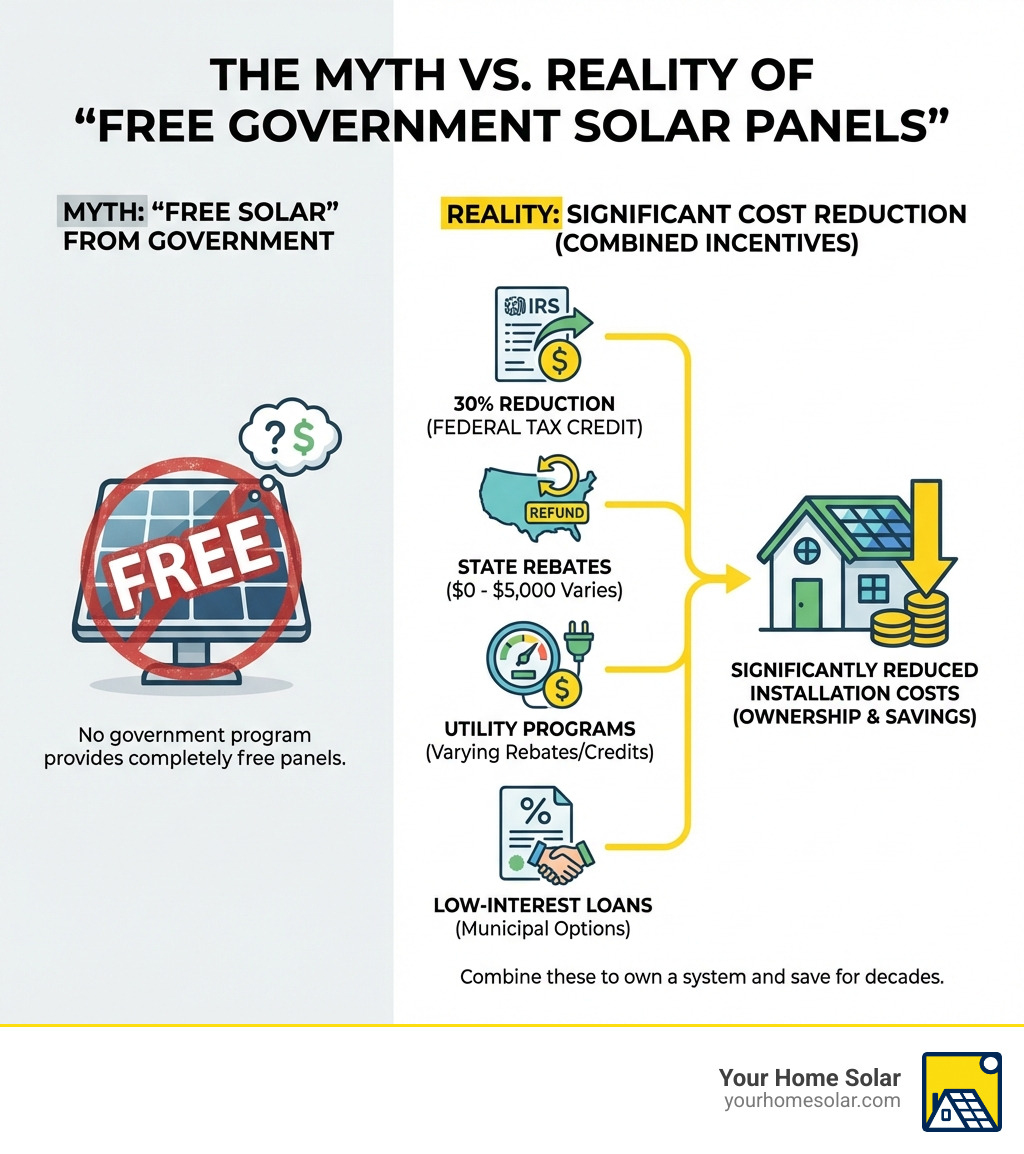
There is no government program that provides completely free solar panels. However, the federal government and some state programs offer substantial financial incentives that can reduce your out-of-pocket costs by 30% to 50% or more. The most significant is the Federal Residential Clean Energy Credit, which covers 30% of your total solar installation cost.
Key Government Incentives for Solar:
- Federal Tax Credit: 30% of total system cost (2022-2032)
- State Rebates: Varies by location, typically $0-$5,000
- Local Utility Programs: May offer additional rebates or credits
- Low-Interest Loans: Available in some municipalities
The reality is better than “free.” When you combine these incentives, you can own a solar system that saves you money for decades, protects your home from power outages, and increases your property value. You’re not renting or leasing—you own the system and all the savings it generates.
The confusion comes from misleading ads that promise “free” solar. What they’re really talking about are programs that reduce your upfront costs, not eliminate them entirely. Some ads refer to leasing arrangements where you pay nothing upfront but also don’t own the system or qualify for tax credits. Others simply exaggerate the value of government incentives.
According to the IRS, the Residential Clean Energy Credit equals 30% of the costs of new, qualified clean energy property for your home installed between 2022 and 2032. For a typical East Tennessee solar installation costing $20,000, that’s a $6,000 tax credit—significant, but not free.
I’m Ernie Bussell, Founder and CEO of Your Home Solar, and I’ve spent years helping East Tennessee homeowners steer the truth about how to get free solar panels from the government and understand what financial help is genuinely available. After managing operations for a $40 million solar company and now running East Tennessee’s #1 solar contractor, I’ve seen every misleading claim in the industry—and I’m here to give you the straight facts.
The “Free Solar” Myth vs. The Reality of Government Support
The allure of “free solar” is understandable. Who wouldn’t want to harness the sun’s power without any out-of-pocket expense? However, as we’ve already clarified, the notion of how to get free solar panels from the government is a pervasive myth. The truth is far more nuanced and, frankly, more empowering for homeowners.
What “Free Solar” Ads Are Really Referring To
When you see advertisements promising “free solar panels,” they’re often playing on a misunderstanding of how government incentives work. These ads might refer to:
- Leasing Programs or Power Purchase Agreements (PPAs): With these options, you don’t actually own the solar panels. A third-party company installs and owns the system on your roof. You then pay them a monthly fee for the electricity generated (PPA) or for the use of the equipment (lease). While there might be no upfront cost to you, you don’t receive the tax credits or the long-term increase in home value that comes with ownership. You’re essentially renting your electricity.
- Significant Cost Reductions: Some ads simply highlight the dramatic savings offered by federal and local incentives, implying that the reduction is so substantial it’s as good as free. While these incentives are fantastic for making solar affordable, they don’t zero out the cost.
- Misleading or Outdated Information: Unfortunately, some marketing can be intentionally vague or rely on programs that no longer exist or have limited eligibility.
The key takeaway here is that “free” usually comes with a catch, often meaning you forgo ownership and the most significant financial benefits. More info about solar incentives can help you discern these differences.
The Real Deal: How Government Incentives Actually Work
Instead of “free,” think “significantly reduced cost” and “smart investment.” Government incentives are designed to encourage homeowners like you to adopt renewable energy, reducing our collective carbon footprint and strengthening the energy grid. These programs typically take the form of:
- Tax Credits: These are dollar-for-dollar reductions in your income tax liability. The Federal Residential Clean Energy Credit is the prime example.
- Grants: Less common for individual homeowners than tax credits, grants are direct payments that don’t need to be repaid. When they are available, they often have specific eligibility requirements, such as income levels or participation in specific energy efficiency programs.
- Rebates: These are partial refunds on the purchase price of your solar system, often offered by state governments or local utilities.
- Low-Interest Loans: Some municipalities or states provide special financing options with favorable terms to help cover the upfront cost of installation.
These incentives work together to make solar panels a financially attractive option. They directly reduce your out-of-pocket expenses, allowing you to pay less for a system you own. This ownership brings several critical benefits:
- Increased Home Value: Studies consistently show that homes with owned solar panels sell for more and faster than comparable homes without solar.
- Long-Term Savings: Once your system is paid off (and often even before), you’ll enjoy drastically reduced or even eliminated electricity bills for decades.
- Energy Independence: You’re less reliant on the utility company and fluctuating energy prices.
- Environmental Impact: You’re directly contributing to a cleaner, more sustainable future.
Let’s look at a hypothetical example of how incentives can transform the cost of a solar installation:
| Cost Component | Without Incentives | With Federal Tax Credit (30%) |
|---|---|---|
| Total System Cost | $20,000 | $20,000 |
| Federal Tax Credit (30%) | $0 | -$6,000 |
| Net Cost to Homeowner | $20,000 | $14,000 |
As you can see, while not “free,” that $6,000 reduction makes a massive difference in the overall investment. And this doesn’t even factor in potential state or local incentives that could further lower your costs!
The #1 Government Incentive: The Federal Residential Clean Energy Credit
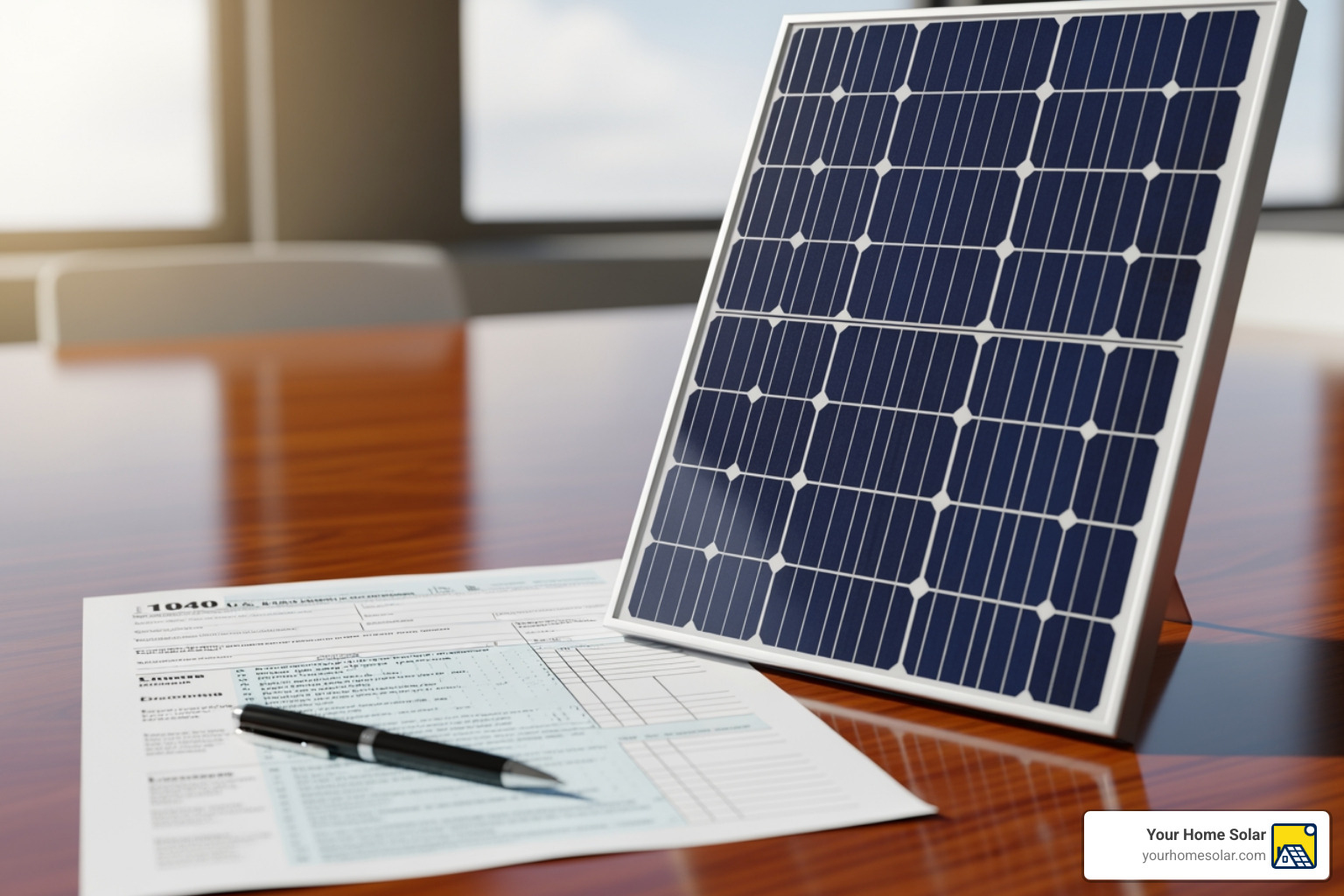
When we talk about how to get free solar panels from the government—or rather, how to significantly reduce their cost—the Federal Residential Clean Energy Credit (often just called the federal solar tax credit) is the undisputed heavyweight champion. This incentive is a cornerstone of making solar energy accessible and affordable for homeowners across the United States, including right here in East Tennessee.
How the 30% Federal Solar Tax Credit Works
The Residential Clean Energy Credit is a federal income tax credit. But what exactly does that mean?
- Dollar-for-Dollar Reduction: Unlike a tax deduction, which reduces your taxable income, a tax credit directly reduces the amount of income tax you owe, dollar for dollar. If you owe $7,000 in federal income taxes and qualify for a $6,000 solar tax credit, your tax liability drops to $1,000.
- Nonrefundable Credit: This credit is “nonrefundable,” meaning it can reduce your tax liability down to $0, but you won’t get a refund check for any credit amount exceeding your tax liability.
- Carry Forward Unused Credit: The good news is that if your credit amount is more than the tax you owe in a given year, you can carry forward the unused portion of the credit to future tax years. This means you won’t lose out on the full value of the credit, even if you don’t have enough tax liability in the year your system is installed.
This powerful incentive was reinforced by the Inflation Reduction Act. For systems installed between 2022 and 2032, homeowners can claim a credit equal to 30% of the cost of their new, qualified clean energy property. This percentage is set to decrease in the coming years:
- 30% for systems installed from 2022 through 2032
- 26% for systems installed in 2033
- 22% for systems installed in 2034
- The credit is set to expire starting in 2035 unless Congress renews it.
To claim this credit, you’ll typically complete and attach IRS Form 5695, Residential Energy Credits, to your federal tax return (Form 1040 or Form 1040NR). We always recommend seeking professional tax advice to ensure you maximize your benefits and comply with all IRS requirements. For more detailed information, you can consult the Homeowner’s Guide to the Federal Tax Credit for Solar Photovoltaics and the Instructions for Form 5695.
What Expenses and Who is Eligible for the Credit?
Understanding what counts toward the credit and who can claim it is crucial.
Eligible Expenses include:
- Solar PV Panels/Cells: The actual solar panels that convert sunlight into electricity.
- Labor Costs: This includes onsite preparation, assembly, or installation of the solar system. Permitting fees, inspection costs, and developer fees are also typically included.
- Balance-of-System Equipment: This covers essential components like wiring, inverters (which convert DC power from panels to AC power for your home), and mounting equipment.
- Energy Storage Devices (Battery Storage): If you install a battery storage system with a capacity of at least 3 kilowatt-hours (kWh), its cost can also be included in the credit. This is a fantastic benefit for East Tennessee homeowners looking for energy resilience during power outages.
- Sales Tax: Any sales tax paid on eligible expenses can generally be included.
Who is Eligible?
- Ownership Requirement: You must own the solar PV system. If you lease the system or enter into a Power Purchase Agreement (PPA), you generally cannot claim the credit, as the third-party owner claims it.
- New Property: The system must be new and installed for the first time. Used solar property is not eligible.
- Primary and Secondary Homes: The eligible property can be installed at your main home (primary residence) or a second home/vacation home located in the United States.
- New Construction: If you purchase a new home with solar PV already installed, you can claim the credit for the year you move in, provided the builder did not claim it. It’s wise to ask the builder for a cost allocation of the solar system.
- Non-Homeowners (in specific cases): Even if you’re not a traditional homeowner, you might qualify. For example, if you’re a tenant-stockholder in a cooperative housing corporation or a member of a condominium association and contribute to the cost of a solar PV system installed on the building, you could claim the credit based on your contribution.
- Off-Grid Systems: The solar PV system does not need to be connected to the electric grid to qualify.
- Ground-Mounted Systems: Panels don’t have to be on your roof; ground-mounted systems on your property that generate electricity for your residence also qualify.
Traditional roofing materials or structural components that don’t generate electricity (like roof trusses) do not qualify. However, some innovative solar roofing tiles and shingles that serve both as roofing and solar electric collectors do qualify.
For the most up-to-date and comprehensive details on eligibility and qualified expenses, always refer to the official IRS guidance, such as the Residential Clean Energy Credit page.
How to Get Financial Help for Solar Panels from the Government Beyond Federal Credits
While the federal tax credit is a fantastic start, it’s not the only way to get significant financial assistance for solar panels. For homeowners in East Tennessee, we also look to state, local, and utility-specific programs that can further reduce your costs. The question of how to get free solar panels from the government expands to include these regional initiatives.
Finding State and Local Solar Incentives in Tennessee
Tennessee has been making strides in renewable energy adoption, and while we don’t have the extensive state-level rebates found in some other states, there are still valuable programs to explore.
A great starting point for any homeowner is the Database of State Incentives for Renewables & Efficiency (DSIRE). This is the most comprehensive source of information on solar incentives across the U.S. You can search by state to find what’s currently available in Tennessee.
Specific to our region, we’re keenly aware of programs that impact our customers in Knoxville, Johnson City, Maryville, Oak Ridge, and across East Tennessee:
- Tennessee Valley Authority (TVA): As the primary power provider for much of our region, TVA often has programs or works with local power companies (LPCs) to offer incentives related to energy efficiency and renewable energy. While direct solar rebates from TVA are less common now, their broader initiatives can still create favorable conditions for solar adoption.
- Local Utility Programs: Your specific local power company (e.g., Knoxville Utilities Board, Johnson City Power Board, Appalachian Electric Cooperative) might offer localized rebates or net metering policies that improve the financial benefits of solar. Always check directly with your utility provider.
- Solar for All: This program, funded through the Inflation Reduction Act, aims to expand solar access to low-income and disadvantaged communities. While it’s a federal initiative, it is implemented at the state level. Tennessee has a “Solar for All” program that could provide grants or other assistance to eligible households. This is one of the closest things to “free” solar, but it’s specifically targeted and has strict eligibility criteria. You can find more information about the Tennessee program through the state’s energy office: Solar for All.
- Property Tax Exemptions: In some areas, the added value of a solar energy system might be exempt from property tax assessments, meaning your property value increases without a corresponding increase in your tax bill. This is a subtle but significant financial benefit.
We’ve dedicated resources to keeping our East Tennessee customers informed about these local opportunities. You can dive deeper into what’s available with our guides: Solar Incentives Tennessee 2026 Guide and What Incentives Exist in Solar Within Tennessee? Ernie Answers This Commonly Asked Question.
Understanding How to Get Free Solar Panels from the Government in Other Forms
Beyond tax credits, the terms “grant,” “rebate,” and “loan” often come up in discussions about how to get free solar panels from the government. While they all offer financial assistance, they function differently:
- Grant: A grant is money given by an organization (like the government) for a specific purpose, which does not need to be repaid. Grants are often highly competitive and have strict eligibility requirements, sometimes based on income, location, or specific project types. When available for solar, they are indeed “free money,” but they are rare for typical residential solar installations outside of targeted programs like “Solar for All.”
- Rebate: A rebate is a partial refund on the purchase price of an item. For solar, this means you pay the full price upfront (or finance it), and then you receive a check or credit back from the state or utility after the installation is complete and approved. Rebates effectively lower your out-of-pocket cost.
- Loan: A loan is borrowed money that must be repaid, usually with interest. Government-backed or sponsored loans, however, often come with very favorable terms, such as low or even zero interest rates and extended repayment periods, making the initial investment more manageable. They don’t reduce the total cost of the system, but they make it much easier to afford.
Here’s a quick comparison:
| Feature | Grant | Rebate | Tax Credit | Loan |
|---|---|---|---|---|
| Repayment | No | No | No | Yes |
| Form of Benefit | Direct payment | Partial refund | Reduction in tax liability | Upfront capital |
| Eligibility | Often strict (income, location) | Varies (state, utility, equipment) | Broad (system ownership, location) | Creditworthiness, program criteria |
| Impact on Cost | Reduces upfront cost | Reduces upfront or net cost | Reduces net cost (after taxes) | Spreads cost over time (no reduction) |
| “Free” Aspect | Closest to “free money” | Reduces total paid | Reduces taxes owed | Makes affordable, but not free |
By understanding these distinctions, East Tennessee homeowners can better steer the various programs and stack incentives to maximize their savings.
Your Step-by-Step Guide to Claiming Solar Savings
Navigating solar incentives can seem daunting, but with a clear roadmap, it’s a straightforward process. As your trusted partner at Your Home Solar, we’re here to guide you every step of the way. Here’s how we approach helping East Tennessee homeowners claim their solar savings.
Step 1: The Home Energy Assessment
Before you even think about panels, the first crucial step is to understand your home’s energy needs and efficiency. This is where a professional home energy assessment comes in.
- Purpose of an Energy Audit: An energy audit, or pre-retrofit evaluation, helps identify where your home is losing energy and how you can make it more efficient. While this might sound like an extra step, it’s often a prerequisite for certain incentive programs and can significantly impact the optimal size and design of your solar system. By tightening up your home’s envelope, you might need a smaller, less expensive solar system to meet your needs.
- Finding an Energy Advisor: For some programs, you might need a qualified energy advisor to perform an EnerGuide evaluation. While these might not be directly linked to the federal tax credit, they are beneficial for overall energy planning.
- Identifying Efficiency Opportunities: Our team at Your Home Solar always starts by understanding your current energy consumption. We’ll look at your utility bills, assess your roof’s solar potential, and discuss your goals. This allows us to accurately size your solar system, ensuring you generate enough power to offset your consumption without over-investing. A thorough feasibility analysis is an important aspect of solar energy systems planning.
For a comprehensive look at how a home energy assessment ties into your solar journey, check out our Residential Solar Solutions Guide: Incentives and Tax Credits for Solar Systems.
Step 2: Applying for and Claiming Your Incentives
Once your solar system is designed and installed by a qualified installer (like us!), it’s time to claim those valuable incentives.
- Documentation Required: Keep meticulous records! This includes:
- All invoices and receipts for your solar equipment and installation costs.
- Proof of purchase and installation dates.
- Any certifications for eligible equipment (e.g., ENERGY STAR for geothermal, specific kWh capacity for batteries).
- Your solar installation contract.
- IRS Form 5695: To claim the Federal Residential Clean Energy Credit, you will file IRS Form 5695, Residential Energy Credits, with your federal income tax return for the year your system was “placed in service” (meaning installed and operational). The Instructions for Form 5695 will guide you through the process. The credit is claimed for the tax year the property is installed, not purchased.
- State and Local Rebate Forms: For any state or local rebates (like those from your utility company), you’ll typically need to fill out separate application forms provided by the program administrator. These often require proof of installation, equipment specifications, and sometimes a post-installation inspection. We assist our customers in identifying and applying for all applicable local incentives.
- Working with Your Installer: A reputable solar company, like Your Home Solar, should be well-versed in the available incentives and can help you gather the necessary documentation. We’re here to ensure you have everything you need to claim every dollar you’re entitled to.
Step 3: Understanding Net Metering and Your Electric Bill
Once your solar panels are generating electricity, you’ll enter net metering, a crucial component of maximizing your investment.
- Selling Excess Power: Net metering is a billing mechanism that allows you to send any excess electricity your solar panels generate back to the grid. When your panels produce more power than your home needs (e.g., on a sunny afternoon), that surplus energy flows into the utility grid.
- Grid Credits: In return, your utility company typically gives you a credit on your electricity bill for the power you’ve contributed. This credit can then offset the cost of electricity you draw from the grid when your panels aren’t producing enough (e.g., at night or on cloudy days).
- Utility Policies: Net metering policies vary by utility and state. In Tennessee, the specific terms will depend on your local power company and TVA’s overarching guidelines. It’s important to understand your local utility’s net metering rules to accurately project your savings.
- Energy Independence & Maximizing Investment: Net metering, combined with battery storage, allows you to significantly reduce your reliance on the grid. By effectively “storing” your excess solar energy with the utility or in your home battery, you ensure that every kilowatt-hour your system produces is put to good use, maximizing your financial return and moving you closer to true energy independence.
Frequently Asked Questions about Government Solar Programs
We hear a lot of questions about how to get free solar panels from the government and related incentives. Here are answers to some of the most common ones:
Are there truly any programs that offer how to get free solar panels from the government?
No, government programs do not provide entire solar systems for free; they offer financial incentives like the 30% federal tax credit to significantly lower your out-of-pocket cost, making solar more affordable. The closest you might get to “free” are highly specific, income-qualified grant programs like “Solar for All” in Tennessee, which aim to provide solar to disadvantaged communities. Even then, there might be maintenance costs or other responsibilities. The vast majority of homeowners will benefit from substantial cost reductions, not zero-cost installations.
Can I claim the federal tax credit if I finance my solar panel system?
Yes, you can claim the credit based on the total cost of the system, even if you finance it with a loan; however, interest and financing fees are not eligible for the credit. The key is that you must own the system. If you take out a loan to purchase your solar panels, you are the owner, and therefore eligible for the 30% Residential Clean Energy Credit on the full system cost. Just remember to exclude any loan interest or fees from the amount you claim.
Are solar batteries also covered by government incentives?
Yes, the Federal Residential Clean Energy Credit covers 30% of the cost of a qualifying battery storage system with a capacity of 3 kWh or more when installed in a home. This is excellent news for East Tennessee homeowners seeking backup power solutions for peace of mind during outages. The battery can be installed at the same time as your solar panels or as a standalone addition at a later date, as long as it’s for your main residence and meets the capacity requirement.
Conclusion: Make a Smart Investment in Solar
The dream of “free solar” is a myth, but the reality is even better: you can own a system that saves you money for decades with significant help from the government. By understanding tax credits and rebates, you can make a financially sound investment in your home’s energy future. For homeowners in East Tennessee, the experts at Your Home Solar can provide a trusted, transparent, and rewarding path to energy independence. We pride ourselves on 100% customer satisfaction, offering custom, reliable, and rewarding installations across Knoxville, Johnson City, Maryville, Oak Ridge, and all surrounding counties. We’ll help you steer the incentives and design a system that’s perfect for your home and your budget.