Sustainable Energy Solutions Start With a Smarter, More Resilient Home
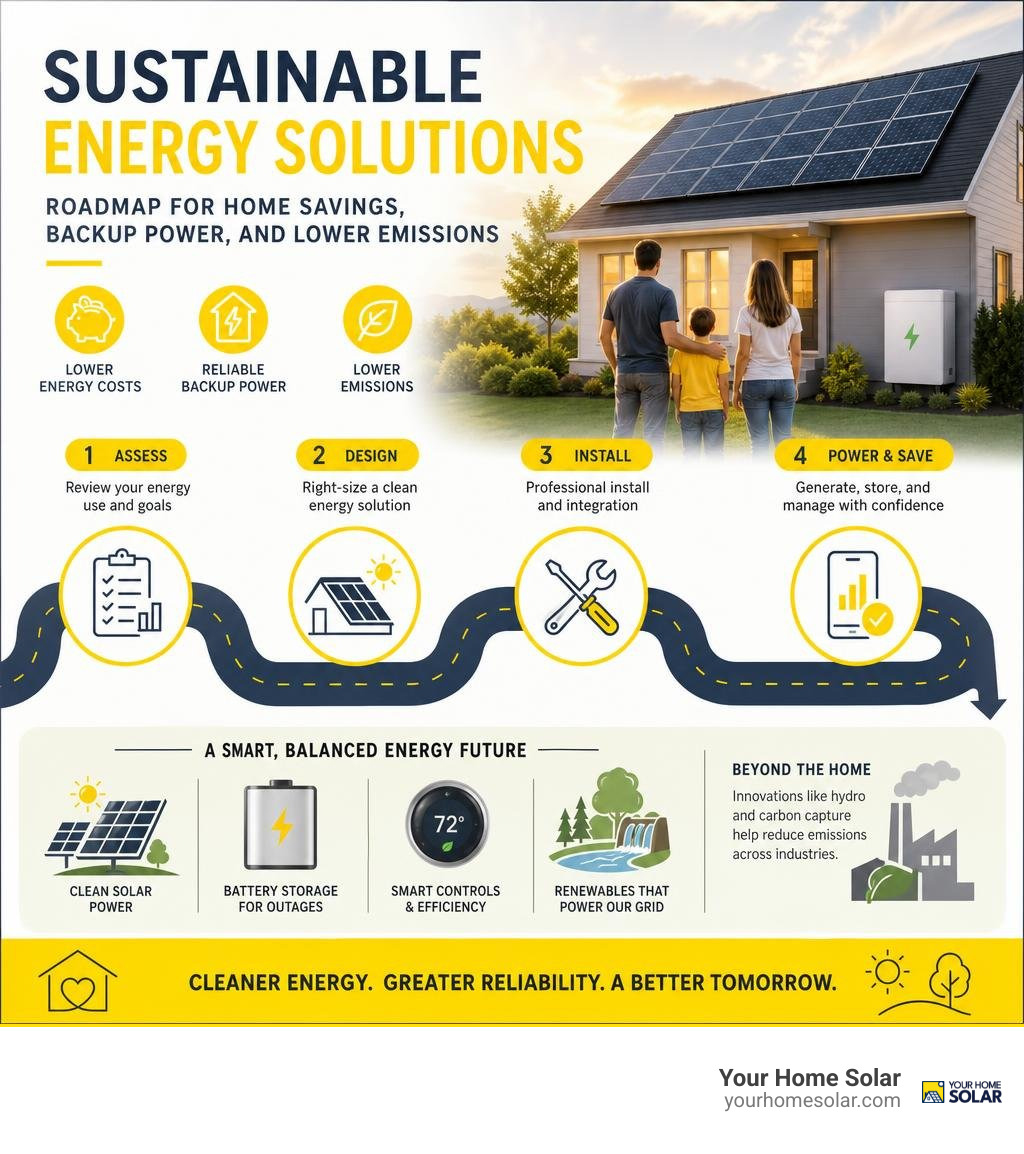
Sustainable energy solutions combine clean power, energy efficiency, battery storage, and smart controls to lower energy costs, reduce emissions, and keep essential household systems running when the grid goes down. For most East Tennessee homeowners, the practical starting point is to review electricity use, assess roof and shade conditions, then compare solar with battery backup based on the appliances and outage protection that matter most.
Solar can reduce the amount of electricity you buy from the utility during the day. Batteries can store extra power for evening use or outages. Together, they give homeowners more control over unpredictable bills and less reliable grid conditions.
The bigger energy transition needs more than rooftop panels. It also includes steady renewable resources such as hydro, smarter inverters that support grid stability, and carbon capture for industries like cement that cannot simply switch to electricity overnight. The goal is not one perfect technology. It is a reliable mix that fits the location, budget, and energy need.
I am Ernie Bussell, founder and CEO of Your Home Solar, with hands-on experience leading solar operations, installation scheduling, and homeowner-focused energy education. My work in Sustainable energy solutions is grounded in helping families understand how solar, storage, and long-term system support work together before they make a decision.
Simple Sustainable energy solutions word guide:
Core Pillars of Sustainable Energy Solutions
Modern energy infrastructure relies on a diversified framework of technologies working in unison. Achieving deep decarbonization and long-term grid reliability requires integrating intermittent generation, firm baseload generation, and direct carbon abatement technologies for heavy industrial processes. An overview of clean energy systems highlights how balancing these core components creates an adaptable, resilient power architecture across utility, commercial, and residential sectors.
Advanced Solar Photovoltaics and Smart Tracking
Photovoltaic (PV) technology has advanced beyond static rooftop panels. Modern utility and commercial installations utilize bifacial modules paired with single-axis tracking systems, such as dual-row tracker configurations. Bifacial tracking algorithms optimize the panel tilt angle continuously to capture reflected ground irradiance (albedo), increasing overall energy production by roughly 0.30% while reducing structural earthwork requirements by 12% to 14%.
Innovations in power architecture include 1000V AC string systems, which minimize balance-of-system (BOS) capital costs by 0.27 to 0.55 Euro Cents per watt-peak ($W_p$) and reduce commissioning labor across large-scale arrays. At the residential and commercial scale, pairing high-efficiency PV arrays with solar energy and sustainable architecture maximizes rooftop space, optimizes shading mitigation, and lowers the levelized cost of energy (LCOE) across the asset lifecycle.
Baseload Renewables and Hydroelectric Power Generation
Intermittent resources require firm renewable generation to maintain system inertia and grid balance. Hydroelectricity serves as a foundational pillar, accounting for around 24% of global electricity generation and approximately 80% of all renewable electricity production worldwide.
Run-of-river installations, conventional impoundments, and pumped-storage facilities provide dispatchable capacity, rapid ramping capability, and black-start support. Geothermal systems and biomass facilities complement hydro assets by extracting consistent sub-surface thermal energy or converting agricultural residues into heat and power, providing uninterrupted capacity during peak demand periods.
Cryogenic Carbon Capture and Industrial Emissions Abatement
Industrial facilities account for nearly 30% of emissions, with hard-to-abate sectors like cement production generating massive volumes of process-related exhaust. Cryogenic Carbon Capture (CCC) offers a post-combustion abatement pathway by flash-cooling industrial flue gas to freeze, separate, and liquefy carbon dioxide.
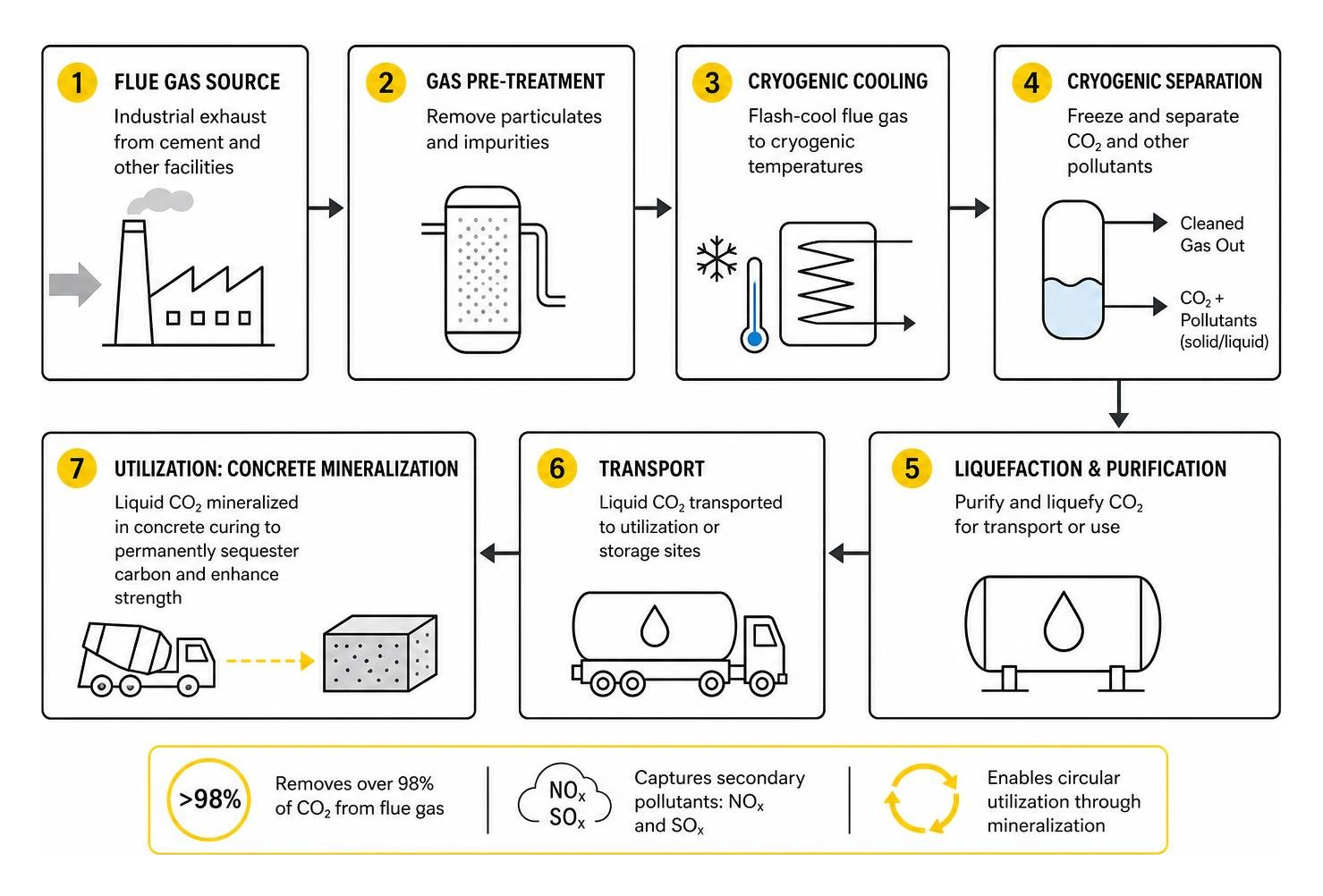
Cryogenic separation removes over 98% of $CO2$ from raw flue streams while capturing secondary pollutants such as nitrogen oxides ($NOx$) and sulfur oxides ($SOx$). In cement manufacturing, captured liquid $CO2$ can be mineralized directly into concrete during the curing cycle, permanently sequestering the greenhouse gas while improving product structural strength.
Next-Generation Integration: Storage, Microgrids, and Floating Solar
Modern generation assets require dynamic balancing mechanisms to accommodate distributed power feeds. Implementing comprehensive sustainable site energy solutions requires combining local energy storage, islandable microgrids, and decentralized offshore or nearshore generation platforms.
Grid-Forming Inverters and Battery Energy Storage Systems
Traditional solar inverters operate in grid-following mode, relying on external voltage and frequency references from centralized thermal or hydro turbines. As conventional rotating mass decommissions, loss of grid inertia creates severe frequency instability during sudden load swings.
Grid-forming inverters introduce synthetic inertia with programmable response times of 0 to 20 seconds. These systems deliver sub-10-millisecond active power injections during transient faults, self-establishing voltage and frequency references. Deploying utility-scale battery energy storage systems (BESS) alongside residential lithium iron phosphate ($LiFePO_4$) batteries enables clean energy solutions beyond the grid that buffer distribution networks, manage peak demand spikes, and ensure uninterrupted power delivery during grid disturbances.
Circular Design in Nearshore Floating Solar Modules
Land-constrained coastal environments, island communities, and industrial waterfronts face severe spatial limitations for ground-mounted solar arrays. Nearshore floating solar arrays resolve this constraint by deploying marine-grade PV pontoons engineered from repurposed materials.
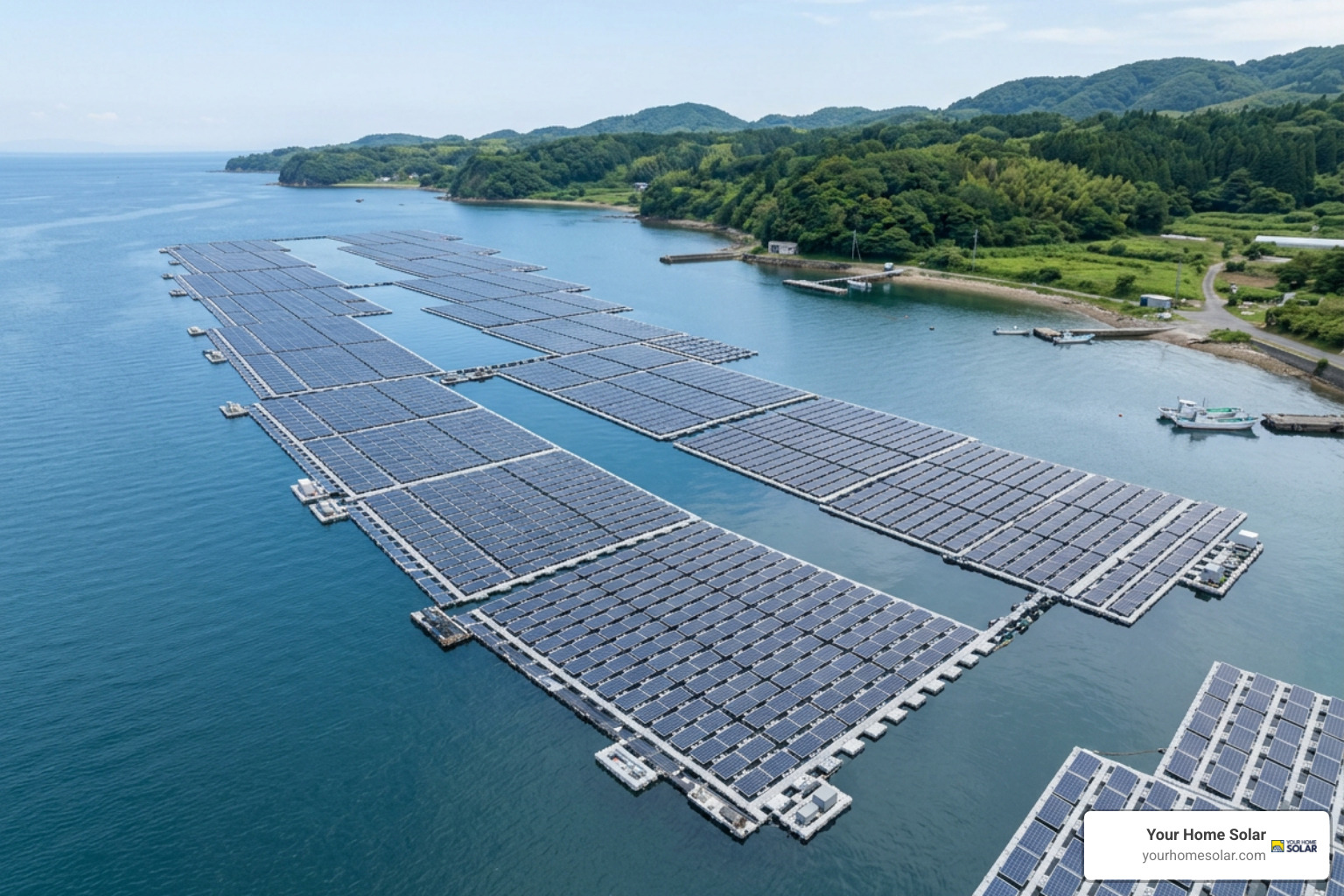
Approximately 50,000 wind turbine blades will reach retirement by 2035. Transforming these decommissioned composite structures into buoyant, modular pontoons prevents industrial landfill waste while providing durable marine platforms. These circular modules offer substantial operational capabilities:
- Structural Resilience: High-density fiber-reinforced walls withstand wave heights up to 4 meters and oceanic water depths up to 50 meters.
- Scalable Modular Capacity: Standardized 100 $kWp$ blocks scale from 1 $MWp$ to 50 $MW_p$ utility arrays.
- Integrated Battery Storage: Integrated storage of 1 $MW_p$ solar to 3 MWh BESS delivers continuous, dispatchable power past sunset.
- Diesel Displacement: Offsets expensive diesel generation ($250+/MWh) in remote island communities with levelized costs ranging between $45 and $195/MWh.
Adopting repurposed materials reinforces solar energy and circular economy principles across clean technology supply chains.
Zero-Carbon Industrial Parks and DC-Flexible Systems
Industrial manufacturing parks are transitioning from passive energy consumers into self-sufficient power ecosystems via full-chain “Generation-Storage-Usage-Management” architectures. China has planned 52 national-level zero-carbon parks with over 100 additional hubs underway, contributing to more than 12,000 integrated zero-carbon projects deployed globally.
A core technical innovation within these facilities is PV-DC-Direct-Flexible coupling. DC power generated by rooftop solar arrays feeds directly into variable-frequency centrifugal chillers, industrial heat pumps, and DC microgrids. Bypassing DC-to-AC-to-DC inversion stages cuts electrical conversion losses and boosts system-wide energy efficiency by over 15%. Automated digital platforms provide ISO 14064-compliant carbon accounting, helping manufacturers track Scope 1 and Scope 2 emissions for regulatory compliance.
Economic and Environmental Value of Modern Clean Energy
Investing in clean energy systems yields measurable financial returns, optimizes operational expenses, and mitigates long-term carbon tax exposures.

Evaluating Trade-Offs in Sustainable Energy Solutions
Balancing capital allocation against site-specific constraints requires evaluating core generation and abatement technologies across lifecycle metrics:
| Technology Category | Capital Expenditure (CAPEX) | Levelized Cost (LCOE / Abatement) | Dispatchability & Firmness | Primary Land / Siting Constraint | Lifecycle Carbon Offset Potential |
|---|---|---|---|---|---|
| Bifacial Solar PV + Trackers | Low to Moderate ($0.80–$1.20/W) | $30–$55/MWh | Intermittent (requires storage pairing) | Medium footprint; compatible with dual-use agrivoltaics | High (0 g operational $CO_2/kWh$) |
| Nearshore Floating Solar (BESS) | Moderate ($1.10–$2.50/W) | $45–$195/MWh | Fully Dispatchable (1MW / 3MWh storage) | Zero terrestrial land use; requires sheltered waters | High (replaces heavy marine diesel) |
| Conventional Hydroelectricity | High ($2,500–$5,000/kW) | $40–$90/MWh | High (Baseload, black-start, load-following) | Topography dependent; river basin requirements | Very High (decades of firm capacity) |
| Cryogenic Carbon Capture (CCC) | High ($60–$100/t $CO_2$ capacity) | $40–$75/tonne $CO_2$ captured | Continuous (Point-source industrial load) | Compact physical footprint; industrial plant integration | >98% direct point-source $CO_2$ removal |
Levelized Cost of Energy Reductions and Payback Timelines
Deploying distributed generation with intelligent load-shifting delivers compelling financial returns for commercial and residential facilities. Integrated industrial energy systems achieve electricity cost reductions of 35% to 50%, reaching full capital payback within 4 to 7 years.
Financial optimization relies on automated peak-valley arbitrage: battery systems charge during low-tariff off-peak periods or peak solar production, discharging stored power during peak tariff windows. For residential properties, combining high-efficiency PV arrays with home battery storage lowers utility dependence, as detailed in our guide to sustainable home energy.
Community Impact and Sustainable Energy Solutions for Remote Areas
Decentralized solar microgrids provide a scalable mechanism to resolve energy poverty in underserved and off-grid communities. Globally, thousands of off-grid solar and micro-hydro projects provide foundational power to remote settlements, eliminating reliance on costly kerosene and diesel fuels.
Beyond generating clean power, localized energy deployment fosters domestic workforce development. Technical training programs equip local technicians with installation, system design, and operations skills, multiplying regional economic growth while demonstrating the direct environmental impact of solar energy.
Overcoming Future Grid Integration and Infrastructure Challenges
Scaling clean energy systems requires resolving key technical, logistical, and regulatory hurdles:
- Grid Congestion and Intermittent Balancing: High penetration of solar and wind generation strains distribution feeders during peak generation windows. Upgrading regional transmission infrastructure, deploying dynamic line rating technologies, and mandating grid-forming inverter standards are essential to prevent curtailment.
- Carbon Infrastructure Deficits: Cryogenic carbon capture facilities require dedicated transport logistics to move liquid $CO_2$ from industrial capture sites to permanent sequestration formations or manufacturing hubs. Developing pressurized distribution networks and modular transport skids is critical for industrial scale-up.
- Supply Chain Circularity: With tens of thousands of wind turbine blades and early-generation solar panels reaching end-of-life over the next decade, manufacturers must institutionalize circular recycling pipelines, composite repurposing models, and closed-loop material reclamation standards.
Frequently Asked Questions About Sustainable Energy
How does cryogenic carbon capture differ from renewable power generation?
Renewable generation (such as solar, wind, and hydro) replaces fossil fuel combustion by producing zero-emission electricity. In contrast, Cryogenic Carbon Capture (CCC) is a post-combustion abatement technology installed directly on industrial flue stacks. It cools exhaust gases to separate and liquefy carbon dioxide, preventing emissions from hard-to-abate manufacturing processes that cannot be electrified with current technology.
What are the main economic benefits of decentralized solar and storage?
Decentralized solar and storage systems lower electricity bills by generating free power on-site and shielding facility owners from volatile utility rate hikes. Battery storage enables peak-shaving and time-of-use rate arbitrage, while providing continuous backup power during extreme weather events, avoiding costly operational downtime.
How do microgrids and grid-forming systems stabilize remote island networks?
Remote island grids traditionally rely on diesel generators to maintain network frequency and voltage. Microgrids equipped with grid-forming inverters and battery energy storage deliver synthetic inertia and high-speed reactive power support, stabilizing the grid autonomously without requiring continuous thermal generator operation.
Conclusion
Building an equitable, low-carbon future requires deploying a balanced mix of clean technology solutions: advanced solar PV, firm hydroelectric generation, grid-forming storage, circular nearshore arrays, and industrial carbon capture. Integrating these systems transforms intermittent generation into dispatchable, long-term energy resilience.
To explore customized solar and battery storage systems tailored for your property, discover our residential solar installation options and take control of your energy independence today.