Custom Solar Design Starts With Your Home, Energy Goals, and Roof
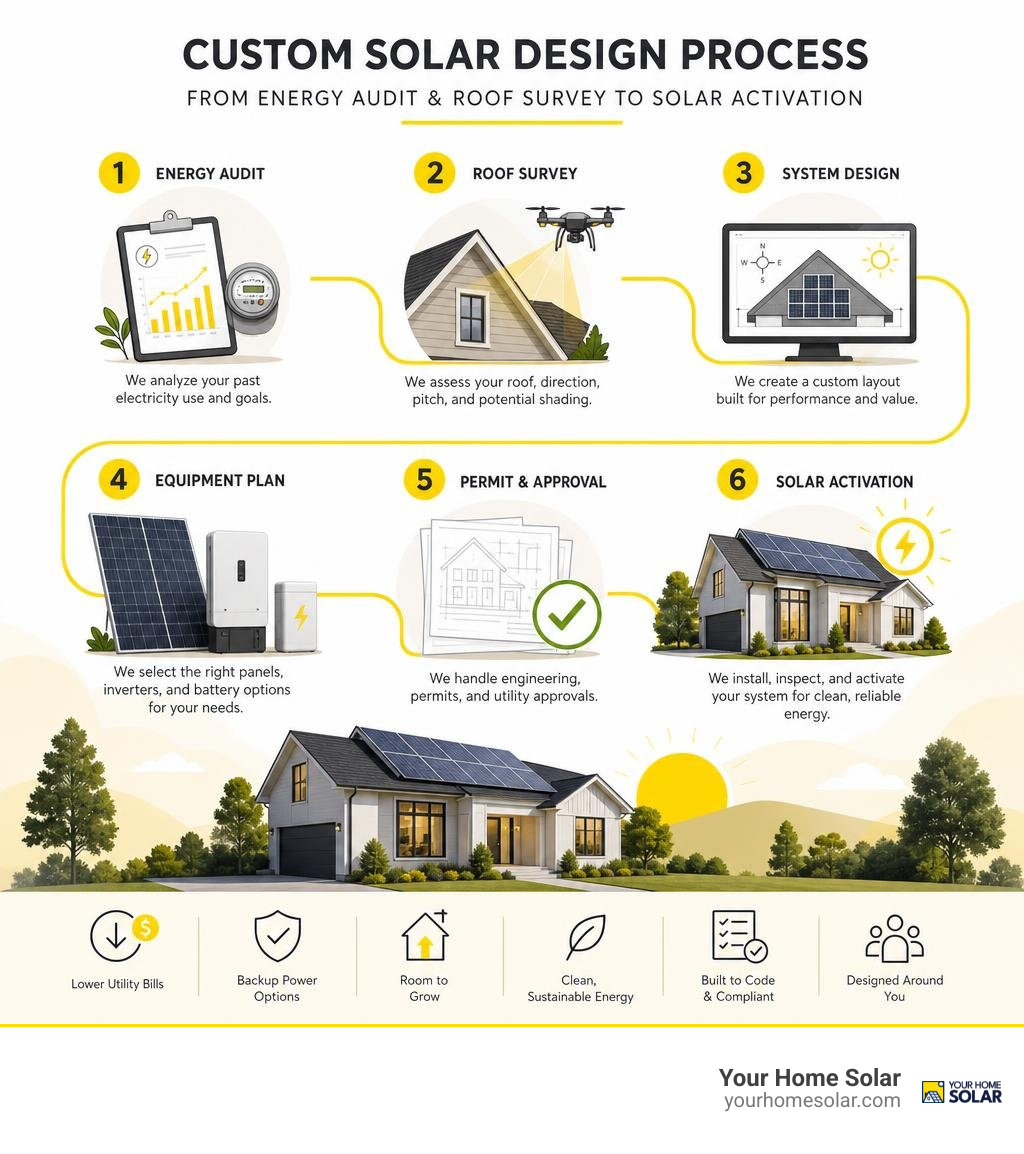
Custom solar design is the process of building a solar system around your actual home instead of forcing your home to fit a standard package. Start with your past electricity use, then factor in roof space, direction, shade, local weather, backup-power goals, and future needs such as an EV charger or battery.
A well-designed system should answer three practical questions:
- How much electricity do you use now, including high-use seasons?
- Which roof areas can produce the most reliable solar energy despite trees, vents, chimneys, or dormers?
- Do you want lower utility bills only, or battery backup during East Tennessee power outages too?
That work matters because panel placement, inverter choice, battery capacity, and electrical design all affect production, reliability, and long-term value. A custom plan can also preserve curb appeal, leave room for expansion, and meet local electrical, structural, permitting, and utility requirements before installation begins.
I am Ernie Bussell, founder and CEO of Your Home Solar. My background in solar operations, technical process management, and homeowner education informs our approach to Custom solar design: clear planning, careful installation, and systems built for the long haul.
Custom solar design terms simplified:
- residential solar panel design
- residential solar system design
- kit or custom finding the perfect household solar panels for your needs
The Core Principles of Custom Solar Design
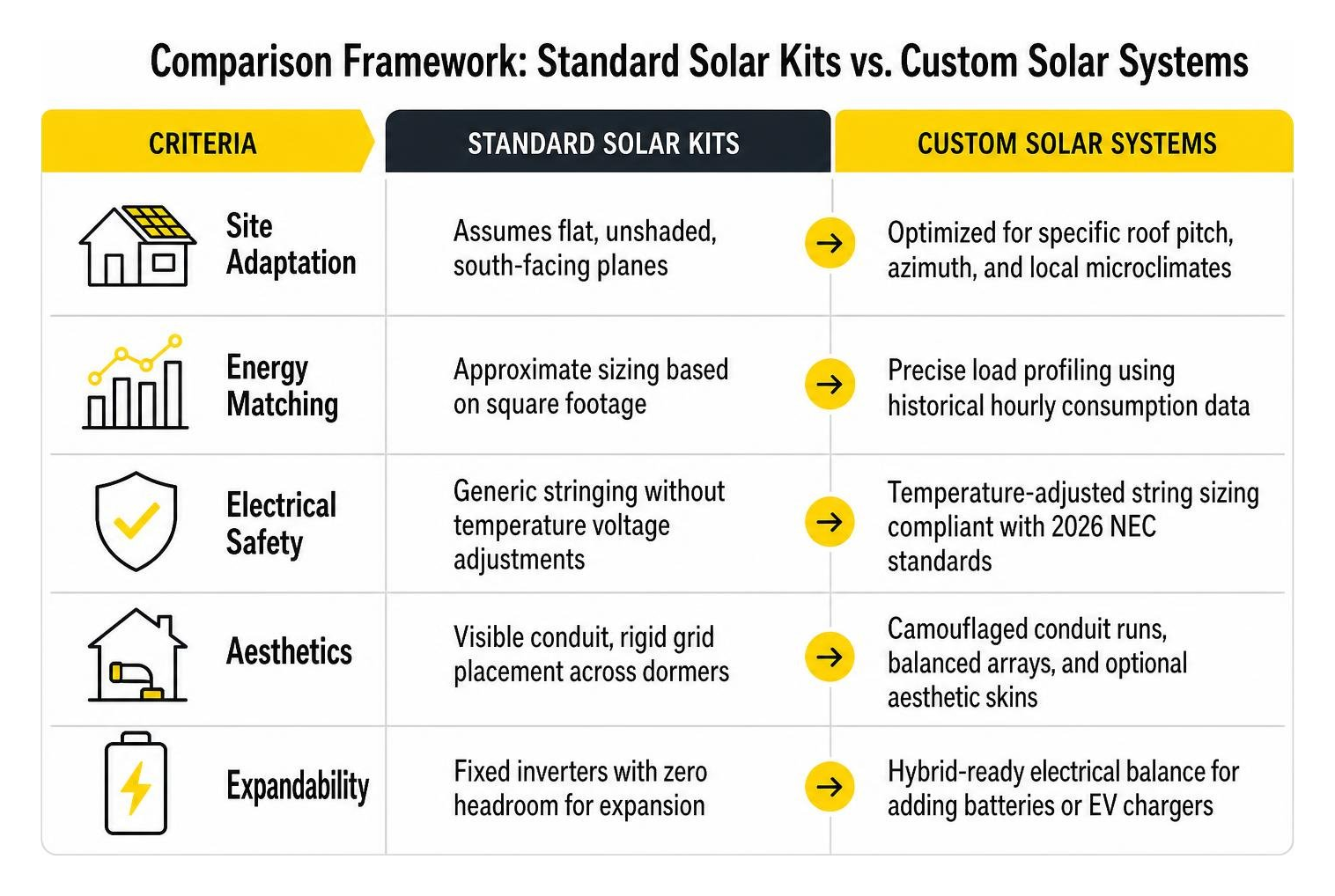
Every home possesses unique physical and electrical characteristics. Off-the-shelf solar packages treat a steep roof in Farragut the same as a sprawling ranch in Sevierville, leading to underperforming systems and missed savings. In fact, a study by the U.S. Department of Energy (DOE) tracked residential solar expanding from 30,000 homes in 2006 to millions nationwide, yet many systems fail to reach their full potential because they rely on generic templates rather than custom engineering.
| Feature | Standard One-Size-Fits-All Solar Kits | Custom-Engineered Solar Systems |
|---|---|---|
| Site Adaptation | Assumes flat, unshaded, south-facing planes | Optimized for specific roof pitch, azimuth, and local microclimates |
| Energy Matching | Approximate sizing based on square footage | Precise load profiling using historical hourly consumption data |
| Electrical Safety | Generic stringing without temperature voltage adjustments | Temperature-adjusted string sizing compliant with 2026 NEC standards |
| Aesthetics | Visible conduit, rigid grid placement across dormers | Camouflaged conduit runs, balanced arrays, and optional aesthetic skins |
| Expandability | Fixed inverters with zero headroom for expansion | Hybrid-ready electrical balance for adding batteries or EV chargers |
A successful installation begins by evaluating site solar potential to ensure your investment delivers maximum financial and environmental returns.
Analyzing Energy Consumption and Daily Load Profiles
The first step in our engineering workflow involves dissecting your historical utility bills to calculate daily watt-hours and identify seasonal consumption spikes. A central air conditioning unit running through humid East Tennessee summers requires far different generation capacities than winter heating baseloads.
Our engineers perform detailed load profiling that audits peak power surges from heavy appliances like heat pumps, water heaters, and well pumps. Properly sizing a residential solar system ensures you do not waste money over-building an oversized array or get stuck buying expensive grid power during peak hours.
Structural Roof Modeling and Environmental Site Analysis
No two rooflines share the exact same structural load or orientation. Moving from roof assessment to system reality requires precise measurements of roof pitch, azimuth, and structural integrity.
Using high-resolution aerial imagery and LiDAR mapping, our team builds a digital twin of your roof. We model complex architectural features—such as dormers, skylights, plumbing vents, and chimneys—to calculate exact setbacks and maintain proper inter-row spacing. This prevents self-shading during critical winter months and ensures code compliance with local fire access pathways.
Engineering the Electrical Architecture and Hardware

A high-performing array demands a balanced electrical backbone. While standard panels often suffer from shading losses across interconnected cells, premium monocrystalline panels with Interdigitated Back Contact (IBC) architecture maximize light absorption by moving metal contacts to the rear of the cell. Understanding DIY solar sizing and electrical calculations helps illustrate how continuous DC wiring must be sized for at least 125% of the continuous load current to keep voltage drop below 2%.
Choosing the Right Inverter and String Configuration
Your inverter is the operational brain of your system, converting direct current (DC) generated by the panels into alternating current (AC) for household appliances. In a custom installation, selecting between microinverters, string inverters, and DC power optimizers depends entirely on your roof geometry and shading exposure.
Matching PV strings to the inverter’s Maximum Power Point Tracking (MPPT) operational window requires adjusting for regional climate extremes. Solar panel open-circuit voltage ($V_{oc}$) increases as temperatures drop. Our engineers calculate string lengths against historical record-cold mornings to ensure the array never exceeds the inverter’s maximum input voltage, providing reliable residential solar solutions built to endure decades of seasonal temperature swings.
Integrating Battery Storage and Future Electrification
Modern energy independence depends on reliable energy storage. Lithium Iron Phosphate ($\text{LiFePO}_4$) batteries deliver between 2,000 and 6,000 cycles at an 80% to 100% Depth of Discharge (DoD), far outlasting older lead-acid alternatives.
When preparing your home for solar installation, we configure your electrical service panel with future expansion in mind. Whether you plan to add a Level 2 EV fast charger next year or require dedicated subpanels for whole-home backup during grid outages, custom engineering ensures seamless integration without costly electrical overhauls down the road.
Advanced Software and Architectural Integration
Behind every successful residential project is a detailed engineering plan. Custom systems require single-line and three-line wiring diagrams, structural framing plans, and equipment cut sheets to satisfy local Authorities Having Jurisdiction (AHJ). Utilizing advanced photovoltaic BIM design software allows us to streamline permitting and accelerate designing solar for your home.
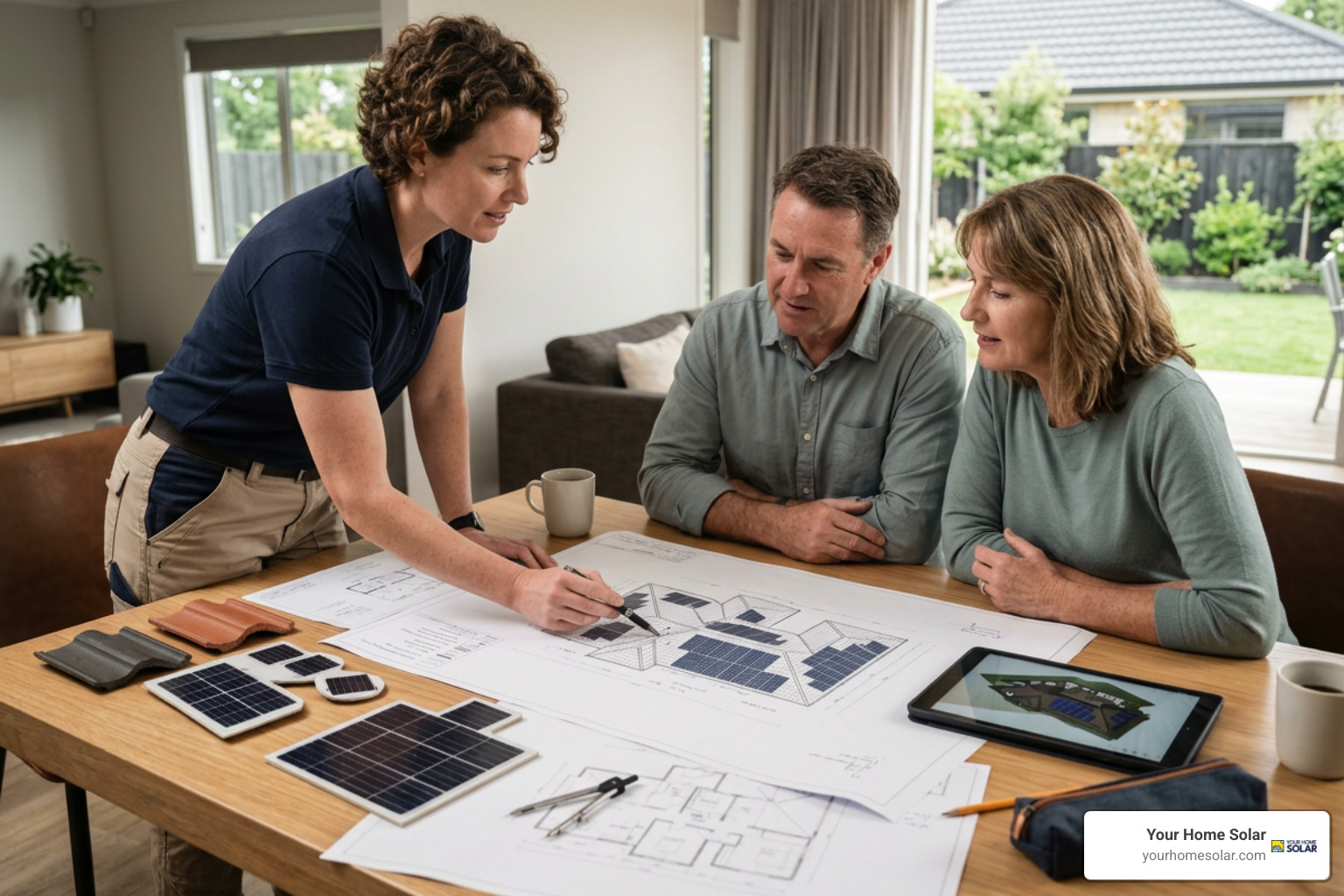
Professional Software and 3D Modeling in Custom Solar Design
Professional solar designers leverage global climatic databases like Meteonorm and PVGIS to model historical solar irradiation and temperature profiles across specific geographic coordinates.
By running dynamic horizon shade analyses within 3D CAD environments, design tools simulate the sun’s exact trajectory across all 365 days of the year. This precision modeling verifies electrical clearances, identifies minor shading obstacles that could disproportionately harm system yield, and generates permit-ready plan sets with turnaround times as fast as 24 to 48 hours.
Aesthetic and Architectural Custom Solar Design Innovations
Clean energy should enhance your home’s curb appeal, not compromise it. Recent innovations in selective light filtration technology, such as SolarSkin graphic overlays, allow panels to mimic the appearance of slate, clay tile, or architectural shingles.
These micro-engineered graphic layers reflect only the minute fraction of light needed for the human eye to perceive the pattern, transmitting the vast majority of sunlight to the photovoltaic cells below. While custom aesthetic overlays add roughly a 10% premium to initial hardware costs, a properly engineered system still delivers tens of thousands in lifetime utility savings while preserving your neighborhood’s architectural aesthetic.
Financial Feasibility and Long-Term Value
Investing in solar is an exercise in long-term financial stability. By locking in your energy generation costs today, you hedge against utility rate hikes for the next 25 to 30 years. When understanding home solar system pricing, our team constructs complete financial cash flow models, factoring in local net metering policies, equipment degradation rates, and payback periods.
Navigating Soft Costs, Permitting, and Local Incentives
A large portion of residential solar expense comes from “soft costs”—including site surveys, municipal permitting, utility interconnection fees, and engineering reviews. When planning your home solar budget, having code-compliant designs stamped by licensed structural and electrical Professional Engineers (PE) prevents costly inspection delays and secures your access to federal clean energy tax credits.
Long-Term Value and System Longevity
High-tier monocrystalline solar panels degrade at an exceptionally slow rate, retaining over 85% of their original generation capacity after 25 years. Custom systems backed by comprehensive 25-year manufacturer and workmanship warranties protect your investment while increasing overall property equity. Evaluating lifetime solar savings shows that a custom-designed array consistently out-produces generic kits, delivering superior net savings over decades of service.
Frequently Asked Questions About Tailored Solar Systems
How much more does a custom solar installation cost compared to a standard kit?
A custom-designed solar installation typically carries a minor upfront premium over a generic DIY kit, largely due to professional engineering, permitting, and high-efficiency tier-1 components. For example, specialized aesthetic overlays like SolarSkin add about a 10% premium to panel costs. However, because custom systems are sized precisely to your energy profile and roof angles, they generate significantly higher long-term yields, delivering over $30,000 in lifetime energy savings that far outweigh the initial cost difference.
How does custom solar design handle heavy roof shading and obstructions?
Custom design resolves shading challenges through advanced Module-Level Power Electronics (MLPE), such as microinverters or DC power optimizers with independent MPPT channels. Unlike traditional string systems where shading on a single panel degrades the output of the entire string, MLPE allows each panel to operate independently. During the initial design phase, 3D solar modeling simulates seasonal shade patterns from nearby trees and chimneys to ensure panels are placed exclusively in optimal solar windows.
How long does the custom solar planning and permitting process take?
The initial engineering layout and CAD drafting are typically completed within 24 to 48 hours following the on-site survey. The overall timeline—from initial design to final utility interconnection—generally takes 4 to 8 weeks, depending on local municipal AHJ permitting review schedules and regional utility approval processes.
Conclusion
A home solar energy system is a multi-decade investment in energy independence, property value, and financial predictability. Moving beyond generic blueprints to embrace custom solar engineering guarantees that every watt generated is optimized for your specific roof, your daily power habits, and your family’s future electrification goals.
At Your Home Solar, our team combines technical expertise with dedicated customer service to design, permit, and install high-performance energy solutions tailored for your home. Explore our custom residential solar solutions to take control of your energy future today.