Why Finding the Right Solar Panel Installers for Home Can Save You Thousands
If you’re looking for solar panel installers for home, here’s a quick answer to get you started:
Top ways to find trusted home solar installers:
- Check for NABCEP certification — the gold standard for solar professionals
- Compare local vs. national companies — local installers quote ~10% less on average (NREL)
- Evaluate system types — roof-mounted, ground-mounted, and battery storage options
- Understand your regional incentives — federal tax credits, state rebates, and net metering
- Review the full installation process — from consultation and permitting to activation and support
Rising electricity bills are pushing more East Tennessee homeowners to seriously consider solar. And for good reason — a well-installed solar system can eliminate a large portion of your monthly energy costs, protect you from grid outages, and add real value to your home.
But here’s the problem: not all solar installers are equal.
Some companies sell fast and disappear faster. Others use subcontractors you’ve never met. A few quote prices that sound great until the fine print shows up. Choosing the wrong installer can cost you years of savings — or leave you with a system that underperforms from day one.
This guide walks you through exactly how to find an installer you can trust.
I’m Ernie Bussell, founder and CEO of Your Home Solar — East Tennessee’s top-rated solar energy contractor — and before building this company, I spent years in solar operations management, overseeing installation crews and customer systems for a $40 million per year operation, which gave me a front-row seat to what separates great solar panel installers for home from the ones you should avoid. That experience is the foundation of everything in this guide.
1. Look for Certified and Experienced Solar Panel Installers for Home
When you begin your search for the perfect team to install solar panels on your roof, certifications and verifiable experience should be your first line of defense. The residential solar industry has grown rapidly, drawing in many general contractors who may lack specialized electrical and structural training.
To ensure your home is in safe hands, we always advise homeowners to look for credentialed professionals who understand the nuances of solar engineering. If you want to avoid common industry pitfalls, you can read our guide on Don’t Get Burned: How to Spot and Select Professional Solar Installers.
Why Certifications Matter for Solar Panel Installers for Home
The gold standard for solar training and certification is the North American Board of Certified Energy Practitioners (NABCEP). When evaluating solar panel installers for home, check if their lead designers and installers hold the NABCEP PV Installation Professional (PVIP) Board Certification.
NABCEP-certified professionals have undergone rigorous peer-reviewed training, logged hundreds of hours of hands-on installation experience, and passed comprehensive exams covering electrical codes, safety standards, and system design. You can verify an installer’s credentials directly on the NABCEP Board Certified Professionals Directory. Working with certified professionals ensures your system complies with local building codes, passes utility inspections without delay, and operates safely for decades.
Evaluating Warranties and Reviews
A solar energy system is a 25- to 30-year investment. Therefore, the warranties backing your equipment and installation are just as important as the panels themselves. A reputable installer should offer two distinct types of warranties:
- Manufacturer Warranties: These cover the physical equipment (panels, inverters, and racking) and usually guarantee that panels will produce at least 85% of their original power output after 25 years.
- Workmanship Warranties: Offered directly by the installer, these cover the actual labor, roof penetrations, and wiring. While some national companies offer brief 1- to 10-year workmanship warranties, premier local installers often provide 25-year workmanship guarantees to match the lifespan of the equipment.
Before signing any contract, look at what actual customers in your area have to say. Read through verified third-party reviews on Google, EnergySage, and the Better Business Bureau. For local insights, check out our compilation of the Best Solar Companies Tennessee Reviews to see how homeowners in Knoxville, Maryville, and Oak Ridge rate their experiences.
2. Compare Local vs. National Solar Companies
One of the biggest decisions you will make is whether to hire a massive national solar brand or a dedicated local installer. While national brands have large marketing budgets, data shows that staying local is almost always the smarter, more cost-effective choice for your home.
The Benefits of Choosing Local Installers
A landmark study by the National Renewable Energy Laboratory (NREL) revealed that solar quotes from national installers are about 10% higher on average compared to those provided by local installers. Because national companies spend heavily on door-to-door sales teams and television advertising, they pass those high customer acquisition costs directly onto you.
Beyond saving money, choosing a local company means you get:
- Grid and Utility Expertise: Local installers work daily with regional utilities like the Tennessee Valley Authority (TVA), Knoxville Utilities Board (KUB), and local electric cooperatives. They know the exact paperwork, permitting processes, and interconnection requirements needed to get your system turned on quickly.
- Personalized Support: If you have a question or need service, you can speak directly to someone in your community rather than waiting on hold with a national call center.
- Community Accountability: Local businesses rely on word-of-mouth reputation. They are highly motivated to do the job right the first time because their neighbors are watching.
For more tips on choosing the right path, you can consult the U.S. Department of Energy: Homeowner’s Guide to Going Solar.
Spotting Sales-First vs. Installer-First Companies
The solar industry has seen a rise in “sales-first” organizations. These are marketing companies that employ aggressive sales representatives to sign you to a contract, only to subcontract the actual installation to the lowest-bidding local crew. This often leads to poor communication, delayed projects, and finger-pointing if something goes wrong.
In contrast, “installer-first” companies handle everything in-house. From your initial energy audit and engineering design to the actual physical installation and long-term maintenance, you work with the same W-2 employed, licensed, and insured professionals. To protect yourself from high-pressure sales tactics, review our breakdown of Solar Companies Knoxville Real vs Sales.
3. Evaluate System Types and Equipment Quality
Every home is unique, meaning a cookie-cutter solar package rarely delivers optimal savings. The right installer will assess your property’s orientation, shading, and structural integrity to design a system tailored to your specific energy goals.

Choosing the Right Solar System for Your Property
Depending on your land and roof type, you will choose between two primary mounting options:
- Roof-Mounted Solar: The most common residential setup. Panels are secured directly to your roof shingles, metal seams, or flat roof membranes using engineered racking systems designed to withstand high winds and heavy snow loads.
- Ground-Mounted Solar: If your roof is heavily shaded, faces the wrong direction, or is nearing the end of its lifespan, a ground-mounted system is an excellent alternative. While ground mounts require dedicated yard space and slightly higher trenching costs, they can be oriented at the perfect angle to maximize daily sun exposure.
Before moving forward, it is important to understand your utility’s specific parameters. For instance, homeowners in upper East Tennessee can review the Residential Solar Energy Options program to see how local power distributors integrate home solar systems.
Integrating Battery Storage and EV Chargers
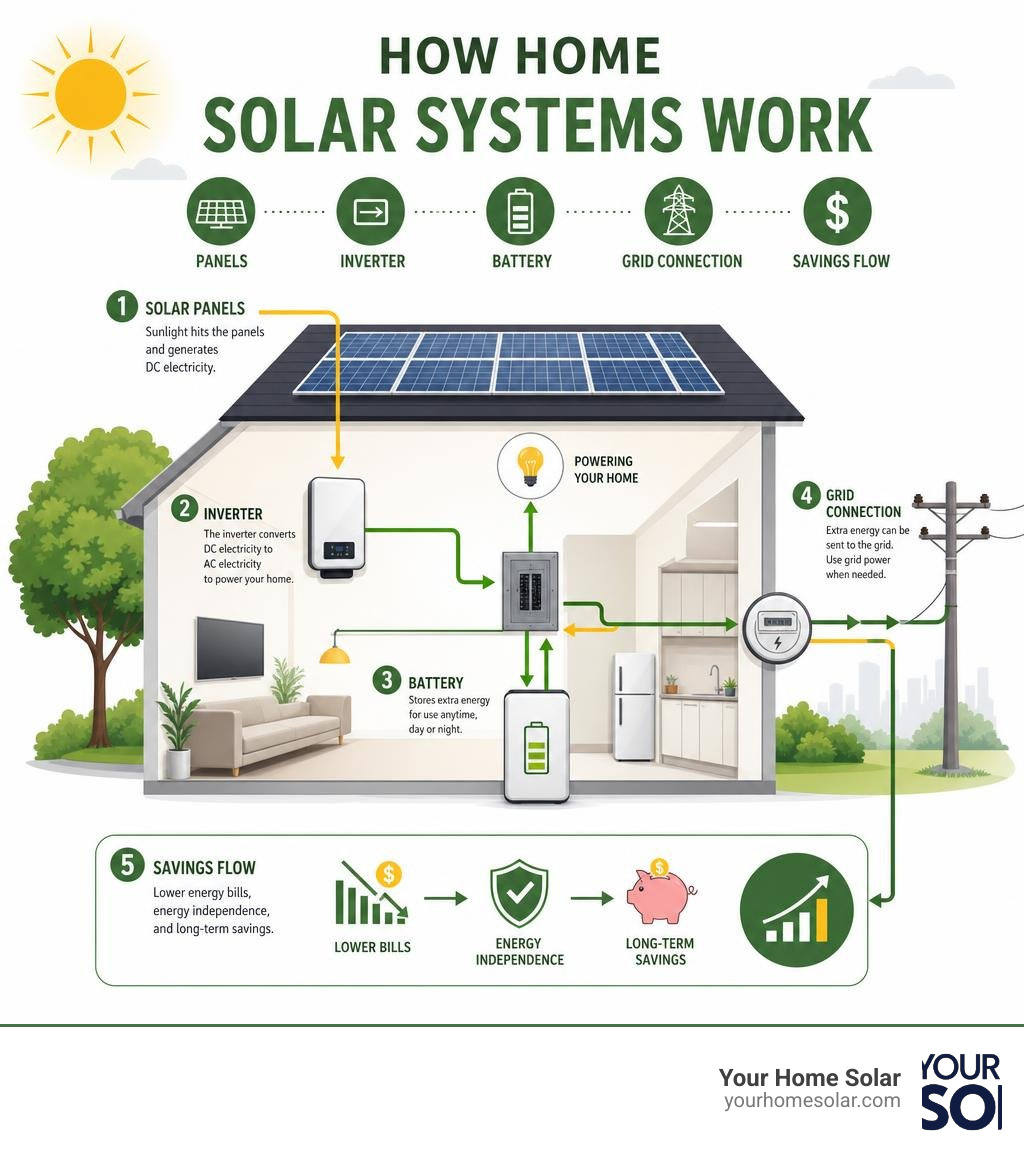
Modern solar is about more than just panels; it is about building a complete home energy ecosystem. Adding a battery backup system, like the Tesla Powerwall, allows you to store excess solar electricity generated during the day to power your home at night or keep your lights, refrigerator, and medical equipment running during grid outages.
Furthermore, if you own or plan to buy an electric vehicle, integrating a Level 2 EV charger into your solar design allows you to drive on 100% clean, self-generated power. To explore how these systems tie together in our region, check out our Solar Installers Near Me East TN Guide.
4. Understand Regional Incentives, Costs, and Payback Periods
Going solar is highly accessible in June 2026 thanks to a combination of federal tax credits, regional incentives, and steady payback periods. Let’s look at how the financial landscape shapes up for residential installations.
| Region / Metric | Average Pre-Incentive Cost | Net Cost (After 30% Federal Tax Credit) | Average Payback Period | Expected 25-Year Savings |
|---|---|---|---|---|
| East Tennessee (Knoxville, Farragut, Kingsport) | $18,000 – $32,000 | $12,600 – $22,400 | 8 – 11 Years | $35,000 – $60,000 |
| Pittsburgh, PA | $30,775 | $21,542 | 10.45 Years | $57,941 |
| New York City (Brooklyn, Queens) | $30,000 | $15,000 (with local rebates) | 6 – 8 Years | $80,000+ |
Solar Costs and Savings Across Different States
While solar costs vary by region due to local permitting fees and labor rates, the long-term return on investment remains consistently strong. For example, in Pittsburgh, PA, the average price per watt of solar power is $2.62/W, leading to an average payback period of just over 10 years.
In East Tennessee, competitive local pricing and excellent solar exposure allow homeowners to achieve rapid returns on investment. If you live in Knox County, you can find localized cost data through the Solar Panel Cost Guide in Farragut, TN (2025 Update) – EcoWatch.
Navigating State-Specific Rebates and Tax Credits
No matter where you live, the Federal Residential Clean Energy Credit (Section 25D) allows you to deduct 30% of your total solar installation costs — including panels, labor, permitting, and battery storage — directly from your federal taxes.
Beyond federal help, local incentives make a huge difference:
- Tennessee Incentives: While Tennessee does not have a state income tax credit, homeowners benefit from a 100% property tax exemption on the added value of their solar system. This means your home value increases, but your property taxes do not.
- Other Regional Insights: In places like New York City, local incentives can slash upfront costs by up to 50%, while states like Oregon and New Jersey offer robust net metering programs that credit you for every kilowatt-hour of excess energy you feed back to the grid.
To explore all the active programs in your specific ZIP code, search the comprehensive DSIRE: Database of State Incentives for Renewables & Efficiency.
If you are researching trusted installers in specific East Tennessee communities, you can compare local market data using these resources:
- Best Solar Companies in Knoxville, TN: 2026 Trusted Local Installers
- Best Solar Companies in Maryville, TN: 2026 Trusted Local Installers
- Best Solar Companies in Kingsport, TN: 2026 Trusted Local Installers
- Best Solar Companies in Sevierville, TN: 2026 Trusted Local Installers
(Note: If you are looking at neighboring mid-Atlantic states, you can also view guides like the Best Solar Companies in Oak Ridge, NJ: 2026 Trusted Local Installers or the Best Solar Companies in Morristown, NJ: 2026 Trusted Local Installers to see how different utility landscapes compare.)
5. Assess How Installers Handle Challenges and the Full Installation Process
A truly professional solar company does not just mount panels on your roof; they manage the entire project from start to finish, guiding you through local regulations, engineering hurdles, and utility approvals.
How Professional Solar Panel Installers for Home Manage the Process
The journey to energy independence follows a structured, step-by-step process:
- Initial Consultation & Feasibility Analysis: We look at your historical energy bills, assess your roof’s age and structural integrity, and analyze shading patterns to ensure solar is a financially viable option for your home.
- Engineering & Custom Design: Our in-house designers model a system down to the shingle, optimizing panel placement to capture maximum sunlight while keeping wire runs short and efficient.
- Permitting & HOA Approvals: We handle all the paperwork, submitting detailed plans to local building departments (such as Knoxville, Maryville, or Kingsport) and coordinating with your Homeowners Association (HOA).
- Physical Installation: Our professional crew completes the installation, usually taking just 1 to 2 days on your roof with minimal disruption to your daily routine.
- Utility Interconnection & PTO: We coordinate final inspections with your local utility provider to secure your official Permission to Operate (PTO), allowing you to safely flip the switch and start saving.
To prepare for your first meeting with an installer, review our list of Knoxville Solar Installers: Questions to Ask. If you are ready to connect with trusted local experts, you can learn more about finding Expert Solar Installers in Knoxville TN, partner with a Top Solar Installer in Knoxville TN – Your Home Solar, or discover why we are considered One of the Top Solar Companies in Knoxville TN – Your Home Solar.
Overcoming HOA and Structural Obstacles
Many homeowners worry that their HOA will block solar panel installations. Fortunately, Tennessee and many surrounding states have laws protecting a homeowner’s right to generate solar energy. While HOAs can request reasonable aesthetic modifications (such as placing panels on the rear of the house rather than the front), they generally cannot forbid solar installations entirely.
Additionally, if your roof is older, a professional installer will advise you to replace it before installing solar, as panels are built to last 25+ years. For more information on navigating neighborhood guidelines, check out the U.S. Department of Energy: Solar Energy and Homeowners Associations.
Frequently Asked Questions about Solar Panel Installers
How much do solar panels increase home value?
According to comprehensive real estate data, homes equipped with solar energy systems sell for an average premium of 4.1% more than comparable non-solar homes. In high-cost utility areas, this premium can rise even higher. This means that a home solar system is not just an energy-saving measure; it is a tangible asset that builds equity in your property. You can read the full study details at Zillow Research: Solar Panels Can Increase Home Values.
What is the average payback period for home solar?
For most East Tennessee homeowners, the average payback period ranges between 8 and 11 years. Once the system pays for itself, the electricity your panels produce for the remainder of their 25- to 30-year lifespan is essentially pure profit. You can explore regional grid programs and connection details through TVA Green Connect: Solar Resources for Homeowners.
Do solar panels require ongoing maintenance?
Solar panels have no moving parts, making them incredibly durable and low-maintenance. In East Tennessee, our regular rainfall is usually more than enough to keep the panels free of dust and pollen. However, we recommend having your installer perform a quick system health check every few years to ensure all electrical connections remain tight and secure. To dive deeper into the science behind solar durability, review the National Renewable Energy Laboratory: Solar Photovoltaic Technology Basics.
Conclusion
Finding the right solar panel installers for home does not have to be an overwhelming process. By prioritizing NABCEP-certified professionals, choosing trusted local companies over national sales networks, and selecting high-quality equipment backed by robust workmanship warranties, you can make your transition to clean energy seamless and rewarding.
At Your Home Solar, we pride ourselves on providing the highest level of local expertise and 100% customer satisfaction across East Tennessee. Whether you are in Knoxville, Maryville, Kingsport, or any of our surrounding counties, we are here to help you design a tailored energy system that fits your budget and lifestyle.
Ready to take control of your energy future and eliminate rising utility bills? Schedule a consultation for residential solar with our friendly local experts today!