How Much Does a 100 kW Solar Power Plant Cost in 2026?
The 100 kw solar power plant cost typically falls between $200,000 and $400,000 in the United States for a fully installed commercial system. In India, the same system runs between ₹35 lakh and ₹55 lakh, depending on system type and components.
Here’s a quick snapshot of what to expect:
| System Type | US Cost (Installed) | India Cost (Installed) |
|---|---|---|
| Grid-tied (on-grid) | $200,000 – $250,000 | ₹35 – ₹50 lakh |
| Off-grid (with batteries) | $400,000 – $530,000 | ₹40 – ₹50 lakh |
| Hybrid | $350,000 – $480,000 | ₹50 – ₹55 lakh |
| Kit only (no install) | $91,500 – $235,000 | ₹47.3 lakh (avg) |
A few things worth knowing upfront:
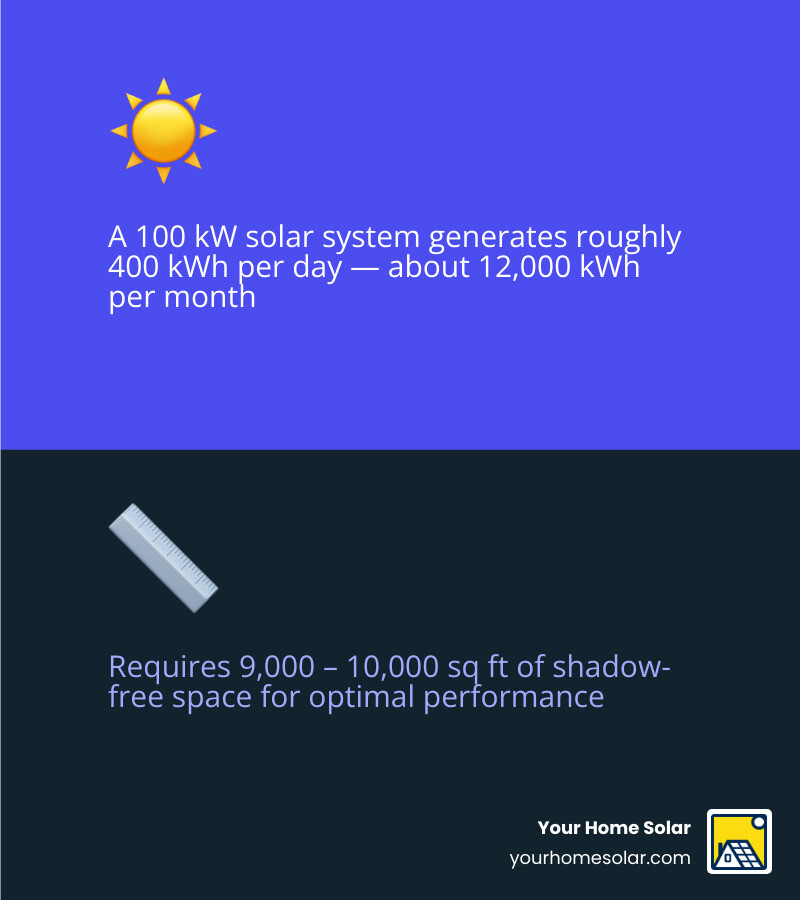
- A 100 kW system generates roughly 400 kWh per day — about 12,000 kWh per month
- It requires 9,000 – 10,000 sq ft of shadow-free space
- Most businesses see a payback period of 3–5 years
- The federal Investment Tax Credit (ITC) can significantly reduce your net cost
These numbers shift based on your location, the type of system you choose, the panels and inverter you use, and whether you’re buying a kit or a fully installed system. We’ll break all of that down clearly in this guide.
I’m Ernie Bussell, founder and CEO of Your Home Solar, and I’ve spent years working hands-on in solar operations — including overseeing large-scale commercial installations as part of a $40 million per year operation — which gives me a grounded, practical perspective on what a 100 kw solar power plant cost actually looks like in the real world. Let’s walk through everything you need to know to make a confident, informed decision.
100 kw solar power plant cost terms you need:
- average cost of solar panels per kilowatt
- average solar panel cost per watt
- 2 kilowatt solar system price
Total 100 kw solar power plant cost Breakdown for 2026
When we look at the 100 kw solar power plant cost in April 2026, we have to distinguish between the “sticker price” of the hardware and the “turnkey price” of a fully operational system. If you are a business owner in Knoxville or a facility manager in Johnson City, you aren’t just buying panels; you’re buying an engineering feat that involves permitting, labor, and long-term utility coordination.

Hardware vs. Soft Costs
A standard 100 kW commercial system is an assembly of thousands of individual parts. In the U.S. market, the cost generally breaks down as follows:
- Solar Modules (35-45%): This is your biggest expense. For a 100 kW array, you’re looking at roughly $42,000 to $90,000 just for the panels, depending on whether you choose high-efficiency N-type TOPCon modules or standard monocrystalline panels.
- Inverters (8-12%): These are the brains of the operation. A commercial-grade string inverter or a set of microinverters for a 100 kW system typically costs between $9,500 and $20,000.
- Racking and Mounting (10-15%): Whether you are going with a ballasted rooftop mount or a ground-mount system with earth anchors, expect to pay around $6,600 to $15,000.
- Balance of System (BOS) (5-10%): This includes the wiring, junction boxes, conduits, and safety switches.
- Soft Costs and Labor (25-35%): This covers the engineering, permitting, interconnection fees with utilities like KUB or TVA, and the actual boots-on-the-roof labor.
If you are looking for a DIY approach or have your own electrical team, you might consider 100 kW Solar Kits | SunWatts, where prices for the hardware alone can start as low as $91,500 (approximately $0.915 per watt). However, these kits do not include the specialized labor or the local permitting expertise required in East Tennessee.
Factors Influencing 100 kw solar power plant cost
Not every 100 kW system is created equal. Several variables can swing the price by tens of thousands of dollars.
- Panel Efficiency and Technology: Using bi-facial panels can increase your generation by capturing reflected light from the roof or ground, but they come at a premium. High-efficiency panels (21%+) allow you to fit more power into a smaller footprint, which is vital if your rooftop in Maryville or Kingsport is space-constrained.
- Inverter Choice: String inverters are the traditional choice for large systems because they are cost-effective. However, microinverters or power optimizers provide module-level monitoring and better performance if your site has shading issues.
- Mounting Hardware: A flat-roof ballasted system is often cheaper than a ground-mount system that requires trenching and concrete foundations. If you’re interested in more localized pricing details, check out our guide on Solar Panel Installation Knoxville Cost.
- Interconnection and Infrastructure: If your existing electrical panel or the local utility transformer needs an upgrade to handle the 100 kW backfeed, your costs will rise. In East Tennessee, coordinating with providers like LCUB or KUB is a critical step we handle to ensure there are no surprise charges.
Estimating 100 kw solar power plant cost by System Type
The architecture of your system—whether it talks to the grid or lives on an island—is the biggest fork in the road for your budget.
| Feature | On-Grid (Grid-Tied) | Off-Grid | Hybrid |
|---|---|---|---|
| Primary Use | Bill reduction | Remote locations | Backup + Savings |
| Battery Storage | None | Massive | Moderate |
| Net Metering | Yes | No | Yes |
| Avg. Cost (US) | $200k – $250k | $450k – $530k | $350k – $480k |
| Complexity | Low | High | Medium |
- On-Grid Systems: These are the most common for businesses in Morristown or Sevierville. They are the most affordable because the utility grid acts as your “battery.”
- Off-Grid Systems: These require a massive battery bank to ensure power 24/7. Because 100 kW is a significant load, the battery costs can easily double the total project price.
- Hybrid Systems: These are gaining popularity in 2026. They offer the savings of a grid-tied system with the security of a backup battery for essential loads during outages.
Technical Specifications and Energy Production
Understanding the 100 kw solar power plant cost is only half the battle; you also need to know what that investment buys you in terms of “juice.”

A 100 kW system is a powerhouse. Here is the typical output you can expect in a climate like East Tennessee:
- Daily Generation: 400 to 450 units (kWh) on a sunny day.
- Monthly Generation: Approximately 12,000 to 13,500 kWh.
- Annual Generation: Between 144,000 and 160,000 kWh.
To put that in perspective, a typical large retail store or a small manufacturing plant might consume 15,000 kWh a month. A 100 kW system could potentially offset 80% to 100% of that bill. For a deeper dive into how these systems perform, see 100kW Solar Power System: Cost, Benefits, and Area Required.
Component Checklist for 100 kW:
- Solar Panels: Approximately 180 to 250 panels (assuming 400W to 550W modules).
- Inverters: Usually one or two large commercial string inverters (e.g., 50kW or 100kW units).
- Monitoring: A web-based portal to track real-time production and health.
Space Requirements and Installation Logistics
Where are you going to put all those panels? A 100 kW system isn’t something you can just tuck away in a corner.
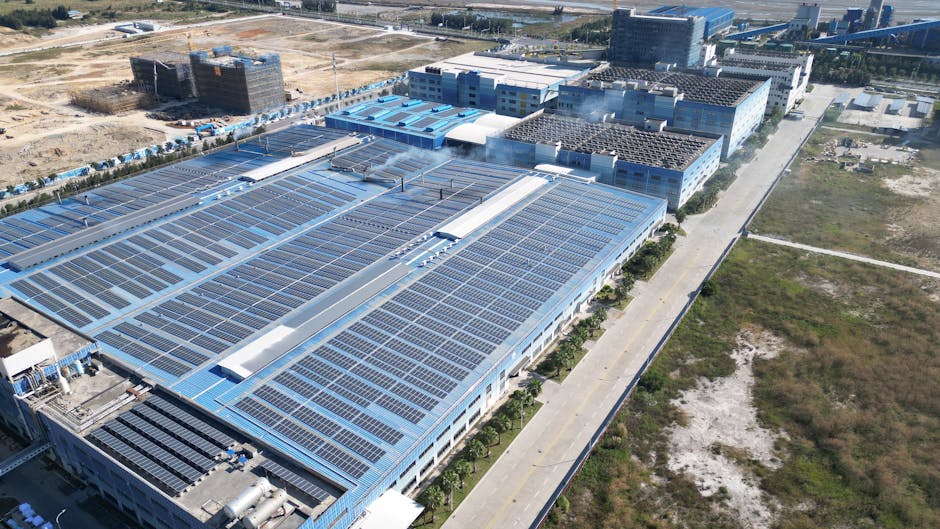
- Rooftop Area: You will need between 9,000 and 10,000 square feet of clear, shadow-free roof space. If you are using high-efficiency “InRoof” solutions or TOPCon panels, you might squeeze this down to 7,000 sq ft, but standard installations need room for walkways and fire code setbacks.
- Ground-Mount Space: If your roof isn’t suitable, a ground-mount system is a great alternative. This requires roughly a quarter-acre of land. Modern ground-mounts often use earth anchors, which can be installed quickly without massive concrete pours.
- Site Survey and Permitting: Before a single panel is mounted, we conduct a structural analysis of your building. We ensure the roof can handle the “dead load” (the weight of the panels) and the “wind load” (the lift created by Tennessee gusts).
For businesses looking for Affordable Solar Installation In Knoxville Tn, we focus on optimizing the layout to maximize every square inch of your available space.
Financial ROI, Incentives, and Payback Periods
This is where the 100 kw solar power plant cost starts to look like a brilliant financial move rather than just an expense. In 2026, the financial landscape for solar is incredibly favorable.
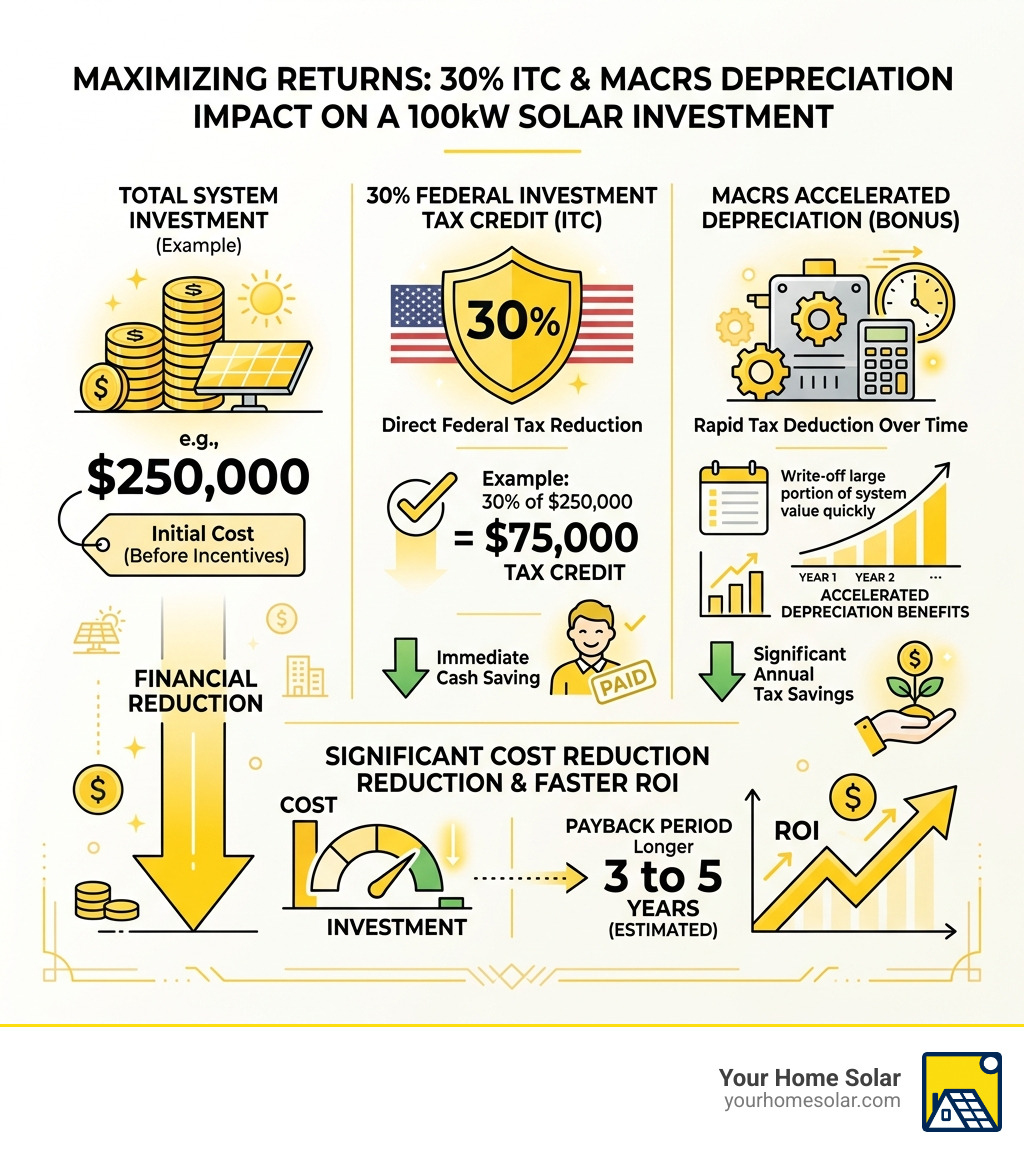
- Federal Investment Tax Credit (ITC): Under current laws, businesses can claim a 30% tax credit on the total system cost. On a $250,000 system, that is a $75,000 direct reduction in your federal tax liability.
- MACRS Depreciation: Solar equipment qualifies for accelerated depreciation. You can often write off a significant portion of the system value in the very first year, providing a massive cash-flow boost.
- Net Metering and TVA Incentives: While programs change, many East Tennessee utilities allow you to “sell” excess power back to the grid or receive credits on your bill. This effectively turns your meter backward during the day.
- Payback Period: For most commercial entities in our region, the system pays for itself in 3 to 5 years. After that, the electricity is essentially free for the remaining 20+ years of the system’s life.
For the latest updates on regional benefits, check out our Solar Incentives Tennessee 2026 Guide.
Frequently Asked Questions about 100kW Solar
We get a lot of questions about the long-term reality of owning a mini-power plant. Here are the most common ones we hear at our offices in Oak Ridge and Maryville.
What is the typical maintenance cost for a 100kW system?
Solar systems are remarkably low-maintenance because they have no moving parts. However, you should budget for:
- Cleaning: Once or twice a year to remove pollen, dust, and bird droppings. This usually costs $500–$1,500 per cleaning for a system this size.
- Annual Inspection: A professional check of connections and inverter health (roughly $1,000/year).
- Inverter Replacement: While panels last 25-30 years, inverters typically have a 12-15 year warranty. You should plan to replace them once during the system’s lifespan.
How much roof space is required for 100kW?
As mentioned, plan for 9,000 to 10,000 square feet. It’s not just about the size of the panels; you need “shadow-free” area. Even a small vent pipe casting a shadow on one panel can drop the production of an entire string if you aren’t using optimizers. The orientation should ideally be South-facing, though East-West arrays are also effective for commercial use.
What is the expected lifespan of the components?
- Solar Panels: Most come with a 25-year performance warranty, but they often continue producing power for 30 to 40 years at a slightly reduced efficiency.
- Inverters: 10 to 15 years is standard.
- Racking: Designed to last as long as the building, usually made of marine-grade aluminum or galvanized steel.
- Batteries (if applicable): Lithium-ion batteries in 2026 typically last 10-15 years or 6,000+ cycles.
For more details on how to fund these projects, see our Residential Solar Solutions Guide/Cost And Financing Of Solar Systems.
Conclusion
Investing in a 100 kW solar power plant is one of the most stable financial decisions a business or large property owner in East Tennessee can make. While the initial 100 kw solar power plant cost might seem significant, the combination of tax incentives, energy savings, and property value increase makes the net cost much lower than it appears on paper.
At Your Home Solar, we pride ourselves on being more than just installers; we are your energy partners. Whether you are in Farragut, Powell, or all the way out in Greeneville, we provide tailored, reliable, and rewarding installations. We don’t just slap panels on a roof; we engineer a solution that maximizes your ROI and ensures your energy independence for decades to come.
If you’re ready to stop renting your power and start owning it, we’re here to guide you through every step of the process.
Ready to see your custom numbers? More info about cost and financing