The EV Charging Boom: Why Building Your Own Station Makes Sense Right Now
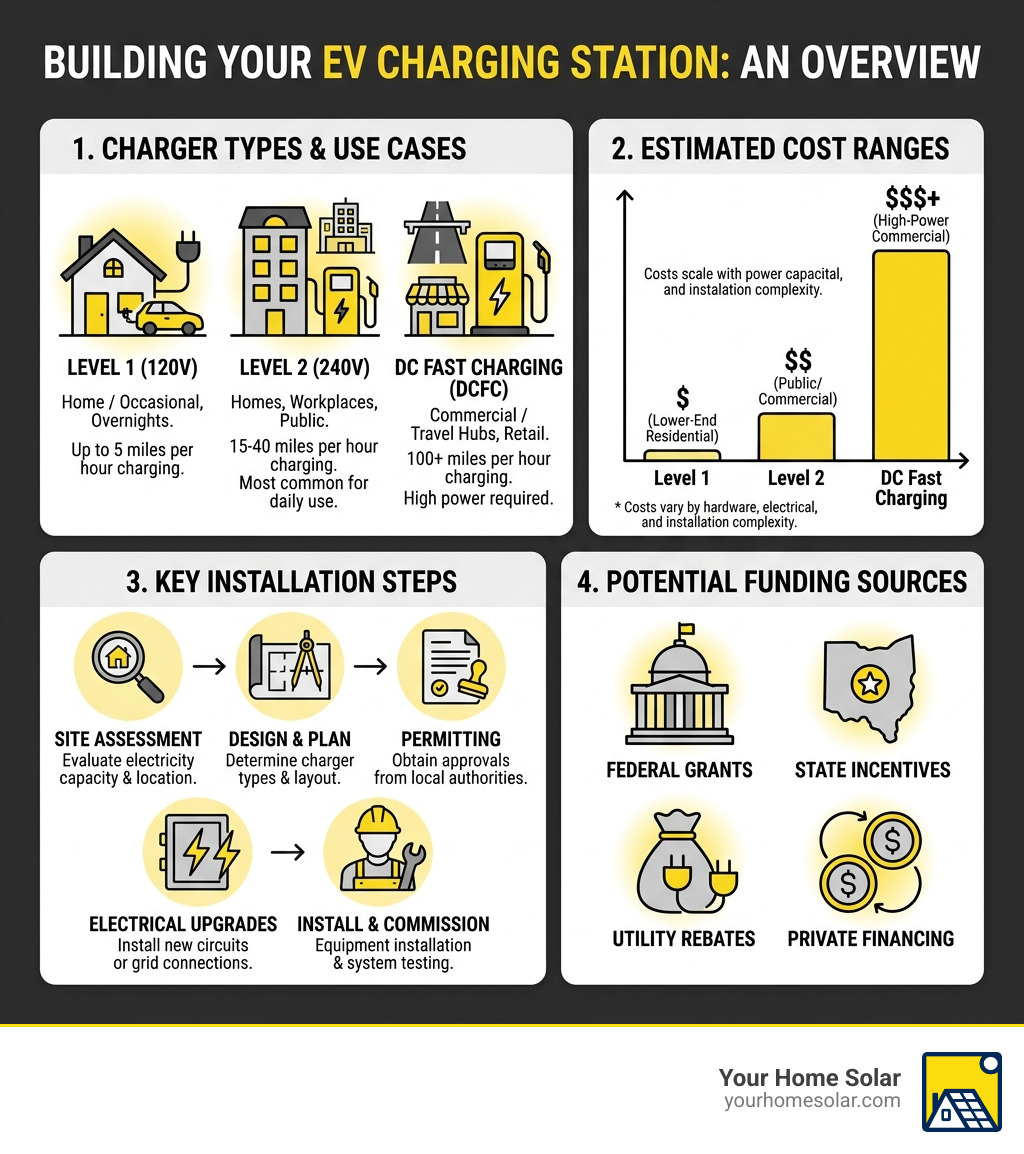
If you want to build EV charging station infrastructure — whether at home or for a commercial property — here is a quick overview of what the process involves:
- Choose your charger type — Level 1 (120V), Level 2 (240V), or DC Fast Charging
- Assess your electrical capacity — check panel amperage and available circuits
- Plan your site — location, conduit routing, ADA access, and safety considerations
- Pull permits — work with your local Authority Having Jurisdiction (AHJ)
- Install and commission — hire a licensed electrician, test the system, and connect to a network if needed
- Explore funding — federal grants, state incentives, and utility rebates can offset significant costs
Electric vehicles are no longer a niche product. Global EV sales surpassed 16.7 million in 2024, and experts project that within just a few years, half of all new auto sales in the US will be electric. That shift is creating real, urgent demand for charging infrastructure everywhere — at homes, workplaces, retail centers, and beyond.
The pressure is real for property owners too. Research shows that 88% of consumers actively seek out sustainable amenities like EV charging when choosing where to shop, stay, or live. That means a charging station is not just a convenience — it is quickly becoming a competitive necessity.
But building EV charging infrastructure is not as simple as plugging in a cable. Costs can range from a few hundred dollars for a basic home setup to well over $200,000 per DC Fast Charger for a commercial installation. Timelines can stretch from 12 months to 2 years for large projects. Permits, electrical upgrades, equipment selection, and ongoing management all require careful planning.
This guide walks you through every step — clearly and without the jargon.
I’m Ernie Bussell, founder and CEO of Your Home Solar, East Tennessee’s #1 solar energy contractor, and my background in large-scale energy system operations gives me a practical, boots-on-the-ground perspective on what it actually takes to build EV charging station infrastructure that works long-term. Whether you’re a homeowner in Knoxville or a business owner looking to future-proof your property, this playbook is built for you.
Quick look at build ev charging station:
Planning and Technology: Choosing Your Charger Type
When we sit down with clients in Knoxville or Maryville to discuss how to build EV charging station setups, the first question is always: “How fast do we need to go?” The answer depends entirely on “dwell time”—how long a car sits in one spot.
There are three primary levels of charging technology:
- Level 1 (120V): This uses a standard household outlet. It’s slow, adding about 3–5 miles of range per hour. It’s okay for a hybrid with a tiny battery, but for a full EV, it can take over 20 hours for a full charge. For most of our customers, this is the “emergency only” option.
- Level 2 (240V): This is the “sweet spot” for homes and many businesses like hotels or workplaces. It requires a dedicated 240V circuit (like a clothes dryer). It adds 25–60 miles of range per hour, meaning a car is topped off in 4–10 hours.
- DC Fast Charging (Level 3): This is the heavy hitter. Using high-voltage direct current, these stations can charge an EV to 80% in just 20–40 minutes. These are essential for highway corridors and “on-the-go” retail locations where customers only stay for half an hour.
| Feature | Level 1 | Level 2 | DC Fast Charging |
|---|---|---|---|
| Voltage | 120V AC | 240V AC | 480V+ DC |
| Range Per Hour | 3–5 miles | 25–60 miles | 100–200+ miles |
| Best For | Home (Overnight) | Home/Work/Retail | Highway/Fleet |
| Install Cost | Low ($0–$500) | Moderate ($1k–$10k) | High ($40k–$200k+) |
In connectors, the landscape is shifting. While the J1772 has been the standard for Level 2 charging for years, and CCS was the standard for fast charging, the industry is rapidly moving toward the NACS (North American Charging Standard), popularized by Tesla. When you build EV charging station infrastructure today, we recommend equipment that is either NACS-native or easily adaptable to ensure you aren’t left with “betamax” technology in a “VHS” world.
Another critical tech term is OCPP (Open Charge Point Protocol). This ensures your hardware can talk to any software network. Avoiding “vendor lock-in” is vital for commercial success. For more on the latest tech, check out our guide on Smart EV Charger Installation in Knoxville.
Choosing the Right Equipment to Build EV Charging Station Infrastructure
Selecting hardware isn’t just about the plug; it’s about durability and intelligence. In East Tennessee, our equipment has to handle everything from humid summers to icy winters in the Smokies. Look for chargers with high IP (Ingress Protection) and IK (Impact Protection) ratings if they are going outdoors.
Smart features are no longer optional. A “dumb” charger just passes electricity; a smart charger allows you to:
- Schedule charging for off-peak hours (when electricity is cheaper).
- Monitor energy usage via an app.
- Balance the load so you don’t trip your main breaker if the AC and the dryer are running at the same time.
Reliability is the biggest hurdle for public adoption. Researchers at ORNL are constantly working on “ride-through” technologies to help chargers stay online during grid fluctuations, which is why we prioritize equipment that has a proven track record of high uptime.
Future-Proofing for Scalability and Emerging Tech
If you are going to build EV charging station units today, you must think about tomorrow. We often suggest installing larger conduit than you currently need. If you’re running wire for two chargers now, why not lay the pipe for four? The “trenching” (digging the dirt) is the expensive part; the extra plastic pipe is cheap.
Emerging technologies like V2G (Vehicle-to-Grid) and ISO 15118 readiness are also on the horizon. ISO 15118 allows for “Plug & Charge,” where the car and the charger communicate automatically—no apps or credit card swipes needed. The car just knows who you are and bills your account.
We are also seeing a rise in mobile or portable charging solutions. These are great for car dealerships or fleet operators who need to move their “gas pump” to where the cars are parked, rather than moving the cars to the pump.
The Financial Blueprint: Costs and Funding Opportunities
Let’s talk numbers. Building a station is an investment, and the price tag varies wildly based on your goals.
- Home Level 2: Typically costs between $500 and $2,000 for the unit and installation, depending on how close your electrical panel is to the garage.
- Commercial Level 2: Expect to pay $2,500 to $10,000 per port. This includes the ruggedized hardware, networking software, and more complex permitting.
- DC Fast Charging: These are the big-ticket items. Equipment starts at $20,000, but once you add high-voltage utility upgrades, specialized labor, and permitting, the total “all-in” cost can hit $150,000 to $200,000 per charger.
The good news? You don’t have to foot the whole bill. The Bipartisan Infrastructure Law (BIL) and the NEVI (National Electric Vehicle Infrastructure) program are pumping billions into the grid. In fact, there are specific grants offering a minimum of $500,000 for rural communities with fewer than 10,000 people to help bridge the charging gap.
Locally, the City of Knoxville often provides updates on local incentives and sustainability initiatives that can help offset costs for local businesses.
Revenue Models for a Commercial Build EV Charging Station
If you’re a business owner, you aren’t just providing a service; you’re looking for an ROI. There are three main ways to play it:
- Host-Owned: You buy the equipment, you set the price, and you keep 100% of the profit. This has the highest upfront cost but the best long-term margins.
- Network-Owned (Turnkey): A provider installs the equipment at no cost to you. They keep the charging revenue, but you benefit from the increased foot traffic and “sustainable brand” image.
- Hybrid: You share the costs and the profits with a network provider.
Beyond direct session fees, EV chargers increase property value and attract high-spending customers. If an EV driver knows they can get a “top-off” while they spend 45 minutes in your restaurant or retail shop, they are much more likely to choose you over a competitor.
Ongoing Maintenance and Operational Reliability
You can’t just “set it and forget it.” To maximize your ROI, you need a Charging Station Management System (CSMS). This software monitors your stations 24/7. If a charger goes offline, the system tells you immediately.
Maintenance involves:
- Physical inspections of cables and connectors (the most common point of failure).
- Cleaning cooling fans and vents.
- Software updates to ensure compatibility with new car models.
- Load management to avoid “peak demand” charges from your utility company, which can eat into your profits if multiple cars plug in at the same time.
Engineering and Installation: How to Build EV Charging Station Sites

This is where the rubber meets the road—or the wire meets the wall. A successful site starts with an electrical capacity audit. We look at your existing panel to see if it can handle the continuous load of an EV charger. If your panel is already “full” (meaning it’s drawing near its limit when the AC and stove are on), you may need a service upgrade from your utility provider.
For a commercial build EV charging station project, the steps usually look like this:
- Site Assessment: Finding the shortest path from the power source to the parking spot to minimize trenching costs.
- Engineering Design: Creating blueprints that meet NEC Article 625 (the section of the National Electrical Code specifically for EV charging).
- Permitting: Submitting plans to the local building department.
- Construction: Trenching, laying conduit, pulling wire, and mounting the units.
- Commissioning: Testing the software, payment systems, and safety shut-offs.
For local homeowners, the process is much faster. You can see how we handle these projects in our guide to EV Charger Installation Knoxville.
Navigating Permits and Standards to Build EV Charging Station Projects
Permitting can be the most time-consuming part of the process. While some states like California have mandated timelines (20–40 days for approval), in Tennessee, it varies by county. Working with an experienced contractor who knows the local inspectors in Knox, Blount, or Sevier County is essential to keep the project on track.
Safety is paramount. Beyond the electrical code, you must ensure your site is ADA compliant. This means having at least one charging spot that is accessible to drivers with disabilities, including proper van-accessible spacing and reachable cord heights. For a deep dive into implementation strategies, the NYSERDA implementation plans offer a great template for how municipalities and businesses should structure their rollout.
Best Practices for Site Selection and Wiring
Where you put the charger matters as much as what charger you buy. Here are our top tips:
- Proximity to Power: Every foot of trenching and heavy-gauge copper wire adds to the bill. Keep chargers as close to the electrical room as possible.
- Visibility: Public chargers should be easy to find. Good signage and lighting not only help drivers but also improve safety.
- Protection: Use safety bollards (those yellow metal posts) to protect your expensive chargers from being bumped by cars.
- Cable Management: Nobody likes tripping over a cord or finding a connector lying in a puddle. Use retractable cord reels or holsters to keep things tidy.
Essential Tool Checklist for Installation:
- Torque wrench (to ensure connections meet manufacturer specs and prevent fires).
- Circuit analyzer and EVSE tester.
- Multimeter for voltage verification.
- Conduit benders and heavy-duty wire pullers.
Frequently Asked Questions about Building EV Charging Stations
How long does it take to build a commercial EV charging station?
A standard commercial Level 2 installation can take 3 to 6 months from initial planning to “power on.” However, if you are installing DC Fast Chargers that require a new transformer from the utility company, that timeline can stretch to 12 to 24 months.
What are the primary differences between Level 2 and DC Fast chargers for businesses?
It comes down to “dwell time.” Level 2 is perfect for places where people stay for 2+ hours (offices, apartments, hotels). DC Fast Charging is for locations where people stay for 20–40 minutes (gas stations, fast food, convenience stores).
Are there specific grants available for rural EV infrastructure in 2026?
Yes! Under the Bipartisan Infrastructure Law, rural communities are a major priority. Programs like the Community Charging and Fueling Infrastructure (CFI) Grant Program provide billions specifically for locations outside of major urban centers to ensure “charging deserts” are eliminated.
Conclusion
Building an EV charging station is one of the smartest ways to future-proof your home or business in East Tennessee. As we move through 2026, the transition to electric mobility is only accelerating. By investing in the right infrastructure today, you are not just adding a plug—you are adding value, sustainability, and a new stream of potential revenue.
At Your Home Solar, we pride ourselves on being more than just installers; we are your partners in the energy transition. From the initial load calculation in Oak Ridge to the final commissioning in Johnson City, our team brings the expertise and local knowledge needed to make your project a success. We don’t just build stations; we build reliable energy solutions that last.
Ready to take the next step? Whether you want to power your car with the Tennessee sun or provide a premium amenity for your customers, we are here to help.