Is Solar Energy in Tennessee Worth It? Here’s What You Need to Know
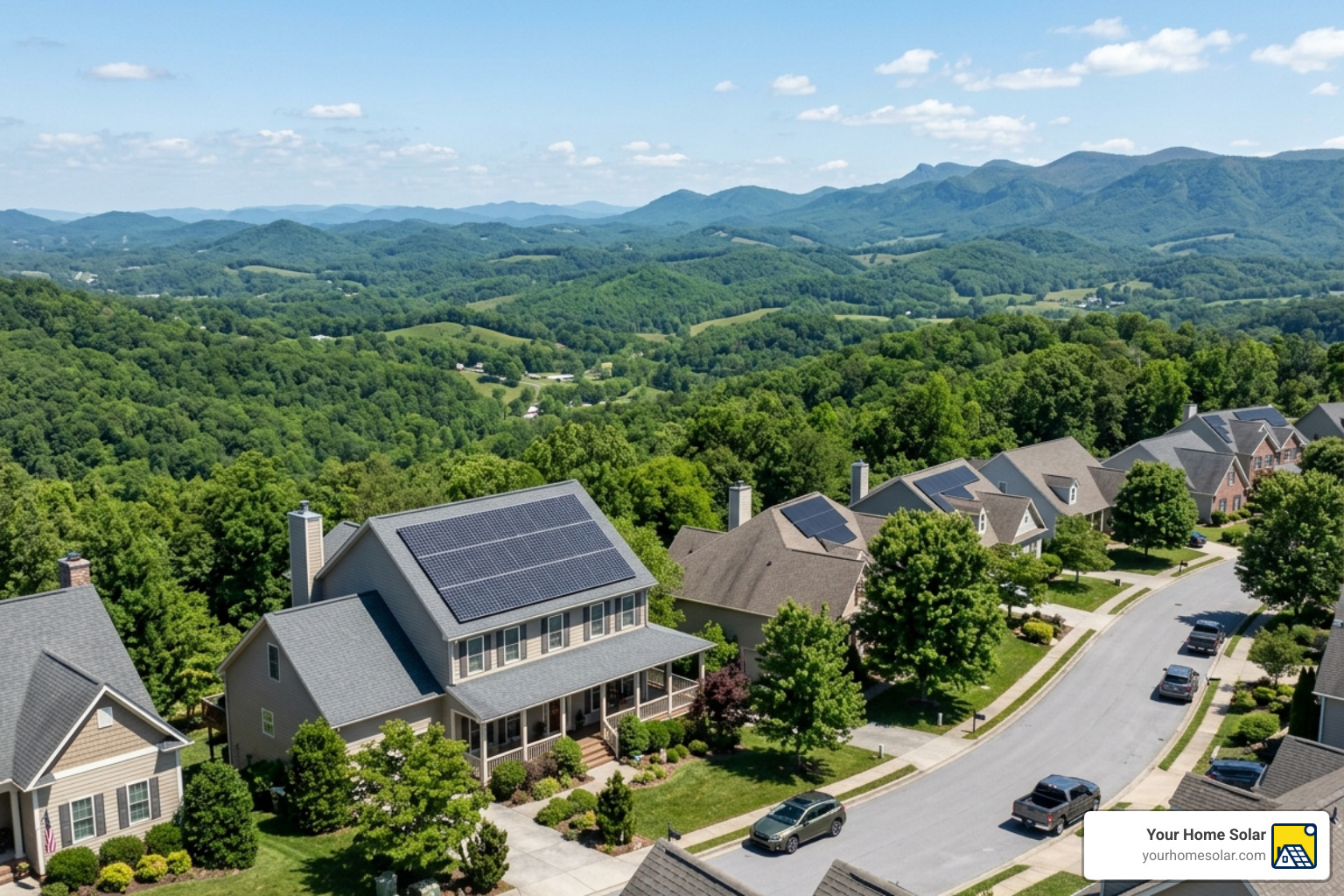
Solar energy in Tennessee is growing fast — and for East Tennessee homeowners, it’s becoming one of the smartest ways to cut energy bills, protect against outages, and gain real energy independence.
Here’s a quick snapshot of where things stand:
| Fact | Detail |
|---|---|
| Total solar installed | 1,206 MWdc (enough for 121,779 homes) |
| Share of state electricity | 1.87% |
| National ranking | 37th overall, 30th in 2025 additions |
| Total solar investment | $1.7 billion |
| Solar jobs | 5,266 (projected 10,856 by 2030) |
| TVA solar goal | 10,000 MW by 2035 |
| Key incentive | 30% Federal Solar Tax Credit |
| Net metering | No statewide policy — varies by local utility |
Tennessee’s solar market has gone from nearly nothing (just 0.4 MW in 2007) to over 1,206 MW today. Prices have dropped 42% over the past decade. And with the Tennessee Valley Authority (TVA) pushing hard toward a 10,000 MW solar target by 2035, the momentum is only building.
That said, Tennessee has a unique energy landscape. TVA controls electricity for 99.7% of the state, there’s no statewide net metering law, and nearly 25% of the state’s electricity still comes from coal. Navigating all of this — and making the right decision for your home — takes some understanding of how it all works.
That’s exactly what this guide covers.
I’m Ernie Bussell, Founder and CEO of Your Home Solar, the #1 solar energy contractor in East Tennessee — and I’ve spent years helping homeowners make confident, informed decisions about solar energy in Tennessee. My background spans the U.S. Navy, a decade in education, and hands-on operational leadership scaling a $40 million solar installation business, so I understand this industry from every angle.
Let’s break it all down.
The Current State of Solar Energy in Tennessee
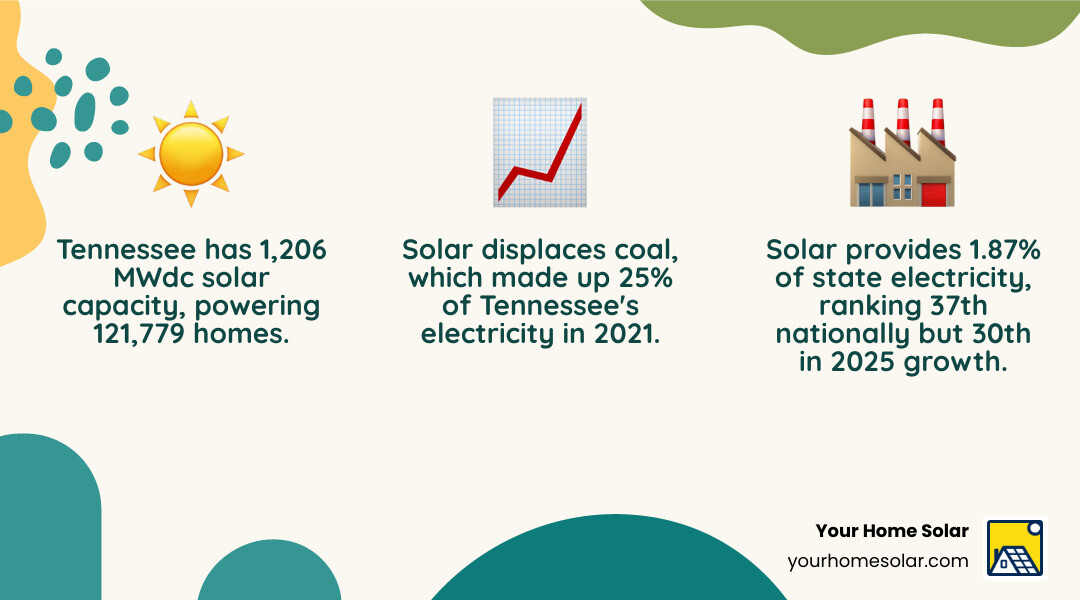
As we look across the rolling hills of East Tennessee, from the Great Smoky Mountains to the Tennessee River, the landscape is changing. We are seeing more blue-tinted silicon panels than ever before. Currently, Tennessee has an installed capacity of 1,206 MWdc. While we rank 37th nationally in total capacity, we are punching above our weight in recent growth, ranking 30th for projected 2025 additions.
Today, solar provides about 1.87% of the state’s total electricity. That might sound small, but it is enough to power 121,779 homes. This shift is critical because Tennessee still relies heavily on older energy sources; as of 2021, nearly 25% of our electricity came from coal. By integrating more clean energy solutions, we are actively displacing coal and cleaning up the “dirtiest” parts of our power grid.
Economic Impact of Solar Energy in Tennessee
The “Volunteer State” is truly volunteering for a cleaner future, and it’s paying off in green—both environmentally and financially. The solar industry has brought $1.7 billion in total investment to our state. This isn’t just about hardware; it’s about people. There are currently 5,266 solar jobs in Tennessee spread across 138 companies.
Looking ahead, the Solar power in Tennessee – Wikipedia entry and industry data from Tennessee Solar and Storage suggest a bright future. We expect to see 1,453 MW of growth over the next five years, and the National Renewable Energy Laboratory (NREL) projects that solar-related jobs could double to over 10,800 by 2030.
Utility-Scale Growth and the Tennessee Energy Mix
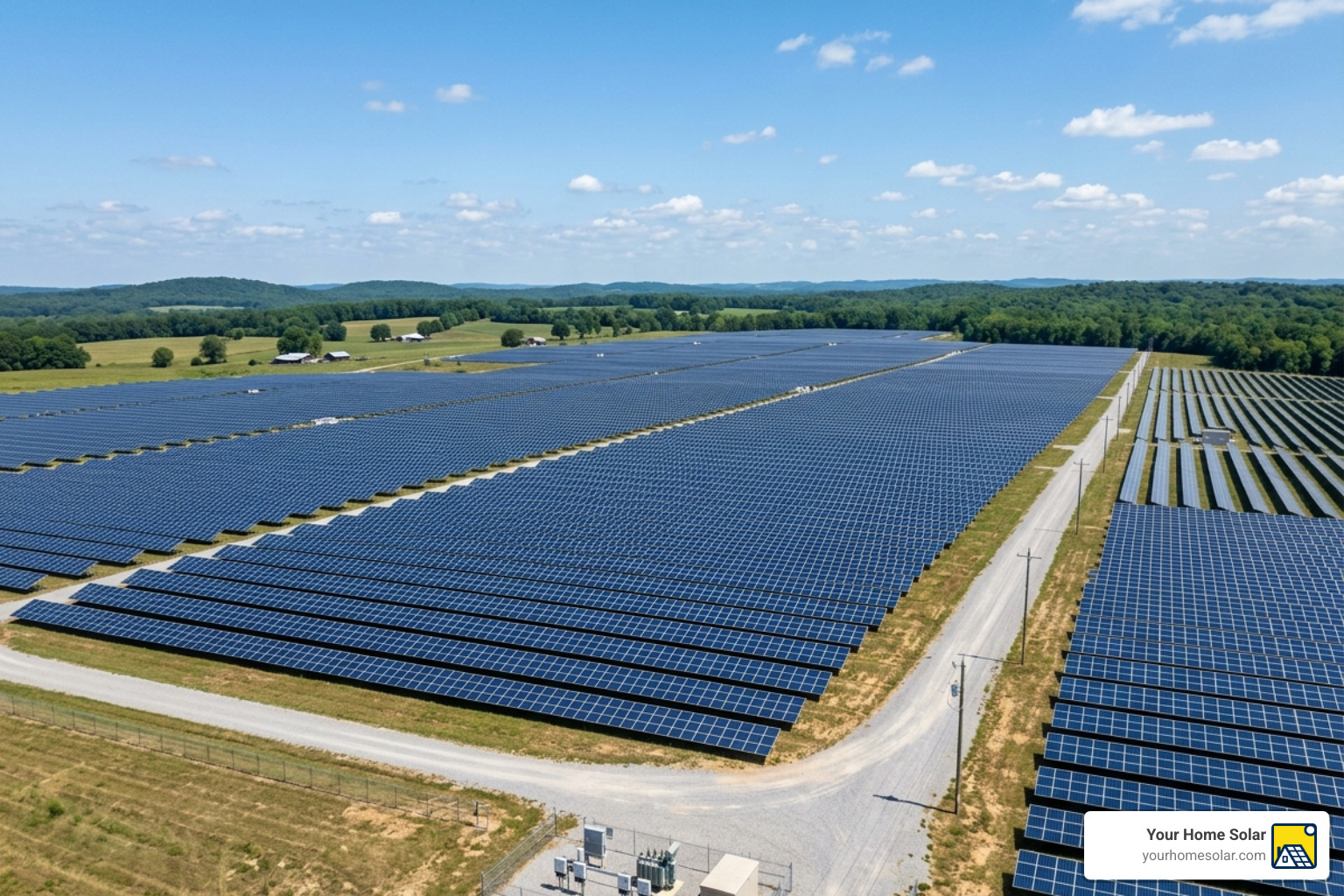
Utility-scale projects—those massive fields of panels you see along the highway—are the primary drivers of our state’s capacity. The Tennessee Valley Authority (TVA) has set an ambitious goal to add 10,000 MW of solar by 2035. To put that in perspective, if all that solar were built on Tennessee farmland, it would only take up about 1% of the state’s total agricultural land.
This growth is essential for grid stability. As our population in places like Knoxville, Maryville, and Johnson City grows, so does our demand for power. By diversifying the energy mix, TVA can better manage peak demand and move toward carbon neutrality. You can track these shifts through Tennessee Solar Energy Market Trends and Adoption Data | Tennessee Solar Authority.
Major Solar Projects and Utility Influence
Several landmark projects have paved the way for solar energy in Tennessee. The Millington Solar Farm, which came online in 2019, stands as one of the largest at 68.5 MWdc. Another pioneer is the West Tennessee Solar Farm, featuring 21,000 fixed-tilt panels. This site even includes the “SPECTRUM” exhibit, an interactive educational center where visitors can learn about solar science—perfect for a weekend family trip to become a “solar genius.”
In our neck of the woods, the Volkswagen Chattanooga plant features a massive 8 MW array that helps power their manufacturing operations with the sun. These projects show that solar isn’t just a residential hobby; it’s a foundational part of Tennessee’s industrial infrastructure.
How TVA Shapes Solar Energy in Tennessee
You cannot talk about solar energy in Tennessee without talking about the Tennessee Valley Authority. Because TVA provides electricity to 99.7% of the state and regulates 153 local power companies (LPCs), they essentially set the rules of the game.
TVA offers several programs through TVA Programs | Oak Ridge, TN, such as:
- Green Invest: Helps large commercial and industrial customers meet sustainability goals through long-term agreements.
- Green Connect: A program that connects residential customers with quality, pre-vetted installers (like us!) to ensure a high standard of work.
- Wholesale Power Policy: TVA self-regulates its fuel mix, meaning their commitment to solar directly impacts the “cleanliness” of the power coming out of your wall outlet.
Leading Commercial and Community Solar Initiatives
For those who can’t install panels on their own roof—perhaps due to heavy shading or renting—community solar is a fantastic alternative. Programs like Music City Solar allow residents to subscribe to a portion of a larger solar array.
The potential for rooftop solar in Tennessee is staggering. Research indicates that if we utilized all suitable rooftop space, we could generate 16,000 MW of power, meeting roughly 23% of the state’s total electricity needs. This is why the Solar Energy office at the state level continues to provide toolkits for local governments to streamline these installations.
Financial Incentives and Tax Credits for Homeowners
We know the biggest question on every homeowner’s mind: “What’s this going to cost me?” The good news is that while Tennessee doesn’t have a state-level income tax credit for solar, the federal incentives are stronger than ever.
The cornerstone of solar savings is the Federal Investment Tax Credit (ITC). This allows you to deduct 30% of the total cost of your solar system from your federal taxes. Whether you are in Knoxville or Kingsport, this 30% credit applies to the panels, labor, and even battery storage systems.
Residential Savings and Payback Periods
Is it a good investment? According to What Incentives Exist in Solar Within Tennessee? Ernie Answers This Commonly Asked Question, a typical 5 kW system in Tennessee can pay for itself in about 14 years. Over a 25-year lifespan, that same system can net a homeowner over $16,000 in total savings.
With solar prices dropping 42% over the last decade, the “math” of solar has never looked better. You can find more details in our Solar Incentives Tennessee 2026 Guide and our dedicated page on Tax Credits Incentives.
Low-Income and Disadvantaged Community Programs
We believe solar should be accessible to everyone, not just those with high credit scores. Tennessee recently received $156 million from the EPA’s “Solar for All” program. Managed by the TDEC Office of Energy Programs, this initiative aims to help low-income households achieve up to 20% savings on their electricity bills.
This program, detailed at Solar for All, will fund residential rooftop solar and community solar projects, alongside workforce development to train the next generation of Tennessee solar installers.
Navigating Regulations and Net Metering in the Volunteer State
One of the most confusing parts of solar energy in Tennessee is net metering. Unlike some states that have a single, statewide law, Tennessee’s policy is a patchwork. Since there is no state mandate, each of the 153 local power companies (like KUB in Knoxville or BrightRidge in Johnson City) can set their own rules.
Understanding Net Metering for Solar Energy in Tennessee
Most utilities in the TVA region use what is called a “Dual-Channel” or “Dispersed Power Production” (DPP) program. Instead of a 1-to-1 credit for every kilowatt-hour (kWh) you send back to the grid, the utility might buy your excess power at a wholesale rate while you buy power at the retail rate.
Key things to know:
- Bi-directional Meters: Your utility will install a meter that tracks power flowing both ways.
- Credit Rollover: Some utilities allow you to roll over kilowatt credits from month to month.
- Local Variation: Solar Power – Morristown Utilities might have different buy-back rates than a utility in Sevierville.
Check out our guide on Solar Panel Viability in Tennessee to see how your specific location impacts your ROI.
Consumer Protection and Avoiding Solar Scams
Unfortunately, as the industry grows, so do the “solar bros” with high-pressure sales tactics. Between 2020 and 2023, the Tennessee Attorney General received 498 fraud complaints against residential solar companies—with the vast majority targeting just two bad actors.
To protect yourself, we always recommend:
- NABCEP Certification: Look for installers with North American Board of Certified Energy Practitioners (NABCEP) credentials. It’s the gold standard for technical excellence.
- Local Presence: Avoid companies that “parachute” in from out of state. You want a team that knows East Tennessee’s weather and utility codes.
- No Pressure: If a salesperson says a deal “expires tonight,” walk away.
- Read Reviews: Check Best Solar Companies Tennessee Reviews to see real feedback from your neighbors.
Maximizing Your Investment: Storage and Property Suitability
Solar panels are great, but solar panels plus a battery are a game-changer. Tennessee has about 184 MWh of storage capacity currently installed. Why is this important? Because solar only works when the sun is out, but your fridge needs to run 24/7.
A battery backup system allows you to:
- Achieve Energy Independence: Use your own stored power at night.
- Protect Against Outages: When the grid goes down during a Tennessee thunderstorm, your lights stay on.
- Avoid Peak Rates: If your utility uses time-of-use pricing, you can use battery power when grid prices are highest.
Learn more about the Advantages of Installing Solar Panels in Tennessee.
Determining if Your Property is Ready for Solar
Not every roof is a candidate for solar. Before you get too far down the path, we look at a few key factors:
- Orientation: South-facing roofs are the “gold mine” for solar production in the Northern Hemisphere.
- Roof Condition: We recommend your roof have at least 10–15 years of life left. If you need a new roof soon, it’s best to do it right before or during the solar install.
- Shading: Those beautiful Tennessee oaks are great for shade, but they’re the enemy of solar production. We use solar radiance maps to see exactly how much sun hits your shingles.
Our Residential Solar Solutions Guide/Incentives and Tax Credits for Solar Systems provides a deeper dive into these technical requirements.
The Future of Agrivoltaics and Land Use
One of the coolest trends in solar energy in Tennessee is agrivoltaics—the dual use of land for both solar and farming. Currently, there are nine active projects across 1,900 acres in Tennessee where sheep graze under solar panels or crops are grown between rows. This solves the “land use” debate by keeping the land productive for agriculture while harvesting the sun. We also prioritize brownfield redevelopment (using old industrial sites) to protect our pristine forests and farmland.
Frequently Asked Questions about Solar Energy in Tennessee
Does Tennessee have a statewide net metering policy?
No. Tennessee does not have a mandated statewide net metering law. Policies are determined by the 153 local power companies under the TVA umbrella. Most offer a version of the Dispersed Power Production (DPP) program, where you are credited for the energy you send back to the grid, though the rates vary.
How much does it cost to install solar panels in Tennessee?
While every home is different, solar prices have dropped 42% over the last decade. Most homeowners find that after the 30% federal tax credit, the system pays for itself in roughly 14 years. We offer free, tailored estimates to give you an exact number for your specific roof and energy needs.
What are the requirements of the Tennessee Decommissioning Law?
Known as Public Chapter 866, this law primarily affects large-scale solar farms (5 MW or larger). It requires developers to have a clear plan and financial assurance (like a bond) to remove the equipment and restore the land once the project is finished. This protects Tennessee landowners and ensure our rural landscapes aren’t left with abandoned hardware.
Conclusion
At Your Home Solar, we aren’t just one of the many solar power companies in tennessee; we are your neighbors. From Knoxville to Johnson City and down to Chattanooga, we specialize in providing East Tennessee with tailored energy solutions that actually work for our climate and our utility rules.
Whether you’re looking for rooftop panels, a whole-home backup generator, or a high-speed EV charger, our goal is 100% customer satisfaction. We take the “drama” out of the installation process, focusing on integrity, expert craftsmanship, and long-term reliability.
Ready to stop renting your power and start owning it? Start your journey toward energy independence in East Tennessee today. We’ll help you navigate the incentives, the tech, and the TVA paperwork so you can just enjoy the sunshine.