What Is the Solar Panel Assembly Process?
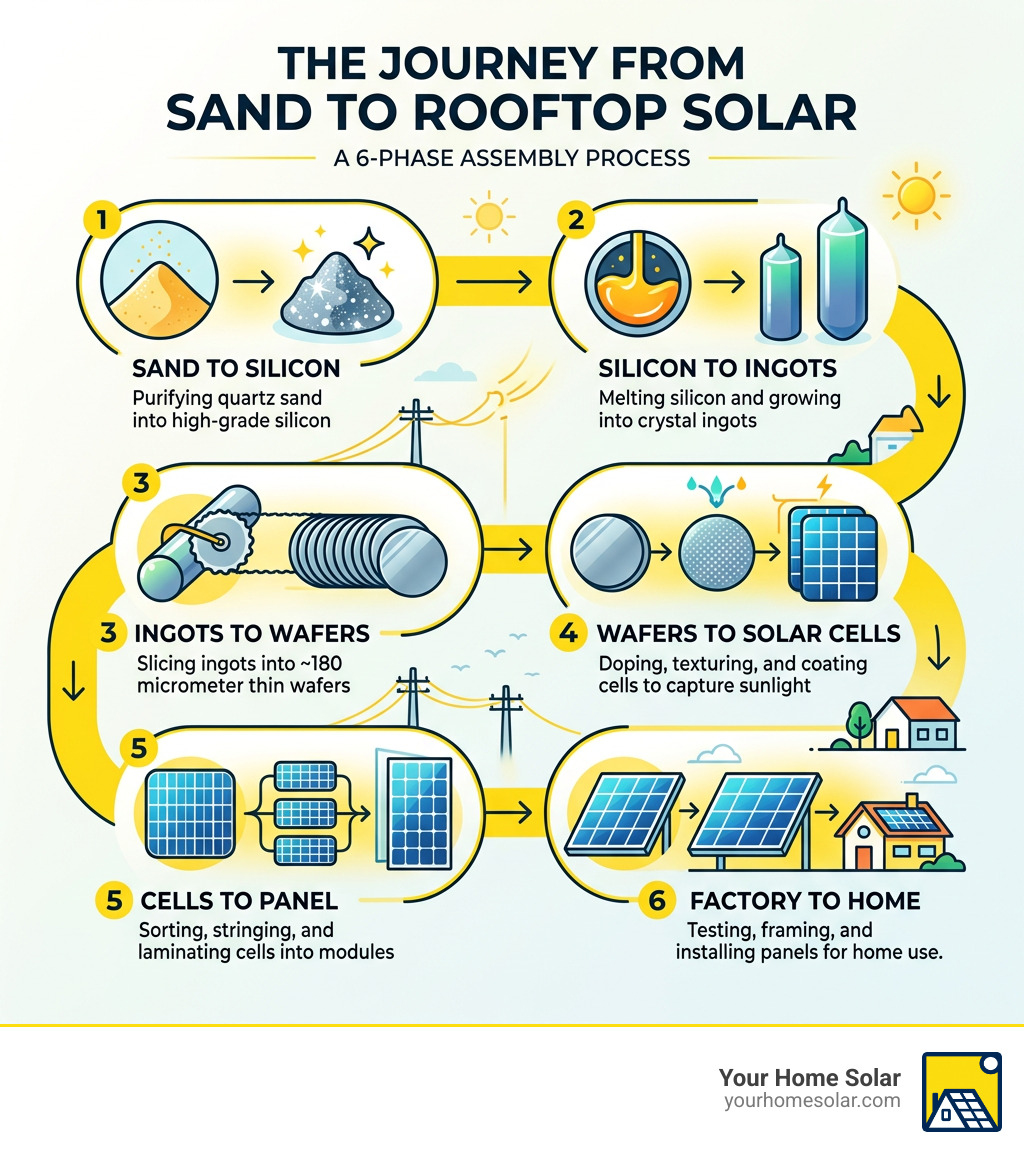
The solar panel assembly process transforms raw materials — starting with little more than sand — into the high-performance modules now powering homes across East Tennessee and beyond. Here is a quick overview of the six core phases:
- Sand to Silicon – Quartz sand is purified into high-grade silicon
- Silicon to Ingots – Silicon is melted and grown into crystal ingots
- Ingots to Wafers – Ingots are sliced into ultra-thin silicon discs (~180 micrometers)
- Wafers to Solar Cells – Cells are doped, textured, and coated to capture sunlight
- Cells to Panel – Cells are sorted, strung, and laminated into a complete module
- Factory to Home – Finished panels are tested, framed, and shipped for installation
The full process takes roughly 3 to 4 days from silicon wafer to finished module.
Most homeowners flip on a light switch without thinking twice about what went into the panel on their roof. But understanding what’s inside that module — and how it was built — helps explain why quality matters so much for long-term performance.
Solar panels are designed to last. Many still operate at around 80% efficiency after 20 to 25 years, and some first-generation panels have been running for nearly six decades. That durability doesn’t happen by accident. It’s the result of a precise, multi-stage manufacturing process with strict quality controls built in at every step.
I’m Ernie Bussell, founder and CEO of Your Home Solar, and my background in quality assurance — first in the U.S. Navy working with precision systems and later overseeing solar installation operations at scale — gave me a deep respect for the solar panel assembly process and why getting it right matters for every homeowner. In this guide, I’ll walk you through exactly how a solar panel is made, from raw sand to your rooftop.
From Sand to Silicon: The Birth of a Solar Wafer
The journey of every solar panel begins with one of the most abundant elements on Earth: silicon. While silicon is everywhere (it makes up a huge chunk of the Earth’s crust), it isn’t ready to power your Knoxville home straight out of the ground. We start with high-purity quartz sand, which is processed in an electric arc furnace to extract metallurgical-grade silicon.
To reach the “solar grade” purity required for electricity, the silicon undergoes further purification, often using a “floating zone” technique to remove impurities until it is nearly perfect. From here, manufacturers create the building blocks of the panel using two primary methods:
- The Czochralski Method (Monocrystalline): A seed crystal is dipped into molten silicon and slowly rotated and withdrawn. This grows a single, continuous crystal ingot. Because the crystal lattice is perfectly aligned, these “mono” cells are highly efficient and feature that sleek, dark look we love for residential installs in places like Maryville and Farragut.
- Polycrystalline Casting: Molten silicon is poured into a square mold and allowed to cool. This creates a block made of many different silicon crystals. While slightly less efficient than monocrystalline, it is a cost-effective alternative.
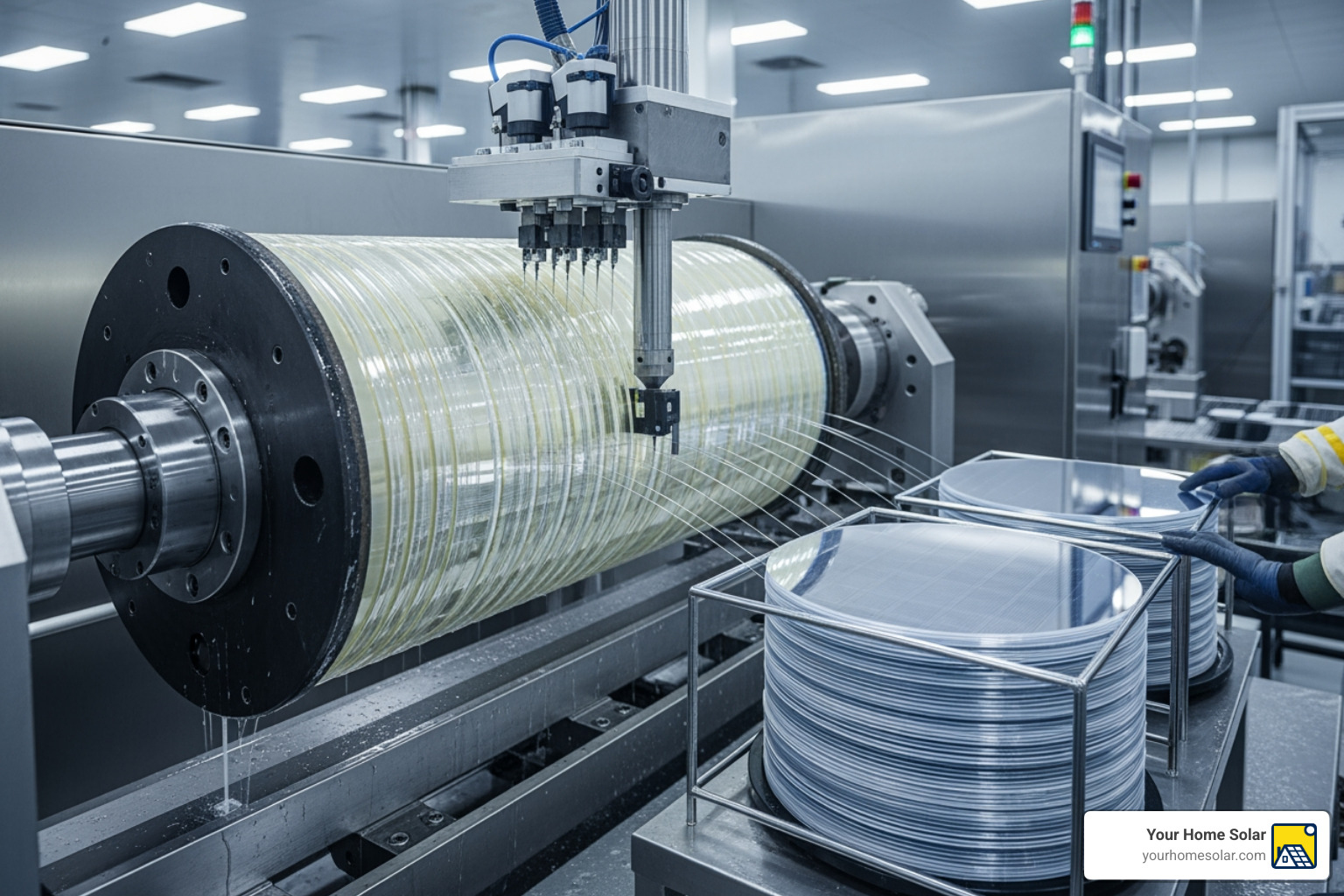
Once the ingots are ready, they are sliced into ultra-thin discs using diamond wire saws. These wafers are incredibly delicate—sliced to roughly 180 micrometers thick, which is about the thickness of two human hairs. After slicing, the wafers are polished to remove saw marks, though some manufacturers leave a slightly rougher surface to help with light absorption.
For a deeper look at how these materials come together, check out this Basics of Solar Panel Manufacturing guide.
Transforming Wafers into High-Efficiency Solar Cells
A plain silicon wafer won’t generate power on its own; it needs a push. This is where chemical doping comes in. We introduce specific elements to the silicon to create an internal electric field.
Typically, the wafer is treated with Boron to give it a positive electrical charge (P-type). Then, a layer of Phosphorus is diffused into the surface to create a negative charge (N-type). The boundary where these two layers meet is called the P-N junction. When sunlight hits this junction, it knocks electrons loose, creating the flow of electricity known as the photovoltaic effect.
To ensure the cell doesn’t just reflect all that valuable Tennessee sunlight away, manufacturers apply a few more treatments:
- Texturization: Using chemicals like potassium hydroxide (KOH), the surface is etched to create microscopic pyramid structures that trap light.
- Anti-Reflective Coating: A thin layer of silicon nitride is applied. This is why panels look blue or black. Without it, silicon reflects about 35% of sunlight; with it, efficiency can improve by as much as 50%.
- Silver Contacts: Finally, thin silver “fingers” are printed onto the cell to collect the generated electrons and move them into the circuit.
The Core Solar Panel Assembly Process: Stringing and Layout
Once the individual cells are tested and sorted by efficiency, the actual solar panel assembly process moves into high gear. We don’t just throw cells into a frame; they are meticulously arranged into “strings.”
In a standard commercial panel, you’ll typically find 48, 60, or 72 cells. Modern high-efficiency panels often use half-cutting technology. By cutting a standard cell in half, we reduce the internal current, which significantly lowers resistive heat loss. This simple change can boost the overall power output of the module.
Robotic arms are used to arrange these cells on a sheet of tempered glass. Precision is everything here. We maintain a fixed 2-5 mm spacing between the cells. This tiny gap isn’t just for aesthetics; it allows for light to reflect off the backsheet and back into the cell, further increasing efficiency.
Advanced Welding and Interconnection in the Solar Panel Assembly Process
To get the power from the cells to your home’s breaker box, the cells must be interconnected. This is done through a process called stringing and busing.
Manufacturers use thin copper ribbons coated in solder to connect the positive front of one cell to the negative back of the next. This creates a series connection, adding the voltage of each cell together. High-temperature bonding ensures these connections are rock-solid.
We are also seeing a shift toward advanced technologies like PERC (Passivated Emitter and Rear Cell) and TOPCon. These designs add extra layers to the back of the cell to reflect unabsorbed light back through the silicon, giving the photons a second chance to generate power. For more on the technical basics of these interconnections, you can visit the Department of Energy’s photovoltaic manufacturing basics page.
Protection and Longevity: Lamination and Framing
In East Tennessee, our panels have to survive everything from sweltering July humidity to heavy winter snow in the Smokies. The “sandwich” of materials that protects the cells is what ensures they last for decades.
| Layer | Material | Function |
|---|---|---|
| Front Cover | Tempered Glass | High transparency and impact resistance |
| Encapsulant | EVA (Ethylene-Vinyl Acetate) | Bonds layers and provides cushioning |
| Active Layer | Solar Cells | Converts sunlight to DC electricity |
| Encapsulant | EVA | Seals the back of the cells |
| Backsheet | Polymer or Glass | Moisture barrier and electrical insulation |
The most critical stage here is vacuum lamination. The entire “sandwich” is placed in a laminator where heat and pressure are applied. This causes the EVA to melt and “cross-link,” turning into a clear, rubbery plastic that seals the cells against moisture and oxygen. If this step isn’t perfect, moisture ingress can lead to corrosion and panel failure. You can learn more about how these layers contribute to Solar Panel Durability.
Once laminated, the module is fitted with an aluminum alloy frame. This frame provides structural integrity, making the panel easy to mount and protecting the glass edges from impact.
Finalizing the Solar Panel Assembly Process with Junction Boxes
The final physical component added is the junction box. Mounted on the back of the panel, this box houses the electrical connections and bypass diodes. These diodes are crucial—they allow electricity to “bypass” shaded cells so that one leaf falling on a panel doesn’t shut down the whole string.
The junction box is attached using a high-grade silicone sealant and allowed to cure for 10-12 hours. Once sealed, it provides a waterproof housing for the cables that will eventually connect to your inverter. Each panel also receives a nameplate rating, which lists its tested power output, voltage, and current under Standard Test Conditions (STC).
Quality Control: Ensuring 25 Years of Performance
At Your Home Solar, we know that a solar system is a 25-year investment for our neighbors in Kingsport or Johnson City. That’s why quality control during the solar panel assembly process is so rigorous.
One of the most impressive tests is EL (Electroluminescence) testing. It’s essentially an X-ray for solar panels. By running a current through the panel, it glows in infrared light. A special camera captures this glow, revealing “dead” cells or microscopic cracks that are invisible to the naked eye. These tests are usually performed twice: once before lamination and once after final assembly.
Other standard tests include:
- Insulation Resistance Test: Ensures the panel can handle high voltage without leaking current.
- Flash Testing: The panel is placed under a solar simulator that mimics 1000 Wm⁻² of sunlight (STC). This confirms the panel actually produces the wattage it claims on the label.
Packaging and Logistics for Global Distribution
Once the panels pass their final exam, they are cleaned and prepped for shipping. Because glass makes up nearly 75% of the material in a panel, they are heavy and require careful palletization with protective padding to prevent vibration damage during transport.
Even at the end of their life, these panels are designed with the future in mind. Most of the materials—including the glass, aluminum frame, and copper wiring—are highly recyclable. As the industry grows, recycling programs are becoming more sophisticated, ensuring that the “green” energy of today doesn’t become the waste of tomorrow. For a deeper dive into the full lifecycle of a system, see our Comprehensive Guide to Understanding Solar Panels.
Frequently Asked Questions about Solar Manufacturing
How long does the full assembly process take from cells to finished module?
While the journey from raw quartz sand to a finished wafer takes time, the actual assembly of the module (stringing, laminating, and framing) is surprisingly fast thanks to automation. However, when you factor in the 10-12 hours required for the junction box adhesives to cure and the various testing phases, the entire process from a silicon wafer to a shippable panel typically takes 3 to 4 days.
What is the role of EVA and backsheets in protecting the panel?
Think of EVA (Ethylene-Vinyl Acetate) as the “glue” and “cushion” of the panel. It provides UV protection and mechanical damping for the fragile silicon cells. The backsheet acts as the final line of defense, providing electrical insulation and preventing moisture from reaching the electrical circuits. Without high-quality encapsulation, a panel wouldn’t survive a single Tennessee summer.
How does the layout and spacing of cells affect panel efficiency?
Layout is a balancing act. If cells are too close, there’s no room for the materials to expand and contract with temperature changes. If they are too far apart, you waste space. By maintaining a precise 2-5 mm slit spacing, manufacturers can use the white backsheet to reflect light back into the glass, where it bounces into the cells—a neat trick that boosts the “fill factor” and overall efficiency.
Conclusion
The solar panel assembly process is a marvel of modern engineering, turning simple sand into a sophisticated power plant that sits quietly on your roof for decades. From the precision of diamond-wire sawing to the high-tech “X-rays” of EL testing, every step is designed to maximize efficiency and ensure your home stays powered through every season.
At Your Home Solar, we take pride in bringing this advanced technology to our communities across East Tennessee—from the bustling streets of Knoxville to the quiet hills of Roane and Blount counties. We don’t just install panels; we provide tailored home energy solutions backed by trusted expertise and a commitment to 100% customer satisfaction.
Ready to see how these high-tech modules can transform your energy bills? Start your solar journey with us today and experience the rewarding feeling of generating your own clean power.