Why Affordable Solar Financing Makes Going Solar Possible for Most Homeowners
Affordable solar financing lets you go solar with little or no money down, spreading the cost over monthly payments that are often lower than your current electricity bill.
Here are the most common options at a glance:
| Financing Type | Upfront Cost | Who Owns the System | Tax Credits |
|---|---|---|---|
| Solar Loan | $0 down available | You | Yes |
| Solar Lease | $0 down | Provider | No |
| Power Purchase Agreement (PPA) | $0 down | Provider | No |
| Cash Purchase | Full cost | You | Yes |
The average residential solar system in Canada and the U.S. runs between $10,000 and $30,000. That’s a real barrier for most families. But over 60% of solar customers today use financing — meaning most people who go solar don’t pay cash upfront.
The good news? Between zero-interest loans, low-APR financing, and federal tax credits worth up to 30% of your system cost, the real out-of-pocket cost is far lower than the sticker price suggests.
Here in East Tennessee, rising utility bills and the threat of power outages make this conversation even more urgent. Energy independence isn’t just a nice idea — it’s a practical goal that smart financing can make real.
I’m Ernie Bussell, founder and CEO of Your Home Solar and a former solar operations leader who helped oversee a $40 million per year installation business, and I’ve guided hundreds of homeowners through affordable solar financing decisions. In the sections below, I’ll walk you through every major option so you can make a confident, pressure-free choice.
Understanding Your Options for Affordable Solar Financing
When we talk about affordable solar financing, we aren’t just talking about one-size-fits-all bank loans. The market has evolved significantly to meet the needs of different homeowners. Whether you want to own your equipment outright or simply pay for the power it produces, there is a path forward.
For many in East Tennessee, the goal is to balance the monthly payment with the savings on the electric bill. If your loan payment is $150 but your utility bill drops by $160, you are essentially getting paid to go solar from day one. This “cash-flow positive” approach is why solar has exploded in popularity.
To dig deeper into the mechanics of these choices, you can explore our detailed guide on the Cost and Financing of Solar Systems.
Solar Loans: The Path to Ownership
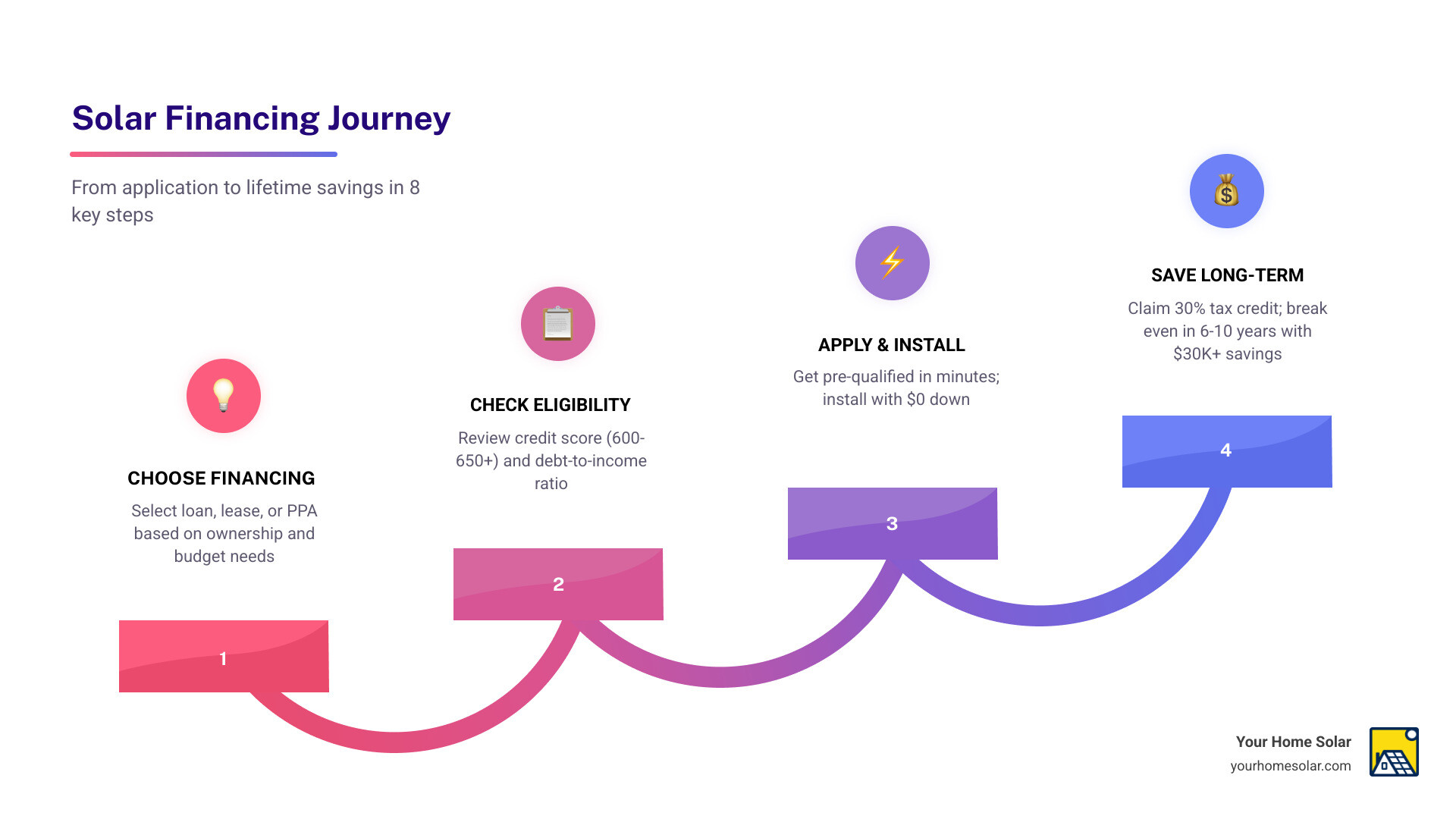
Solar loans are the most popular choice for a reason: they allow you to own the asset. When you own the system, you get to keep the 30% federal tax credit, and you eventually reach a point where the loan is paid off, leaving you with decades of free electricity. Many lenders offer $0-down options with terms ranging from 5 to 25 years. APRs typically fall between 2.99% and 7.99%, depending on your credit profile.
One thing to watch out for is “re-amortization.” Some solar loans assume you will take your 30% tax credit check and pay down the principal within the first 18 months. If you don’t, your monthly payment might jump up. We always recommend asking how you pay for solar panels in a way that aligns with your long-term tax planning.
Solar Leases and PPAs
If you aren’t interested in maintenance or don’t have enough tax liability to use the federal credit, a lease or Power Purchase Agreement (PPA) might be the right fit. In these models, a third party owns the panels on your roof. You either pay a fixed monthly “rent” (lease) or a set rate for every kilowatt-hour the panels produce (PPA).
The upside? The provider handles all repairs and performance monitoring. The downside? You don’t get the tax credit, and these agreements often include “escalators”—small annual increases in your payment rate (usually 1-3%).
Key Benefits of Interest-Free Affordable Solar Financing
Nothing beats “free money.” Interest-free or low-interest programs are the gold standard of affordable solar financing. By eliminating interest, every dollar you pay goes straight toward the principal, drastically shortening your “break-even” point.
- Immediate Cash Flow: Without interest eating into your savings, your monthly energy bill reduction often exceeds the loan payment immediately.
- Debt-to-Income Stability: Lower interest rates mean lower monthly obligations, making it easier to qualify for other life necessities like a mortgage or car loan.
- Maximized ROI: Over the 25-to-30-year lifespan of a solar array, avoiding interest can save you $10,000 to $20,000 compared to a high-interest personal loan.
To see how these financial benefits stack up with government “carrots,” check out our breakdown of Incentives and Tax Credits for Solar Systems.
Comparing Ownership Loans vs. Third-Party Leases
Deciding between owning and leasing is the biggest fork in the road. Here is how we break it down for our neighbors in Knoxville and Sevierville:
- Asset Ownership: With a loan, the panels are yours. They add roughly 4% to your home’s value—about $16,000 on a $400,000 home. With a lease, the panels belong to the company, which can sometimes complicate a home sale if the buyer doesn’t want to take over the lease.
- Maintenance: Owners are responsible for the system, though most modern panels come with 25-year warranties that cover almost everything. Lessees enjoy a hands-off experience where the provider fixes everything.
- Tax Credits: This is the big one. Owners get the 30% federal credit. In a lease, the provider keeps the credit, though they usually pass some of those savings to you through a lower monthly rate.
Government Programs and Interest-Free Initiatives
While many programs are regional, the federal landscape provides a strong foundation for affordable solar financing. In the past, programs like the Canada Greener Homes Loan offered up to $40,000 interest-free for 10 years, showing just how much government support can move the needle. While that specific program has closed to new applicants as of late 2025, it set a precedent for the types of low-barrier entry points we look for.
For those in unique housing situations, such as Multi-Unit Residential Buildings (MURBs), there are often additional requirements or specific windows of opportunity to apply for green energy funding. Similarly, residents in specific regions like Quebec have historically followed detailed retrofit steps to secure government backing.
Maximizing the 30% Federal Investment Tax Credit (ITC)
The single most important piece of the affordable solar financing puzzle in the U.S. is the Residential Clean Energy Credit. This allows you to deduct 30% of the cost of your solar system from your federal income taxes.
- Average Savings: On a $30,000 system, that is a $9,000 direct credit.
- No Cap: There is no maximum limit on the credit amount.
- Carry-Forward: If you don’t owe enough in taxes this year to use the whole credit, you can “roll it over” to future years.
- Expiration: The 30% rate is locked in through 2032. It drops to 26% in 2033 and 22% in 2034.
We encourage all our clients to review the Tax Credits & Incentives page to ensure they are getting every penny they deserve.
Regional Incentives and Affordable Solar Financing in Tennessee
Tennessee offers a unique landscape for solar. While we don’t have a state-wide income tax credit, we have other ways to make solar “pencil out.”
Local utility providers, particularly those under the TVA (Tennessee Valley Authority) umbrella, often have specific programs for renewable energy. Furthermore, Tennessee law provides property tax exemptions for the value added by a solar system. This means that while your home’s value goes up by 4%, your property taxes don’t have to!
For a deep dive into local opportunities, see our Solar Incentives Tennessee 2026 Guide or look at specific opportunities for Affordable Solar Installation in Knoxville, TN.
Navigating Credit Requirements and Application Processes

Getting approved for affordable solar financing is faster than it used to be. Most modern solar lenders offer “instant pre-qualification” that doesn’t affect your credit score.
What You Need for Approval
- Credit Score: Most lenders look for a score of 650 or higher, though some specialized programs can go as low as 600.
- Debt-to-Income (DTI): Lenders generally want to see that your total monthly debt payments (including the new solar loan) don’t exceed 44% of your gross monthly income.
- Documentation: Usually, a photo ID and a recent utility bill are all you need. If you’re going for a larger or secured loan, they might ask for a property tax bill or proof of income.
Financing for Low-Income Households and Renters
We believe energy independence should be for everyone, but we recognize that traditional financing has barriers. For the one-third of Canadians and Americans who are renters, installing panels on a roof you don’t own is rarely an option.
However, new models are emerging to fight “energy poverty”:
- On-Bill Repayment: Some utilities allow you to finance energy upgrades and pay them back through your monthly bill.
- PAYS (Pay-As-You-Save): This model ensures your monthly payment is always less than the money you save on electricity.
- Inclusive Frameworks: Organizations are working on an Inclusive Solar Finance Framework to help those with lower credit scores access the same savings as everyone else.
Community Solar: Affordable Access Without Installation
If your roof is too shaded or you live in an apartment in Maryville or Johnson City, community solar is your best friend. In this model, you “subscribe” to a share of a large solar farm located elsewhere in the community.
You receive credits on your electric bill for the power your share produces. It requires no installation, no maintenance, and often has no long-term contract. It’s a fantastic way to access affordable solar financing benefits without the hardware. You can learn more about how this interacts with net metering and consumer protection to ensure you’re getting a fair deal.
Protecting Your Investment: Risks and Long-Term Value
Going solar is an investment, and like any investment, you need to watch out for the fine print. While affordable solar financing is generally safe, there are “red flags” to avoid:
- Dealer Markups: Some lenders charge the installer a “dealer fee” to offer low interest rates. This fee (often 10-30%) is usually added to your loan principal. Always compare the “cash price” vs. the “financed price” to see the true cost.
- Escalator Clauses: In leases, a 3% annual increase might seem small, but over 20 years, your $100 payment could grow to $180.
- Prepayment Penalties: Avoid loans that punish you for paying them off early. Most reputable solar loans are “open,” meaning you can pay them off whenever you want.
When done right, solar significantly boosts your home’s appeal. Prospective buyers love the idea of a $0 or $20 electric bill. For more on the local impact, read about Solar Home Energy Financing in East Tennessee.
Frequently Asked Questions about Solar Funding
Is the Canada Greener Homes Loan still available for new applicants?
No, the Canada Greener Homes Loan (CGHL) officially closed to new applications on October 1, 2025. The program was so successful that funding was fully allocated earlier than expected. However, those who were already in the portal before the deadline can still proceed with their retrofits and funding draws.
What credit score is typically needed for solar loan approval?
Most premium lenders look for a FICO score of 650 or higher. However, there are “sub-prime” solar lenders and government-backed PACE (Property Assessed Clean Energy) programs in some areas that can work with scores as low as 580-600.
How do solar panels impact my home’s resale value and property taxes?
On average, solar panels increase a home’s value by about 4%. In Tennessee, we are fortunate that state law generally prevents this increase in value from resulting in higher property tax assessments for a certain period, allowing you to enjoy the equity without the extra tax bill.
Conclusion
At Your Home Solar, we’ve spent years helping our neighbors across East Tennessee—from the bustling streets of Knoxville to the quiet hills of Roane and Anderson Counties—navigate renewable energy. We know that the technical side of solar is exciting, but the financial side is what makes it a reality.
Our mission is to provide tailored, reliable, and rewarding installations that leave you 100% satisfied. Whether you are looking for a $0-down loan to maximize your tax credits or want to explore backup power options like generators and EV chargers, we are here to help.
Don’t let the upfront cost of energy independence hold you back. Let’s find a plan that fits your budget and secures your family’s future. Start your affordable solar journey today with a free, no-pressure consultation.