
Why Electric Vehicle Charging Home Matters for East Tennessee Drivers
Electric vehicle charging home is simpler than most people think—and it’s quickly becoming the most convenient, cost-effective way to power your EV. Here’s what you need to know:
Quick Answer: Home EV Charging Options
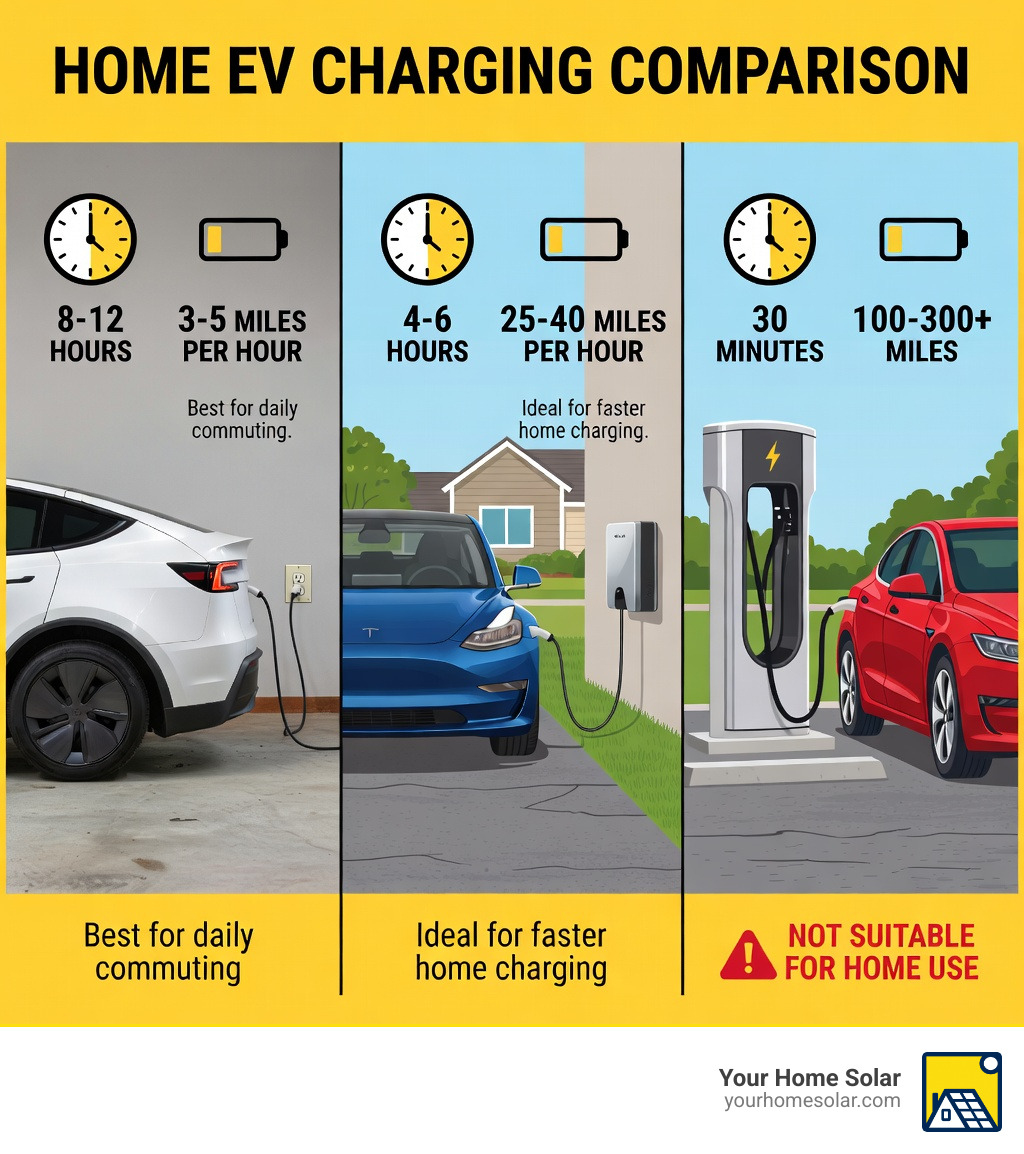
- Level 1 (Standard Outlet): Plug into any 120V outlet, adds 3-5 miles per hour—sufficient for many daily commutes when charging overnight
- Level 2 (Dedicated Charger): Uses 240V circuit, adds 25-40 miles per hour—ideal for longer drives and faster turnaround
- Cost: Equipment runs $400-$1,000, installation $300-$2,000, with federal tax credits covering up to 30% (capped at $1,000)
- Installation: Requires electrician assessment, possible panel upgrade, permits, and safety-certified equipment
Most EV drivers charge at home overnight using either a standard outlet or a dedicated 240V charger. Around 80% of all EV charging happens at home, making it the primary refueling method for electric vehicles. The process is similar to charging your phone—you plug in when you get home, and you wake up with a full charge.
Home charging costs roughly one-third of what you’d pay at public DC fast chargers, and if you charge during off-peak hours, the savings increase even more. For East Tennessee homeowners already dealing with high energy bills and frequent power outages, pairing home EV charging with solar panels can dramatically reduce your transportation and energy costs while building long-term resilience.
I’m Ernie Bussell, founder and CEO of Your Home Solar, and I’ve helped hundreds of East Tennessee homeowners integrate comprehensive energy solutions including electric vehicle charging home setups paired with solar systems. With my background in operations management within the solar and energy sector, I understand how to design charging solutions that work with your home’s existing electrical capacity and future energy goals.
Understanding Charging Levels and Speed
When we talk about electric vehicle charging home, we generally refer to two distinct “levels” of power. The distinction is crucial because it dictates how long your car sits in the garage before it’s ready for the road.
Level 1: The “Trickle” Charge
Level 1 charging uses a standard 120-volt household outlet—the same one you use for your toaster or coffee maker. Most EVs come with a portable Level 1 cord set. While it is the most accessible option, it is also the slowest. You can expect to gain about 3 to 5 miles of range per hour of charging.
If you drive less than 40 miles a day, Level 1 might actually be enough for you. You plug in at 6:00 PM, and by 8:00 AM the next morning, you’ve regained about 50 miles of range. However, if you have a long commute from Maryville to Knoxville or frequently head out on weekend trips to the Smokies, Level 1 will likely leave you with “range anxiety.”
Level 2: The Gold Standard for Home
Level 2 charging uses a 240-volt circuit, similar to what powers your clothes dryer or electric oven. This is where electric vehicle charging home becomes truly efficient. Level 2 equipment (often called EVSE, or Electric Vehicle Supply Equipment) provides about 25 to 40 miles of range per hour.
Instead of waiting days for a full charge, a Level 2 station can typically top off an empty battery in 4 to 8 hours. This allows you to take full advantage of scientific research on the levelized cost of charging, which highlights that home charging is significantly more economical than public infrastructure.
| Feature | Level 1 (120V) | Level 2 (240V) |
|---|---|---|
| Voltage | 120V AC | 208V – 240V AC |
| Amperage | 12 – 16 Amps | 16 – 80 Amps (40A common) |
| Charging Speed | 3-5 miles per hour | 25-40 miles per hour |
| Installation Cost | $0 (if outlet exists) | $750 – $2,000+ |
| Best For | Low-mileage drivers | Daily commuters & PHEVs |
Why Level 3 is Not for Home Use
You might hear about Level 3 charging, also known as DC Fast Charging. These are the massive stations you see at rest stops or shopping centers that can charge a car to 80% in 20-30 minutes.
While they sound great, Level 3 chargers are not suitable for residential use. They require massive amounts of industrial-grade high-voltage power (480V+) that residential grids in East Tennessee simply aren’t designed to handle. Installing one would cost tens of thousands of dollars in infrastructure upgrades. Furthermore, frequent use of DC fast charging can accelerate battery degradation due to the heat generated by such high speeds. For home use, Level 2 is the peak of performance and safety.
Planning Your Electric Vehicle Charging Home Setup
Before you buy a charger, we need to look at the “heart” of your home: the electrical panel. Electric vehicle charging home is considered a “continuous load” by the National Electrical Code (NEC Article 625). This means the circuit must be able to handle the full power draw for hours at a time without overheating.
Assessing Electrical Capacity
Most modern homes in areas like Farragut or Johnson City have 200-amp service, which is usually plenty for a Level 2 charger. However, older homes in historic parts of Knoxville might only have 60 or 100-amp service. If your panel is already full with an electric range, AC, and a hot tub, we may need to discuss a panel upgrade or a “smart” load management system that balances power between your appliances and your car.
A dedicated circuit is a must. You cannot share an EV charging circuit with other high-power devices. For a standard 40-amp charger, the NEC requires a 50-amp breaker (the 80% rule for continuous loads). If you’re curious about the specifics for our local area, you can find more info about EV charger installation on our dedicated service page.
Selecting the Best Equipment for Electric Vehicle Charging Home
When shopping for a charger, you’ll see amperage ratings ranging from 16 to 50 amps.
- 40-Amp Chargers: These are the “sweet spot” for most homeowners, providing about 9.6 kW of power.
- Hardwired vs. Plug-in: A plug-in charger (using a NEMA 14-50 outlet) is great if you might move homes in the future. However, hardwiring the unit directly into your electrical system is often more reliable, more aesthetically pleasing, and required for chargers exceeding 40 amps of output.
Always look for ENERGY STAR safety certified equipment. These units are tested for safety and use 40% less energy when in standby mode, saving you even more on your utility bill.
Connector Types and Future-Proofing
Currently, there are two main connector types in North America:
- J1772: The standard for almost every non-Tesla EV.
- NACS (North American Charging Standard): Originally Tesla’s proprietary plug, now being adopted by Ford, GM, Rivian, and others.
If you want to future-proof your home, consider a “Universal” charger. Some modern units feature a built-in adapter that allows you to charge both J1772 and NACS vehicles without fumbling for extra parts. Also, don’t skimp on cable length! We recommend a 25-foot cable to ensure you can reach the charging port regardless of how you park in your garage or driveway.
Installation Costs and Financial Incentives
The cost of setting up electric vehicle charging home can vary. On average, you’ll spend between $400 and $1,000 on the charging unit itself. Electrician fees for a standard installation typically range from $750 to $1,500, depending on the distance from your panel to the garage.
Breaking Down the Costs:
- Permits: Most municipalities in East Tennessee, including Kingsport and Sevierville, require an electrical permit for Level 2 installations. This ensures the work is inspected and safe.
- Panel Upgrades: If your home needs more “juice,” a panel upgrade can add $1,500 to $3,000 to the project.
- Trenching: If you want a charger on a detached garage or a pedestal by the driveway, digging a trench for the conduit will increase labor costs.
Federal and Local Incentives
The good news is that you don’t have to shoulder these costs alone. The Federal 30C Tax Credit currently offers a credit of 30% of the total cost of the hardware and installation (capped at $1,000) for residents in eligible census tracts. This credit is currently set to expire in mid-2026, so now is the time to act.
Additionally, some local utilities in the Tennessee Valley Authority (TVA) network offer rebates or special “Time-of-Use” rates that make charging even cheaper.
Optimizing Electric Vehicle Charging Home with Solar
This is where we at Your Home Solar really get excited. When you pair an EV with solar panels, you are essentially driving on sunshine. Instead of paying the utility company for electricity, your rooftop generates the fuel for your car.
By integrating a smart EV charger installation in Knoxville, you can set your car to charge only when your solar panels are producing excess energy. We also specialize in V2H (Vehicle-to-Home) technology and battery backups. Imagine a scenario where a storm knocks out the power in Oak Ridge—with the right setup, your EV’s massive battery could actually help power your home’s essential lights and refrigerator!
Advanced Features and Smart Charging Management
Modern electric vehicle charging home stations are more than just “dumb” plugs; they are smart appliances. Most high-quality units now feature Wi-Fi connectivity and dedicated mobile apps.
Why You Want a “Smart” Charger:
- Scheduling: You can set your car to start charging at 11:00 PM when electricity rates are at their lowest (off-peak), even if you plugged it in at 5:00 PM.
- Remote Monitoring: Check your charging status from your couch or while you’re at dinner in downtown Knoxville.
- Load Sharing: If you have two EVs, some chargers can talk to each other and split the power from a single circuit, ensuring you don’t trip a breaker while trying to charge both cars overnight.
Safety Standards and Outdoor Installation
Is it safe to charge in the rain? Absolutely. If you plan to install your charger outdoors—perhaps on the side of your house in Morristown—you need to look at the weatherproofing ratings.
- NEMA 3R: Good for rain and sleet.
- NEMA 4 or IP67: Superior protection against heavy rain, snow, and dust.
We also recommend simple maintenance like checking the charging coupler for debris and ensuring the cable is coiled properly on a hook (a garden hose holder works in a pinch!) to prevent people from tripping or driving over the cord.
Frequently Asked Questions about Home EV Charging
Can I charge my EV using a standard household outlet?
Yes, this is called Level 1 charging. While it works, it’s very slow (3-5 miles of range per hour). It’s a great “emergency” option or a viable solution for those with very short daily commutes. However, most of our customers find that the convenience of Level 2 charging—knowing your car is always “full” by morning—is well worth the investment.
Do I need a dedicated electrical circuit or panel upgrade?
For Level 2 charging, you must have a dedicated circuit. You cannot just “split” the power from your dryer. Whether you need a full panel upgrade depends on your home’s current capacity. A standard 200-amp service is usually sufficient, but we always perform a detailed load calculation during our site visits to ensure your home stays safe.
How do I calculate the electricity cost of charging at home?
It’s simpler than it looks!
- Find your electricity rate (e.g., $0.11 per kWh).
- Know your car’s efficiency (e.g., 3 miles per kWh).
- Divide your daily mileage by the efficiency (e.g., 30 miles / 3 = 10 kWh used).
- Multiply by your rate (10 kWh x $0.11 = $1.10 per day).
In this example, driving 30 miles costs you just over a dollar. Compare that to a gas-powered car getting 25 MPG—at $3.00 a gallon, that same 30-mile trip would cost $3.60. Over a year, the savings are massive!
Conclusion
Setting up electric vehicle charging home is one of the best investments you can make for your convenience and your wallet. Whether you are in Knoxville, Maryville, or the Tri-Cities, the shift toward electric mobility is here, and having a reliable, fast way to fuel up at home is the key to enjoying your EV to the fullest.
At Your Home Solar, we pride ourselves on being East Tennessee’s experts in integrated energy. We don’t just “bolt a charger to the wall.” We look at your whole home—from your solar potential to your backup power needs—to create a tailored solution that offers 100% satisfaction. Ready to take the next step toward energy independence? Find the best solar and EV solutions in Tennessee and let us help you power your future.