Understanding the Complete Solar Panel Installation Procedure
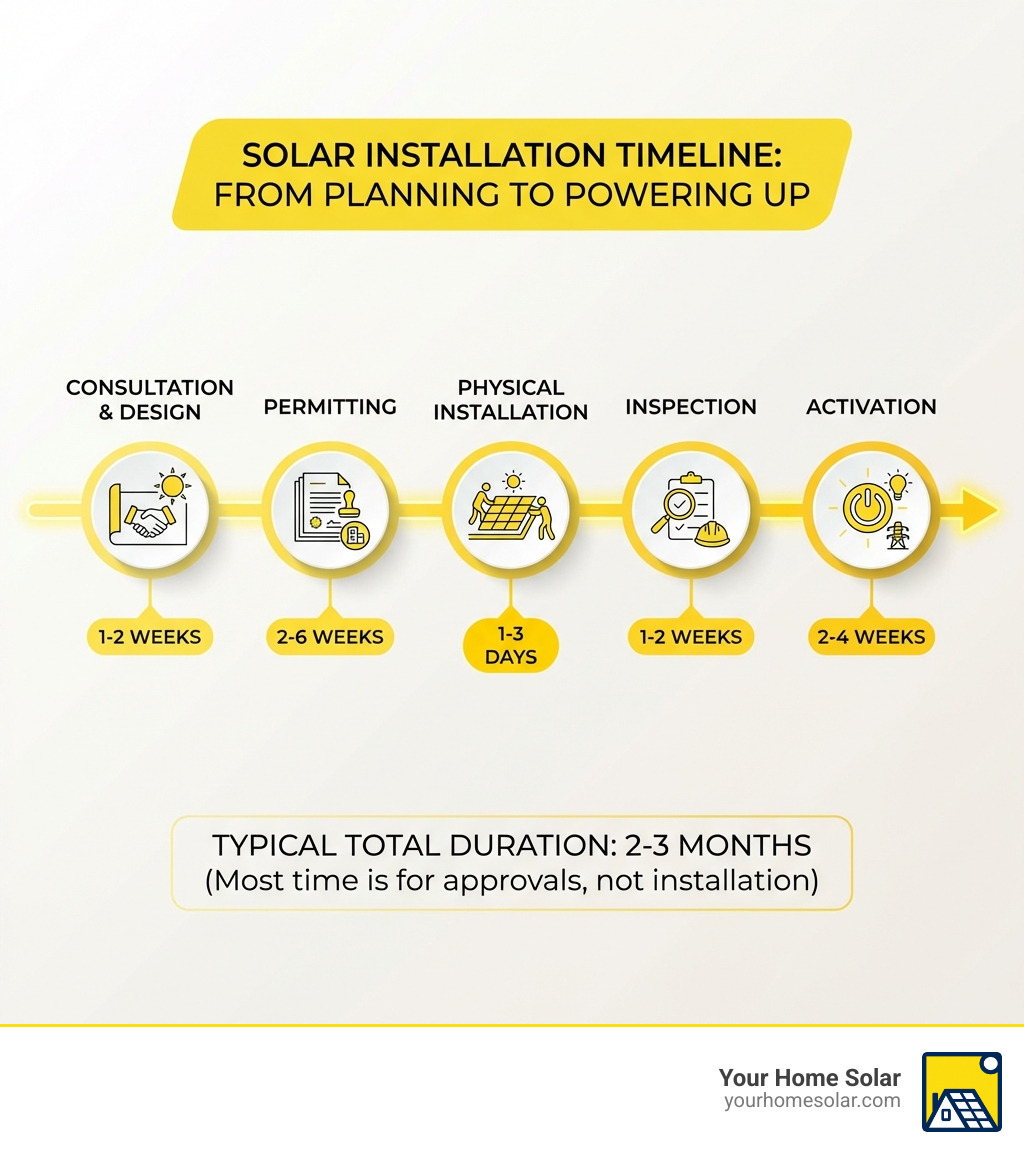
The procedure for solar panel installation follows a structured, multi-phase process that typically takes 2-3 months from start to finish, though the physical installation itself only requires 1-3 days. Here’s what you can expect:
Quick Overview of the Solar Installation Process:
- Planning & Design (1-2 weeks) – Site assessment, system design, and financing selection
- Permitting (2-6 weeks) – Building permits, HOA approval, and utility interconnection applications
- Equipment Ordering (varies) – Solar panels, inverters, and mounting hardware procurement
- Physical Installation (1-3 days) – Mounting racking, installing panels, electrical connections
- Inspection (1-2 weeks) – Local building inspector and utility company review
- Activation (2-4 weeks) – Permission to Operate (PTO) approval and system commissioning
Many East Tennessee homeowners feel overwhelmed when considering solar energy. You’re making a significant investment in your home’s future, and you deserve to understand exactly what happens from your first consultation to the moment your system starts producing clean energy. The good news? While the timeline can seem long, most of that time involves paperwork and approvals—not active work on your home.
The physical installation is surprisingly quick. Professional crews can mount panels, run wiring, and connect your system to your electrical panel in just one to three days. The longer timeline comes from permitting processes, which can range from instantaneous to six or more weeks depending on your local jurisdiction. After installation, you’ll typically wait two weeks to a month for final inspections and utility approval before your system officially goes live.
Why does the process take so long if installation is so quick? The answer lies in the multiple stakeholders involved. Your installer must coordinate with your local building department, your homeowner’s association (if applicable), your utility company, and various inspectors. Each entity has its own timeline and requirements. In East Tennessee specifically, working with a local installer who understands regional requirements and has established relationships with local authorities can significantly smooth this process.
As Ernie Bussell, founder and CEO of Your Home Solar with over three years leading East Tennessee’s #1 solar contractor, I’ve guided hundreds of homeowners through the procedure for solar panel installation from initial consultation to final activation. My background in operations management within the solar industry and hands-on experience with system design has given me deep insight into each phase of this journey.
Phase 1: Planning, Financing, and Design
The first phase of your solar journey is all about understanding your needs, exploring your options, and laying the groundwork for a successful installation. This crucial planning stage ensures your system is perfectly custom to your home and energy goals in East Tennessee.

Our journey with you begins with a thorough site assessment. This initial step is critical to evaluate sunlight exposure, potential shading from trees or neighboring structures, and the overall condition of your roof or chosen installation area. We look for at least 100 square feet of unobstructed roof space, ideally facing south, southeast, or southwest, that receives good sunlight for a minimum of five to six hours daily throughout the year. We’ll also carefully inspect your roof’s age and condition to ensure it can support the solar system’s weight for decades to come. If your roof needs repair or replacement, it’s often best to address this before installation, as a solar array can last 25-30 years or longer, while most roof warranties are for 10-15 years.
Next, we dive into the essential system components. A complete solar energy system typically includes:
- Solar Panels: These convert sunlight into direct current (DC) electricity. While both monocrystalline and polycrystalline panels are available, monocrystalline panels are generally more efficient, though they come at a higher cost. We help you choose the best panels for your energy needs and budget, considering that the most efficient panels can reach efficiency ratings over 22%.
- Inverters: Crucial devices that convert the DC electricity from your panels into alternating current (AC) electricity, which your home appliances use. We’ll discuss options like string inverters or microinverters (mounted on each panel for optimal performance) and their respective warranties (typically 10-12 years).
- Racking and Mounting: The structural framework that securely attaches your solar panels to your roof or ground. These systems are designed to withstand extreme weather and seismic activity, ensuring your panels stay put.
- Battery Storage (Optional): For homeowners interested in energy independence or backup power during outages, we can integrate battery banks into your system. This allows you to store excess solar energy for use when the sun isn’t shining or the grid is down.
As your dedicated solar advisor, our role is to guide you through every decision, ensuring your experience is easy, efficient, and enjoyable. We provide accurate advice, confidently answer technical questions, and set realistic expectations for your solar project, leveraging our hands-on experience and deep understanding of the procedure for solar panel installation.
Choosing Your Financial Path
Understanding your financial options is a key part of the planning phase. Whether you’re in Knoxville, Chattanooga, or any of the surrounding counties in East Tennessee, we help you steer the landscape of solar financing. The main goal is to find a solution that maximizes your savings and aligns with your financial comfort level.
| Feature | Solar Purchase (Cash/Loan) | Solar Lease / Power Purchase Agreement (PPA) |
|---|---|---|
| Ownership | You own the system | Third-party company owns the system |
| Upfront Cost | Higher (cash) or low (loan) | Often $0 or very low |
| Long-Term Savings | Generally highest | Lower than purchasing, but still saves on utility bills |
| Incentives | Eligible for federal tax credits (e.g., 30% ITC) | Not eligible for federal tax credits (owner claims them) |
| Home Value | Increases home value | Minimal impact on home value |
| Maintenance | Your responsibility (or covered by warranty/service plan) | Covered by the third-party company |
| Payment Structure | One-time payment (cash) or monthly loan payments | Fixed monthly lease payment or pay-per-kWh (PPA) |
| Flexibility | More control over system upgrades/changes | Less control, tied to agreement terms |
Cash Purchase: This option typically offers the lowest total cost of ownership over the system’s lifespan. You pay for the system upfront and immediately benefit from reduced or eliminated electricity bills. You also qualify for significant financial incentives.
Solar Loans: For those who prefer not to pay a large upfront sum, solar loans are an excellent option. These function similarly to home improvement loans, and in many cases, your monthly loan payments can be less than your typical energy bill, leading to immediate savings. Federal agencies like the Federal Housing Administration and Fannie Mae offer programs to help finance solar as part of a mortgage.
Federal Tax Credits and Local Incentives: Homeowners who purchase their solar systems are eligible for the federal Solar Investment Tax Credit (ITC), currently 30% of the system’s cost. This is a direct tax credit, not just a deduction, providing substantial savings. While specific local incentives vary across East Tennessee counties like Knox, Blount, or Hamilton, we help you identify any available programs that can further reduce your investment.
Solar leases and Power Purchase Agreements (PPAs) are also available, allowing you to benefit from solar without owning the system or making a large upfront investment. However, with these options, you typically don’t receive the federal tax credit, as the system owner (the leasing company) claims it.
To help you make the most informed decision, we often recommend consulting comprehensive resources like A Homeowner’s Guide to Solar Financing, which explains the advantages and disadvantages of each option in detail.
Finalizing Your System Design
Once we’ve determined the best financial path, we move on to crafting the perfect solar solution for your home. This involves custom system sizing and precise equipment selection.
Our design process begins with a detailed energy consumption analysis. We’ll ask to review 12 months of your electric bills to understand your historical energy usage. This data is crucial for accurately sizing your system, ensuring it meets your needs, whether you’re in a high-consumption family or looking to offset a specific portion of your bill. Families with higher power consumption will naturally require more solar panels.
Next, we focus on equipment selection. We’ll choose the right combination of solar panels and inverters. Modern solar panels are designed to be highly efficient and durable, with product and performance warranties lasting around 25 years. We also consider the best inverter technology for your specific setup. While string inverters are a common choice, microinverters (one per panel) offer advantages in shaded conditions, as the failure of one panel won’t affect the output of others.
Finally, our engineering design team takes over. They perform a crucial structural integrity check of your roof or proposed ground-mount location. This involves assessing the roof’s load capacity, ensuring it can support the additional weight of the solar panels and racking. For new constructions, the EPA’s Renewable Energy Ready Home (RERH) specifications recommend a minimum of 6 lbs/sq. ft. additional dead load capacity. In some cases, an in-person site audit might reveal the need for roof repairs or an electrical panel upgrade before installation can proceed. Our team ensures all designs comply with local building codes and safety regulations in East Tennessee.
The Complete Procedure for Solar Panel Installation: From Paperwork to Panels
With the planning and design complete, we move into the logistical heart of the procedure for solar panel installation: securing approvals and getting the physical work done. This phase often involves more waiting than active work on your property, but our team manages it all for you.

The duration of your entire solar project, from initial design to activation, typically lasts a few weeks to a few months. While the physical installation on your roof usually takes just one to three days, the surrounding permitting process and interconnection agreements with your utility company can extend the timeline. We handle all the necessary coordination with local authorities and utility companies on your behalf, navigating the specific requirements of counties like Knox, Blount, and Hamilton.
Navigating Permits and Interconnection
Before any physical work begins, we must secure several crucial approvals. This includes obtaining building permits and electrical permits from your local jurisdiction. These permits ensure that your solar installation adheres to all safety, structural, and electrical codes.
Simultaneously, we initiate the utility interconnection application process with your local electricity provider. This application is vital because it grants you permission to connect your new solar system to the electrical grid. Without this approval, your system cannot legally operate.
Potential challenges during this phase can include varying timelines for approval. The permitting process can take anywhere from two to four weeks on average, but it might stretch to six weeks or more depending on the efficiency of your local permitting office. Another common hurdle is HOA approval. Many homeowner’s associations have specific rules regarding exterior modifications, and we’ll help you communicate with your HOA to ensure your solar project gets the green light. For more general information on local permitting, you can check resources like Information on local solar permits. Our team’s local expertise in East Tennessee allows us to anticipate and steer these challenges efficiently.
Understanding the Physical Procedure for Solar Panel Installation
Once all permits and agreements are in place, the exciting part begins: the physical installation of your solar array!
- Site Preparation: Our team will prepare the installation area. For roof mounts, this involves ensuring the roof surface is clean and clear of debris. If any minor repairs or cleaning are needed, we’ll address them.
- Mounting the Racking System: This is the foundation of your solar array. We securely attach the racking rails to your roof, typically by locating and marking roof rafters and installing specialized roof attachments. These attachments, such as flashings, are crucial for waterproofing, preventing any leaks where the racking penetrates the roof. Our installers use staggered flashing layouts to ensure structural soundness and prevent water intrusion.
- Installing Solar Panels: With the racking in place, we carefully lift and secure each solar panel onto the rails using clamps. Each panel is checked for proper alignment and security, ensuring it can withstand local weather conditions in East Tennessee. The panels are then wired together in an array, typically in series to create a DC circuit.
- Inverter and Electrical Connection: The DC electricity produced by your panels is then routed to the inverter. If using microinverters, they are mounted directly behind each panel. For string inverters, they are usually located in a designated area, often in your garage or on an exterior wall. The inverter converts the DC power into usable AC power for your home. Our electricians then connect the inverter to your home’s main electrical panel. This step often requires an electrical panel upgrade if your current panel lacks the capacity or available breaker space. We ensure all wiring runs are clean, compliant with codes, and properly managed using conduit.
Safety Precautions and Essential Tools
Safety is our top priority during every procedure for solar panel installation. Our crews are rigorously trained and follow strict protocols to protect themselves, your property, and anyone nearby.
Here are some essential safety measures and tools we use:
- Fall Protection: When working on roofs, our installers use safety harnesses and anchor points to prevent falls.
- Personal Protective Equipment (PPE): This includes hard hats, eye protection, gloves, and closed-toe boots to protect against potential hazards.
- Electrical Safety: Before making any electrical connections to your home’s main panel, the power is safely shut off. Our electricians use insulated tools and multimeters to verify voltage and polarity, ensuring all connections are safe and secure.
- Dig Safety: For ground-mount systems, we always call 811 before any digging begins to locate buried utility lines, preventing accidental damage and ensuring safety.
Our team consists of highly qualified and certified professionals. Many of our installers hold NABCEP (North American Board of Certified Energy Practitioners) certifications, which signify specialized knowledge beyond a standard electrical license. We believe that using local installers, deeply invested in the communities of East Tennessee, provides superior service and a higher level of accountability compared to out-of-state subcontractors.
Phase 3: Inspection, Activation, and Beyond
You’re almost there! Once the physical installation is complete, the final steps involve a series of inspections to ensure everything is up to code, followed by the exciting moment when your system is activated and starts generating clean energy.
Passing Final Inspections
Before your solar system can go live, it must pass several critical inspections. This ensures that the entire procedure for solar panel installation was carried out safely and correctly.
- Local Building Inspector Review: A local building inspector will visit your property to verify that the installation complies with all structural and building codes. This includes checking the racking, panel mounts, and overall integrity of the system.
- Electrical Inspection: An electrical inspector will ensure all wiring, conduits, inverters, and connections meet the National Electrical Code (NEC) and local electrical regulations. They’ll check grounding, circuit breakers, and overall electrical safety.
- Utility Company Inspection: Your local utility provider (e.g., Knoxville Utilities Board, EPB, TVA partners in surrounding counties) will conduct their own inspection. They verify that the system is safely interconnected with the grid and will often install a bi-directional meter. This special meter tracks both the electricity you draw from the grid and the excess solar electricity your system sends back to it, enabling net metering.
- Permission to Operate (PTO): This is the golden ticket! Once all inspections are passed and the utility company gives its final approval, you’ll receive your Permission to Operate (PTO). It’s crucial not to activate your system until you have this official permission to avoid any penalties.
Navigating the Post-Installation Procedure for Solar Panel Installation
Once you have PTO, the real fun begins! We guide you through the final steps to get your system up and running.
- System Commissioning & Activation Process: Our team will walk you through the activation process. This typically involves turning on the PV solar breaker switch, then the AC disconnect, and finally the solar inverter. It’s a quick and exciting moment as your home officially begins to produce its own power!
- Connecting to Monitoring Software: We’ll help you connect your system to our monitoring software or app. This allows you to track your solar production in real-time, see how much energy your home is consuming, and observe your environmental impact. Internet connectivity is required for this real-time data monitoring.
- Understanding Your New Utility Bill & Net Metering: We’ll explain how your new bi-directional meter works and how net metering credits will appear on your utility bill. You’ll see the difference your solar system makes immediately.
Maximizing Your Solar Investment
The procedure for solar panel installation doesn’t end with activation. To ensure you get the most out of your investment for decades to come, a few post-installation steps are recommended.
- System Maintenance: While solar panels require minimal maintenance, periodic inspections and occasional cleaning can help maintain optimal efficiency. We recommend cleaning your panels from time to time, especially after pollen season or heavy dust, to prevent dirt buildup from reducing energy output. You might also consider a service plan for regular professional check-ups.
- Monitoring Performance for Issues: Regularly checking your monitoring app allows you to quickly spot any potential issues, like a dip in production from a specific panel, and address them promptly. Our team is always here to help troubleshoot if anything seems amiss.
- Energy Consumption Habits: Many homeowners find that after going solar, their awareness of energy consumption increases. Monitoring your usage alongside your production can help you optimize your habits and maximize your savings, ensuring you don’t inadvertently use more electricity than your system is designed to offset.
Frequently Asked Questions about the Solar Installation Process
We know you have questions, and we’re here to provide clear, straightforward answers.
How long does the entire solar installation process take?
While the physical installation of solar panels on your roof typically takes just one to three days, the full procedure for solar panel installation, from initial consultation and contract signing to permitting, installation, inspection, and system activation, generally lasts a few weeks to a few months. The permitting process alone can take anywhere from two to six or more weeks, depending on your local jurisdiction in East Tennessee. After the physical installation, it usually takes another two weeks to a month for your system to receive final approval and officially go live.
Will my power be turned off during the installation?
Yes, for safety reasons, your power will need to be shut off for several hours while our electricians connect your new solar system to your home’s main electrical panel and the grid. We always aim to minimize this downtime and will inform you in advance so you can plan accordingly.
Is it better to buy or finance solar panels?
Both options have their advantages. Purchasing a solar system outright (cash or loan) generally offers the greatest long-term savings and makes you eligible for significant financial incentives like the 30% federal tax credit. Ownership also increases your home’s value. If you opt for a solar loan, you can achieve a lower upfront cost, and in many cases, your monthly loan payments will be less than your previous electricity bills, allowing you to save money from day one while still owning the system and receiving those valuable incentives.
Conclusion: Start Your Solar Journey with Confidence
Starting on the procedure for solar panel installation is a significant step towards energy independence and a greener future. We hope this guide has demystified the process, empowering you with the knowledge to make informed decisions. From the initial site assessment and navigating financing options to the physical installation, stringent inspections, and finally, powering up your home, every step is carefully managed.
The long-term benefits of solar are clear: substantial savings on your electricity bills, protection from rising utility rates, increased home value, and a positive environmental impact. At Your Home Solar, we pride ourselves on trusted expertise and 100% customer satisfaction. We are your local East Tennessee partner, committed to delivering custom, reliable, and rewarding solar installations.
Ready to take the next step? Learn more about our process and connect with one of our solar experts today. We’re here to make your solar journey seamless and successful.