
Why Understanding the 240 Volt Outlet for Electric Car Cost Matters
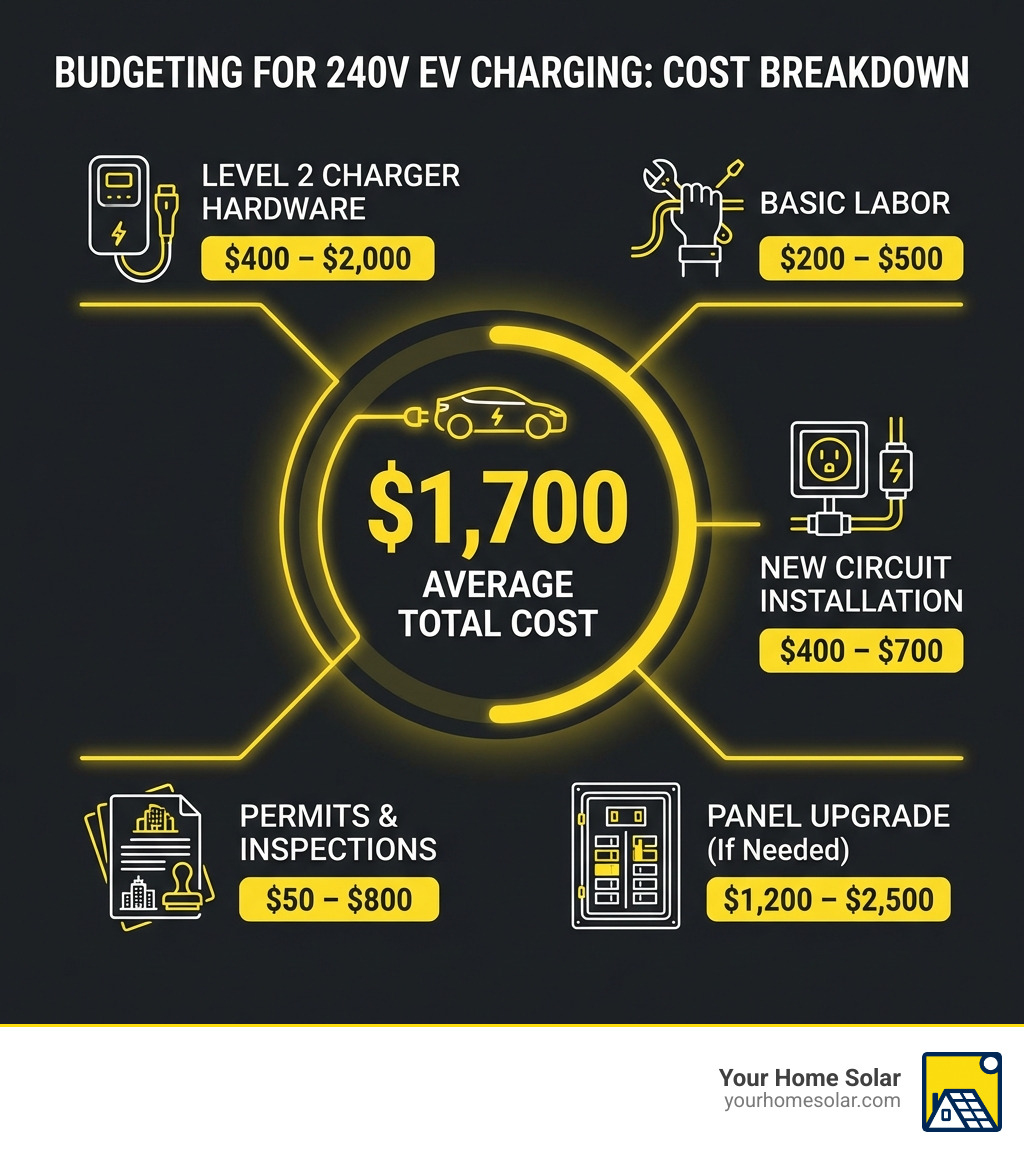
The 240 volt outlet for electric car cost typically ranges from $800 to $2,500, with most homeowners paying around $1,700 for a standard installation. This includes the charger hardware, electrician labor, permits, and inspections. However, your final cost depends on several factors:
- Charger hardware: $400-$2,000
- Basic labor (existing 240V circuit): $200-$500
- New circuit installation (up to 30 ft): $400-$700
- Panel upgrade (if needed): $1,200-$2,500
- Permits and inspections: $50-$800
If you’ve recently made the switch to an electric vehicle—or you’re considering one—you’re probably wondering what it’ll actually cost to charge at home. A standard 120-volt outlet won’t cut it for most drivers. You need a dedicated 240-volt circuit and Level 2 charger to make home charging practical for daily use.
The good news? Installing a 240-volt outlet for your EV is a one-time investment that pays for itself quickly. Home charging costs about $0.13 per kWh compared to $0.45 per kWh at public DC fast chargers. For a driver covering 15,000 miles per year, that’s roughly $1,440 in annual savings. Plus, federal tax credits and utility rebates can reduce your upfront costs by $200 to $1,000 or more.
But installation costs vary widely. The distance from your electrical panel to your garage, whether your home needs a panel upgrade, and local permit fees all play a role. Understanding these variables helps you budget accurately and avoid surprises.
I’m Ernie Bussell, founder and CEO of Your Home Solar, and I’ve spent years helping East Tennessee homeowners steer home energy decisions, including understanding the 240 volt outlet for electric car cost and installation process. After leading operations for a $40 million solar company and guiding hundreds of families through energy upgrades, I know how to break down complex electrical projects into clear, actionable steps.
Level 1 vs. Level 2 Charging: What’s the Difference?
When we talk about home EV charging, you’ll often hear about Level 1 and Level 2. Think of them as different speeds of filling up your car’s “gas tank” – or, in this case, its battery!
A Level 1 charger is essentially your standard 120-volt outlet, the same one you use for your toaster or phone charger. It’s the simplest option, requiring no special installation beyond plugging in. However, it’s also the slowest, providing only about 3-5 miles of range per hour. This means if you have a typical EV with a 200-300 mile range, a full charge could take over 40 hours. While it might be adequate for drivers with very short daily commutes (under 30 miles), most of us need something faster.
Enter the Level 2 charger. This is where the magic happens for home charging. A Level 2 charger requires a dedicated 240-volt outlet, similar to what your electric dryer or oven uses. But don’t confuse the two; while they both use 240V, EV chargers often demand continuous high power, requiring higher quality materials and dedicated circuits. This powerful setup delivers a much faster charging speed, typically adding 25-30 miles of range per hour. That’s five to seven times faster than Level 1, making it the preferred option for most EV drivers in East Tennessee.
The installation of an EV charger, particularly a Level 2 unit, involves several steps. First, an electrician will assess your home’s electrical panel to ensure it has sufficient capacity. Then, they’ll run new wiring from the panel to your chosen charging location, install the 240-volt outlet, and finally, install the charging station itself. Permitting and inspections are also a crucial part of this process to ensure safety and compliance with local codes.
Why Level 2 is the Home Charging Sweet Spot
For most EV owners, a Level 2 charger isn’t just a convenience; it’s a necessity. Here’s why we consider it the home charging sweet spot:
- Daily Commute Needs: If your daily drive takes up more than a few miles, a Level 1 charger simply can’t replenish your battery fast enough overnight. A Level 2 charger ensures you wake up every morning with a full—or nearly full—charge, ready for whatever the day brings, whether it’s navigating Knoxville traffic or heading out to the Great Smoky Mountains.
- Future-Proofing: As battery technology advances and EVs offer longer ranges, charging times will only increase on slower chargers. Investing in a Level 2 charger now future-proofs your home for your current EV and any future electric vehicles you might own.
- Maximizing Off-Peak Rates: Many utility companies in East Tennessee offer time-of-use (TOU) electricity plans, where rates are lower during off-peak hours (usually overnight). With a Level 2 charger, you can fully charge your EV during these cheaper hours, saving you significant money compared to charging during the day or at public stations.
- Increased Home Value: As EV adoption continues to soar, a home equipped with a Level 2 charging station becomes a more attractive asset. It’s a modern amenity that adds tangible value and appeal to your property.
Breaking Down the 240 Volt Outlet for Electric Car Cost
Understanding the 240 volt outlet for electric car cost means looking beyond just the price tag of the charger itself. It’s a comprehensive project that involves several key components, each contributing to the final expense.
The complexity of your home’s existing electrical system and the desired location of your charging station are major cost variables. For instance, running wire through an unfinished basement is far simpler and cheaper than fishing it behind finished walls, through a crawl space, or even underground to a detached garage.
Nationally, the average EV charger installation, including the charger itself, falls between $800 and $2,500. Let’s dive deeper into what makes up this range.
What is the Average 240 Volt Outlet for Electric Car Cost?
As we mentioned, the average cost to install a Level 2 EV charger, which inherently includes the 240 volt outlet for electric car cost, is around $1,700. However, this can fluctuate significantly based on your specific situation.
- Basic Installation Cost: If you’re lucky enough to have an existing 240-volt circuit nearby that can handle the load, or if your electrical panel is conveniently located right next to your parking spot, your costs could be as low as $550-$1,400. A basic Level 2 install with an existing 240V outlet might only cost $200-$500 for electrician labor.
- Complex Installation Cost: On the other hand, if your home is older, your panel needs an upgrade, or the charging spot is far from your electrical panel, pushing the total cost to $1,500-$3,000+. For example, a new 240V circuit run of up to 30 feet, including materials, typically costs $400-$700.
The key factors influencing your overall 240 volt outlet for electric car cost include the price of the charger hardware, labor rates for electricians, the need for electrical panel upgrades, and any necessary permits and inspections.
Hardware Costs: The Charger and Outlet
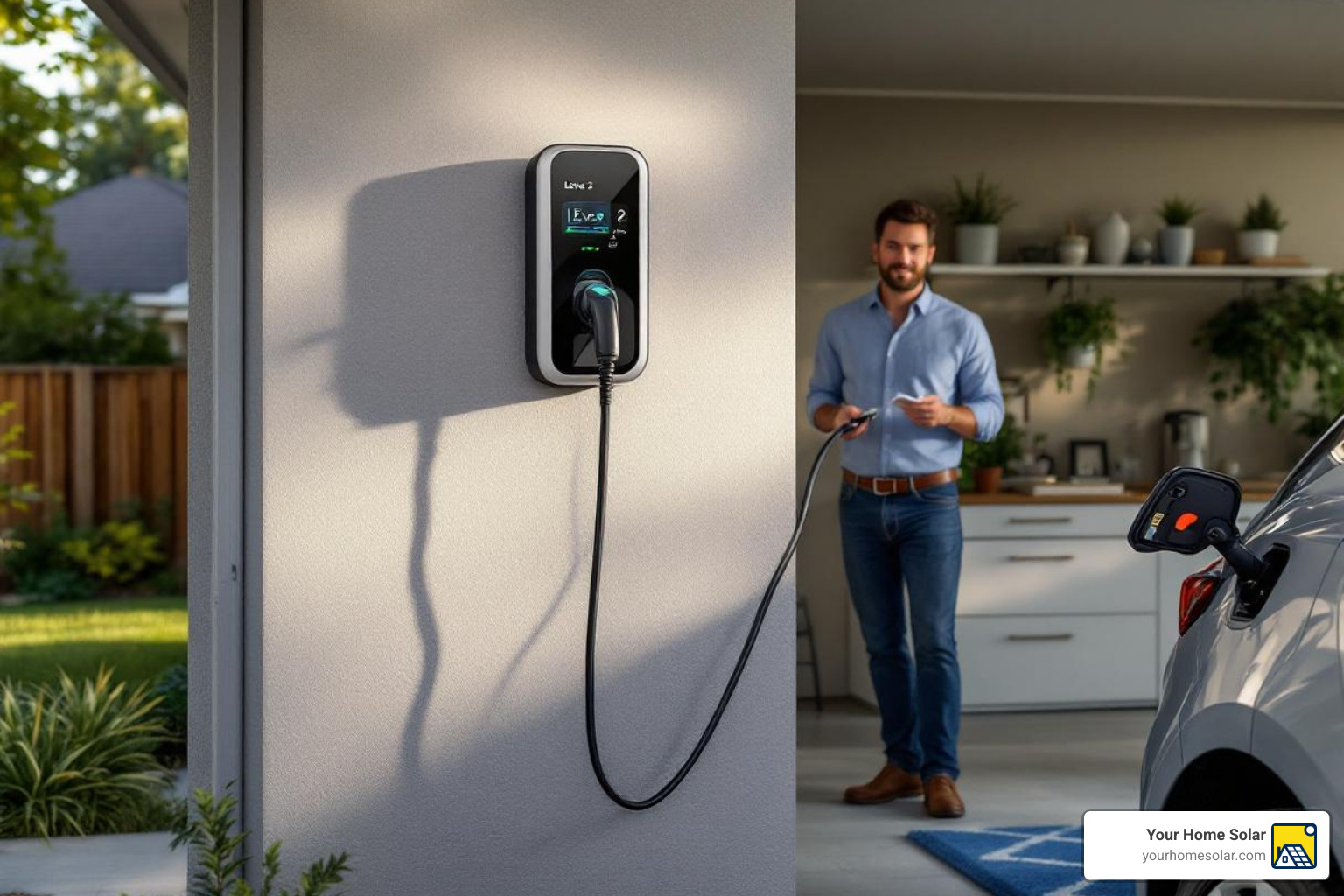
The heart of your home charging setup is the Level 2 charger itself, also known as Electric Vehicle Supply Equipment (EVSE). These units typically range from $400 to almost $2,000. The price depends on brand, charging speed (amperage), and smart features.
Most Level 2 chargers either plug into a NEMA 14-50 outlet or are hardwired directly into your home’s electrical system. A NEMA 14-50 outlet for plug-in installs costs about $15-$40 for the physical outlet itself. Hardwired units might have a slightly higher labor cost for installation but can sometimes allow for safely charging at faster maximum speeds than an outlet can safely deliver, offering a cleaner aesthetic.
When choosing a charger, consider:
- Amperage Options: Common amperages are 32A, 40A, 48A, and even 80A. Higher amperage means faster charging. A 40A breaker and wiring for a Level 2 charger can cost $40-$120 for the materials.
- Smart Features: Many modern chargers offer Wi-Fi connectivity, app control, and scheduling features. These add approximately $75 to the hardware cost but can be invaluable for taking advantage of off-peak electricity rates.
- Safety Certifications: Always choose safety-certified EV chargers from reputable brands with multi-year warranties. This is crucial for equipment that handles continuous high-power usage.
We always recommend choosing a charger with sufficient amperage for your needs, considering cable length (25 feet is often ideal for flexibility), and features like cable management. For detailed tips on selecting the best unit, Consumer Reports offers an excellent guide.
Installation & Labor Costs
This is often the largest variable in your 240 volt outlet for electric car cost. Electrician labor rates can vary depending on your location within East Tennessee, but generally, you can expect to pay for a few hours of skilled work. While hourly rates can range from $70 to over $110 depending on the area, we provide competitive and transparent pricing for our certified installations, ensuring you receive a clear and fair estimate.
Key factors that influence labor costs include:
- Distance from Panel: The further your desired charging location is from your main electrical panel, the more wiring will be needed, and the more labor will be involved. A 60-foot run will naturally cost more than a 15-foot run.
- Wire Routing: This is a big one. Running wire through an unfinished basement or along an easily accessible path is straightforward. However, fishing wire behind finished walls, through crawl spaces, or burying it underground to a detached garage or outdoor pedestal requires significantly more time, skill, and therefore, labor. Trenching for wiring alone can add hundreds of dollars to your installation costs.
- Conduit Costs: If the wiring needs to be protected in conduit (e.g., exposed runs, outdoor installations), this adds both material and labor costs. Long conduit runs (over 50 feet) can add $5-$8 per foot.
- Amperage Requirements: Higher amperage chargers require thicker gauge wiring, such as #6 AWG copper for 48-50A chargers, which can be about 20% pricier than wiring for lower amperage units.
Our certified electricians are experts in efficient and safe wire routing, ensuring your installation meets all local codes in Knoxville, Maryville, Oak Ridge, and throughout East Tennessee.
The Hidden Costs: Panel Upgrades, Permits, and Inspections
Sometimes, the primary cost isn’t just the charger or the wiring, but an essential upgrade to your home’s electrical infrastructure.
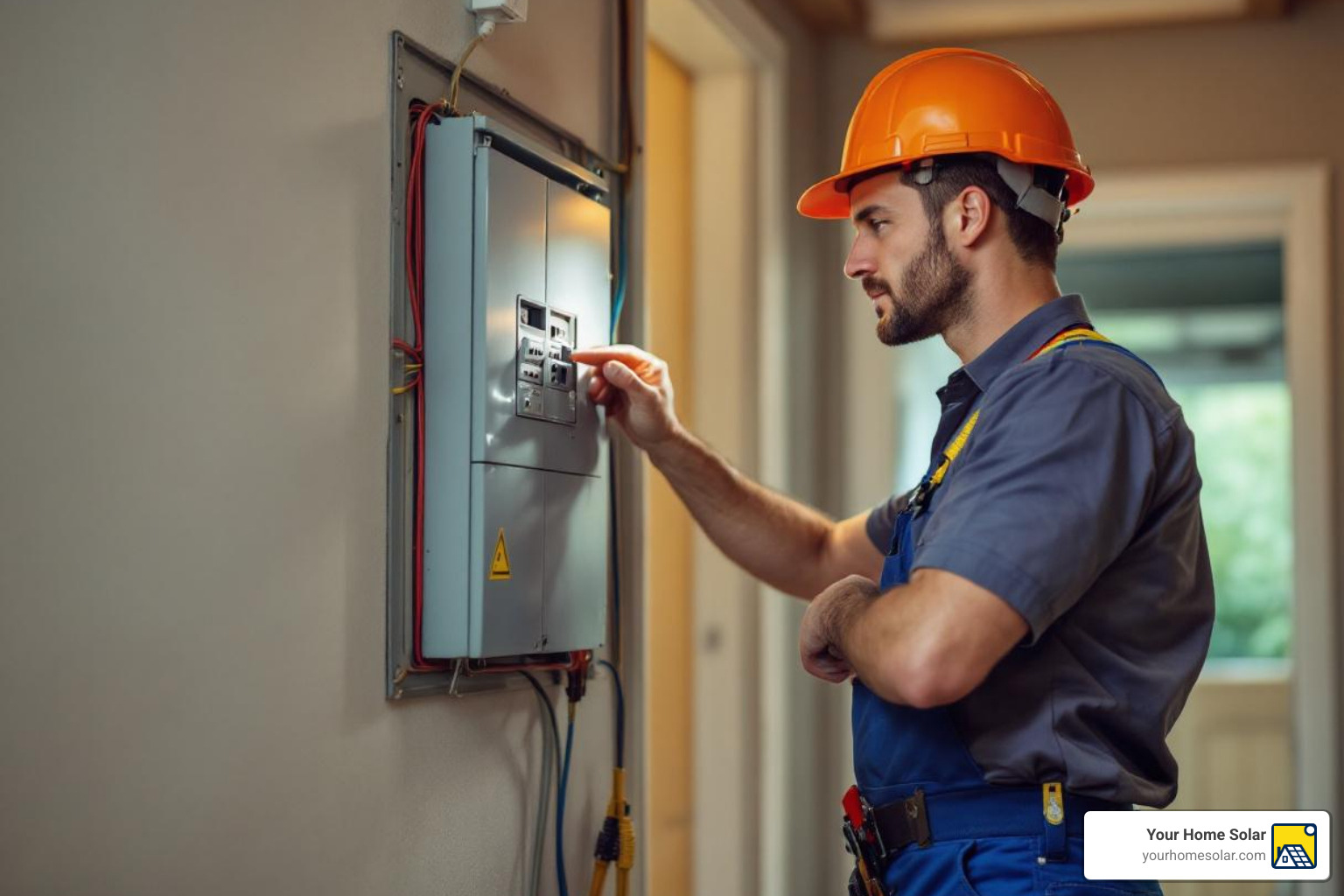
- Electrical Panel Capacity: Your home’s electrical panel is like the heart of its power system. An EV charger, especially a Level 2 unit, draws a significant amount of power continuously. Before any installation, a licensed electrician will perform a load calculation to determine if your existing panel can safely handle the additional demand. Older homes in our region might have 100-amp panels (or even 60- or 30-amp), which may be insufficient for a Level 2 charger without risking tripping breakers or overloading the system. Even newer panels need assessment to ensure they can manage the total electrical usage, especially if you have other high-demand appliances.
- Panel Upgrade Cost: If your panel can’t handle the load, you’ll need an upgrade. This typically involves replacing your existing electrical panel with a higher capacity one (e.g., from 100 A to 200 A). Panel upgrades can be a substantial part of the 240 volt outlet for electric car cost, ranging from $1,200-$2,500. While this adds to the upfront expense, it’s a valuable home improvement that increases your electrical capacity for all your needs.
- Permit Fees: We can’t stress this enough: always get a permit! Installing a new EV charging circuit or hardwiring a station, especially with electrical upgrades, almost always requires a permit. These permits ensure the work is done safely and to code. Permitting and regulatory costs for charging equipment installation can range from $50 to $800, with an average of $310. These fees vary by city and county within East Tennessee.
- Inspection Requirements: After the installation is complete, a local electrical inspector will typically examine the work to ensure it complies with all safety standards and local codes. This inspection is usually covered by the permit fees but is a critical step in ensuring your home and family are safe.
Ignoring permits or inspections can lead to significant problems down the road, including safety hazards, difficulty selling your home, and voided insurance claims. We handle all necessary permits and coordinate inspections to provide you with peace of mind.
Maximizing Your Investment: ROI, Savings, and Incentives
While the initial 240 volt outlet for electric car cost can seem like a significant investment, it’s one that offers substantial long-term returns. Beyond the convenience, you’ll find real financial benefits and an increase in your property’s value.
Calculating Your Savings: Home vs. Public Charging
The most compelling argument for installing a home EV charger is the dramatic savings on fuel costs. Let’s look at the numbers:
- Average Home Electricity Cost: According to the United States Energy Information Administration, U.S. households paid an average of 17.98 cents per kWh in September 2023. This is slightly higher than the $0.13/kWh average cited in some research, but still significantly lower than public options. For our calculations, we’ll use a conservative average of $0.13/kWh for home charging, knowing that rates can vary by utility and time of day in East Tennessee.
- Public DC Fast Charger Cost: Public DC fast chargers, while convenient for road trips, are considerably more expensive. They average around $0.45/kWh, but can go as high as $0.64/kWh or more depending on the network and location.
- Annual Savings Calculation: Let’s consider an EV owner driving 15,000 miles per year, with an average energy consumption of 0.30 kWh/mile.
- Total annual energy needed: 15,000 miles * 0.30 kWh/mile = 4,500 kWh.
- Cost at home: 4,500 kWh * $0.13/kWh = $585 per year.
- Cost at public DC fast charger: 4,500 kWh * $0.45/kWh = $2,025 per year.
- Annual Savings: $2,025 – $585 = $1,440 per year.
This means that a Level 2 charger installation, even at the higher end of the average cost, can pay for itself in under 12 months simply through charging cost savings!
To put it in perspective, the average EV uses around 11.81 kWh per day to replenish the range driven. This translates to about 353.3 kWh per month and 4,310.65 kWh per year. With an average electricity rate of 16 cents per kWh, that’s roughly $1.92 a day or $56 a month. Compare this to the average gasoline car, which can cost about $145 a month for fuel. The savings are clear.
| Charging Method | Average Cost per kWh | Annual Cost (15,000 miles) | Monthly Cost |
|---|---|---|---|
| Home EV Charging | $0.13 | $585 | $48.75 |
| Public DC Fast Charging | $0.45 | $2,025 | $168.75 |
| Gasoline (30 MPG, $2.86/gal) | N/A | $1,430 | $119.17 |
Open uping Financial Perks: Tax Credits and Rebates
We love helping our East Tennessee customers save money, and thankfully, there are often incentives available to lower your 240 volt outlet for electric car cost.
- Federal Tax Credit (IRC 30C): The federal tax credit for alternative fuel vehicle refueling property (which includes EV chargers) offers 30% of the charger and installation costs, up to a maximum of $1,000. This credit is available through 2032, so you have plenty of time to take advantage of it. Remember to claim this on your tax return.
- State and Utility Incentives: While specific state incentives vary and aren’t always directly applicable to East Tennessee, utility rebates are often available. Many local utility companies offer programs that can lower the net cost of EV charger installation by $200 to $1,000. These programs are constantly changing, so we always recommend checking with your local provider (e.g., Knoxville Utilities Board, TVA, etc.) for current offerings.
Here’s a list of potential financial incentives to look out for:
- Federal Tax Credit (IRC 30C)
- State-level rebates or grants (check Tennessee state energy office websites)
- Local utility company rebates (contact your specific East Tennessee provider)
- Manufacturer incentives on specific EVSE units
By stacking these incentives, you can significantly reduce your upfront investment, making your home charging setup even more affordable.
DIY vs. Professional Installation: A Safety-First Approach
When it comes to installing a 240 volt outlet for electric car cost, the idea of a DIY project might cross your mind to save a few bucks. However, we strongly advise against it. This is not a project for the inexperienced.
The risks associated with DIY electrical work, especially involving high-voltage circuits, are significant:
- Electrical Code Violations: Electrical codes are complex and vary by locality. Without expert knowledge, you risk violating these codes, which can lead to fines, difficulties with home insurance, or issues when selling your property.
- Fire Hazards: Improper wiring, incorrect breaker sizing, or inadequate grounding can create severe fire hazards, putting your home and family at risk. Level 2 EV chargers draw continuous high power for many hours, demanding precise installation.
- Voided Warranties: Many EV charger manufacturers and even home insurers require professional installation by a licensed electrician to maintain product warranties and electrical system coverage. DIY work can void these protections.
- Personal Injury: Working with 240 volts is dangerous and can lead to severe injury or electrocution.
Professional installation, on the other hand, ensures safety, compliance, and peace of mind. Our licensed electricians are experienced in EV charger installations specifically. We understand the nuances of load calculations, proper wiring, and local permitting requirements in East Tennessee. We prioritize safety above all else, ensuring your EV charging station is installed correctly and efficiently.
For more information on how we ensure a seamless and safe setup, explore our page on Smart EV Charger Installation in Knoxville.
Frequently Asked Questions about EV Charger Installation
We get a lot of great questions from homeowners in East Tennessee about setting up their EV charging stations. Here are some of the most common ones:
Can I use my existing dryer outlet to charge my EV?
This is a popular question, and the answer is: maybe, but with significant caveats.
Yes, a dryer outlet is a 240-volt outlet, which is what a Level 2 EV charger needs. However, there are crucial considerations:
- Dedicated Circuit Requirement: EV chargers draw continuous power for many hours. Your dryer circuit might not be “dedicated” and could be shared with other appliances, potentially leading to overloads.
- Breaker Size: Your dryer circuit’s breaker size might not match the requirements of your EV charger. An EV charger designed to manage 80 amps, for instance, requires a 100-amp breaker to adhere to the 80% continuous load rule.
- Load Capacity: Even if it’s a dedicated circuit, a professional load calculation is essential to ensure your home’s entire electrical system can handle both your dryer and the EV charger (not simultaneously, but the overall potential draw).
- NEMA Plug Compatibility: Dryer outlets typically use a NEMA 14-30 or NEMA 10-30 plug, while most EV chargers that plug in use a NEMA 14-50. You might need an adapter, but this can introduce additional risks if not properly managed.
While it might seem like a quick fix, we highly recommend a professional assessment. An electrician can determine if your dryer outlet and circuit can be safely used or adapted for EV charging, or if a new dedicated circuit is necessary.
How does the choice of charger influence the installation cost?
The charger you choose plays a direct role in your overall 240 volt outlet for electric car cost.
- Amperage Requirements: As discussed, higher amperage chargers require heavier gauge wiring. For example, a 48-50A charger needs #6 AWG copper wire, which is pricier than the wiring for a lower amperage unit. This impacts both material costs and potentially labor if the thicker wire is harder to route.
- Hardwired vs. Plug-in: While a NEMA 14-50 outlet costs $15-$40, hardwired chargers eliminate the need for the outlet itself. The labor for hardwiring might be slightly different but typically falls within the same range as installing an outlet. Some hardwired units can safely deliver more power than a plug-in option.
- Smart Features: Chargers with Wi-Fi connectivity and advanced features often cost a bit more, but these features can help you save money on electricity by scheduling charging during off-peak hours.
- Brand and Warranty: Reputable brands with longer warranties might have a higher upfront cost but offer greater reliability and peace of mind.
Our team can help you select the ideal charger that balances your budget, charging needs, and home’s electrical capacity. Learn more about our services on our EV Charger Installation Knoxville page.
How long does a typical installation take?
The timeline for installing a Level 2 EV charger can vary, but here’s a general breakdown:
- Permit Approval Time: This is often the longest part of the process. Depending on your local municipality in East Tennessee, permit approval can take anywhere from a few days to several weeks. We handle this process for you to minimize delays.
- Standard Installation: Once permits are approved, the actual physical installation for a straightforward project (e.g., panel nearby, easy wire run) typically takes our electricians 2-4 hours. This includes running the new circuit, installing the 240-volt outlet, and mounting the charger.
- Complex Installation Time: For more complex projects, such as those requiring a full electrical panel upgrade, extensive wire routing, or trenching, the installation could take a full day or even longer. We’ll provide a clear timeline during your initial assessment.
We strive for efficient and timely installations without compromising on safety or quality, getting you “juiced up” as quickly as possible!
Power Your Drive with Confidence
Investing in a home EV charging station, specifically a Level 2 setup, is a smart decision for any electric vehicle owner in East Tennessee. While the 240 volt outlet for electric car cost involves several factors, it’s a one-time expense that offers significant long-term savings and convenience.
Key takeaways from our guide:
- Level 2 charging is the practical standard for home EV charging, offering speeds far superior to Level 1.
- Costs vary widely based on your home’s electrical system, the distance from your panel, and the complexity of the wire run.
- Hidden costs like electrical panel upgrades, permits, and inspections are crucial to budget for.
- The investment pays for itself quickly through substantial savings compared to public charging and gasoline.
- Federal tax credits and utility rebates can significantly reduce your upfront costs.
- Professional installation is paramount for safety, code compliance, and maintaining warranties.
For homeowners in East Tennessee seeking a trusted partner for their home energy needs, Your Home Solar provides expert, reliable installations. Our commitment to 100% customer satisfaction means we’re here to guide you through every step, ensuring your EV charging solution is custom, efficient, and rewarding.